Health-And-Beauty-On-Black-Friday-Studying-Pricing-Strategies-Of-Leading-US-Retailers

We have traveled a long from medical herbs and face paint to billion-dollar industries reforming around beauty and health. Consumers are getting progressively bombarded with different products promising something for everybody. As per the recent product data scrape study, health and Beauty are the most popular categories among CPG in the United States in terms of brand concentration and strength of assortment. With most other categories, pricing around these two categories comes into the limelight when Black Friday comes around.

As part of our pricing research series for the top retailers across categories of Black Friday, the Product Data Scrape team analyzed the sample of over 15k products from Walmart, Nordstrom, Amazon, Target, JCPenney, and Macy's. We covered 10 types of products across hair care, Makeup, Ayurveda, Fragrance, etc., and our analysis focused on the top 400 products of each product type.

Added Markdowns
Added-Markdowns

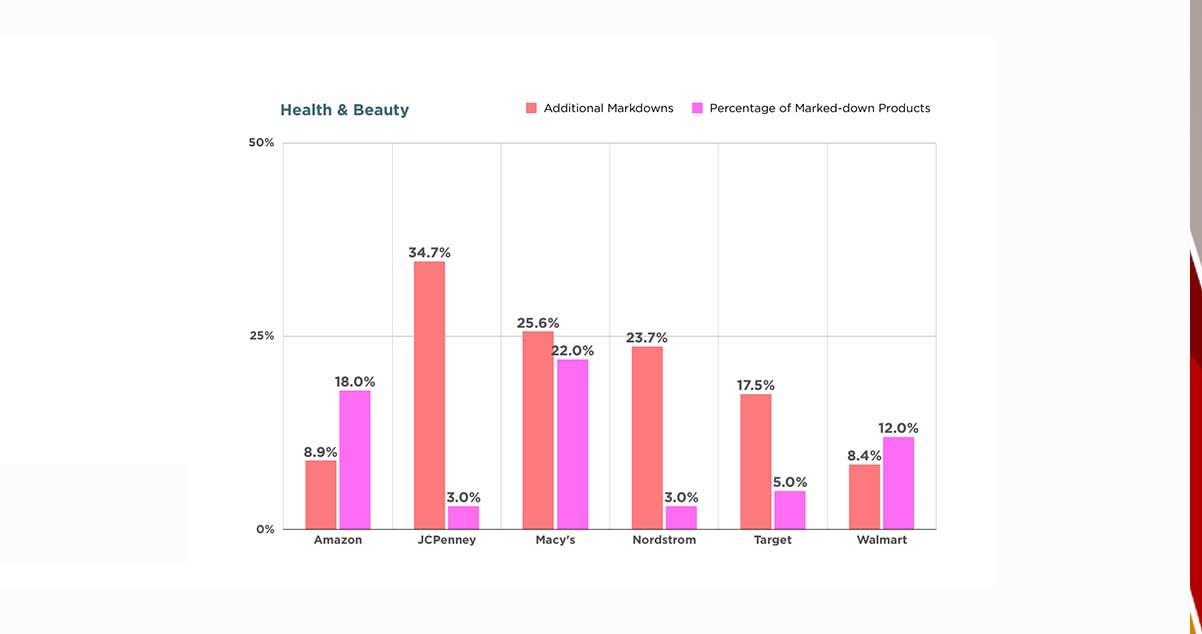
For this study, our team compared the previous week's prices with those during the sale. You can see the painted pic of the added markdowns for the duration of the sales.

Likewise, in our preferred coverage of the fashion category on the Black Friday sales, Macy's led in marked-down product reach by around 26 percent. The average markdown percentage was 22 percent, and JCPenney eclipsed it by approximately 35 percent. On the other hand, Walmart had the lowest markdowns under 10 percent. But they could cover the top 3 products with 18 and 12 percent. The other companies, Target and Nordstrom, offered average markdowns with their conservative approach to selecting the products of 5 and 3 percent products, respectively.

Additional Product Markdowns
Additional-Product-Markdowns

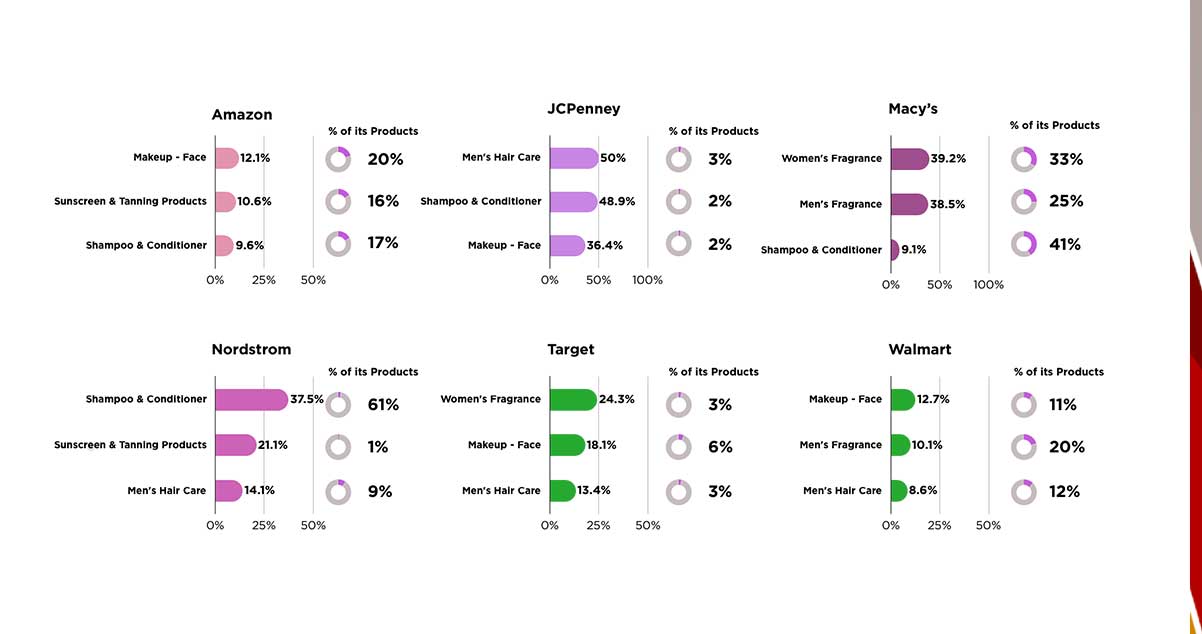
When we dived deep into the product types, we observed that most retailers marked down shampoo, conditioners, makeup, and hair care products for men heavily. The below table shows the first three discounted product categories for all the retailers.

Product Premiumness
Product-Premiumness

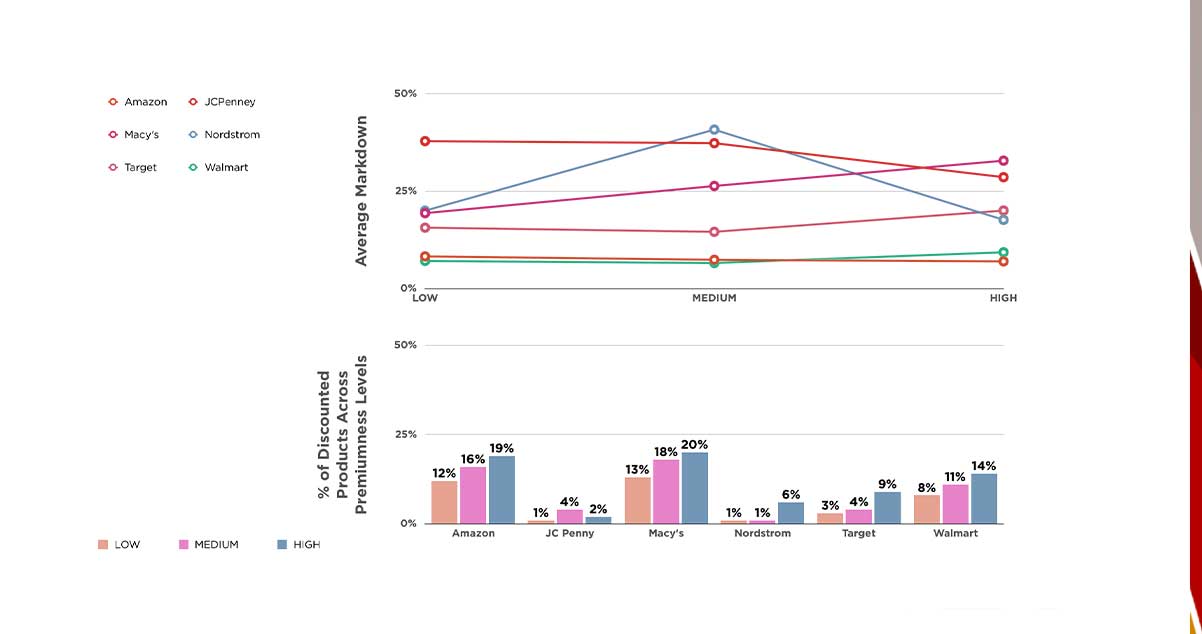
We filtered the products across retailers into cheap and expensive categories and compared them with the rest of the products which retailers had listed. For a few products, the MRP was not shown. We considered the highest price of the product during the holiday period before the Black Friday event to categorize them. Later, we tagged products as low, medium, and high in terms of the premiumness of products, with low referring to the cheapest product.

In line with past trends, Macy's led the markdown on products of high level at 33 percent. It also covered a wide range of categories at 20 percent. Further, Amazon, Target, Macy's, and Walmart followed the expected approach of offering higher markdowns on the more expensive products, with a higher share of these products.

Apart from these, JCPenney and Nordstrom had different approaches here, where JCPenney offered markdowns on the least premium products, and Nordstrom offered markdowns on a medium range of products. It was encouraging to reiterate that both retailers' share of products with markdowns was small.

Product Popularity
Product-Popularity

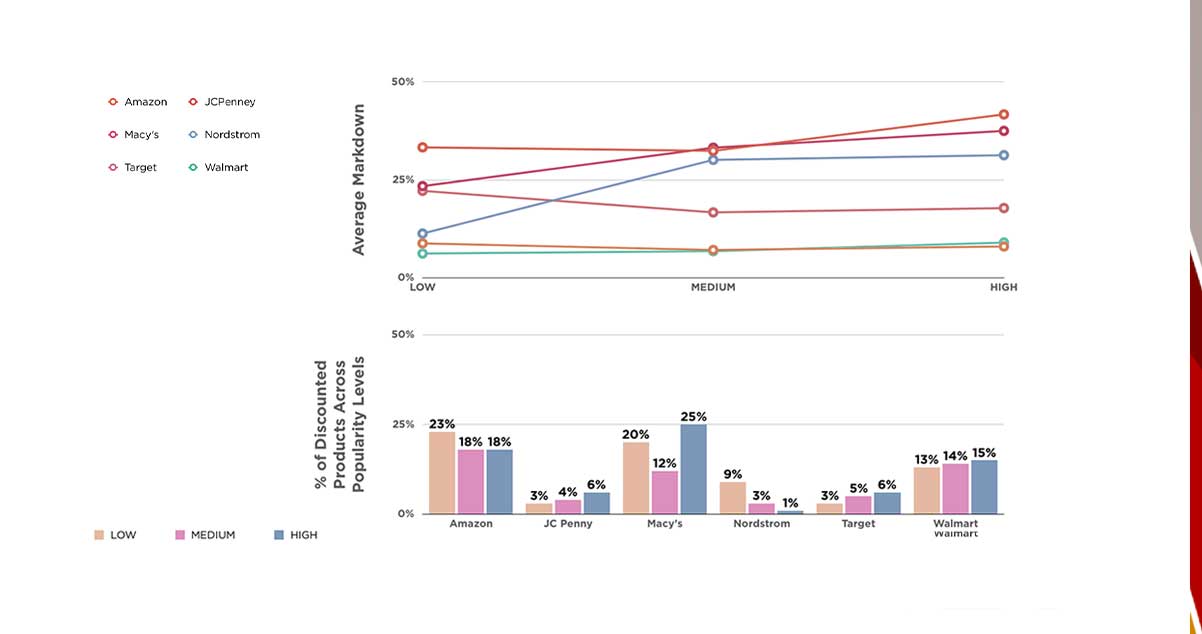
Similar to filtering the products for product premiumness, we also screened them in popularity levels. To define popularity, we used a combination of the number of reviews received for each product and the average review rating.

Here, we couldn't see a consistent pattern that indicated a strategic focus on product popularity factor in the pricing strategy of retailers on Black Friday.

JCPenney and Macy's decided to mark down more portions of top-rated products. Nordstrom, JCPenney, and Macy's preferred providing higher markdowns on favorite products. Some retailers, including Amazon, came with a different approach, marking down the prices of the least popular products. The reason is to liquidate the excessive stock of these less popular products to increase the cash flow during the sales.

Price Change Activities
Price-Change-Activities Price-Change-Activities-2

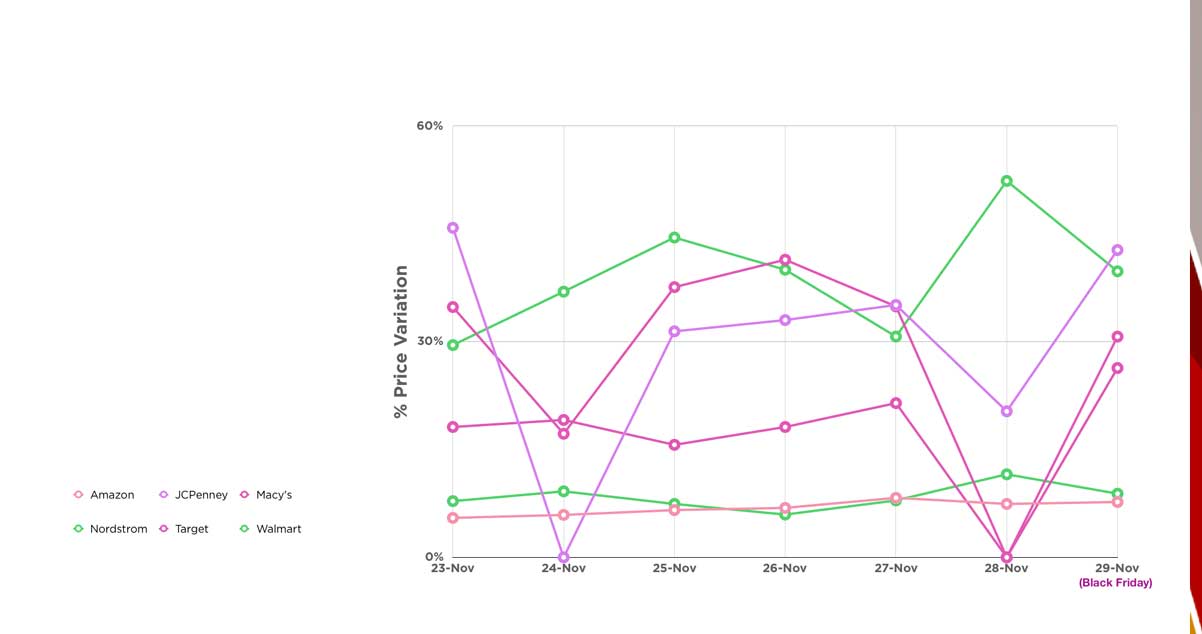
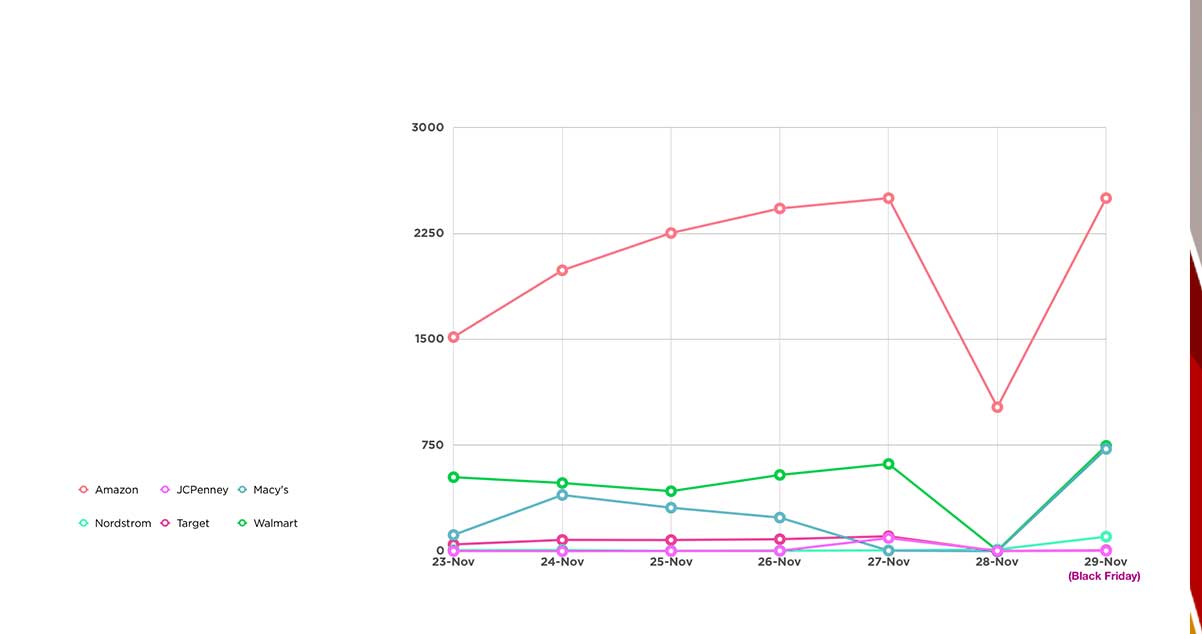
As observed quite frequently in recent times, the black Friday sale is not limited to a single-day event. But attractive offers are named Black Friday sales, often broadcast throughout November, particularly the last week of the month. We monitored the pricing activity level across all the retailers for the last week of November to check the number of price changes and the average price variation of every eCommerce retailer.

Typically, we saw that Amazon had the most significant number of price changes by a considerable margin, peaking at a margin of 2500 for the set of tracked products. The following in line was Walmart which made 618 variations on the 27th. Even changing multiple times, their average price variation remained at the bottom end of the scale without touching 10 percent.

The remaining retailers experimented with fewer price variations, except for the leading Macy's in the event of Black Friday. However, the variations almost reverted from the day prior, only to rise back on the 29th.

Every e-commerce retailer tended to follow a predictable pattern of decreasing changes on the 28th and sharply hiking it the following day. However, Walmart and Nordstrom did the opposite when they offered discounts during the event.

Wrapping Up

To conclude the analysis, we deduced that Macy's marked down relatively more products than the remaining eCommerce retailers. JCPenney, Target, and Nordstrom offered markdowns but only on some of the products. However, there was no surprise that Amazon and Walmart followed their past strategies and stayed conservative in their added markdowns during the Black Friday deals season to be on the top to attract more customers.

Look at Product Data Scrape to extract Health and Beauty related retail product data. Stay tuned for our observations and analysis of the other product categories in the coming days

LATEST BLOG

Scrape Amazon vs Best Buy Laptop Prices - A Data-Driven Web Scraping Comparison

Scrape Amazon vs Best Buy laptop prices to compare deals, track price changes, and gain real-time insights for smarter purchasing and pricing strategies.

Using Web Search APIs For AI Applications, Agents, and Large Language Models in 2026

Learn how using web search APIs for AI applications enables real-time data access, better context retrieval, improved accuracy, and scalable intelligence for modern AI systems.

How Apparel & Accessories Data Collection from Indian E-Commerce Drives Smarter Fashion Decisions?

Apparel & Accessories Data Collection from Indian E-Commerce enables real-time tracking of prices, availability, and trends across online retail platforms in India.

Case Studies

Discover our scraping success through detailed case studies across various industries and applications.

WHY CHOOSE US?

Product Data Scrape for Retail Web Scraping

Choose Product Data Scrape to access accurate data, enhance decision-making, and boost your online sales strategy effectively.

Reliable Insights

Reliable Insights

With our Retail Data scraping services, you gain reliable insights that empower you to make informed decisions based on accurate product data and market trends.

Data Efficiency

Data Efficiency

We help you extract Retail Data product data efficiently, streamlining your processes to ensure timely access to crucial market information and operational speed.

Market Adaptation

Market Adaptation

By leveraging our Retail Data scraping, you can quickly adapt to market changes, giving you a competitive edge with real-time analysis and responsive strategies.

Price Optimization

Price Optimization

Our Retail Data price monitoring tools enable you to stay competitive by adjusting prices dynamically, attracting customers while maximizing your profits effectively.

Competitive Edge

Competitive Edge

THIS IS YOUR KEY BENEFIT.
With our competitive price tracking, you can analyze market positioning and adjust your strategies, responding effectively to competitor actions and pricing in real-time.

Feedback Analysis

Feedback Analysis

Utilizing our Retail Data review scraping, you gain valuable customer insights that help you improve product offerings and enhance overall customer satisfaction.

5-Step Proven Methodology

How We Scrape E-Commerce Data?

01
Identify Target Websites

Identify Target Websites

Begin by selecting the e-commerce websites you want to scrape, focusing on those that provide the most valuable data for your needs.

02
Select Data Points

Select Data Points

Determine the specific data points to extract, such as product names, prices, descriptions, and reviews, to ensure comprehensive insights.

03
Use Scraping Tools

Use Scraping Tools

Utilize web scraping tools or libraries to automate the data extraction process, ensuring efficiency and accuracy in gathering the desired information.

04
Data Cleaning

Data Cleaning

After extraction, clean the data to remove duplicates and irrelevant information, ensuring that the dataset is organized and useful for analysis.

05
Analyze Extracted Data

Analyze Extracted Data

Once cleaned, analyze the extracted e-commerce data to gain insights, identify trends, and make informed decisions that enhance your strategy.

Start Your Data Journey
99.9% Uptime
GDPR Compliant
Real-time API

See the results that matter

Read inspiring client journeys

Discover how our clients achieved success with us.

6X

Conversion Rate Growth

“I used Product Data Scrape to extract Walmart fashion product data, and the results were outstanding. Real-time insights into pricing, trends, and inventory helped me refine my strategy and achieve a 6X increase in conversions. It gave me the competitive edge I needed in the fashion category.”

7X

Sales Velocity Boost

“Through Kroger sales data extraction with Product Data Scrape, we unlocked actionable pricing and promotion insights, achieving a 7X Sales Velocity Boost while maximizing conversions and driving sustainable growth.”

"By using Product Data Scrape to scrape GoPuff prices data, we accelerated our pricing decisions by 4X, improving margins and customer satisfaction."

"Implementing liquor data scraping allowed us to track competitor offerings and optimize assortments. Within three quarters, we achieved a 3X improvement in sales!"

Resource Hub: Explore the Latest Insights and Trends

The Resource Center offers up-to-date case studies, insightful blogs, detailed research reports, and engaging infographics to help you explore valuable insights and data-driven trends effectively.

Get In Touch

Scrape Amazon vs Best Buy Laptop Prices - A Data-Driven Web Scraping Comparison

Scrape Amazon vs Best Buy laptop prices to compare deals, track price changes, and gain real-time insights for smarter purchasing and pricing strategies.

Using Web Search APIs For AI Applications, Agents, and Large Language Models in 2026

Learn how using web search APIs for AI applications enables real-time data access, better context retrieval, improved accuracy, and scalable intelligence for modern AI systems.

How Apparel & Accessories Data Collection from Indian E-Commerce Drives Smarter Fashion Decisions?

Apparel & Accessories Data Collection from Indian E-Commerce enables real-time tracking of prices, availability, and trends across online retail platforms in India.

How Dior Paris Product Data Scraping Unlocks Luxury Market Intelligence

Dior Paris product data scraping delivers real-time insights on pricing, collections, availability, and trends to support luxury retail intelligence.

D2C Founders Used E-Commerce Data APIs to Validate New Product Categories

E-Commerce Data APIs to Validate New Product Categories help brands analyze pricing, demand, competition, and trends faster, reducing risk and enabling confident product launch decisions.

Scaling Global Product Data Collection from AliExpress for Trend Analysis

Gain actionable ecommerce insights through product data collection from AliExpress to track pricing, SKUs, seller performance, demand trends, and sourcing opportunities.

Shelf Life Intelligence - Sephora vs Ulta Beauty product Shelf-life analysis

Analyze Sephora vs Ulta Beauty product Shelf-life analysis to track availability duration, product rotation, and optimize inventory and assortment strategies.

Data scraping for Uline.ca to get product data - Extract Product List, Unit Prices & Saller Data

Get structured pricing, SKUs, specs, and availability using data scraping for Uline.ca to get product data, enabling smarter procurement, catalog analysis, and B2B decisions.

Using Amazon and Namshi Product APIs for Advertising to Overcome Inventory and Targeting Challenges in Digital Marketing

Use Amazon and Namshi product APIs for advertising to optimise bids, track price changes, align ads with availability, and improve ROAS using real-time product intelligence.

Reducing Returns with Myntra AND AJIO Customer Review Datasets

Analyzed Myntra and AJIO customer review datasets to identify sizing issues, helping brands reduce garment return rates by 8% through data-driven insights.

Before vs After Web Scraping - How E-Commerce Brands Unlock Real Growth

Before vs After Web Scraping: See how e-commerce brands boost growth with real-time data, pricing insights, product tracking, and smarter digital decisions.

Scrape Data From Any Ecommerce Websites

Easily scrape data from any eCommerce website to track prices, monitor competitors, and analyze product trends in real time with Real Data API.

5 Industries Growing Fast Because of Web Scraping Technology

Discover how web scraping fuels growth in quick commerce, e-commerce, grocery, liquor, and fashion industries with real-time data insights and smarter decisions.

Why Meesho Sellers Are Growing Faster Than Amazon Sellers (Data Deep Dive)

This SMP explores why Meesho sellers are growing faster than Amazon sellers, using data-driven insights on pricing, reach, logistics, and seller economics.

How Real-Time Grocery Price APIs Power India & UAE Retail Intelligence (2025)

Real-time grocery price APIs help India and UAE retailers track prices, stock, and trends in 2025 to drive smarter pricing and retail intelligence decisions.

FAQs

E-Commerce Data Scraping FAQs

Our E-commerce data scraping FAQs provide clear answers to common questions, helping you understand the process and its benefits effectively.

E-commerce scraping services are automated solutions that gather product data from online retailers, providing businesses with valuable insights for decision-making and competitive analysis.

We use advanced web scraping tools to extract e-commerce product data, capturing essential information like prices, descriptions, and availability from multiple sources.

E-commerce data scraping involves collecting data from online platforms to analyze trends and gain insights, helping businesses improve strategies and optimize operations effectively.

E-commerce price monitoring tracks product prices across various platforms in real time, enabling businesses to adjust pricing strategies based on market conditions and competitor actions.

Let’s talk about your requirements

Let’s discuss your requirements in detail to ensure we meet your needs effectively and efficiently.

bg

Trusted by 1500+ Companies Across the Globe

decathlon
Mask-group
myntra
subway
Unilever
zomato

Send us a message