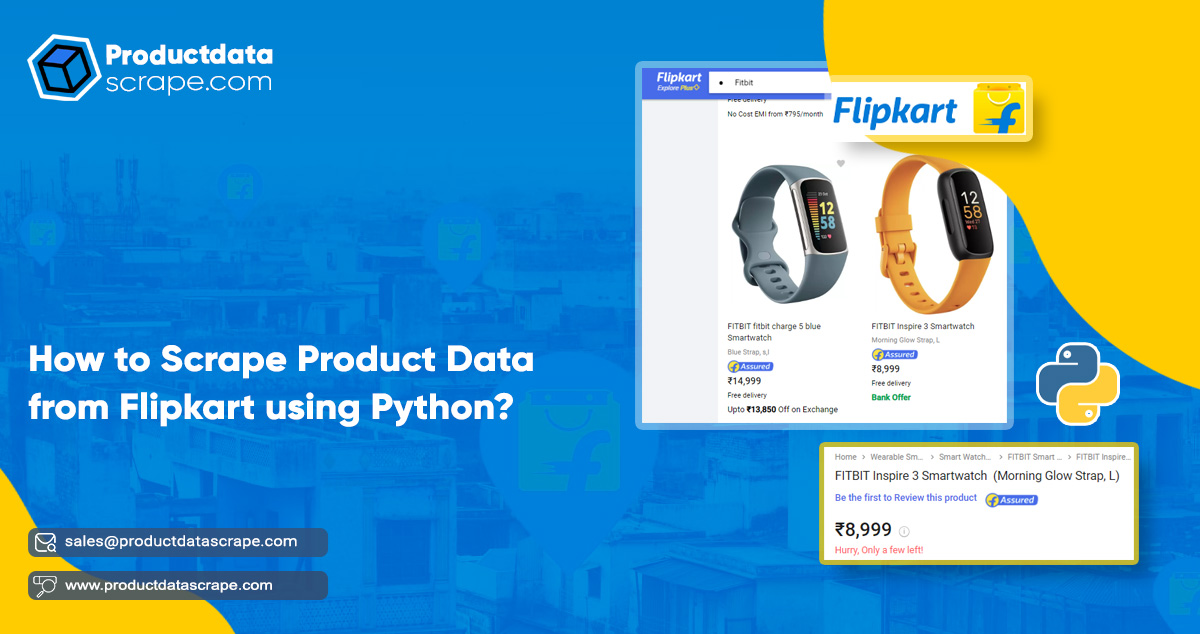
How-to-Scrape-Product-Data-from-Flipkart-using-Python

Flipkart is one of the top eCommerce platforms in India that offers courier services, online shopping, and bill payment options. It also comes under the biggest marketplaces category in the country, which supplies a broader product range to its users.

There is a huge volume of product data available on the Flipkart servers that attract marketers and marketing professionals to consider it as a treasure trove. Many brands and businesses find this data valuable and want to understand how their competitors are growing. This data's detailed study helps eCommerce businesses win more market share, accelerate their branding, increase brand image, maintain brand loyalty, and understand customers.

In this post, we'll share how to scrape product data from Flipkart using Python. We'll extract data for various smartwatches from the top Indian smartwatch companies and store the scraped data in CSV format.

The Brands

Before moving ahead with the process, let us inform you that we will scrape the smartwatch data for the following brands.

  • Fitbit
  • Apple
  • Honor
  • Garmin
  • Samsung
  • Noise
  • Amazfit
  • boAt
  • Huawei
  • Fossil

The Attributes

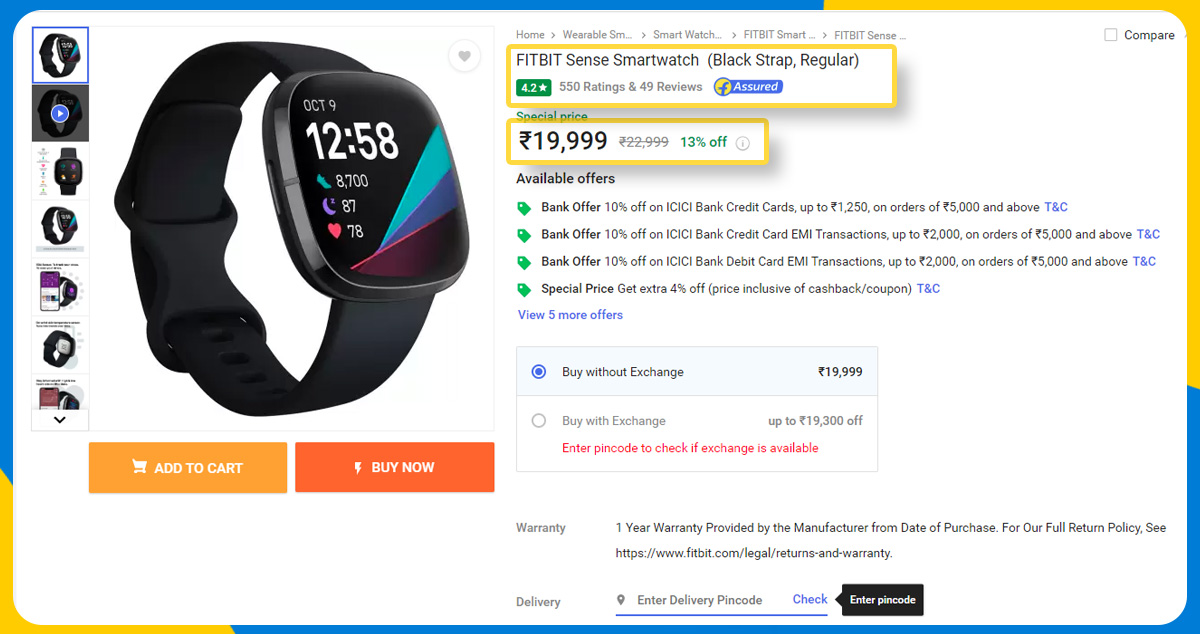
We are going to scrape the below product attributes for every smartwatch using Python.
The-Attributes
  • Product URL - It is the product address of the specific product available on the web.
  • Product Title - it is the product name on the Flipkart platform.
  • Brand - It is a product brand like Huawei.
  • Selling Price - This is a product price after applying a discount.
  • MRP - It is the usual market price for the specific product.
  • Discount Percentage - It is the percentage deduction from the product market price.
  • Memory - It is the internal smartwatch memory.
  • Rating Count - It is the total rating count that smartwatches receive from customers.
  • Review Count - It is the total review count that customers wrote for a specific product.
  • Star Rating - It is the overall product rating that customers give after using the product.
  • Description - it is the short specifications or details for the product you can see on the product page on the Flipkart website.

What are the Required Libraries to Scrape Product Data from Flipkart Using Python?

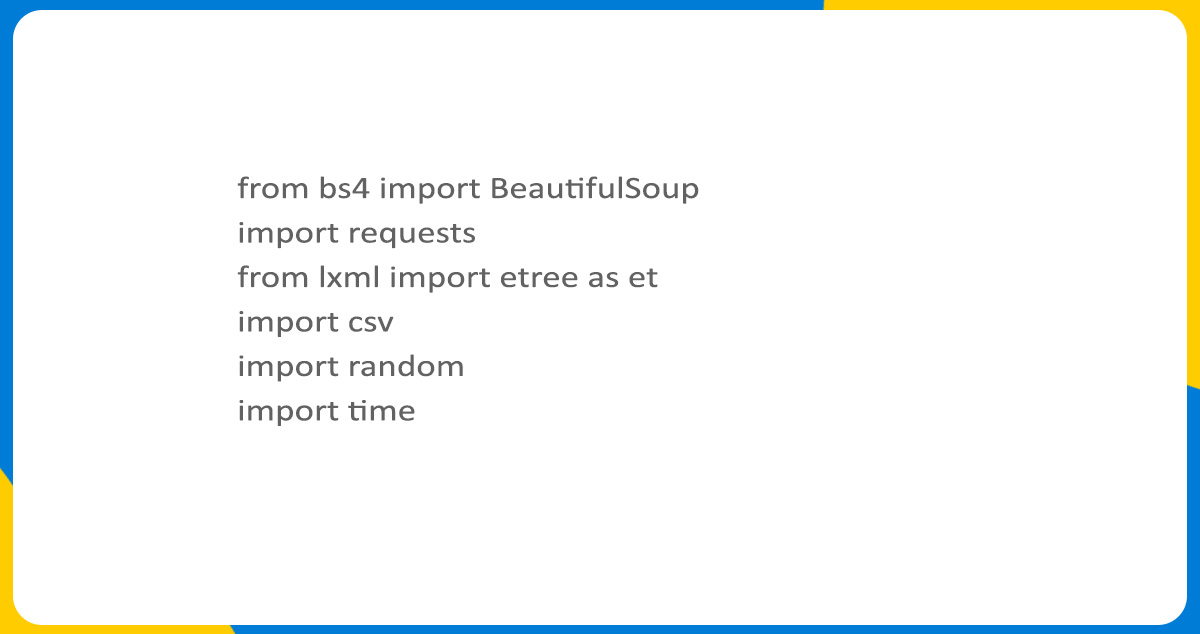
Importing libraries is the primary step to scrape Flipkart product data using Python. In this project, we import requests, BeautifulSoup, CSV library, time library, random library, and etree module from the LXML library.
What-are-the-Required-Libraries-to-Scrape

The BeautifulSoup library from Python parses and pulls product data from XML and HTML files.

The LXML library processes XML and HTML data, and etree or Elementtree parses XML documents.

The Requests Python library sends HTTP requests to servers.

The Random library generates numbers and randomizes the data scraping process in Python.

The CSV library reads and converts tabular information in the CSV format.

Time library represents time in multiple ways.

Now, it's time to go through the Flipkart data scraping process using Python.

Flipkart Data Scraping Process using Python

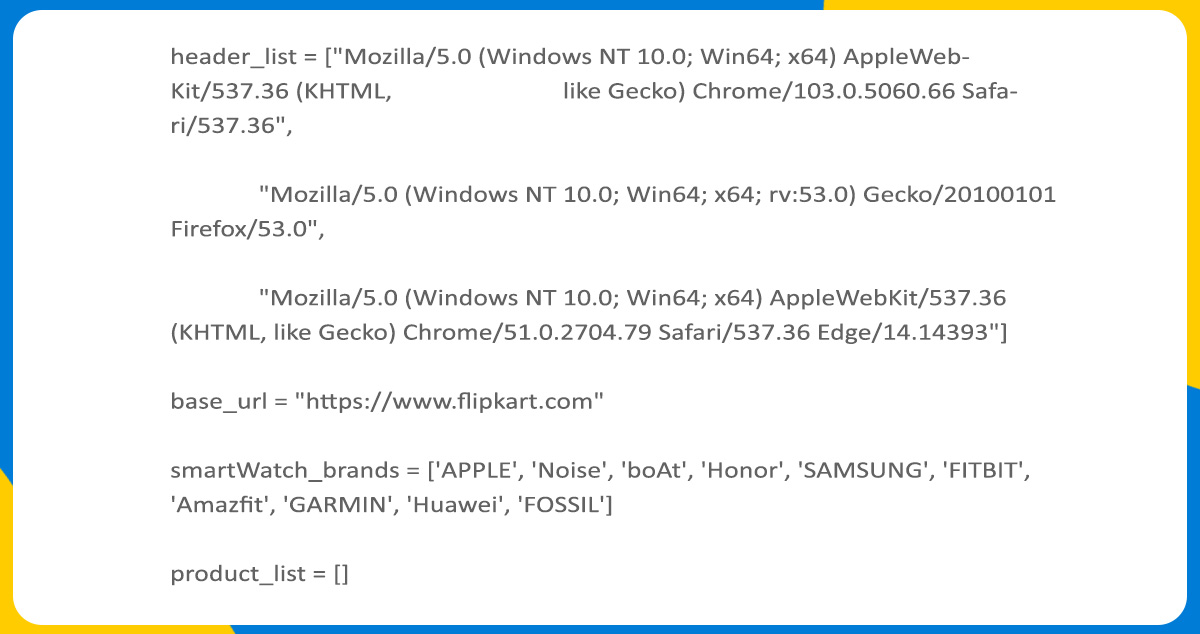
Once you import the necessary Python libraries, define the user agent header list in the next step. The user agent's string contains the text that the customer shares using a request to help the server recognize the web browser, operating system, and device type that you're using to perform the scraping process.

Many eCommerce websites block data Scrapers as they don't want to share product data from their platform with bots or automated data scrapers. To avoid Blocking from the source website, you must define a user agent to make requests. The web server may recognize and block your user agent using a single user-agent header. To avoid this, you should keep rotating the user agent. It will signal to the web server that a different user agent is requesting from different web browsers.
Flipkart-Data-Scraping-Process-using-Python

In the above code block, you can observe that we've designated a user agent list, namely header_list, and passed three headers of user agents in it. Further, we've initiated two more lists, namely smartWarch_brands, and product_list. These lists contain brands of watches and black places to store product URLs, respectively. We will also use the base_url string later in the process that we have also initiated.

Then we go through every operation during Scraping the specific product link.
Flipkart-Data-Scraping-Process-using-Python-1

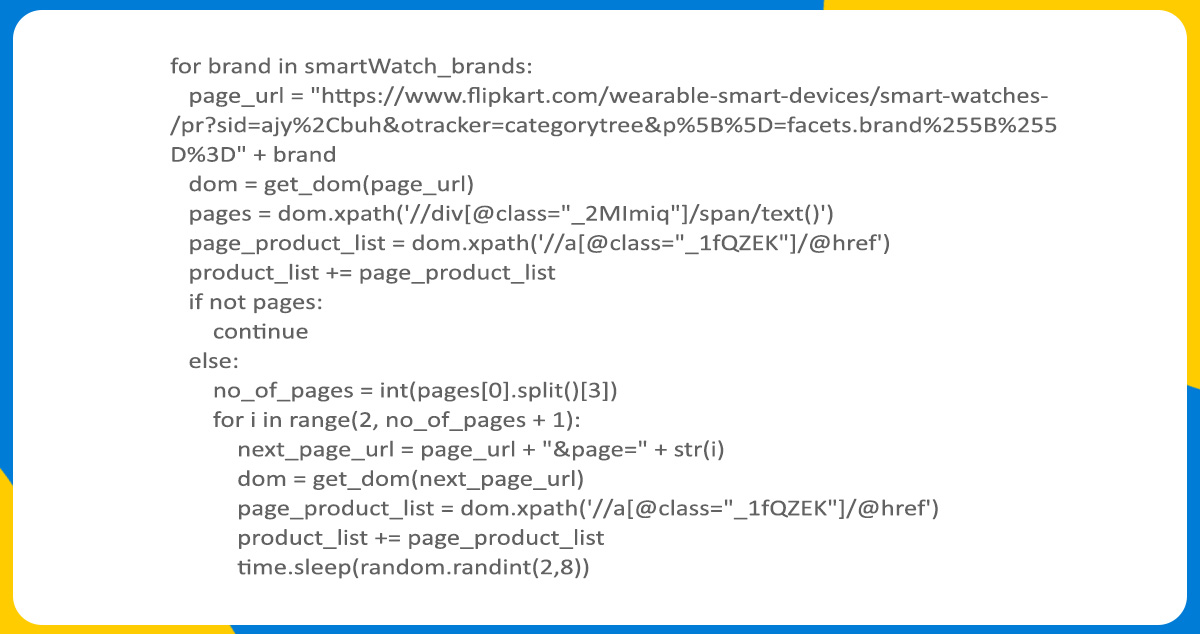
While scraping data from the targeted website, the URL is the first requirement. Using the for loop, we collect every smartwatch brand from the string smartWatch_brands and concatenate it with the string to save in the page_url variable. It consists of the link to the first web page for the specific smartwatch category from the source. Now, it's time to call the function get_dom() and pass the parameter as page_url.
Flipkart-Data-Scraping-Process-using-Python-2

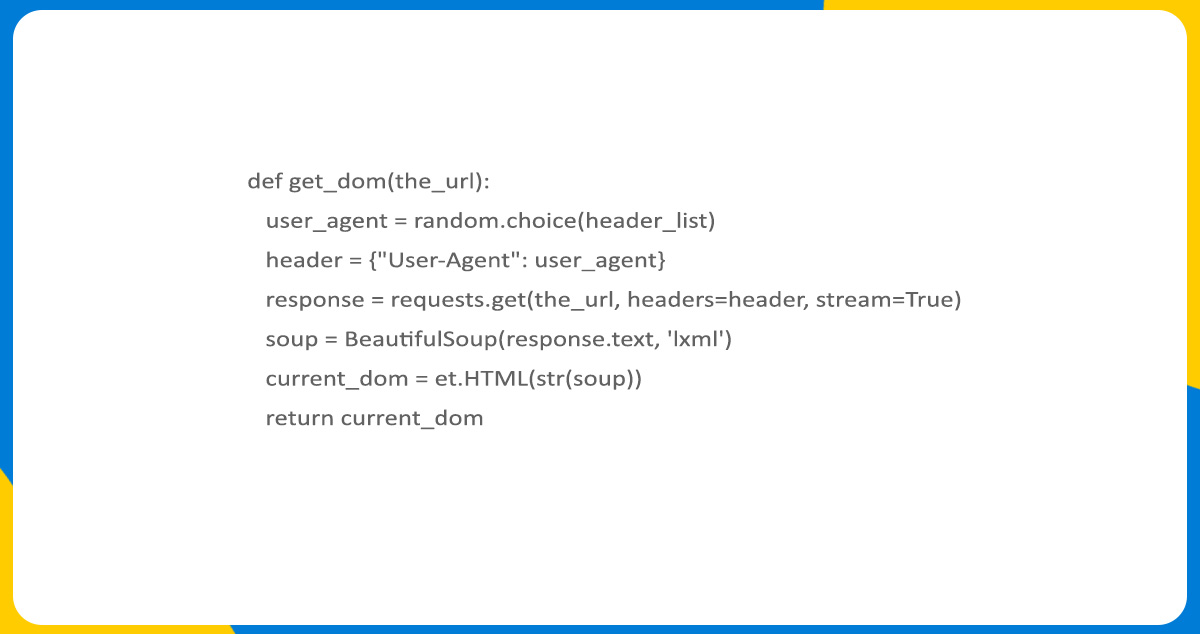
We randomly choose the user agent header in the get_dom function from header_list and pass it to the user_agenr as the value. Later, we send the HTTP request to the webpage UTL we wish to access using a user-agent like a header. We use the Requests library from Python to send this request. It reflects the response object that includes the response of the server. The server response contains the HTML content of the source website, and it stores it in the response variable. This HTML content is hard to parse due to its raw form. Hence, to ease traversing, we will transform that raw HTML content format into the parse tree with the help of a parser. BeautifulSoup library will help us to achieve this with the etree module of the LXML library, where we will convert the raw HTML content in the tree structure. Python libraries will return and store the tree structure in the dom various inside the loop.

We will use XPath in the next step to store various elements we plan to collect from the website. To do this, we will choose the element from the website to extract and inspect it by right-clicking on the mouse. By doing this, we will get the class name and tag where we can see the enclosed elements. We will use the class and tag name to get the element out from the XPath. Check the below example of scraping an element using XPath.

We can observe the product link enclosed inside the anchor tag and _1fQZEK class. We retrieved the URL for this product using the following code line.

Flipkart-Data-Scraping-Process-using-Python-3

This code line in the program will save the URLs of each product listed on the page with the list, namely page_product_list. We will add this list to the product _list, which contains all the URLs of smartwatches with brands from the smartWatch_brands list. Lastly, we gave a time delay with the help of the time library to bypass the blocking from the source while scraping.

The Process to Extract Data

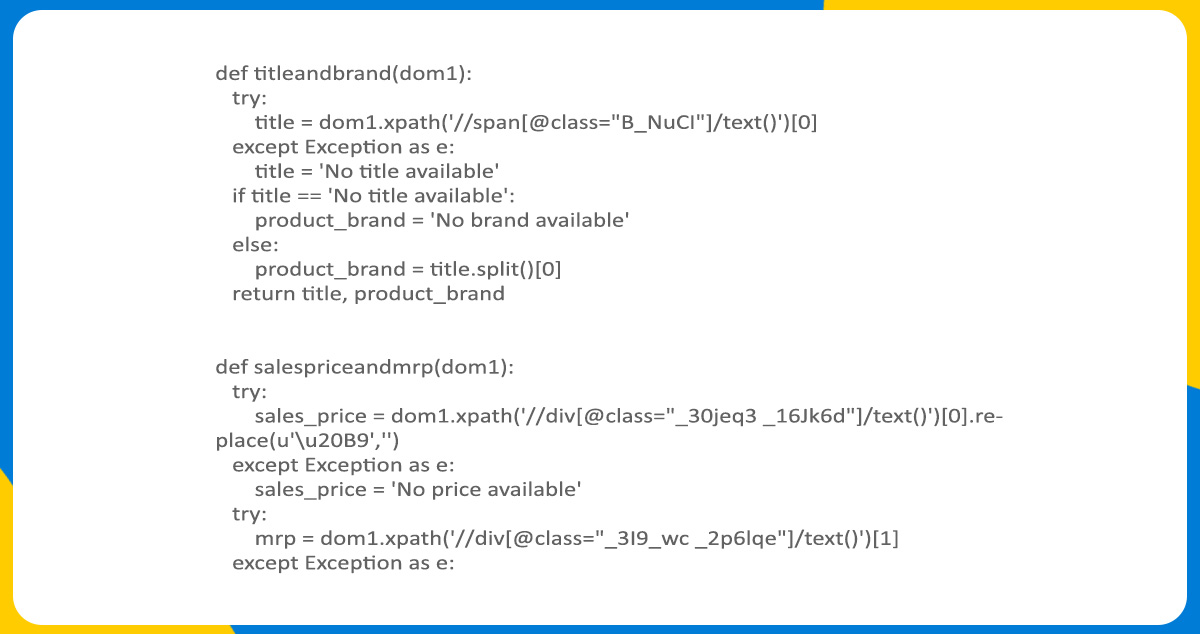
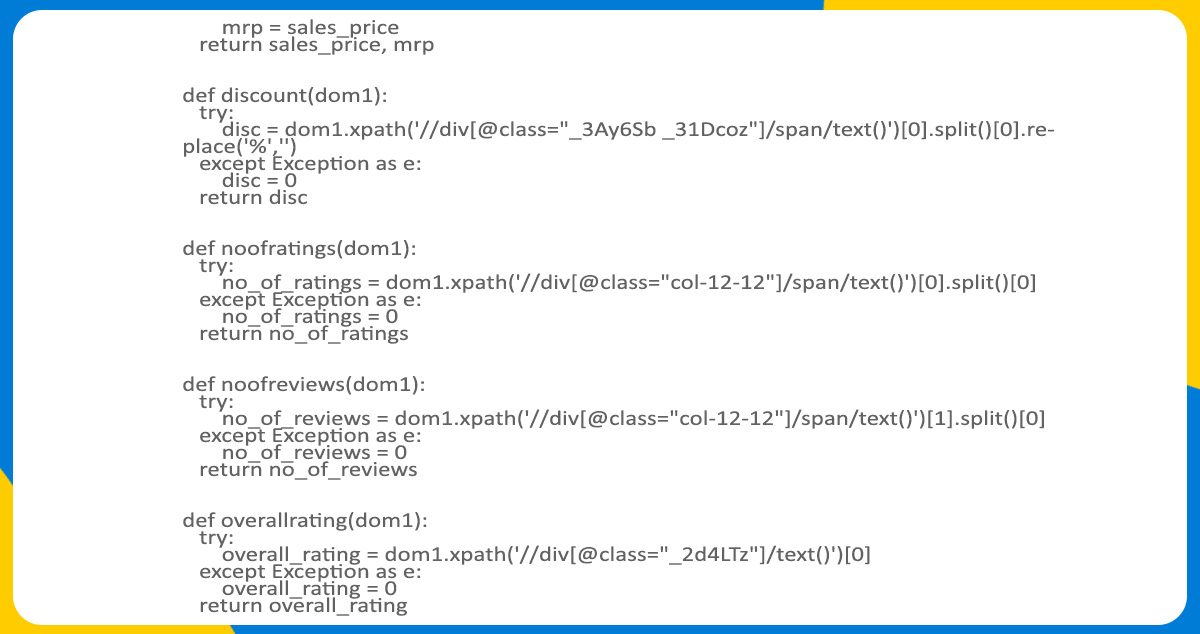
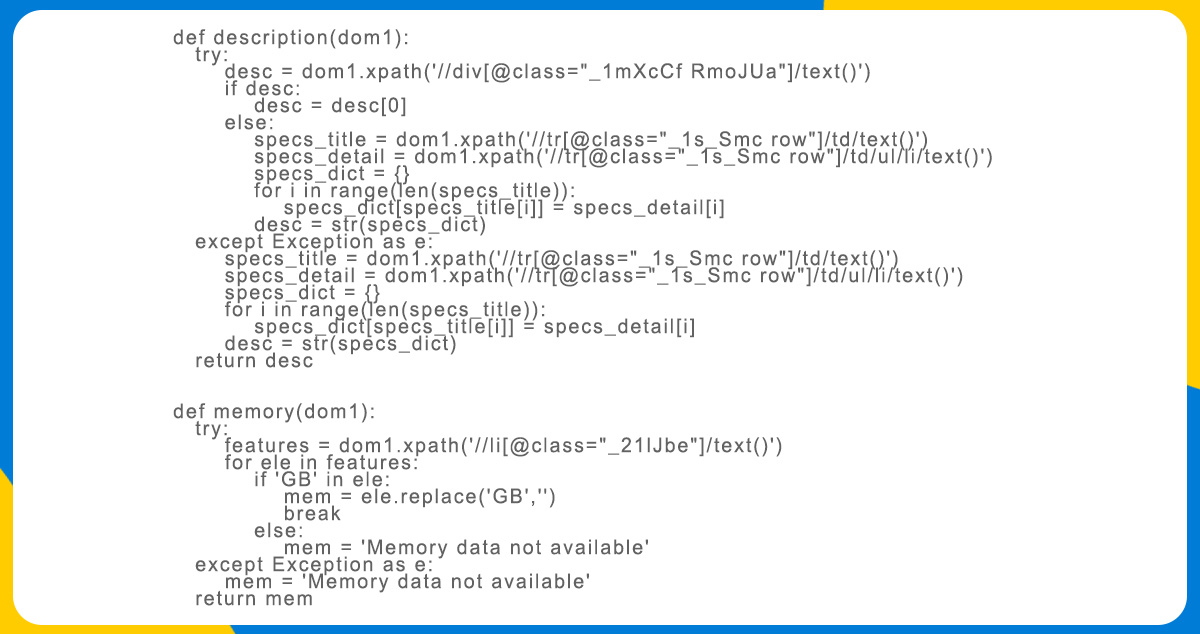
Now, we've all the product URLs and know how to extract specific products from the targeted website while web scraping Flipkart product data. We can retrieve the required attributes for smartwatches. For this, check the following functions.

The-Process-to-Extract-Data The-Process-to-Extract-Data-2 The-Process-to-Extract-Data-3

Writing the Data to a CSV File

After extracting the data, we should save it for future use for various requirements like market research, competitor analysis, price monitoring, and more. Let's understand how to write the collected data to the CSV file.

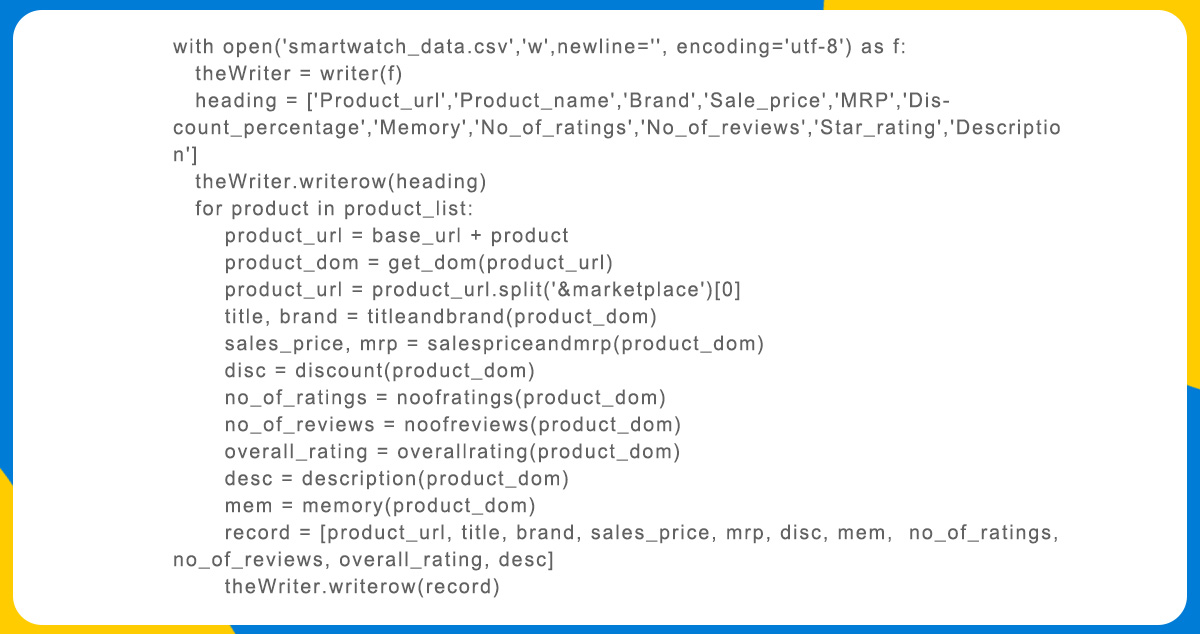
Open the comma-separated value file smartwatch_data.csv in f as the write mode. Then make a writer object, namely theWriter, and initiate the heading list containing every data column. After this, write to the CSV file using the below writerow() function.
Writing-the-Data-to-a-CSV-Fil

Once we write the heading in the file, we will iterate through all the products from the list. The URLs in the product _link don't have a Flipkart domain name. Hence, we will concatenate the Flipkart domain name to it using the base_url we initially defined and pass this URL as the function parameter. Every function retrieves separate product attributes and reflects them. We store these values in the record list. Later, we will write product details as the next two inside the CSV file using the function writerow(record).

Conclusion

In this way, we explored how to scrape product data from Flipkart using Python and various Python libraries for one of our project in Flipkart Data Scraping Services. Here we scraped smartwatch data. But by making some changes in the code, you can scrape any product category with customization from Flipkart using Python with the help of our Flipkart product data extraction services.

At Product Data Scrape, we help with eCommerce data scraping services, product matching, retail analytics, competitor monitoring, market research, and more. If you want any help, contact Product Data Scrape.
LATEST BLOG

Using Web Search APIs For AI Applications, Agents, and Large Language Models in 2026

Learn how using web search APIs for AI applications enables real-time data access, better context retrieval, improved accuracy, and scalable intelligence for modern AI systems.

How Apparel & Accessories Data Collection from Indian E-Commerce Drives Smarter Fashion Decisions?

Apparel & Accessories Data Collection from Indian E-Commerce enables real-time tracking of prices, availability, and trends across online retail platforms in India.

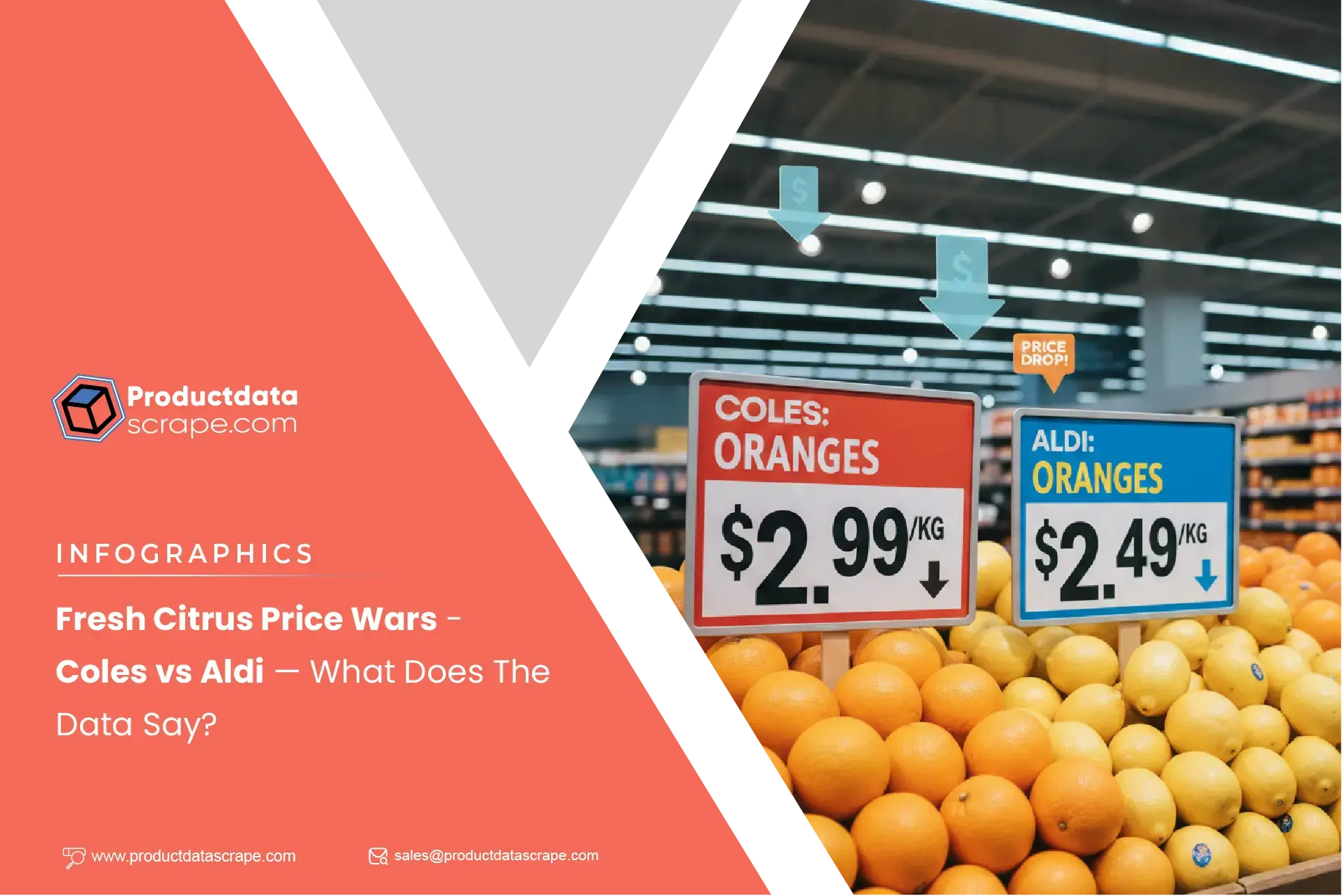
Scraping Coles & Aldi Citrus Listings Data For Compare Pack Size, Price per Kg & Offers

Get actionable insights by scraping Coles & Aldi citrus listings data to compare prices, track availability, analyse demand trends, and optimise grocery sourcing decisions.

Case Studies

Discover our scraping success through detailed case studies across various industries and applications.

WHY CHOOSE US?
Product Data Scrape for Retail Web Scraping

Choose Product Data Scrape to access accurate data, enhance decision-making, and boost your online sales strategy effectively.

Reliable Insights

Reliable Insights

With our Retail Data scraping services, you gain reliable insights that empower you to make informed decisions based on accurate product data and market trends.

Data Efficiency

Data Efficiency

We help you extract Retail Data product data efficiently, streamlining your processes to ensure timely access to crucial market information and operational speed.

Market Adaptation

Market Adaptation

By leveraging our Retail Data scraping, you can quickly adapt to market changes, giving you a competitive edge with real-time analysis and responsive strategies.

Price Optimization

Price Optimization

Our Retail Data price monitoring tools enable you to stay competitive by adjusting prices dynamically, attracting customers while maximizing your profits effectively.

Competitive Edge

Competitive Edge

THIS IS YOUR KEY BENEFIT.
With our competitive price tracking, you can analyze market positioning and adjust your strategies, responding effectively to competitor actions and pricing in real-time.

Feedback Analysis

Feedback Analysis

Utilizing our Retail Data review scraping, you gain valuable customer insights that help you improve product offerings and enhance overall customer satisfaction.

5-Step Proven Methodology

How We Scrape E-Commerce Data?

01
Identify Target Websites

Identify Target Websites

Begin by selecting the e-commerce websites you want to scrape, focusing on those that provide the most valuable data for your needs.

02
Select Data Points

Select Data Points

Determine the specific data points to extract, such as product names, prices, descriptions, and reviews, to ensure comprehensive insights.

03
Use Scraping Tools

Use Scraping Tools

Utilize web scraping tools or libraries to automate the data extraction process, ensuring efficiency and accuracy in gathering the desired information.

04
Data Cleaning

Data Cleaning

After extraction, clean the data to remove duplicates and irrelevant information, ensuring that the dataset is organized and useful for analysis.

05
Analyze Extracted Data

Analyze Extracted Data

Once cleaned, analyze the extracted e-commerce data to gain insights, identify trends, and make informed decisions that enhance your strategy.

Start Your Data Journey
99.9% Uptime
GDPR Compliant
Real-time API

See the results that matter

Read inspiring client journeys

Discover how our clients achieved success with us.

6X

Conversion Rate Growth

“I used Product Data Scrape to extract Walmart fashion product data, and the results were outstanding. Real-time insights into pricing, trends, and inventory helped me refine my strategy and achieve a 6X increase in conversions. It gave me the competitive edge I needed in the fashion category.”

7X

Sales Velocity Boost

“Through Kroger sales data extraction with Product Data Scrape, we unlocked actionable pricing and promotion insights, achieving a 7X Sales Velocity Boost while maximizing conversions and driving sustainable growth.”

"By using Product Data Scrape to scrape GoPuff prices data, we accelerated our pricing decisions by 4X, improving margins and customer satisfaction."

"Implementing liquor data scraping allowed us to track competitor offerings and optimize assortments. Within three quarters, we achieved a 3X improvement in sales!"

Resource Hub: Explore the Latest Insights and Trends

The Resource Center offers up-to-date case studies, insightful blogs, detailed research reports, and engaging infographics to help you explore valuable insights and data-driven trends effectively.

Get In Touch

Using Web Search APIs For AI Applications, Agents, and Large Language Models in 2026

Learn how using web search APIs for AI applications enables real-time data access, better context retrieval, improved accuracy, and scalable intelligence for modern AI systems.

How Apparel & Accessories Data Collection from Indian E-Commerce Drives Smarter Fashion Decisions?

Apparel & Accessories Data Collection from Indian E-Commerce enables real-time tracking of prices, availability, and trends across online retail platforms in India.

Scraping Coles & Aldi Citrus Listings Data For Compare Pack Size, Price per Kg & Offers

Get actionable insights by scraping Coles & Aldi citrus listings data to compare prices, track availability, analyse demand trends, and optimise grocery sourcing decisions.

D2C Founders Used E-Commerce Data APIs to Validate New Product Categories

E-Commerce Data APIs to Validate New Product Categories help brands analyze pricing, demand, competition, and trends faster, reducing risk and enabling confident product launch decisions.

Scaling Global Product Data Collection from AliExpress for Trend Analysis

Gain actionable ecommerce insights through product data collection from AliExpress to track pricing, SKUs, seller performance, demand trends, and sourcing opportunities.

How Scraping Zepto Order Data For Analyze Stockouts & Delivery Speed - Mumbai vs Delhi

Analyze how scraping Zepto order data compares stockouts and delivery speed in Mumbai vs Delhi to optimise inventory planning and last-mile performance.

Shelf Life Intelligence - Sephora vs Ulta Beauty product Shelf-life analysis

Analyze Sephora vs Ulta Beauty product Shelf-life analysis to track availability duration, product rotation, and optimize inventory and assortment strategies.

Data scraping for Uline.ca to get product data - Extract Product List, Unit Prices & Saller Data

Get structured pricing, SKUs, specs, and availability using data scraping for Uline.ca to get product data, enabling smarter procurement, catalog analysis, and B2B decisions.

Using Amazon and Namshi Product APIs for Advertising to Overcome Inventory and Targeting Challenges in Digital Marketing

Use Amazon and Namshi product APIs for advertising to optimise bids, track price changes, align ads with availability, and improve ROAS using real-time product intelligence.

Reducing Returns with Myntra AND AJIO Customer Review Datasets

Analyzed Myntra and AJIO customer review datasets to identify sizing issues, helping brands reduce garment return rates by 8% through data-driven insights.

Before vs After Web Scraping - How E-Commerce Brands Unlock Real Growth

Before vs After Web Scraping: See how e-commerce brands boost growth with real-time data, pricing insights, product tracking, and smarter digital decisions.

Scrape Data From Any Ecommerce Websites

Easily scrape data from any eCommerce website to track prices, monitor competitors, and analyze product trends in real time with Real Data API.

5 Industries Growing Fast Because of Web Scraping Technology

Discover how web scraping fuels growth in quick commerce, e-commerce, grocery, liquor, and fashion industries with real-time data insights and smarter decisions.

Why Meesho Sellers Are Growing Faster Than Amazon Sellers (Data Deep Dive)

This SMP explores why Meesho sellers are growing faster than Amazon sellers, using data-driven insights on pricing, reach, logistics, and seller economics.

How Real-Time Grocery Price APIs Power India & UAE Retail Intelligence (2025)

Real-time grocery price APIs help India and UAE retailers track prices, stock, and trends in 2025 to drive smarter pricing and retail intelligence decisions.

FAQs

E-Commerce Data Scraping FAQs

Our E-commerce data scraping FAQs provide clear answers to common questions, helping you understand the process and its benefits effectively.

E-commerce scraping services are automated solutions that gather product data from online retailers, providing businesses with valuable insights for decision-making and competitive analysis.

We use advanced web scraping tools to extract e-commerce product data, capturing essential information like prices, descriptions, and availability from multiple sources.

E-commerce data scraping involves collecting data from online platforms to analyze trends and gain insights, helping businesses improve strategies and optimize operations effectively.

E-commerce price monitoring tracks product prices across various platforms in real time, enabling businesses to adjust pricing strategies based on market conditions and competitor actions.

Let’s talk about your requirements

Let’s discuss your requirements in detail to ensure we meet your needs effectively and efficiently.

bg

Trusted by 1500+ Companies Across the Globe

decathlon
Mask-group
myntra
subway
Unilever
zomato

Send us a message