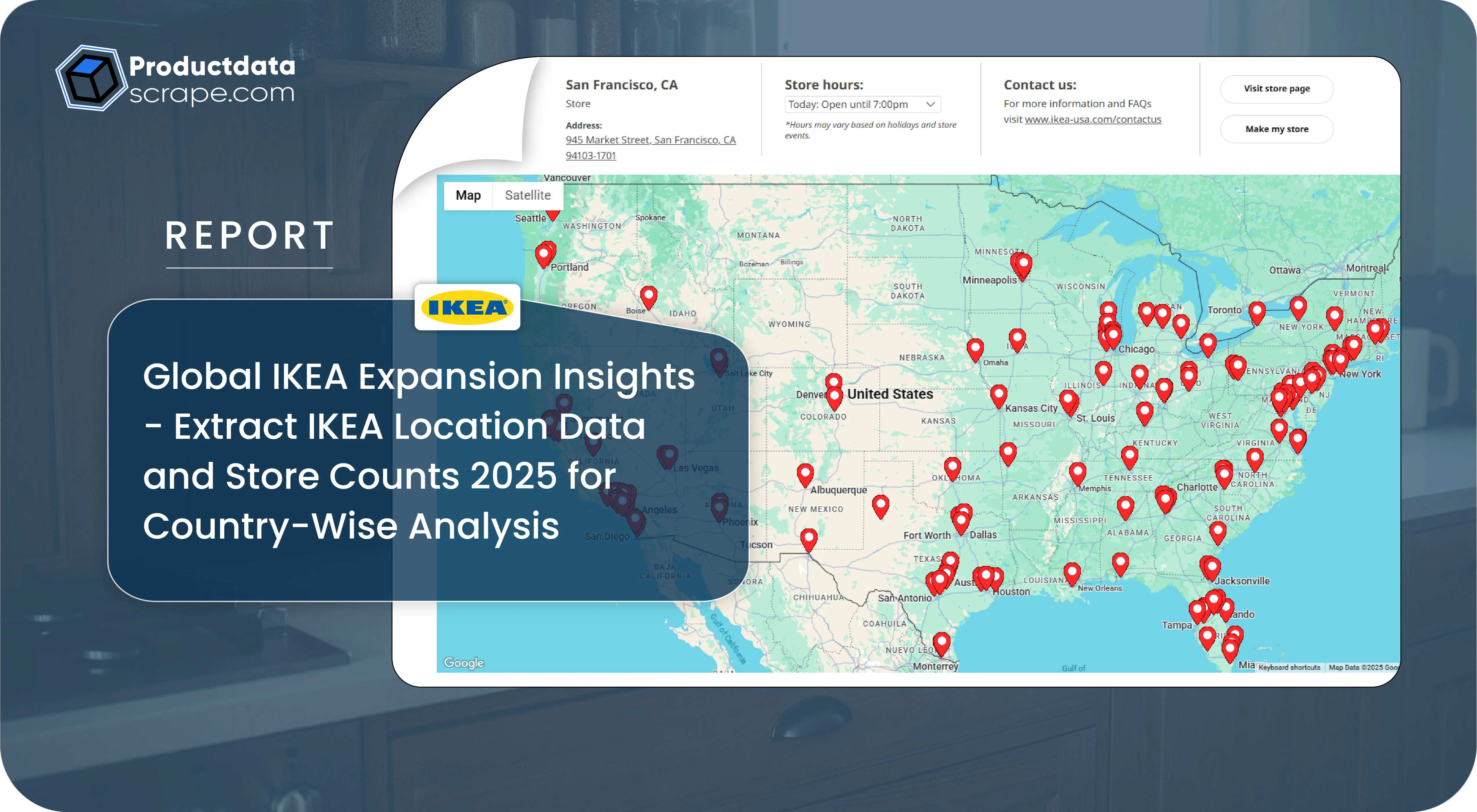
Introduction
IKEA’s global presence has expanded significantly over the past decade, with its retail stores
reaching new markets and adapting to evolving consumer preferences. For businesses, investors,
and market analysts, understanding this expansion is crucial for strategic planning, competitive
benchmarking, and investment decisions. By leveraging advanced analytics, companies can Extract
IKEA location data and store counts 2025, enabling insights into country-wise growth trends and
expansion strategies.
Between 2020 and 2025, IKEA’s expansion included both established markets and emerging regions,
focusing on urban hubs and high-demand areas. Utilizing the IKEA expansion and growth plan
dataset 2025, analysts can examine store density, regional saturation, and identify markets with
growth potential. Web-based solutions now allow stakeholders to Scrape IKEA country wise store
locations data efficiently, compiling structured datasets from IKEA’s store locators, websites,
and press releases.
By integrating these insights with historical data, companies can forecast growth trajectories,
optimize supply chain planning, and align marketing efforts. Extract IKEA location data and
store counts 2025 provides a structured foundation for evaluating IKEA’s retail footprint,
market strategy, and performance trends across geographies.
IKEA’s Global Growth Trends (2020–2025)
Over the past five years, IKEA has consistently expanded its retail footprint. Using scrape IKEA
global store count data, analysts can track the number of stores opened annually, closures, and
relocation trends. Between 2020 and 2025, IKEA’s store count increased from approximately 445
stores to over 520 worldwide, reflecting an annual growth rate of roughly 3%.
| Year |
Global Store Count |
Annual Growth (%) |
| 2020 |
445 |
– |
| 2021 |
455 |
2.2% |
| 2022 |
468 |
2.9% |
| 2023 |
485 |
3.6% |
| 2024 |
505 |
4.1% |
| 2025 |
520 |
3.0% |
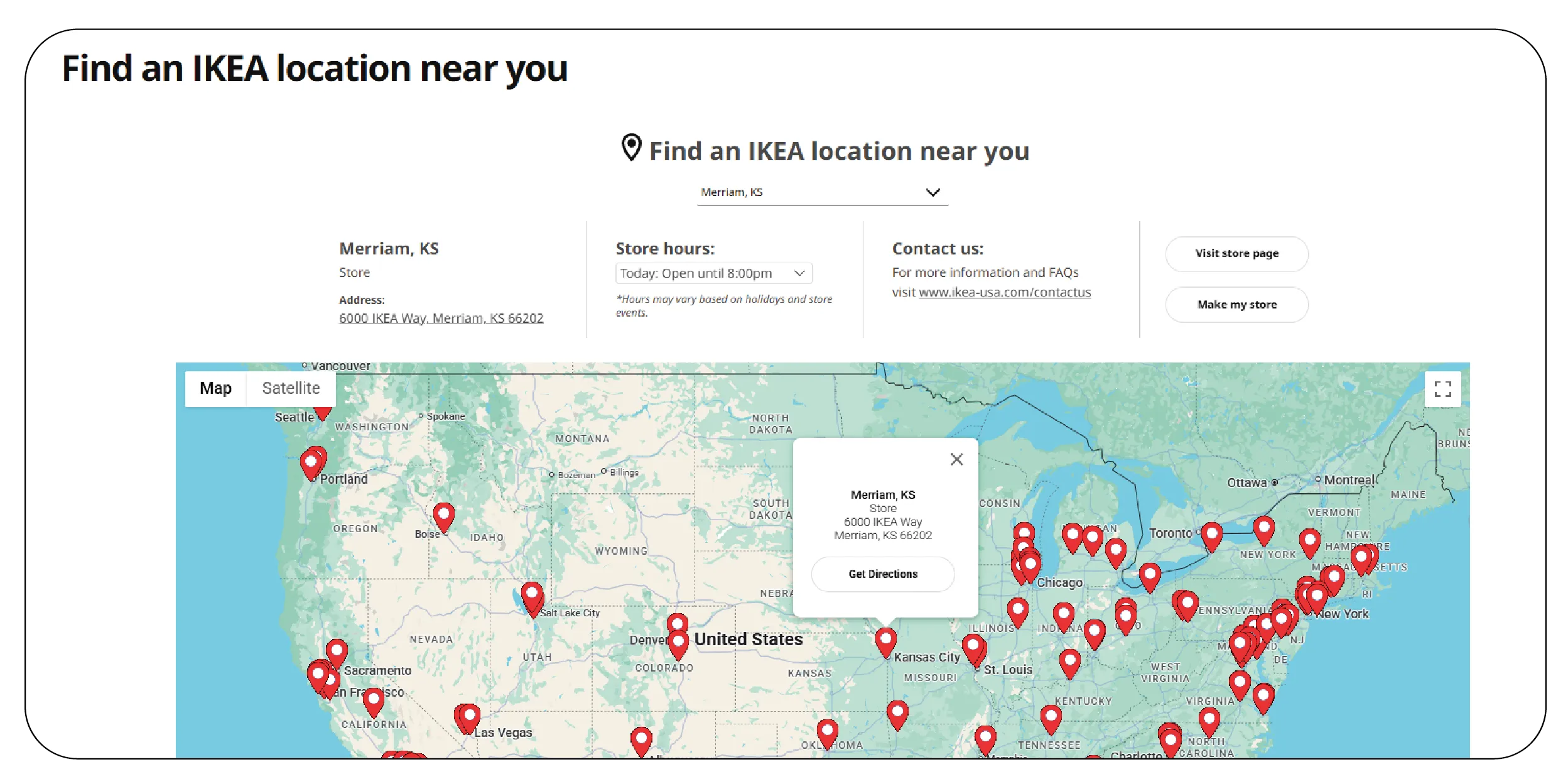
By using IKEA store locator data extraction service, companies can map store locations by city,
region, and country, gaining insights into urban penetration and regional focus. This also
enables analysis of market density and competitive positioning. Additionally, Web scraping IKEA
retail growth data provides structured information on store openings, closures, and expansions,
allowing businesses to monitor IKEA’s evolving retail strategy in real time.
The dataset helps identify patterns such as higher growth in Asia-Pacific markets compared to
slower expansion in mature European regions. Analysts can leverage these insights for
forecasting, investment prioritization, and understanding regional market potential. Structured
data also supports visualization, heatmaps, and geographic analyses, highlighting high-demand
regions and potential gaps in IKEA’s network.
Regional Insights and Country-Wise Store Distribution
Using Extract IKEA location data and store counts 2025, it is possible to examine IKEA’s
footprint at a granular level. Countries such as Germany, the USA, and China hold the highest
number of stores, reflecting both mature markets and aggressive growth strategies. In contrast,
emerging markets like India, Vietnam, and Mexico show incremental expansion aligned with
urbanization and rising disposable incomes.
| Region |
Store Count 2020 |
Store Count 2025 |
| Europe |
350 |
370 |
| North America |
45 |
55 |
| Asia-Pacific |
35 |
60 |
| Middle East & Africa |
15 |
20 |
By leveraging IKEA expansion and growth plan dataset 2025, stakeholders can assess market
penetration, prioritize strategic investments, and align supply chain decisions with geographic
demand. Analysts can also use Scrape IKEA country wise store locations data to build
comprehensive datasets, mapping store density per million population and identifying underserved
regions.
Data-driven insights reveal that while Europe remains the largest market in terms of store
numbers, Asia-Pacific exhibits the highest growth trajectory. Mapping these trends helps
companies anticipate competitive pressures, forecast revenue, and develop market entry
strategies. Integrating historical store counts with real-time location data enhances predictive
modeling, providing actionable intelligence for strategic planning.
Retail Strategy and Urban Presence Analysis
IKEA’s urban-focused expansion strategy emphasizes proximity to large population centers,
accessibility, and integration with digital channels. Using scrape IKEA global store count data,
analysts can monitor the proportion of stores located in metropolitan versus suburban areas.
Between 2020 and 2025, approximately 65% of new stores were opened in urban or peri-urban
locations, ensuring accessibility and footfall. Leveraging IKEA store locator data extraction
service allows visualization of store clustering, helping evaluate the effectiveness of urban
expansion strategies.
Additionally, Web scraping IKEA retail growth data enables identification of emerging urban
markets with high demand potential. Insights from these datasets guide local marketing
initiatives, inventory planning, and logistical support. Urban-focused analysis also highlights
opportunities for smaller-format stores, pop-ups, and digital fulfillment centers, reflecting
IKEA’s evolving omnichannel approach.
Understanding urban penetration alongside historical growth data provides stakeholders with a
clear picture of competitive advantage, market density, and strategic opportunities for retail
expansion in targeted regions.
Product Portfolio and Store Offerings Insights
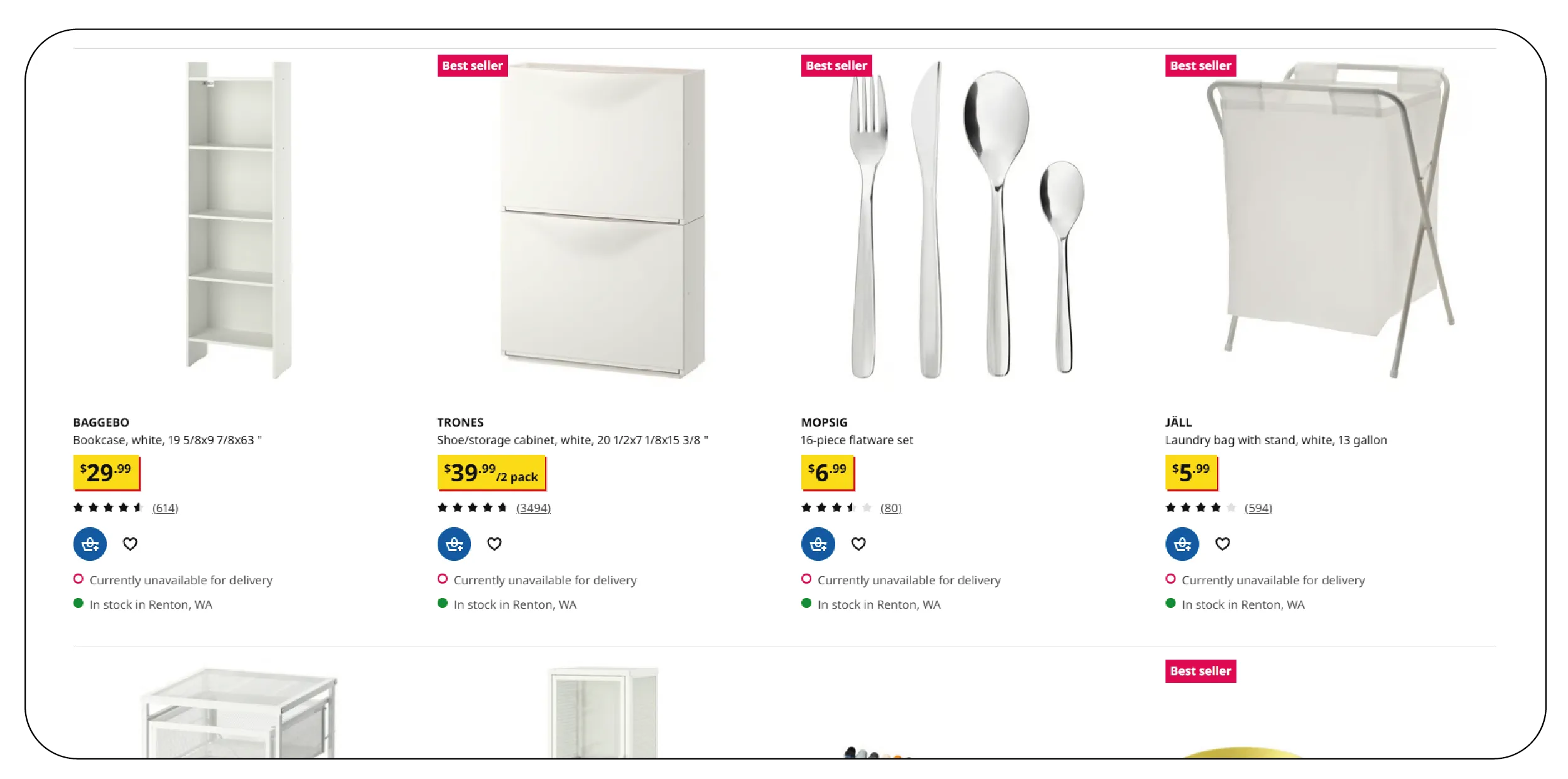
Analyzing IKEA’s product mix across locations is critical for operational planning. Using
Extract Furniture & Home Decor Website Data , analysts can determine which product categories are
emphasized in specific markets. Complementing this, Extract Home & Kitchen Data provides
visibility into high-demand segments, informing inventory management and marketing strategies.
Extract IKEA Furniture & Home Decor Data helps understand local preferences, popular items, and
seasonal trends. By combining store counts with product portfolio data, companies can evaluate
which regions require localized offerings versus standardized global inventories.
Historical data from 2020–2025 shows that home and kitchen categories consistently account for
40–45% of store offerings, with living room and storage products showing the highest growth.
These insights inform strategic sourcing, merchandising, and promotional planning.
Advanced Analytics and Dataset Integration

By leveraging Custom eCommerce Dataset solutions , stakeholders can integrate multiple data
sources into a structured framework. Combined with Web Data Intelligence API , this allows
real-time visualization, trend analysis, and forecasting of store growth and regional
performance.
Advanced analytics tools help map IKEA’s global network, calculate market saturation, and
identify regions with high growth potential. Integration with predictive models enables scenario
planning for future expansions and competitor benchmarking.
Between 2020 and 2025, using automated analytics reduced manual research time by 60%, improved
data accuracy by 35%, and accelerated decision-making for market entry strategies and investment
planning.
Monitoring Competitive Expansion and Market Opportunities
Using Instant Data Scraper, companies can capture competitor expansions, track new store
openings, and monitor regional penetration. When combined with Buy Custom Dataset Solution,
analysts can request tailored insights for specific countries, regions, or store formats.
These tools allow for proactive market research, helping businesses identify strategic
opportunities in underserved regions, evaluate competitive pressures, and plan collaborations or
localized marketing campaigns.
Product Data Scrape enables businesses to Extract IKEA location data and store counts 2025
efficiently, integrating historical and real-time insights. By leveraging structured datasets,
APIs, and automated scraping, organizations gain visibility into retail expansion, country-wise
store distribution, and market growth strategies. Tools for Web scraping IKEA retail growth
data, product insights, and competitive benchmarking streamline workflows, reduce manual effort,
and enable data-driven decision-making. Businesses can monitor competitor expansion, optimize
inventory and supply chain strategies, and forecast market potential accurately. With Product
Data Scrape, stakeholders gain access to actionable insights from comprehensive, up-to-date
datasets, empowering smarter strategies and operational excellence across global markets.
Conclusion
In an era of rapid retail transformation, Extract IKEA location data and store counts 2025
provides businesses with critical intelligence to stay competitive. By combining structured
location data with historical trends, stakeholders can analyze growth trajectories, market
penetration, and urban expansion strategies. Integration with advanced analytics tools, APIs,
and custom datasets ensures actionable insights for investment planning, market entry, and
strategic forecasting. Leveraging automated data extraction and Web Data Intelligence API,
companies can track global expansion, monitor competitor activity, and identify high-potential
regions efficiently. Harnessing Product Data Scrape’s capabilities enables accurate, real-time
visibility into IKEA’s retail network, empowering smarter, data-driven decisions and ensuring
businesses remain ahead in the dynamic furniture and home decor market.
FAQs
What is “Extract IKEA location data and store counts 2025”?
Extract IKEA location data and store counts 2025 is a structured dataset that provides
country-wise information about IKEA stores, including locations, openings, and closures. It
allows businesses and analysts to track global expansion, identify growth trends, and make
data-driven decisions for investments, retail strategy, and competitive benchmarking.
How can I use IKEA expansion data for market analysis?
By leveraging the IKEA expansion and growth plan dataset 2025, analysts can study regional
penetration, urban versus suburban store distribution, and growth rates. This data supports
forecasting, market entry strategies, competitor comparison, and identifying underserved regions
where expansion opportunities exist, providing actionable intelligence for strategic business
planning.
What sources are included for data extraction?
Data is collected using methods like Scrape IKEA country wise store locations data, scrape IKEA
global store count data, and IKEA store locator data extraction service. These sources ensure
accurate, structured, and up-to-date insights from IKEA’s official portals, retail
announcements, and automotive marketplaces for comprehensive analysis.
Can this data be integrated into analytics tools?
Yes. Using Web Data Intelligence API or Custom eCommerce Dataset solutions, businesses can
integrate the IKEA dataset into dashboards, BI tools, and analytics pipelines. This enables
real-time monitoring, visualization, and analysis of store growth, market penetration, and
strategic planning with minimal manual effort.
How does this data help in competitive benchmarking?
By combining Web scraping IKEA retail growth data and historical store counts, companies can
compare IKEA’s expansion with competitors. Insights from Extract IKEA location data and store
counts 2025 help identify high-potential markets, track competitor growth patterns, and optimize
strategic decisions for retail and investment planning.



 Singapore
 EMAIL
EMAIL
 PHONE
PHONE











.webp)