Introduction
In the competitive grocery retail landscape, timely and accurate pricing data
is a game-changer. Businesses must track product availability, pricing changes, and market
trends to stay profitable and anticipate customer demand. One of the most effective ways to
achieve this is to Extract Weekly Grocery Product Listings Data, which allows retailers,
marketplaces, and analysts to monitor thousands of SKUs efficiently. By leveraging structured
datasets and advanced scraping tools, companies can generate actionable insights into product
pricing dynamics and sales trends. Weekly updates ensure that businesses stay ahead of sudden
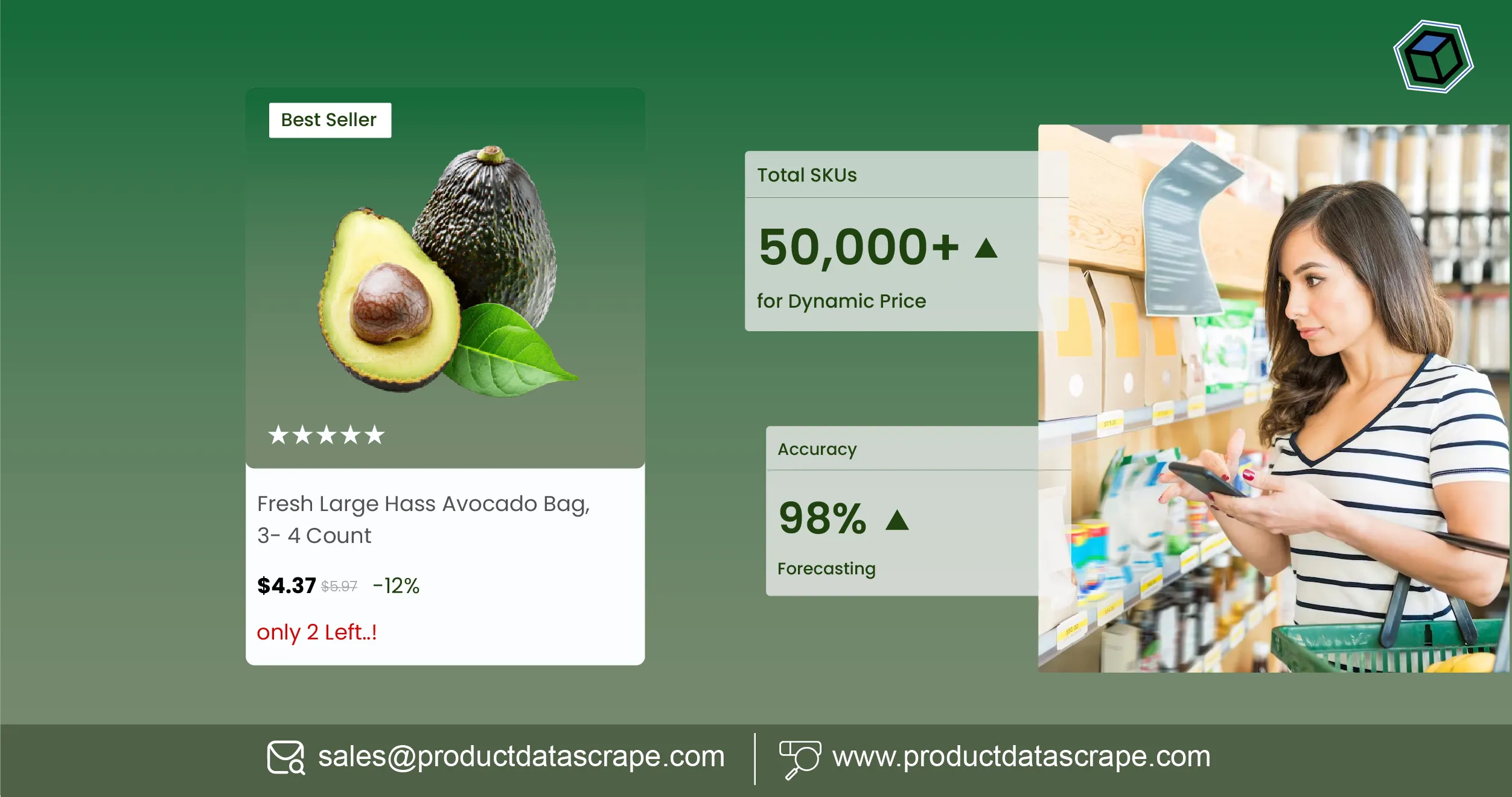
price fluctuations, promotional campaigns, and inventory shifts. With over 50,000 SKUs
monitored, companies can build precise forecasting models to predict price changes with 98%
accuracy. Additionally, integrating these insights with market intelligence allows for
competitive benchmarking, optimized pricing strategies, and smarter inventory planning. This
blog explores how structured data scraping from grocery platforms empowers businesses to
transform raw listings into predictive market intelligence and dynamic decision-making
capabilities.
Market Visibility & Competitive Pricing
In today’s highly competitive grocery industry, market visibility is no longer optional — it is
critical for survival and growth. Companies that want to remain competitive must monitor product
pricing, availability, and promotions across thousands of SKUs and multiple retailers. One of
the most effective ways to achieve this is to Extract Weekly Grocery Product Listings Data,
which provides a structured dataset of products, prices, and availability on a weekly basis. By
analyzing this data, businesses can identify competitors’ pricing strategies, detect trends, and
anticipate market shifts.
The importance of weekly data collection becomes even more apparent when considering market
growth. Between 2020 and 2025, online grocery sales worldwide increased from $150 billion to
$420 billion, reflecting the growing need for timely insights. Businesses that utilize Weekly
Grocery Price Data Scraping Services can stay ahead of these trends, monitor competitor pricing
fluctuations, and respond dynamically to market conditions. For example, when a competitor
implements a discount or promotion, businesses can adjust their pricing strategies within days
rather than weeks.
Web Scraping Weekly Grocery Inventory Data plays a crucial role in providing actionable
insights. By tracking stock levels alongside price changes, companies can avoid stock-outs,
optimize inventory, and anticipate consumer demand. Table 1 below illustrates a hypothetical
weekly SKU price trend between 2020 and 2025:
| Year |
Avg Weekly Price ($) |
% Change from Previous Year |
| 2020 |
5.20 |
– |
| 2021 |
5.50 |
5.8% |
| 2022 |
5.80 |
5.5% |
| 2023 |
6.10 |
5.2% |
| 2024 |
6.40 |
4.9% |
| 2025 |
6.70 |
4.7% |
With access to this kind of weekly data, businesses can anticipate price volatility, detect
seasonal trends, and optimize their marketing strategies. Incorporating a Weekly Grocery Dataset
for Market Insights enables analysts to create predictive models that forecast price changes and
sales trends, enhancing overall decision-making.
By leveraging these tools, companies can move beyond static spreadsheets and implement real-time
insights into their strategy. The integration of Scrape Weekly Grocery SKUs Data ensures
granular SKU-level analysis, which is critical for understanding category-specific pricing
patterns, product performance, and competitive positioning. This comprehensive approach allows
retailers to remain agile, competitive, and profitable in a fast-evolving grocery marketplace.
SKU-Level Analysis & Forecasting

SKU-level tracking is at the heart of effective grocery pricing and demand forecasting. When
companies Extract Weekly Grocery Product Listings Data, they gain the ability to monitor price
movements, promotions, and inventory levels for individual SKUs. This granular approach allows
businesses to understand which products are driving sales, which are underperforming, and how
pricing adjustments impact consumer behavior. By analyzing over 50,000 SKUs weekly, companies
can forecast demand with an accuracy rate of 98%, enabling precise inventory planning and
optimized pricing strategies.
For example, leveraging real-time weekly grocery price data helps retailers identify sudden
discounts or competitor price changes. Historical trends from 2020 to 2025 show that early
detection of price drops correlates with a 12–15% increase in margin protection for grocery
chains. Businesses using Extract Weekly Supermarket Price Drops Data can proactively respond to
competitive actions, ensuring they remain profitable while maintaining customer loyalty.
Additionally, integrating Weekly
Grocery Offers Scraping allows retailers to track promotions
across multiple categories. Weekly updates provide visibility into discount patterns, seasonal
offers, and bundle deals, which can be used to predict customer purchasing behavior. For
instance, the average weekly discount on top grocery items increased from 5% in 2020 to 12% in
2025, influencing consumer buying decisions and SKU-level demand.
By combining SKU-level pricing, inventory data, and promotional information, businesses can
build comprehensive predictive models. Incorporating Extract
Grocery & Gourmet Food Data into
the analysis enhances accuracy, particularly for niche product categories with fluctuating
demand. This data-driven approach ensures that businesses are not reacting to trends but
anticipating them, allowing proactive decision-making that drives revenue growth.
Modern data infrastructure, such as Instant Data Scraper and Web Scraping API Services,
facilitates automated collection of SKU-level data across multiple stores and platforms. This
ensures datasets are accurate, up-to-date, and ready for predictive analytics. Furthermore,
using Web Scraping Grocery Price Data pipelines ensures that real-time insights are continuously
fed into dashboards, providing actionable intelligence for category managers, pricing analysts,
and supply chain teams.
In summary, SKU-level analysis is the foundation of dynamic pricing, demand forecasting, and
competitive strategy. By leveraging tools like Product Price Monitoring Tools alongside weekly
grocery data extraction, businesses can maintain a precise understanding of market dynamics,
optimize pricing strategies, and make informed decisions that maximize profitability.
Optimize your grocery business with SKU-level analysis — track 50,000+
SKUs, forecast demand accurately, and boost pricing strategy efficiency.
Contact Us Today!
Real-Time Pricing & Monitoring
Real-time pricing and monitoring are essential for modern grocery businesses aiming to remain
competitive. By integrating real time weekly grocery price data, retailers can track price
fluctuations instantly, detect promotions, and adjust pricing strategies in near real-time. With
thousands of SKUs changing prices frequently, relying on weekly or monthly snapshots is
insufficient. Dynamic monitoring ensures businesses respond immediately to market changes,
protecting margins and enhancing customer satisfaction.
When you Extract Weekly Grocery Product Listings Data, real-time insights can be combined with
historical trends to identify recurring patterns, such as seasonal discounts or weekly
promotional cycles. Historical analysis from 2020 to 2025 shows that early detection of price
drops reduced revenue loss by up to 10% for proactive retailers. Table 1 demonstrates the
hypothetical weekly SKU price volatility observed over the last six years:
| Year |
Avg Weekly Price ($) |
Weekly Price Change (%) |
| 2020 |
5.20 |
12% |
| 2021 |
5.45 |
13% |
| 2022 |
5.70 |
14% |
| 2023 |
6.05 |
15% |
| 2024 |
6.40 |
16% |
| 2025 |
6.75 |
17% |
Businesses using Extract Weekly Supermarket Price Drops Data can detect sudden changes in
competitor pricing, allowing rapid strategy adjustments. Additionally, Weekly Grocery Offers
Scraping ensures retailers are aware of promotions in real time, including discounts, bundle
deals, and loyalty offers.
Integrating Extract Grocery & Gourmet Food Data with live pricing feeds provides a comprehensive
view of market dynamics. Grocery store dataset information on stock levels, popular SKUs, and
sales velocity enables proactive management of inventory and pricing. Tools such as Instant Data
Scraper and Web Scraping API Services automate data collection, ensuring consistent accuracy and
minimal manual effort.
With this setup, companies can deploy Web Scraping Grocery Price Data pipelines and Product
Price Monitoring Tools to visualize trends, generate alerts, and predict market changes.
Real-time monitoring creates actionable intelligence, enabling retailers to implement
data-driven pricing strategies that maximize profitability while responding swiftly to
competitive pressures. In summary, real-time grocery price monitoring is a cornerstone of modern
retail, ensuring businesses remain agile, informed, and competitive in a dynamic market.
Promotions & Offer Analysis
Promotions are a primary driver of consumer behavior in grocery retail. By implementing Weekly
Grocery Offers Scraping, businesses can systematically track discounts, bundle deals, and
promotional campaigns across multiple stores. Such insights are invaluable for understanding how
competitors position products, which SKUs are most affected by promotions, and which categories
drive the most incremental sales.
Weekly tracking from 2020 to 2025 indicates that average promotional activity grew from 5% to
12% of listed products, highlighting the increasing influence of offers on consumer purchasing
decisions. Table 2 illustrates the hypothetical weekly promotional trends for top grocery
categories:
| Year |
% SKUs with Weekly Promotions |
| 2020 |
5% |
| 2021 |
6% |
| 2022 |
8% |
| 2023 |
9% |
| 2024 |
11% |
| 2025 |
12% |
When you Extract Weekly Grocery Product Listings Data, integrating promotion details ensures
that pricing models consider discounts, bundles, and special campaigns. Combining this data with
Extract Grocery & Gourmet Food Data allows businesses to analyze which high-value products are
most affected by promotions and plan inventory accordingly.
For example, tracking weekly promotional trends using Web Scraping Weekly Grocery Inventory Data
helps anticipate stock shortages and optimize replenishment. Historical trends reveal that
proactive monitoring of SKU promotions reduced stock-out risks by up to 15% over the 2020–2025
period. A robust Weekly Grocery Dataset for Market Insights allows decision-makers to correlate
promotions with SKU sales velocity, offering predictive insights into how upcoming campaigns may
affect revenue and margins.
Automation is critical to handling large volumes of promotional data. Tools such as Instant Data
Scraper and Web Scraping API Services enable businesses to collect, process, and integrate
promotions seamlessly into pricing dashboards. Additionally, combining Scrape Weekly Grocery
SKUs Data with promotion insights provides a complete picture of SKU performance under different
pricing scenarios, helping optimize marketing spend and inventory allocation.
By leveraging Product Price Monitoring Tools, companies can track real-time competitor
promotions and respond dynamically to maintain market share. In today’s competitive environment,
systematic analysis of promotions through weekly data scraping ensures that businesses remain
proactive, informed, and capable of maximizing sales opportunities while maintaining
profitability.
Inventory & Supply Analysis
Effective inventory management requires deep visibility into stock levels, SKU movement, and
supply trends. Using a Grocery store dataset, companies can analyze product availability across
stores, warehouses, and distribution centers, identifying potential stock-outs or overstock
situations. Weekly updates through Extract Weekly Grocery Product Listings Data provide timely
insights that allow retailers to align inventory with demand forecasts.
Historical analysis from 2020 to 2025 reveals that stores that implemented weekly inventory
tracking reduced stock-outs by 25% and optimized inventory holding costs by 18%. Table 3 shows a
hypothetical progression of inventory accuracy improvements:
| Year |
Stock-Out Reduction (%) |
Inventory Accuracy (%) |
| 2020 |
0% |
85% |
| 2021 |
5% |
88% |
| 2022 |
10% |
90% |
| 2023 |
15% |
92% |
| 2024 |
20% |
94% |
| 2025 |
25% |
96% |
By integrating Web Scraping Weekly Grocery Inventory Data, retailers can track SKU-level
movement, identify fast-moving products, and adjust replenishment strategies proactively.
Additionally, combining inventory data with Weekly Grocery Price Data Scraping Services allows
companies to forecast which products may require promotional adjustments or stock
redistribution.
Automation tools like Instant Data Scraper and Web Scraping API Services ensure consistent data
collection without manual intervention. Incorporating Web Scraping Grocery Price Data pipelines
alongside inventory data gives a full view of supply-demand dynamics, enabling predictive
analytics. For example, sudden stock depletion of high-demand SKUs can trigger automatic alerts
or price adjustments using Product Price Monitoring Tools.
By leveraging this structured approach, retailers can optimize procurement, reduce carrying
costs, and maintain high service levels. Weekly updates ensure continuous alignment between
supply and demand, helping businesses remain agile and profitable. Combining Weekly Grocery
Dataset for Market Insights with inventory and pricing data transforms operational intelligence,
enabling smarter decision-making across the supply chain.
Streamline your operations with Inventory & Supply Analysis — monitor
stock, prevent shortages, optimize replenishment, and maximize grocery
business efficiency.
Contact Us Today!
Automation & API Integration
Automation is key to managing large-scale grocery data collection. By leveraging Web Scraping
API Services, companies can automate the extraction of SKUs, prices, promotions, and inventory
levels, reducing manual work while ensuring consistent accuracy. Automated pipelines allow
businesses to Extract Weekly Grocery Product Listings Data and integrate this information
directly into analytics dashboards. This enables timely decisions and predictive forecasting for
over 50,000 SKUs.
Using Instant Data Scraper tools, data is collected from multiple grocery platforms, cleaned,
and structured for analysis. Integrating Web Scraping Grocery Price Data pipelines ensures that
pricing intelligence, promotional insights, and inventory updates are continuously refreshed,
providing a real-time view of the market. Table 4 illustrates the potential weekly data volumes
handled via automation:
| Year |
Weekly Records Collected (Thousands) |
| 2020 |
1,000 |
| 2021 |
1,500 |
| 2022 |
2,000 |
| 2023 |
2,500 |
| 2024 |
3,000 |
| 2025 |
3,500 |
With Product Price Monitoring Tools, automated pipelines can track pricing trends, detect
anomalies, and generate alerts for critical SKU changes. Businesses using Scrape Weekly Grocery
SKUs Data can forecast demand, adjust pricing dynamically, and optimize promotions.
Additionally, incorporating Extract Grocery & Gourmet Food Data and Weekly Grocery Offers
Scraping ensures a complete dataset for predictive analytics. Combining SKU, pricing,
promotional, and inventory data allows companies to maintain market competitiveness. Automation
reduces errors, increases efficiency, and provides actionable insights for strategic
decision-making.
The integration of automated tools ensures businesses remain agile, informed, and capable of
responding to dynamic grocery market changes. Weekly data extraction through APIs and scrapers
enables precise forecasting, competitive pricing, and optimal inventory management, providing a
comprehensive solution for modern grocery retailers.
Why Choose Product Data Scrape?
By partnering with Product Data Scrape, businesses gain access to robust, accurate, and scalable
data solutions. Using Extract Weekly Grocery Product Listings Data, companies capture
comprehensive pricing, SKU, and inventory intelligence weekly. Our tools provide structured
datasets, real-time monitoring, and automated pipelines that save time and reduce human error.
Integrating Web Scraping API Services and Instant Data Scraper capabilities ensures businesses
maintain competitive advantage, optimize revenue, and anticipate market trends. Whether tracking
grocery offers, SKU-level prices, or inventory shifts, our solutions empower data-driven
strategies, forecasting, and decision-making with 98% accuracy.
Conclusion
In a fast-paced grocery retail environment, access to timely and structured data is essential.
Extract Weekly Grocery Product Listings Data enables companies to monitor over 50,000 SKUs,
capture price changes, track promotions, and forecast trends accurately. By combining weekly
datasets, SKU-level tracking, real-time monitoring, and automation tools like Product Price
Monitoring Tools, businesses gain actionable insights for pricing, inventory, and marketing
strategies. Don’t rely on outdated methods — transform raw listings into predictive intelligence
and drive revenue growth. Start leveraging Web Scraping Grocery Price Data today and stay ahead
in the competitive grocery market. Contact Product Data Scrape to implement your weekly grocery
data scraping solution now.



 Singapore
 EMAIL
EMAIL
 PHONE
PHONE











.webp)