Introduction
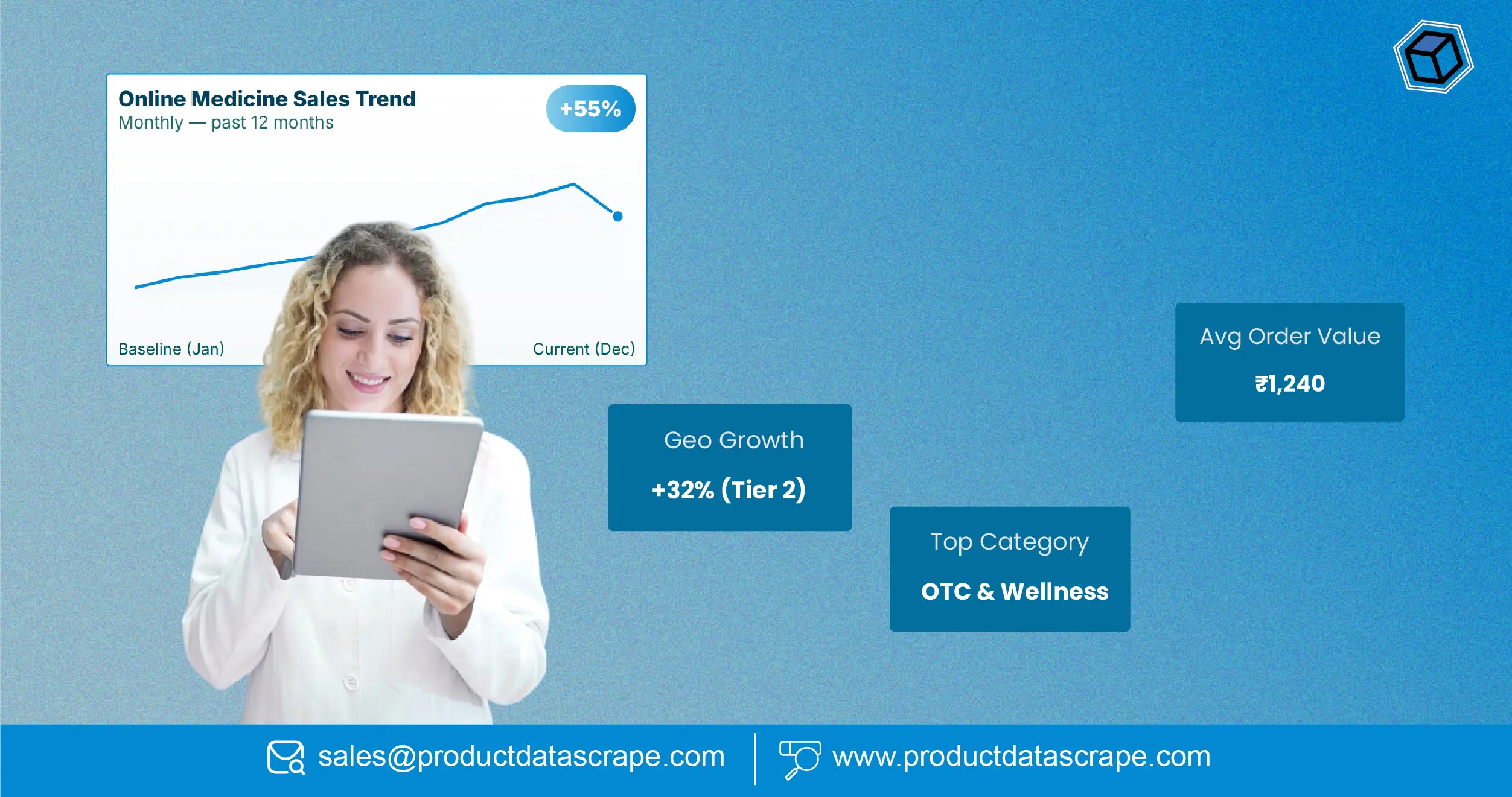
The pharmaceutical retail sector has entered a new digital era, where customer demand, product availability, and pricing fluctuate daily. With growing consumer preference toward online pharmacies, businesses now rely heavily on actionable, data-driven insights. This is why Scraping Pharmacy E-Commerce Websites has become mission-critical for pharmaceutical brands, healthcare retailers, distributors, and investment firms. The rise of digital-first pharmacies such as PharmEasy, Apollo Pharmacy, Netmeds, Walgreens, and CVS illustrates how fast online medicine purchases are becoming the new norm. In fact, the U.S. and India together witnessed a 55% surge in online medicine sales between 2021 and 2024, a trend expected to accelerate further as prescription deliveries, OTC medicine purchasing, and telemedicine adoption continue to scale.
By scraping pharmacy portals in real time, organizations can track pricing, stock fluctuations, product reviews, competitor strategies, generic vs. branded medicine adoption rates, and patient demand patterns. From analyzing doctor-prescribed drug prices to understanding seasonal spikes in cold, allergy, diabetes, and immunity boosters—data fuels every market decision. In this report, we explore how strategic data extraction empowers the global pharma market.
Tracking Pricing & Stock Shifts
Modern pharmacy purchases are driven by transparency and comparison. This is why brands need to Extract medicine prices and availability Data from multiple e-commerce platforms. Doing so enables companies to understand which drugs are in shortage, how prices vary between retailers, and how demand changes during health outbreaks or seasonal illnesses.
Market Stats: Medicine Price Volatility (2020–2025)
| Year |
Avg OTC Price Change |
Prescription Drug Availability Index |
Online Stock-Out Rate |
| 2020 |
+8% |
78% |
12% |
| 2021 |
+11% |
81% |
16% |
| 2022 |
+15% |
84% |
22% |
| 2023 |
+18% |
88% |
26% |
| 2024 |
+21% |
90% |
29% |
| 2025* |
+25% (Projected) |
92% (Projected) |
32% (Projected) |
Extracting real-time pharmacy pricing reveals patterns triggered by inflation, supply chain disruptions, patent expirations, and rise in generic alternatives. Retailers that track these trends react faster to customer intent and adjust their catalog dynamically.
Automating Pharma Website Data Collection
The scalability of healthcare analytics depends on automation. The Pharma website data extraction API is used to collect SKUs, dosage information, disease categories, regulatory warnings, MRP changes, discounts, and product composition. Rather than performing manual checks, APIs allow seamless integration with enterprise dashboards and ERP systems.
Pharma Data API Adoption Growth (2020–2025)
.webp)
| Year |
Global Pharma APIs Adoption |
Automated Compliance Requests |
Data Integration Deployments |
| 2020 |
1,200 Enterprises |
2,400 |
900 |
| 2021 |
1,850 Enterprises |
3,600 |
1,400 |
| 2022 |
2,900 Enterprises |
4,450 |
2,200 |
| 2023 |
4,200 Enterprises |
6,200 |
3,100 |
| 2024 |
5,900 Enterprises |
8,100 |
4,050 |
| 2025* |
7,800 (Projected) |
10,500 (Projected) |
5,500 (Projected) |
APIs future-proof data intelligence, enabling businesses to connect runtime information with procurement systems, pricing engines, and forecasting tools.
Competitive Pricing & Demand Patterns
Understanding price sensitivity is essential, especially when pharmacies run constant discounts to attract customers. The Real-time medicine pricing dataset enables retailers to dynamically benchmark prices against peers. Since Scraping Pharmacy E-Commerce Websites provides structured pricing snapshots, businesses detect shifts such as sudden increases in vaccine demand, diabetes care products, vitamin supplements, or pregnancy and baby care essentials.
Medicine Demand Trends (2020–2025)
| Category |
CAGR Growth |
Online Demand |
Price Variability |
| Immunity Boosters |
44% |
High |
Medium |
| Diabetes Medicines |
37% |
Very High |
High |
| Pain Relief & Analgesics |
28% |
Medium |
Low |
| Chronic Care Drugs |
33% |
Very High |
Low |
| Baby & Mothercare Products |
26% |
High |
High |
Retailers without real-time data fall behind competitors adjusting costs strategically.
AcMarket Signals & Behavioral Shifts
The pharmaceutical e-commerce market requires ongoing competitive awareness. Healthcare retail product Price intelligence enables companies to track new product launches, reformulated generics, expired drug batches, and sudden category shifts influenced by health scares.
Customer Preference Shifts (2020–2025)
.webp)
| Year |
Generic Medicine Adoption |
Brand-Specific Buying |
Online Repeat Purchases |
| 2020 |
28% |
72% |
21% |
| 2021 |
33% |
67% |
28% |
| 2022 |
40% |
60% |
35% |
| 2023 |
47% |
53% |
41% |
| 2024 |
52% |
48% |
48% |
| 2025* |
58% (Projected) |
42% (Projected) |
56% (Projected) |
Consumers increasingly trust affordable alternatives—data makes capturing this transition possible.
Turning Pharma Catalogs into Insights
OTC healthcare products such as vitamins, protein supplements, diagnostics, masks, and hygiene items are growing rapidly. Businesses can Extract Pharma & Wellness Data to understand which brands dominate specific niches, which SKUs trend seasonally, and how buyers perceive benefits via product reviews and sentiment analysis.
Wellness Segment Growth (2020–2025)
| Category |
Market Growth |
Search Volume Increase |
Top Selling Regions |
| Nutritional Aids |
54% |
71% |
Tier 1 Cities |
| Diagnostics Kits |
63% |
89% |
Urban Clinics |
| Sanitization |
91% |
102% |
Global Markets |
These insights allow personalized marketing strategies, targeted SKU onboarding, and improved supply forecasting.
The Intelligence Engine Behind Pharma Analytics
AI-driven analytics connected to a Web Data Intelligence API provides competitive foresight. Pharmacies predict demand surges such as flu seasons, supplement cycles, or allergy outbreaks before competitors respond
AI Impact on Pharma Market Forecasting (2020–2025)
| Parameter |
2020 |
2021 |
2022 |
2023 |
2024 |
2025* |
| AI-driven Insights Usage |
17% |
28% |
42% |
56% |
63% |
78% |
| Inventory Automation |
9% |
19% |
29% |
45% |
62% |
81% |
This results in improved margins and more accurate forecasting models.
Why Choose Product Data Scrape?
With its industry-leading extraction engines, Product Data Scrape empowers pharma, healthcare, and wellness ecosystems using actionable datasets for strategic decisions. Whether analyzing competitor catalogs, mapping SKU-level transformations, or optimizing profitability, our Buy Custom Dataset Solution ensures unmatched accuracy, scalability, and compliance.
Conclusion
Pharmaceutical competition is no longer product-driven—it is data-driven. Businesses that leverage digital purchasing signals, real-time stock levels, and dynamic pricing stand miles ahead. A strong Scraper to Collect Commerce Intelligence Information framework allows organizations to scale operations, reduce acquisition costs, and predict customer behavior with precision. By investing in the right tools and workflows, brands gain an enduring edge through Scraping Pharmacy E-Commerce Websites.
Get pharmacy datasets tailored to your market. Transform decisions with real-time pricing, availability analytics, and demand forecasting. Act now to build the competitive pharmacy advantage your business needs.
FAQs
1. Why is pharmacy website scraping important?
It helps track real-time pricing, stock availability, demand variations, and competitor strategies, enabling smarter decisions, optimized product assortments, and market-driven pricing models.
2. Is scraping legal for pharmacy websites?
Yes, when done responsibly using public data, respecting robots.txt rules, and complying with GDPR, HIPAA, and data retention guidelines.
3. Can pharmacy data predict seasonal demand?
Absolutely. Analytics identifies seasonal spikes like flu season, allergy waves, or metabolic care trends based on real-time purchase signals and search trends.
4. Who benefits from pharmacy e-commerce data?
Manufacturers, distributors, retailers, investors, procurement teams, regulators, and digital pharmacies use data to improve pricing, competitiveness, and customer engagement.
5. What datasets are commonly extracted?
Medicine prices, product ingredients, prescriptions, reviews, stock levels, expiry dates, safety warnings, discount patterns, and geographic demand.



 Singapore
 EMAIL
EMAIL
 PHONE
PHONE


.webp "thumb")









.webp)