Quick Overview
A leading mid-sized fashion retail brand operating in India partnered with Product Data Scrape to overcome inventory inefficiencies and improve stock visibility across online marketplaces. Over a 6-month engagement, we implemented the AI-Based Zara Fashion Product Scraping API to streamline competitive tracking and demand forecasting. Using advanced automation to Extract Zara India Fashion & Apparel Data, we enabled real-time visibility into pricing, stock levels, and SKU-level changes. The impact was measurable: 28% reduction in stockouts, 22% improvement in inventory turnover rate, and 18% increase in sell-through performance across seasonal collections.
The Client
The client is a fast-growing fashion and lifestyle brand catering to urban millennials and Gen Z consumers across India. Operating in a highly competitive omnichannel retail environment, the brand faced intense pressure from global players and fast-fashion leaders. Rapid trend cycles, flash discounts, and frequent assortment updates made it difficult to maintain optimal inventory levels.
The fashion ecommerce industry has shifted toward real-time data-driven merchandising. Competitors were already leveraging Zara fashion product data scraping service models to adjust pricing and align inventory with demand signals. Without access to dynamic market intelligence, the client struggled with delayed restocking decisions and overstocked slow-moving SKUs.
Before partnering with us, their internal analytics relied on manual monitoring and fragmented tools. They lacked a structured Zara Product Data Scraper framework to track competitor pricing, new arrivals, and category-level assortment shifts. As a result, forecasting inaccuracies increased holding costs and reduced responsiveness to fashion trends. Transformation was essential to remain competitive, agile, and data-centric in an evolving retail landscape.
Goals & Objectives
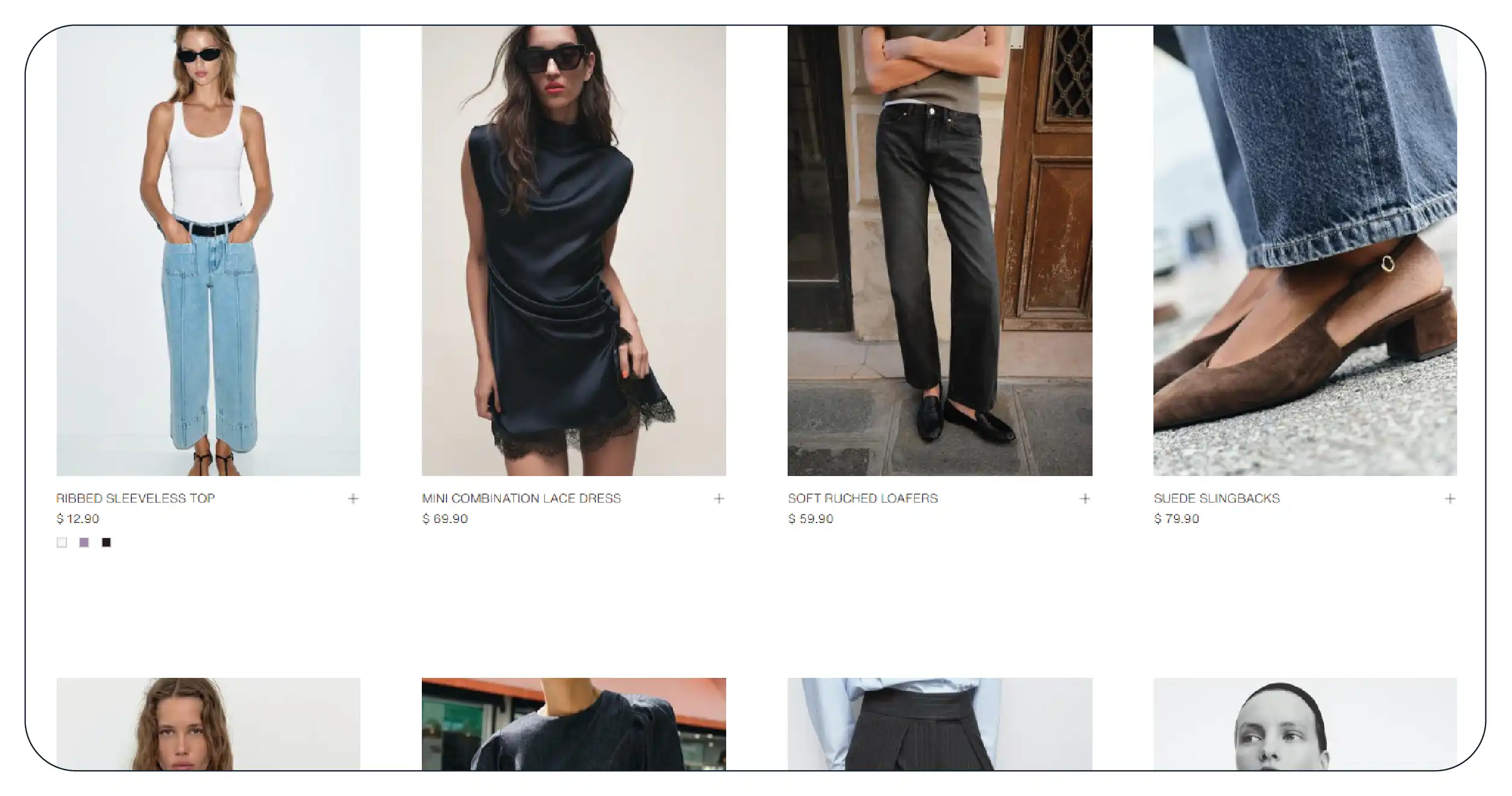
The primary goal was to implement scalable Real-time Zara clothing price monitoring to enhance pricing accuracy and competitive alignment. The client aimed to improve operational efficiency, eliminate manual tracking, and increase data reliability for faster merchandising decisions.
From a technical perspective, we focused on automation, seamless API integration, and structured pipelines to Extract Zara E-Commerce Product Data across categories. The objective was to enable near real-time dashboards for pricing, stock, and assortment intelligence. We also ensured compatibility with the client’s ERP and analytics systems.
25% faster pricing decision cycles
30% improvement in stock allocation accuracy
20% reduction in excess inventory levels
95%+ data accuracy across tracked SKUs
These measurable outcomes defined success from both business and technical standpoints.
The Core Challenge
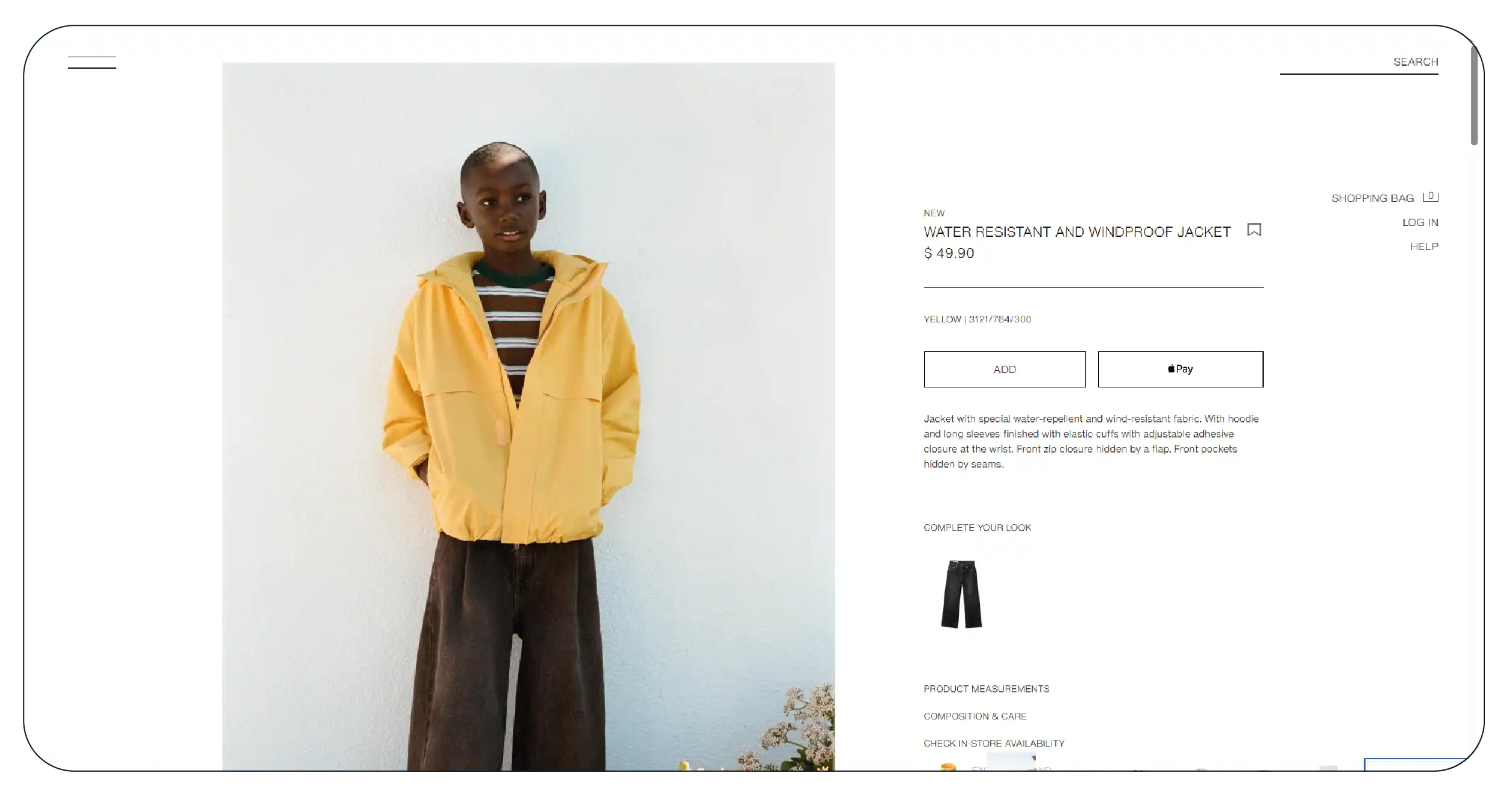
The client’s biggest bottleneck was inconsistent inventory visibility. Without a centralized Zara fashion inventory Data tracking API, they struggled to track competitor stock levels, size availability, and seasonal assortment updates. Manual monitoring caused delays and incomplete datasets.
Operationally, merchandising teams spent excessive time validating competitor prices and catalog updates. The absence of a reliable Zara Product Data Extraction API led to data duplication, formatting inconsistencies, and delayed updates. This affected demand planning and led to reactive pricing adjustments rather than proactive strategy.
Performance issues compounded the problem. Data lag reduced the effectiveness of promotional campaigns, while inaccurate availability signals resulted in missed sales opportunities. Ultimately, slow data pipelines impacted accuracy, speed, and decision confidence—creating a clear need for automation and intelligent scraping infrastructure.
Our Solution

We implemented a phased strategy centered around Automated Zara apparel data extraction to ensure scalability and precision.
Phase 1: Infrastructure & Data Mapping
We analyzed SKU structures, category hierarchies, and regional product variations. This enabled clean schema mapping to Extract Fashion & Apparel Data in structured formats aligned with the client’s analytics systems.
Phase 2: Intelligent Scraping Deployment
Using AI-powered bots and dynamic parsing engines, we automated price, stock, and assortment tracking. The scraping logic adapted to layout changes and promotional banners, ensuring continuity without data gaps. Real-time triggers were added for price drops and new arrivals.
Phase 3 : Integration & Dashboard Enablement
Data pipelines were integrated into the client’s BI dashboards for actionable insights. Automated alerts flagged stockouts, pricing mismatches, and category-level changes. This significantly improved forecasting and replenishment planning.
Each phase directly addressed operational inefficiencies—reducing manual workload, increasing data reliability, and accelerating competitive decision-making.
Results & Key Metrics
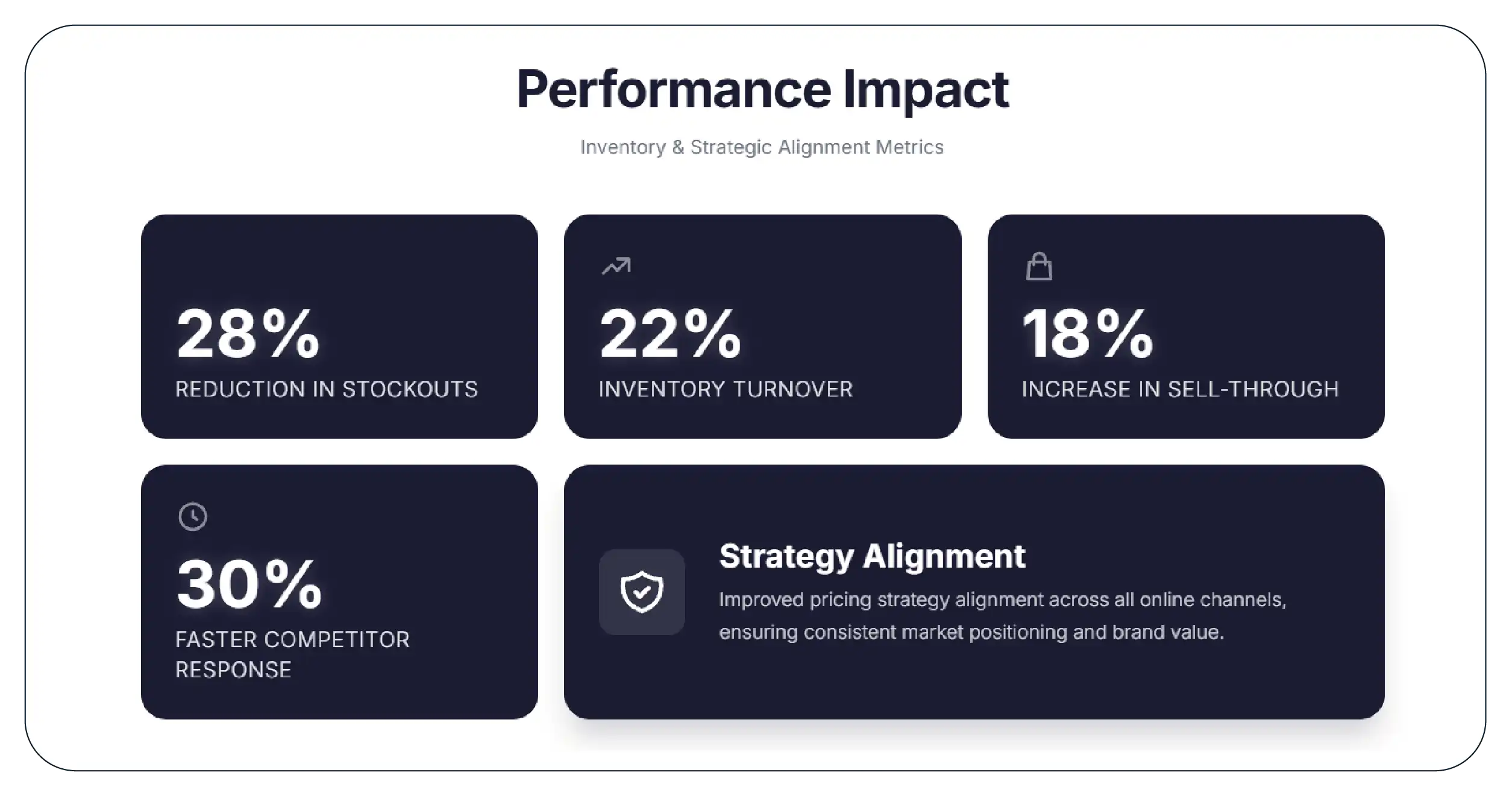
Using our Zara Fashion product catalog scraping solution, the client achieved:
28% reduction in stockouts
22% improvement in inventory turnover
18% increase in sell-through rate
30% faster competitor price response time
Improved pricing strategy alignment across online channels
Results Narrative
With structured competitive insights, the client transitioned from reactive inventory management to predictive planning. Real-time product and pricing visibility enabled smarter replenishment and markdown strategies. Seasonal collections were aligned with market demand signals, minimizing overstock risks. The brand strengthened its omnichannel presence by synchronizing online and offline pricing strategies. Overall, improved inventory optimization translated into higher customer satisfaction and stronger competitive positioning.
What Made Product Data Scrape Different?
Our solution went beyond basic scraping. We implemented intelligent Zara Fashion product stock monitoring powered by adaptive algorithms capable of detecting layout changes and dynamic pricing shifts. Unlike traditional price monitoring services, our framework integrated predictive analytics to anticipate demand trends. Proprietary validation layers ensured high data accuracy and minimized downtime. We delivered scalable architecture, enterprise-grade automation, and proactive monitoring—making our approach future-ready for evolving ecommerce platforms.
Client’s Testimonial
"Partnering with Product Data Scrape transformed our inventory strategy. The AI-Based Zara Fashion Product Scraping API gave us real-time visibility into competitor pricing and stock trends. Our teams now make faster, data-driven decisions with confidence. The automation reduced manual effort significantly and improved forecasting accuracy. This partnership has strengthened our market positioning in the competitive fashion landscape."
— Head of Merchandising, Leading Fashion Retail Brand
Conclusion
This case study demonstrates how Zara Fashion price and stock data scraping can drive measurable inventory optimization in competitive retail markets. By combining automation, analytics, and Competitor Price Monitoring, we empowered the client to enhance visibility, reduce stock risks, and improve profitability. Real-time intelligence is no longer optional—it’s essential for modern fashion retailers seeking sustainable growth and operational agility.
FAQs
1. What is an AI-based Zara scraping API?
It is an automated solution that extracts product, price, and stock data from Zara’s ecommerce platform in real time.
2. How does this help inventory optimization?
By tracking competitor stock levels and pricing, brands can adjust replenishment and markdown strategies efficiently.
3. Is the data updated in real time?
Yes, automated scraping ensures near real-time updates depending on configuration and monitoring frequency.
4. Can the solution integrate with ERP systems?
Absolutely. Data feeds can be structured for seamless integration with ERP, BI, and analytics dashboards.
5. Is this scalable for large SKU volumes?
Yes, our infrastructure supports enterprise-scale data extraction with high accuracy and automation reliability.



 Singapore
 EMAIL
EMAIL
 PHONE
PHONE


.webp)
.webp "thumb")
.webp "thumb")
.webp "thumb")








.webp)