Quick Overview
A leading retail brand in the US partnered with us to optimize local inventory using Walmart Product Data Scraping by ZIP Code. Over a 6-month engagement, we implemented automated solutions to collect location-specific inventory, pricing, and product availability data. The client leveraged Extract Walmart API Product Data to monitor over 5,000 SKUs across multiple stores. Key impact metrics included a 30% faster inventory allocation cycle, a 25% reduction in stockouts, and a 20% improvement in pricing alignment across ZIP codes. This approach empowered the client to make real-time, data-driven decisions that enhanced local store performance and customer satisfaction.
The Client
The client is a multi-location retail brand operating in a highly competitive US market. Consumer expectations and regional demand patterns create significant pressure on inventory management. Seasonal promotions and localized pricing strategies required real-time intelligence to optimize stock across stores.
Before the partnership, the client relied on manual tracking and sporadic price checks. Store managers struggled to align stock levels with actual local demand, leading to overstocking in some locations and shortages in others.
By engaging our Scrape Walmart product prices by ZIP code service and leveraging advanced Ecommerce Data Scraping Services, the client aimed to gain accurate, location-specific insights into inventory and pricing trends. This transformation was essential to reduce operational inefficiencies, maintain consistent stock availability, and improve sales performance. With centralized data and automated workflows, the client could track SKU-level availability and competitor pricing across ZIP codes, ensuring timely adjustments to inventory and pricing strategies while maintaining high service levels across all stores.
Goals & Objectives
Scale data extraction to cover 5,000+ SKUs across multiple ZIP codes.
Reduce manual effort while increasing accuracy of inventory and pricing data.
Gain visibility into competitor stock and pricing strategies at the ZIP code level.
Implement Extract Walmart store inventory Data by ZIP code workflows for automated, real-time insights.
Enable Competitor Price Monitoring to identify pricing gaps and local trends.
Integrate extracted data into dashboards for actionable store-level decisions.
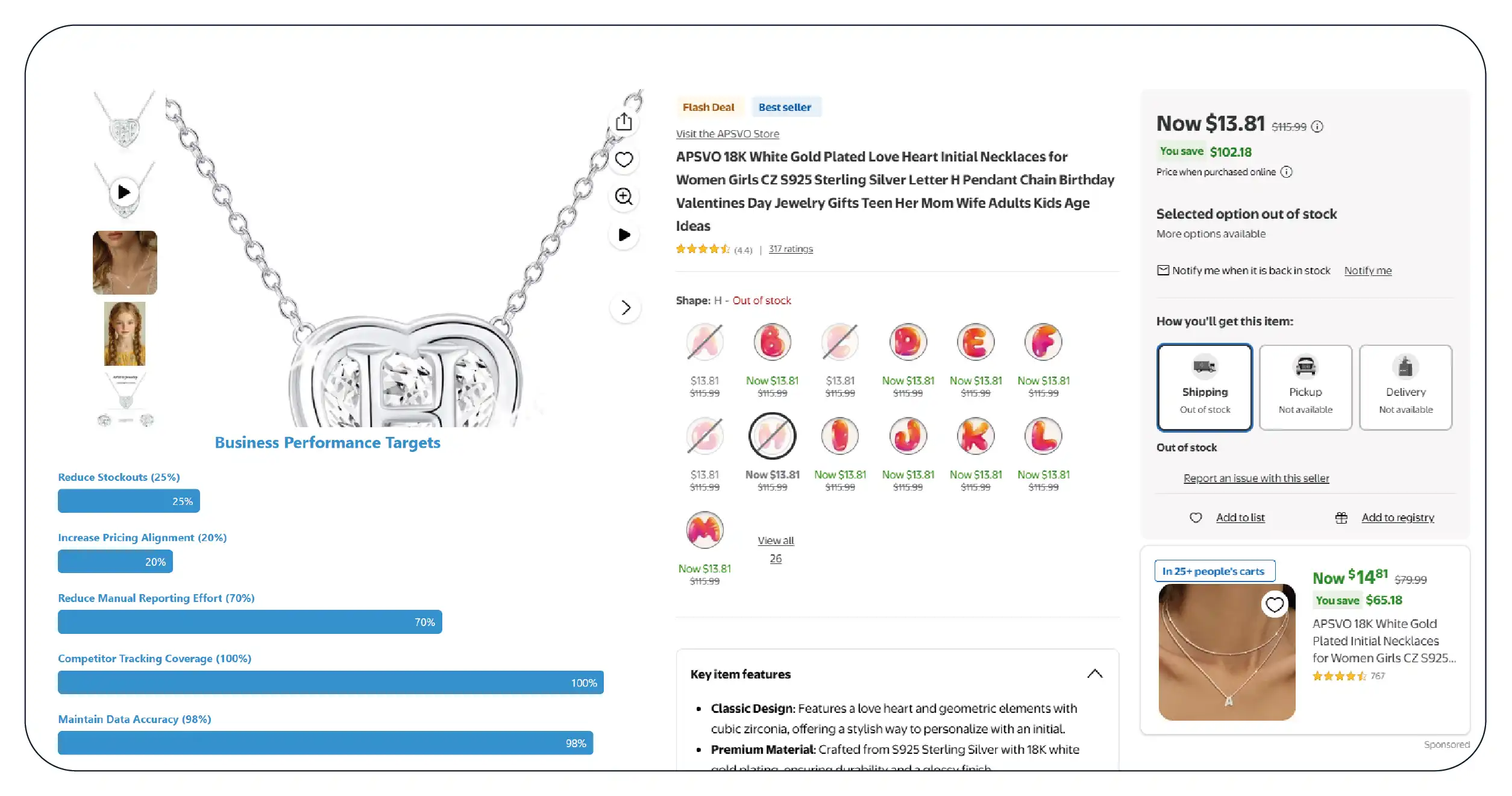
Reduce stockouts by 25% within 3 months.
Increase pricing alignment across stores by 20%.
Automate weekly inventory reporting to reduce manual effort by 70%.
Track competitor pricing and availability in all target ZIP codes.
Maintain data accuracy above 98% for inventory and pricing records.
The Core Challenge
The client faced multiple operational and technical bottlenecks. Manual data collection caused delays, inaccuracies, and inconsistent reporting. Store managers were unable to track stock availability and competitor pricing efficiently, particularly at the ZIP code level.
Performance issues included limited SKU coverage, outdated pricing information, and inconsistent inventory insights across regions. Without real-time intelligence, decision-making was reactive rather than proactive.
Tracking thousands of SKUs manually also created scalability challenges, especially during seasonal promotions and high-demand periods.
By implementing Walmart real-time price tracking by location and structuring a comprehensive eCommerce Product Dataset, we addressed these challenges. Our solution standardized SKU-level data, automated location-based monitoring, and ensured accuracy and speed. This allowed the client to make timely decisions for inventory allocation, pricing adjustments, and competitive positioning across multiple stores.
Our Solution
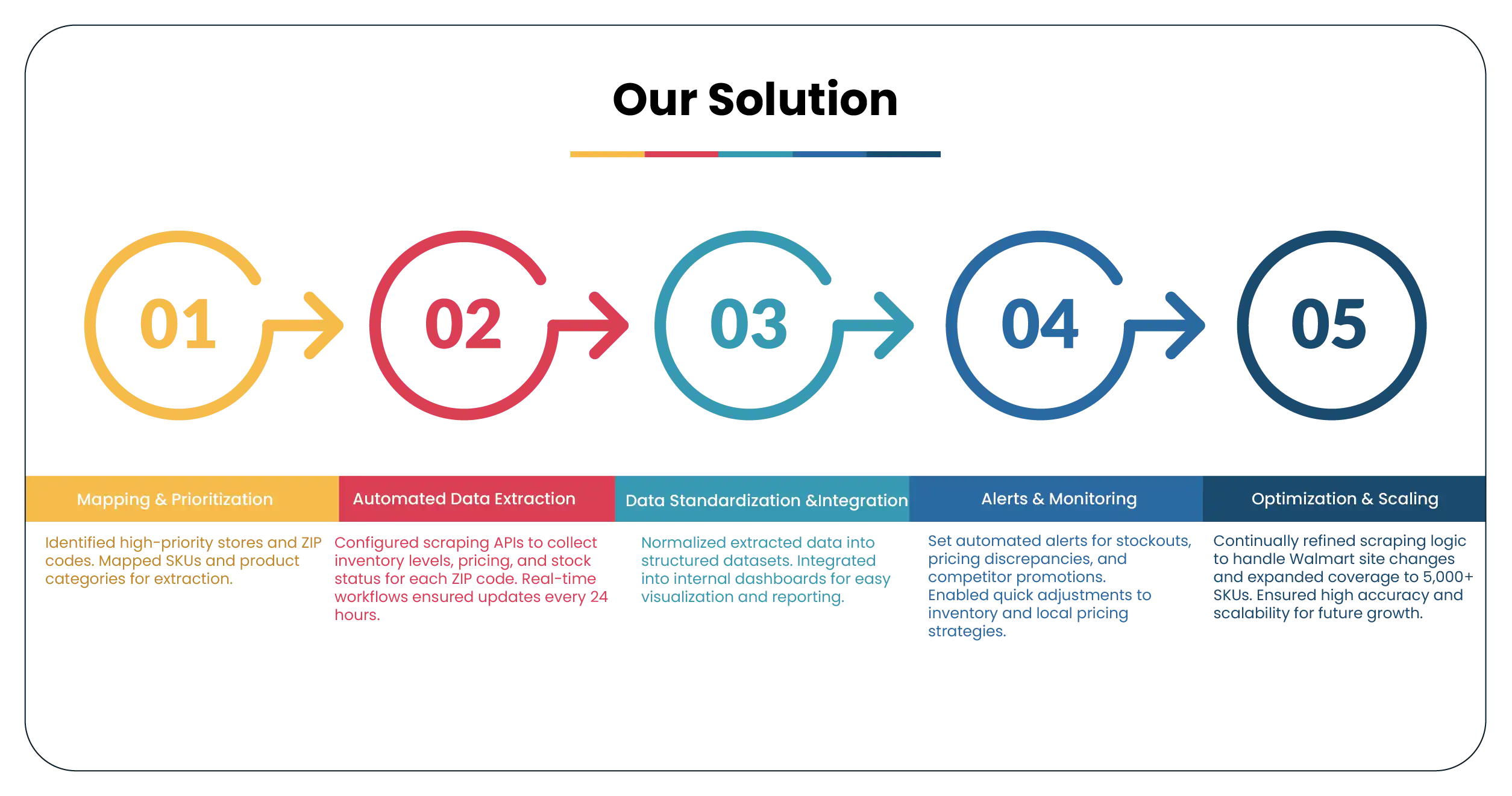
We implemented a phased, automated approach using Walmart product inventory Data monitoring by ZIP code and Web Scraping API Services.
Phase 1 – Mapping & Prioritization:
Identified high-priority stores and ZIP codes. Mapped SKUs and product categories for extraction.
Phase 2 – Automated Data Extraction:
Configured scraping APIs to collect inventory levels, pricing, and stock status for each ZIP code. Real-time workflows ensured updates every 24 hours.
Phase 3 – Data Standardization & Integration:
Normalized extracted data into structured datasets. Integrated into internal dashboards for easy visualization and reporting.
Phase 4 – Alerts & Monitoring:
Set automated alerts for stockouts, pricing discrepancies, and competitor promotions. Enabled quick adjustments to inventory and local pricing strategies.
Phase 5 – Optimization & Scaling:
Continually refined scraping logic to handle Walmart site changes and expanded coverage to 5,000+ SKUs. Ensured high accuracy and scalability for future growth.
The phased solution empowered the client to monitor local inventory, align pricing strategies, and respond proactively to market trends. By combining automated extraction with structured dashboards, we delivered a reliable, actionable intelligence system.
Results & Key Metrics
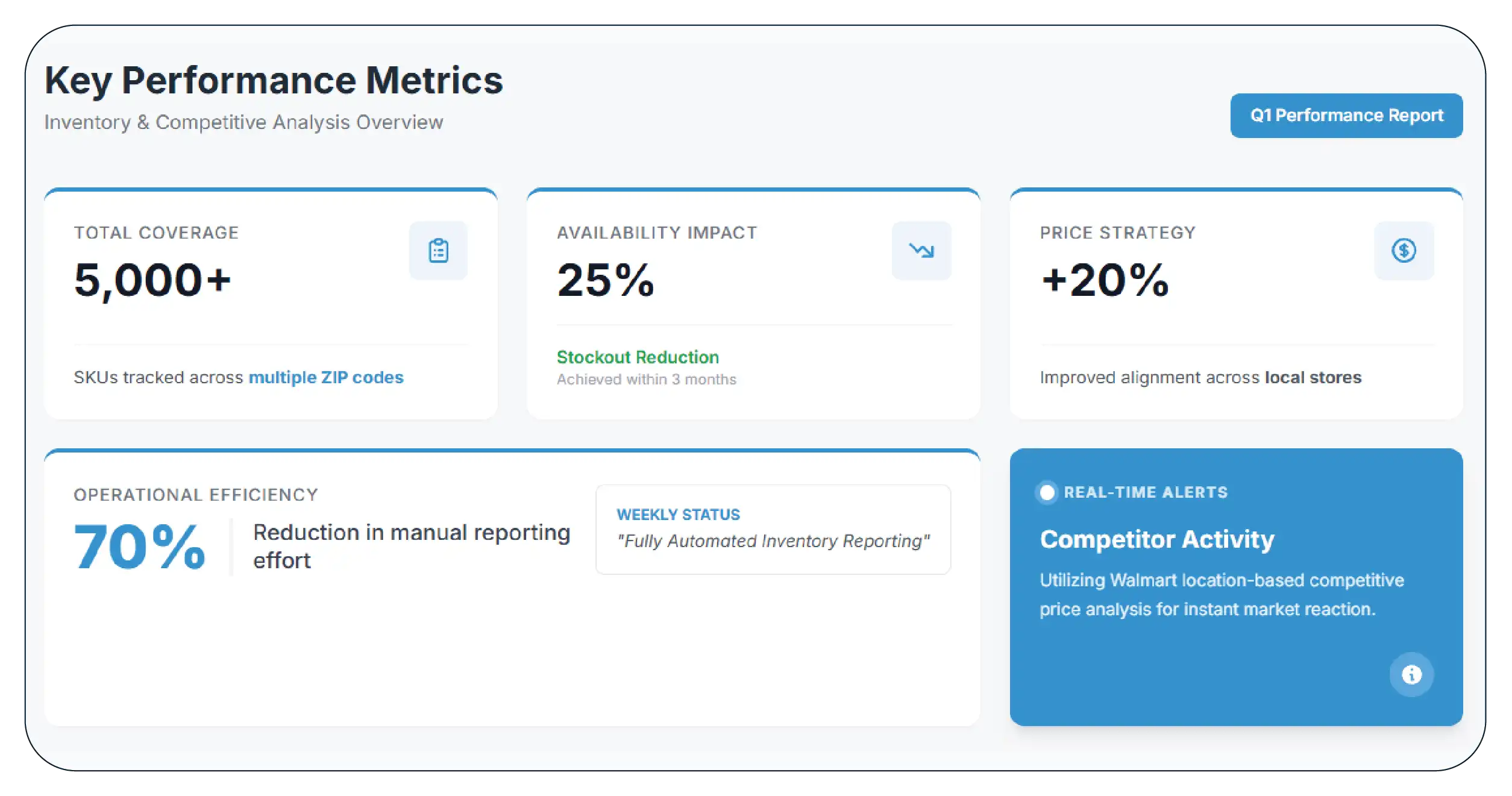
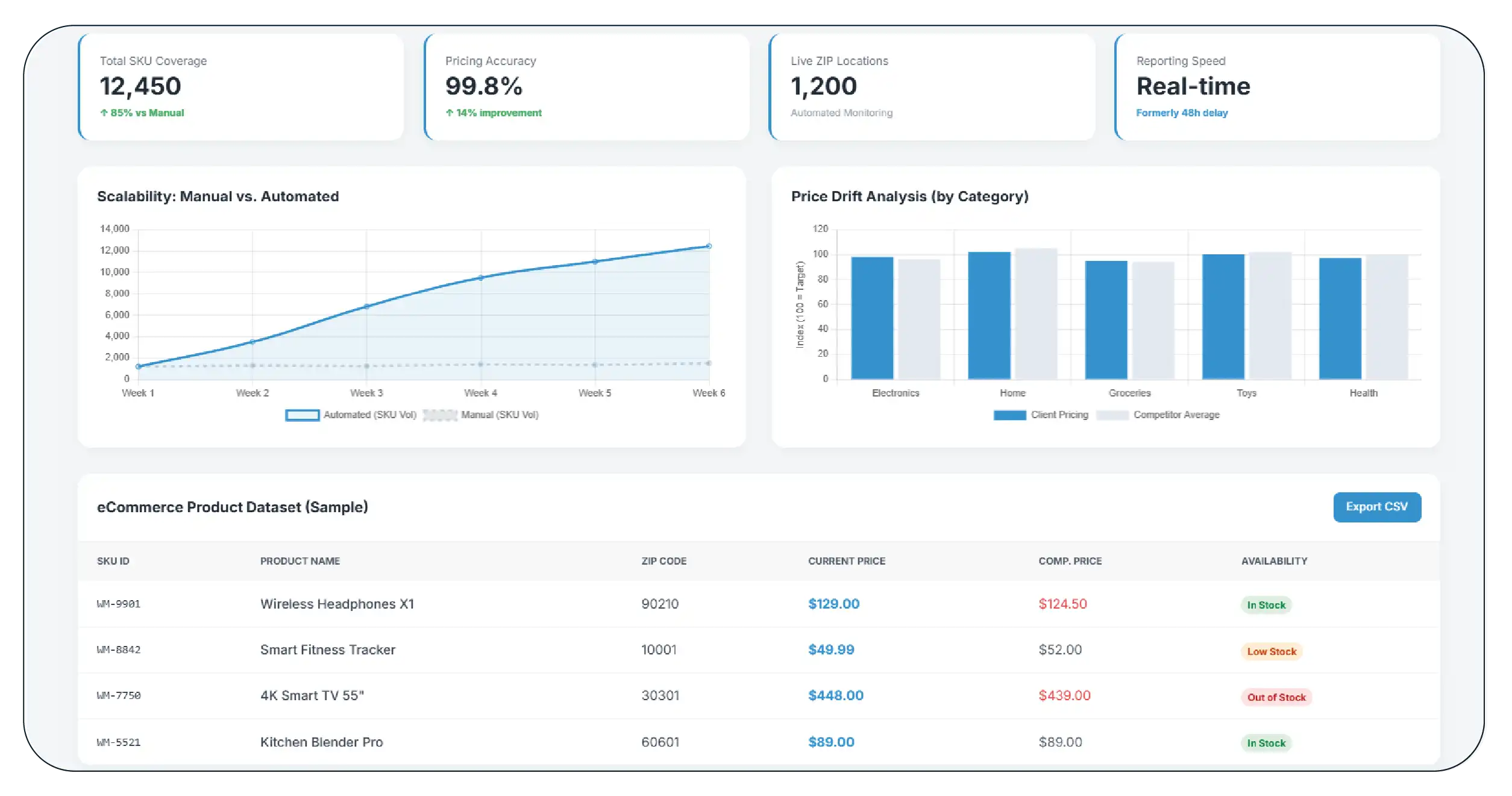
5,000+ SKUs tracked across multiple ZIP codes.
Stockout reduction by 25% within 3 months.
Pricing alignment improved by 20% across local stores.
Weekly automated inventory reporting reduced manual effort by 70%.
Real-time alerts for competitor activity using Walmart location-based competitive price analysis.
Results Narrative
The client gained immediate visibility into store-level inventory and competitor pricing. Automation reduced manual tracking, improved SKU coverage, and enabled faster decision-making. Inventory allocation became proactive, minimizing overstock and stockouts. Pricing strategies were optimized based on location-specific insights, improving local store performance. With dashboards displaying real-time data, teams could quickly respond to market trends and competitor promotions. The solution ensured operational efficiency, enhanced sales, and improved customer satisfaction across all stores.
What Made Product Data Scrape Different?
Our proprietary Walmart product scraping API by ZIP code enabled scalable, automated, and accurate data extraction. Unlike traditional manual methods, our solution provided real-time monitoring of stock and pricing at the ZIP code level. By combining automation, structured dashboards, and alerts, the client gained actionable insights across thousands of SKUs. This innovation ensured faster decision-making, higher accuracy, and consistent store-level performance, setting a new standard for local inventory optimization.
Client’s Testimonial
“Partnering with the team to Extract Walmart E-Commerce Product Data completely transformed how we manage store-level inventory. The automated system gave us real-time visibility into stock and pricing across ZIP codes. Our teams can now adjust inventory and pricing proactively, reducing stockouts and improving local sales. The dashboards are intuitive, and the alerts ensure we never miss critical updates. This solution has become central to our local inventory strategy, allowing us to stay competitive and efficient in a dynamic retail environment.”
— Head of Retail Operations, US Retail Brand
Conclusion
By leveraging Walmart E-commerce Product Dataset and Walmart Product Data Scraping by ZIP Code, the client transformed manual tracking into a real-time, automated system. Inventory allocation became precise, pricing strategies were aligned to local demand, and SKU-level insights drove faster, smarter decisions. The solution scaled across multiple stores and ZIP codes, enhancing operational efficiency and customer satisfaction. With structured data, dashboards, and automated alerts, the brand is now equipped for proactive inventory management, competitive pricing, and sustainable growth across the US retail market.
FAQs
1. What data was extracted?
Inventory levels, stock status, pricing, promotions, and competitor activity by ZIP code.
2. How often is the data updated?
Updates occur every 24 hours, with automated alerts for significant changes.
3. Can this track competitor pricing?
Yes, through Walmart location-based competitive price analysis across ZIP codes.
4. Which stores and ZIP codes are covered?
Coverage includes all client locations and prioritized ZIP codes across multiple regions.
5. Can this system scale?
Yes, the scraping and monitoring solution scales to track thousands of SKUs and multiple ZIP codes efficiently, maintaining data accuracy and operational efficiency.



 Singapore
 EMAIL
EMAIL
 PHONE
PHONE


.webp)
.webp "thumb")
.webp "thumb")
.webp "thumb")









.webp)