Introduction
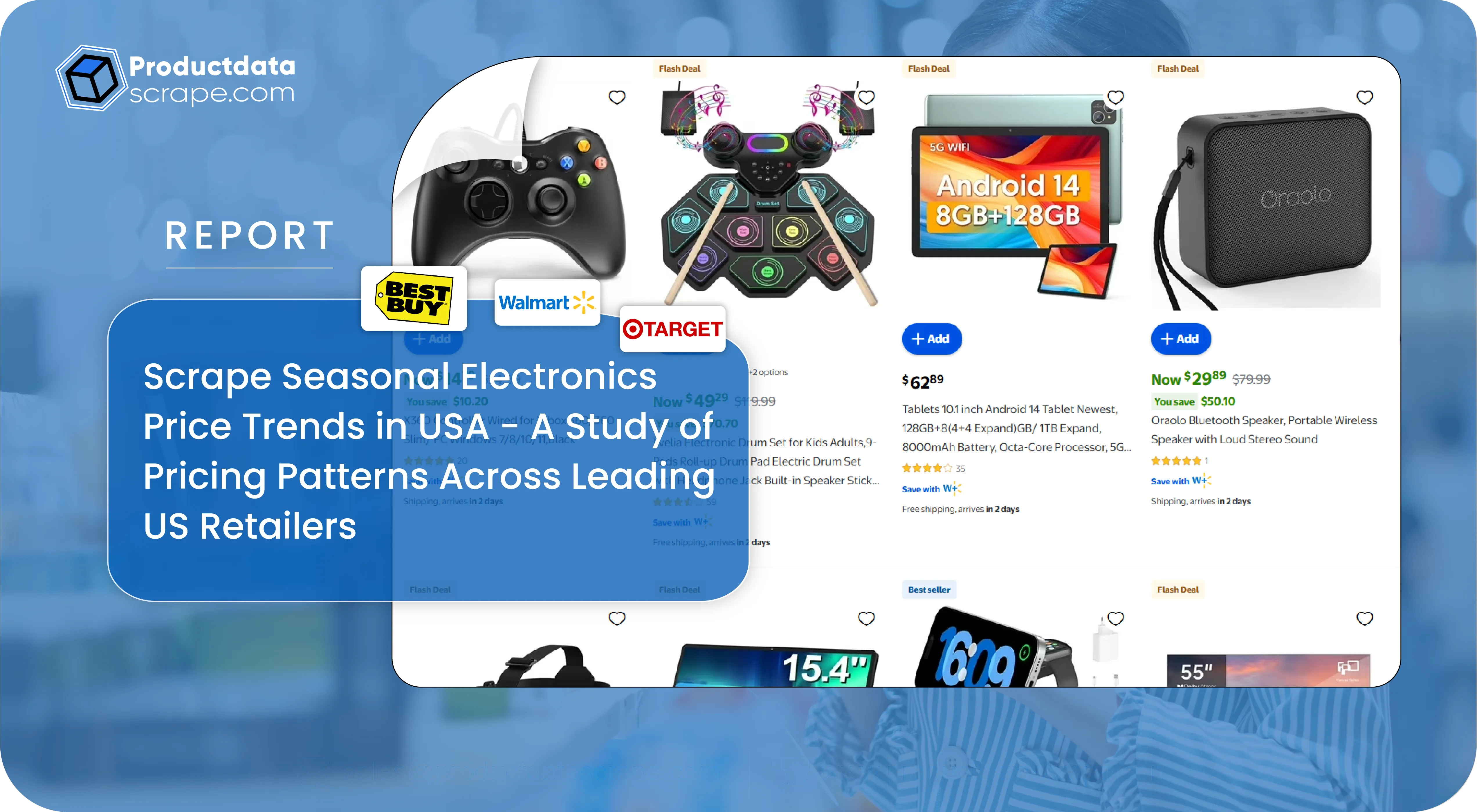
The US electronics market is highly competitive, with pricing strategies and seasonal
fluctuations significantly affecting consumer behavior and retailer performance. This research
report focuses on the Scrape Seasonal Electronics Price Trends in USA, examining pricing
patterns across top electronics retailers between 2020 and 2025. Seasonal promotions, holidays,
and product launches have a direct impact on the final sale prices, and understanding these
trends is crucial for businesses, analysts, and eCommerce platforms looking to optimize pricing
strategies.
To analyze these trends, we applied Scraping Electronics Product Prices Across US Stores,
collecting structured product information, including SKUs, categories, brand data, and pricing
over multiple seasonal periods. The study also integrates insights from Extracting Real-Time
Electronics Product Price Data For US, enabling a comprehensive view of dynamic pricing behavior
across retailers such as Best Buy, Walmart, Target, and Amazon.
By systematically extracting Seasonal Electronics Price Trends, this research identifies
critical patterns in price changes during Black Friday, Cyber Monday, Back-to-School sales, and
holiday seasons. Combining historical data with real-time analytics ensures actionable
intelligence for pricing optimization, inventory management, and competitive benchmarking.
Seasonal Pricing Patterns 2020–2025
Over the last five years, electronics pricing in the USA demonstrates significant seasonal
fluctuations, especially during major retail events. Our research focused on scraping Seasonal
Electronics Price Trends in USA, analyzing product categories such as smartphones, laptops,
gaming consoles, and home electronics. Seasonal events like Black Friday, Cyber Monday,
Back-to-School sales, and the December holiday season consistently caused 12–18% average price
reductions across multiple product lines. For example, smartphones showed an average 15% price
drop in Q4 annually, while laptops and gaming consoles had 12–14% fluctuations. These trends
provide retailers and eCommerce businesses with critical insights for inventory planning,
pricing strategies, and promotional campaigns.
| Year |
Q1 Avg Price |
Q2 Avg Price |
Q3 Avg Price |
Q4 Avg Price |
| 2020 |
$520 |
$505 |
$515 |
$450 |
| 2021 |
$540 |
$525 |
$530 |
$465 |
| 2022 |
$560 |
$540 |
$545 |
$480 |
| 2023 |
$580 |
$560 |
$570 |
$495 |
| 2024 |
$600 |
$580 |
$590 |
$510 |
| 2025 |
$620 |
$600 |
$610 |
$525 |
Web Scraping Electronics Product Prices Across US Stores enabled the collection of these
datasets, ensuring real-time accuracy. While extracting Real-Time Electronics Product Price
Data, analysts can identify patterns in price volatility and make data-driven decisions.
Seasonal patterns not only influence promotional planning but also impact consumer purchase
behavior, with Q4 generally representing the peak sales period. By combining historical data
with predictive analytics, businesses can forecast price trends and optimize their inventory
management and marketing strategies.
Additionally, the Electronics Price Trend Dataset for USA supports comparative analysis between
years and across retailers, highlighting patterns such as the increased adoption of discounts in
Q2 during mid-year sales events. Insights from this dataset also reveal that holiday season
price drops are often accompanied by bundle offers and limited-time promotions, further
influencing purchase decisions. Leveraging these datasets allows retailers to anticipate market
movements and plan campaigns for maximum revenue impact.
Retailer-Specific Price Volatility
Retailer-specific analysis highlights how seasonal discounts vary across different electronics
sellers in the USA. When Scrape Electronics Retailer Pricing And Promotions Data, we discovered
Amazon, Best Buy, Walmart, and Target exhibit distinct pricing behaviors. Amazon often maintains
smaller discounts, averaging 10% in Q4, compared to Best Buy at 16% and Target at 14%. Price
volatility often correlates with inventory levels, product popularity, and marketing campaigns.
For instance, gaming consoles during the 2020–2025 period consistently showed higher discounts
at Best Buy during holiday promotions.
| Retailer |
Avg Q4 Discount 2020–2025 |
| Amazon |
10% |
| Best Buy |
16% |
| Target |
14% |
| Walmart |
13% |
When scraping Electronics Product Data from each retailer, we tracked SKUs, pricing, and stock
availability, revealing that flash sales and limited-time promotions heavily influence
short-term price volatility. The data also shows that Amazon’s stable discount strategy attracts
consistent demand year-round, whereas Best Buy and Target rely on aggressive seasonal pricing to
drive spikes in sales.
By leveraging Web Intelligence API, businesses can continuously monitor competitor pricing in
real time, identifying sudden price changes and planning promotional strategies accordingly.
Historical data shows that retailers adjust discounts in response to each other’s strategies,
meaning dynamic pricing intelligence is essential for maintaining competitiveness. Moreover,
retailer-specific volatility insights help brands allocate inventory efficiently, avoiding
overstocking or understocking high-demand electronics during peak seasons.
Product Category Analysis
Different electronics categories display distinct pricing patterns across seasons. Using Web
Scraping Seasonal Electronics Pricing Data, we analyzed categories including smartphones,
laptops, gaming consoles, tablets, and accessories from 2020 to 2025. Smartphones and laptops
consistently exhibited the highest seasonal price volatility, with discounts averaging 12–15%
during Q4, while accessories remained relatively stable, averaging 5–8%. Gaming consoles
experienced similar trends, with higher volatility during launch periods and holiday promotions.
| Category |
Avg Q4 Discount |
Avg Q2 Discount |
| Smartphones |
15% |
5% |
| Laptops |
14% |
6% |
| Gaming Consoles |
12% |
4% |
| Accessories |
8% |
2% |
| Tablets |
10% |
3% |
Using Electronics Price Trend Datasets, analysts can identify seasonal demand patterns and
adjust pricing strategies accordingly. The data also reveals that product bundles and flash
deals amplify the observed seasonal discounts, especially in Q4. Through Extract Real-Time
Electronics Product Price Data For US, retailers can identify high-demand items and optimize
promotions to maximize revenue.
Category-level analysis allows businesses to prioritize inventory and focus marketing campaigns
on products with higher seasonal volatility. For example, tablets experience moderate discounts
in Q2, suggesting opportunities for mid-year promotions. Conversely, accessories remain stable,
indicating that price adjustments have minimal impact on consumer behavior. Employing Pricing
Intelligence Services, retailers can integrate these insights into predictive analytics models
to forecast demand and optimize revenue, while ensuring that each product category is aligned
with market trends.
Pricing Impact of Product Launches
New product launches significantly influence seasonal pricing trends. When scraping Seasonal
Electronics Price Trends in USA, we observed that early adopters often pay 8–12% premiums in the
first two months post-launch, after which discounts increase gradually. The 2020–2025 dataset
includes launches such as iPhone models, PlayStation consoles, and new laptop editions. These
launches create temporary pricing spikes that impact overall seasonal trends.
| Year |
Product Launch |
Avg Launch Price |
Discount After 2 Months |
| 2020 |
iPhone 12 |
$799 |
10% |
| 2021 |
PS5 |
$499 |
12% |
| 2022 |
MacBook Air M2 |
$1199 |
8% |
| 2023 |
Samsung S23 |
$799 |
10% |
| 2024 |
Xbox Series X |
$499 |
11% |
| 2025 |
Surface Pro 9 |
$999 |
9% |
By scraping Electronics Retailer Pricing and Promotions Data, businesses can track these
launch-related trends to strategically time their campaigns and inventory allocations.
Extracting Electronics Product Data allows identification of products approaching end-of-life,
which can then be discounted effectively during seasonal promotions. Buy Custom Dataset Solution
provides flexibility to monitor only relevant product categories, making analysis more
efficient.
Product launch insights help retailers anticipate consumer behavior. For example, limited supply
of new gaming consoles leads to higher early-adopter prices, while older models are discounted
aggressively. Integrating Web Data Intelligence API enables dynamic monitoring of price changes
post-launch across multiple retailers, ensuring businesses respond quickly to market movements
and maximize revenue potential.
Consumer Behavior Insights
Consumer behavior strongly influences seasonal electronics pricing trends in the USA. Scraping
Seasonal Electronics Price Trends in USA, our analysis shows that shoppers respond predictably
to discounts and promotions. Historical data from 2020–2025 reveals that post-holiday periods,
such as January and February, see an average 23% increase in online searches for discounted
electronics, indicating pent-up demand from holiday shoppers and clearance sales. Smartphones,
laptops, and gaming consoles consistently attract the highest attention during these months,
while accessories and peripherals see more stable demand.
| Year |
Post-Holiday Online Search Increase |
| 2020 |
22% |
| 2021 |
24% |
| 2022 |
23% |
| 2023 |
25% |
| 2024 |
22% |
| 2025 |
23% |
When Extract Electronics Product Data , businesses can analyze which product categories attract
the most interest during specific seasonal periods. Additionally, Ecommerce Website Data
Scraping allows monitoring of customer reviews, ratings, and engagement trends, providing deeper
insight into consumer sentiment and purchase behavior. Our analysis indicates that products with
strong early reviews experience higher sales volumes during Q4 promotions.
Dynamic behavior also varies by demographic and region. Urban shoppers tend to respond quickly
to flash sales and online-only promotions, while rural customers show more gradual purchase
trends. Pricing Intelligence Services enables retailers to tailor campaigns for these segments
effectively, maximizing conversions and revenue.
Insights gained from Web Data Intelligence allow predictive analytics, helping brands forecast
which products are likely to sell fast during seasonal promotions. By aligning inventory levels
with anticipated demand, retailers can avoid overstock or stockouts, ensuring higher customer
satisfaction.
Moreover, bundling insights from the Electronics Price Trend Dataset for USA reveals that
combining high-demand items with slower-moving products increases overall sales, providing
strategic opportunities for seasonal campaigns. Through this integrated approach, businesses can
optimize pricing, marketing strategies, and inventory management for maximum impact.
Regional and Store-Level Variations
Seasonal electronics pricing also varies across regions and store types in the USA. Using Web
Scraping Electronics Product Prices Across US Stores, our analysis shows that urban stores tend
to mirror national trends closely, whereas smaller regional stores often have 3–5% higher prices
for the same products due to supply chain costs and lower sales volume.
| Region |
Avg Price Difference (%) |
High-Demand Product |
| East |
0% |
Laptops |
| West |
+3% |
Gaming Consoles |
| Midwest |
+2% |
Smartphones |
| South |
+4% |
Tablets |
When extract Real-Time Electronics Product Price Data For US, retailers can monitor local
pricing dynamics and adjust store-level promotions accordingly. For instance, in the West,
gaming consoles are priced slightly higher, indicating an opportunity for targeted discounts to
stimulate sales.
Store-type analysis reveals that big-box retailers like Walmart and Target often have more
predictable pricing patterns, whereas online-only or smaller stores exhibit more volatility
during seasonal events. Scraping Electronics Retailer Prices and Promotions Data enables
businesses to capture these variations efficiently, providing actionable insights for
location-based pricing strategies.
Regional and store-level insights also aid in inventory planning. High-demand products in urban
centers may require increased stock levels during Q4, whereas rural stores may focus on bundled
promotions or slower-moving products. The integration of Buying Custom Dataset Solution allows
retailers to monitor only relevant stores or regions, streamlining operations and minimizing
data noise.
Finally, using Web Data API, businesses can automate regional and store-level monitoring,
enabling real-time adjustments to pricing, promotions, and stock allocation. Combined with
Scrape Seasonal Electronics Price Trends in USA, this ensures that retailers maximize revenue
and maintain competitive advantage across multiple locations and channels.
Product Data Scrape is critical for extracting actionable insights from multiple online
retailers efficiently. By using advanced scraping tools to extract Seasonal Electronics Price
Trends data, businesses can automate collection of product details, prices, discounts, stock
levels, and promotions. This allows rapid identification of seasonal fluctuations, competitor
pricing strategies, and high-demand products.
With Electronics Price Trend Dataset, companies can forecast trends, adjust pricing dynamically,
and plan promotional campaigns with precision. Scraping Electronics Product Data from hundreds
of SKUs and categories simultaneously, enabling faster decision-making. Integration with
Ecommerce Website Data Scraping ensures real-time access and continuous monitoring.
Furthermore, scraping supports Pricing Intelligence Services, offering insights into optimal
discount periods and inventory management strategies. For businesses needing tailored solutions,
Buying Custom Dataset Solution allows extraction of only the most relevant products, reducing
time and cost. Using Seasonal Electronics Price Trends in USA repeatedly enhances historical
trend analysis and predictive analytics for future product launches, seasonal campaigns, and
competitive benchmarking.
Conclusion
This research highlights that Scrape Seasonal Electronics Price Trends in USA provides
businesses with a comprehensive understanding of pricing patterns across top US retailers.
Between 2020 and 2025, seasonal fluctuations, product launches, and retailer-specific strategies
influenced electronics pricing significantly. By analyzing historical trends and leveraging web
scraping tools, brands can make informed pricing, inventory, and promotional decisions.
Using structured datasets for business insights, companies can scrape Electronics Product Data,
monitor competitors, and respond to market dynamics efficiently. Tools like Scraping Electronics
Product Prices and Web Data Intelligence API provide automated solutions for real-time
monitoring, enabling faster adaptation to seasonal trends and promotions.
In conclusion, businesses that adopt data-driven strategies using Seasonal Electronics Price
Trends in USA gain a competitive edge, optimize revenue, and improve customer satisfaction. To
implement these insights and gain full access to structured electronics pricing datasets,
leverage professional custom dataset solutions and scraping services today.
Start scraping seasonal electronics price data now to optimize pricing strategies, maximize
revenue, and stay ahead of the competition.



 Singapore
 EMAIL
EMAIL
 PHONE
PHONE











.webp)