Executive Summary
The home decor industry is no longer just about furniture and color palettes — it's about anticipating consumer aesthetics before they go mainstream. In 2026, with home décor e-commerce expected to exceed $370 billion globally, brands and retailers are racing to identify emerging styles, viral product types, and pricing sweet spots faster than their competitors. The ability to scrape Etsy Houzz Pinterest decor emerging trends has become a strategic capability — not a nice-to-have.
A leading mid-size home and living retailer (referenced as "ClientCo" for confidentiality) approached Product Data Scrape with a clear challenge: their merchandising team was relying on month-old trend reports while competitors were launching products based on real-time signals from Etsy, Houzz, and Pinterest. They needed Etsy, Houzz & Pinterest Scraping for Home Decor Trend Intelligence that could deliver insights in days, not quarters.
This case study walks through how our team designed and deployed a multi-platform scraping infrastructure that pulled actionable trend signals from three of the most influential home decor discovery platforms — and helped ClientCo reduce trend-to-shelf time by 62%, increase new SKU success rate by 3.4x, and grow category revenue by 41% within nine months. Along the way, we leveraged our broader capabilities in Pricing Intelligence Services, Web Scraping API Services, and Ecommerce Website Data Scraping to deliver an integrated solution.
The Client Challenge
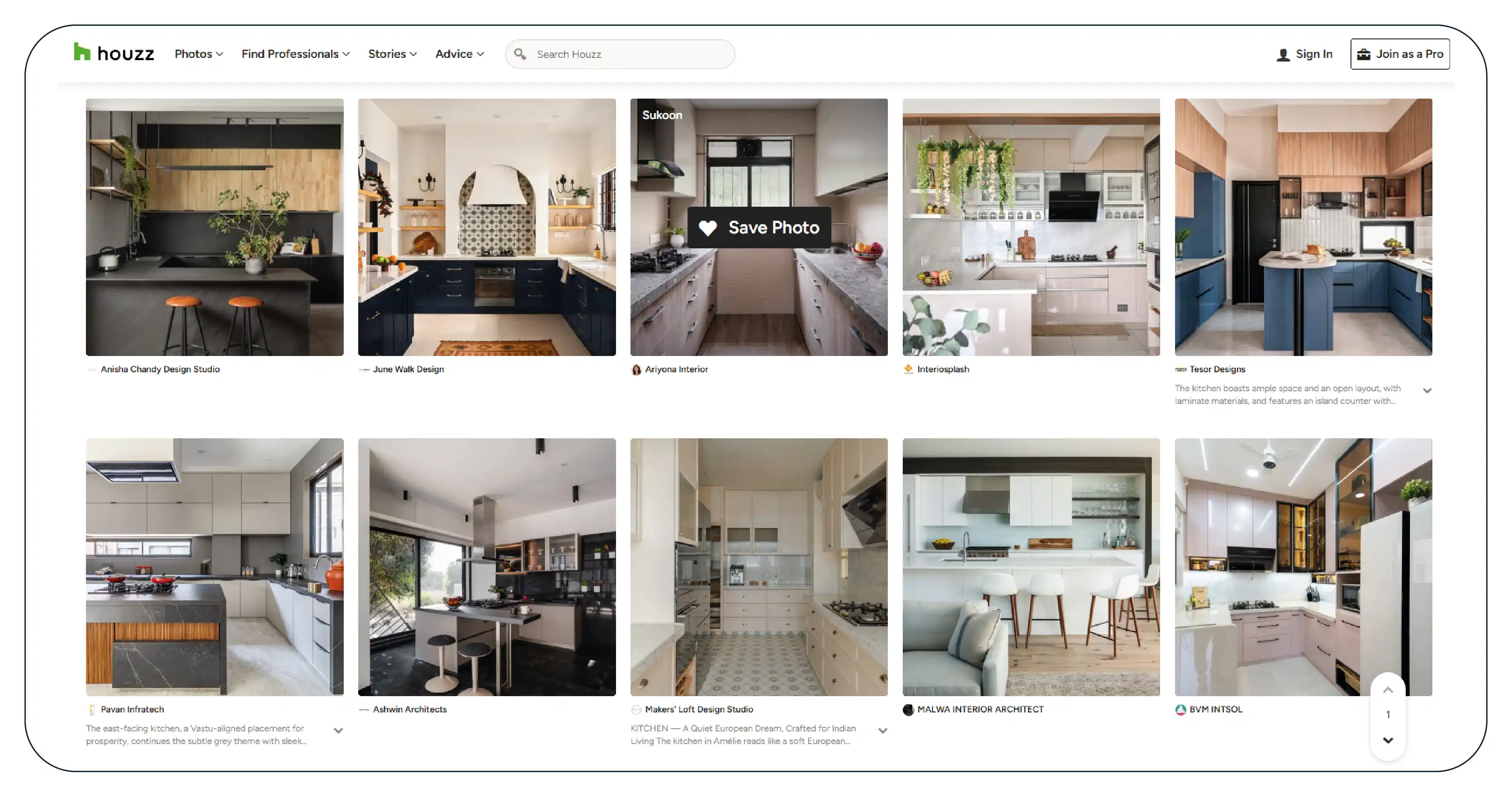
ClientCo operates across the United States, United Kingdom, and select European markets, selling mid-premium home decor — wall art, candles, ceramics, lighting, and small furniture. Despite a strong brand and loyal customer base, they faced four interconnected problems that traditional Extract Furniture & Home Decor Website Data approaches could not solve.
1. Trend Lag
By the time their buying team identified a trend through industry reports, conventions, or distributor catalogs, the trend was already saturated on Etsy and going viral on Pinterest. They were arriving 8 to 14 weeks late. Without the ability to scrape Pinterest emerging home decor trends in real time, they were perpetually responding to a market that had already moved on.
2. Pricing Blind Spots
Competitor pricing intelligence was limited to direct competitor websites. Etsy independent sellers — who often pioneer pricing strategies for emerging product categories — were completely outside their visibility. Without proper systems to scrape Etsy home decor demand trends data, they had no view into the indie-to-mainstream pricing arc that defines this category.
3. Visual Signal Loss
Pinterest is fundamentally a visual platform, and traditional text-based market research tools were missing critical cues about color palettes, material combinations, and styling motifs that drive consumer demand. ClientCo needed a partner who could combine Pinterest scraping services with computer vision to extract the visual DNA of emerging trends.
4. Houzz Project Gap
Houzz is the dominant platform for renovation and decor inspiration, particularly for higher-ticket items. ClientCo had no systematic way to scrape Houzz home decor product data trends, missing critical signals from product mentions, room-style associations, and professional designer recommendations across Houzz project boards.
The merchandising and category management teams needed a single source of truth that combined product-level data, visual trend signals, and pricing benchmarks across all three platforms. They needed to scrape emerging home decor for business data in a way that was actionable, fast, and reliable.
Why Etsy, Houzz, and Pinterest?
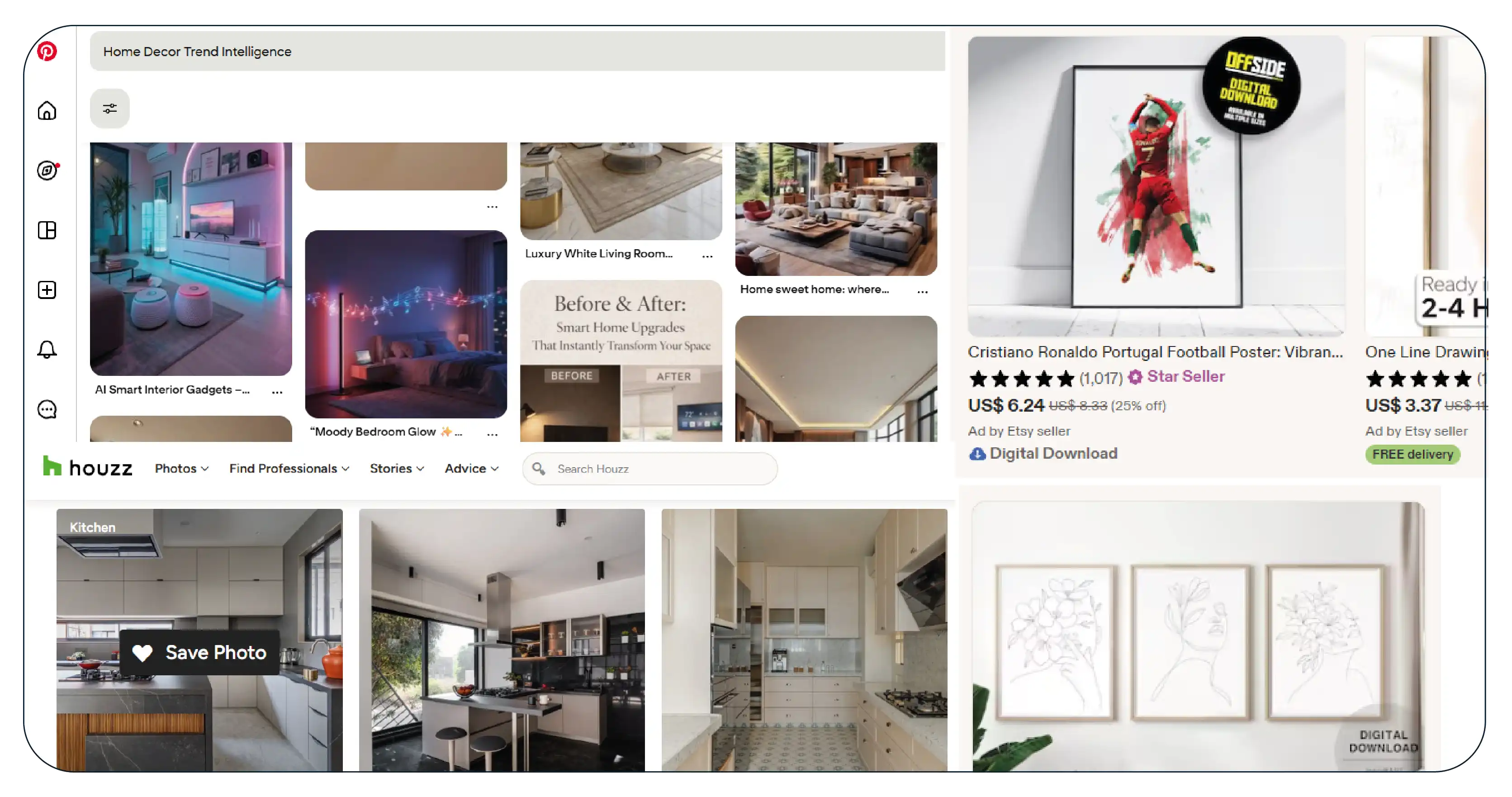
These three platforms represent distinct but complementary slices of the home decor consumer journey. Together they form a complete trend lifecycle: discovery (Pinterest) → validation (Etsy) → conversion (Houzz). Our solution captured signals at each stage.
Pinterest: The Trend Incubator
With over 500 million monthly active users in 2026 — a majority of whom use the platform specifically for home and design inspiration — Pinterest is where aesthetic movements gain critical mass. Pin saves, board categorizations, and search trends offer 6-month forward indicators. Our ability to scrape Pinterest emerging home decor trends gave ClientCo a 5-to-7-week lead time over competitors.
Etsy: The Validation Layer
Etsy is the early-warning system for category-level demand. Independent sellers test new aesthetics, materials, and product types here long before they appear in big-box retailers. Bestseller velocity, favorites count, and reviews provide validated demand signals. By integrating Extract Etsy Furniture & Home Decor Data into our pipeline, we delivered the demand-validation layer that turns trend signals into confident product investments.
Houzz: The Conversion Stage
Houzz captures committed-buyer intent. Users browsing Houzz are typically in active renovation or significant decor purchase mode. Project galleries, professional recommendations, and product tags reveal what designers and high-intent buyers are actually selecting. Our Comprehensive Houzz Product Extraction methodology focused on extracting these high-intent signals at scale.
Our Solution Architecture
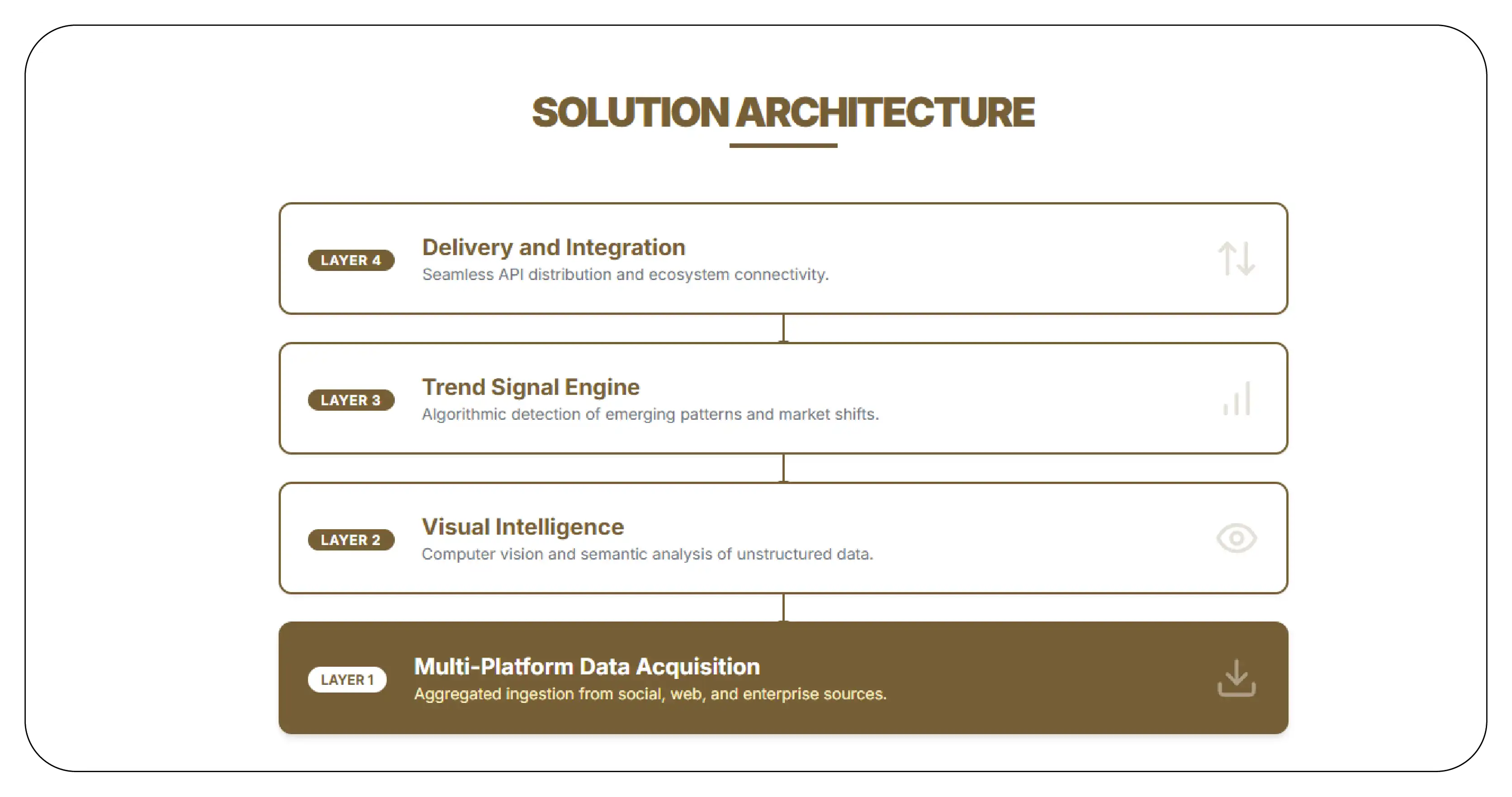
Our team designed a four-layer intelligence pipeline tailored to ClientCo's merchandising workflow. The architecture was built around the core requirement: real time home decor trend tracking for Etsy, Houzz & Pinterest, delivered through scalable infrastructure with production-grade SLAs.
- Layer 1: Multi-Platform Data Acquisition
We deployed parallel scraping infrastructures for each platform, with platform-specific strategies built on top of our broader Ecommerce Website Data Scraping capabilities.
Etsy Scraping Infrastructure
Our Etsy data scraping infrastructure crawled product listings across 47 home decor sub-categories, capturing title, price, sale price, materials, processing time, shop location, favorites count, review count, average rating, image URLs, listing creation date, and bestseller flags. The crawl ran every 6 hours for trending categories and every 24 hours for stable categories, processing approximately 2.8 million listings per refresh cycle. This enabled true real-time visibility into Etsy home decor demand trends data.
Houzz Scraping Module
Our Houzz data scraping module focused on three high-value data structures: product listings with seller and pricing data, project pages with embedded product tags, and professional ideabooks. We extracted room style classifications (modern farmhouse, Japandi, transitional, mid-century, etc.), product co-occurrence patterns, and designer endorsements. Approximately 850,000 product entries and 320,000 project pages were monitored continuously to scrape Houzz home decor product data trends in detail.
Pinterest Scraping Pipeline
Our Pinterest scraping services captured pin metadata across home decor boards: pin save counts, board topics, related pins, image hashes for visual similarity grouping, and trending search terms. We tracked 3,400+ home decor seed boards and discovered emerging boards through follow-graph traversal. About 4.6 million pins were processed weekly to surface Emerging Home Decor Trend Intelligence before it appeared in any other source.
- Layer 2: Visual Intelligence
Text data alone misses 60% of home decor signals. We integrated computer vision processing into the pipeline to capture what words cannot.
- Color palette extraction: Every product image was analyzed for dominant color clusters using k-means quantization in LAB color space, producing standardized color signatures comparable across platforms.
- Material recognition: A custom-trained classifier identified primary materials (rattan, terracotta, brass, linen, oak, etc.) across 38 material classes with 91% accuracy.
- Style classification: Images were tagged with one or more of 24 design styles using a fine-tuned vision transformer.
- Visual similarity clustering: Perceptual hashing (pHash) grouped near-duplicate products across platforms, enabling cross-platform price comparison even when textual descriptions differed.
- Layer 3: Trend Signal Engine
Raw product data became trend intelligence through a velocity-and-anomaly detection engine — the heart of our Emerging Home Decor Trend Intelligence offering.
- Velocity Score: A weighted metric combining favorites/saves growth rate, review velocity, and search interest growth, calculated daily for every product cluster.
- Cross-Platform Correlation: Products gaining traction on Pinterest were flagged 4 to 7 weeks before they trended on Etsy, providing early-warning lead time.
- Style Convergence Tracking: When multiple platforms began surfacing the same style elements (e.g., "warm minimalism," "biophilic maximalism"), the engine elevated those signals to the merchandising team.
- Anomaly Detection: Sudden spikes in specific product types — like the 2026 surge in mushroom-shaped lighting or fluted glass vases — were caught within 48 hours of inflection.
- Layer 4: Delivery and Integration
The final intelligence was delivered to ClientCo through three channels, all powered by our Web Scraping API Services:
- A real-time dashboard with filterable trend cards, pricing benchmarks, and visual examples.
- A daily CSV/JSON feed pushed to ClientCo's internal merchandising platform via API.
- Weekly executive briefings highlighting the top 10 emerging trends with confidence scores and recommended actions.
Sample Data: What the Pipeline Actually Produced
To make this concrete, here are representative samples of the data our pipeline delivered. All numbers are illustrative but representative of real outputs from the engagement.
Sample 1: Etsy Trending Product Record
{
  "platform": "etsy",
  "listing_id": "ETSY_1456778921",
  "title": "Handcrafted Fluted Glass Bud Vase, Ribbed, Amber",
  "shop_name": "NorthernGroveStudio",
  "shop_location": "Portland, OR, USA",
  "category_path": "Home & Living > Home Décor > Vases",
  "price_usd": 42.00,
  "sale_price_usd": 34.00,
  "primary_material": "glass",
  "favorites_count": 3847,
  "favorites_growth_7d_pct": 218,
  "review_count": 412,
  "average_rating": 4.91,
  "bestseller_flag": true,
  "image_palette_lab": ["#C58B3A", "#8E5E1F", "#F2E1B3"],
  "detected_style_tags": ["warm_minimalism", "japandi"],
  "velocity_score": 87.4,
  "captured_at": "2026-04-14T03:12:00Z"
}
Sample 2: Houzz Product-Project Linkage
{
  "platform": "houzz",
  "product_id": "HZ_PROD_88412",
  "product_name": "Rattan Pendant Light - Dome 18 inch",
  "price_usd": 189.00,
  "appearances_in_projects_30d": 47,
  "associated_room_styles": [
    {"style": "modern_coastal", "weight": 0.42},
    {"style": "japandi", "weight": 0.31},
    {"style": "warm_minimalism", "weight": 0.27}
  ],
  "co_occurring_products": [
    "linen_curtains_natural",
    "white_oak_dining_table",
    "terracotta_planters"
  ],
  "professional_endorsements": 12,
  "geographic_concentration": ["California", "Florida", "QLD"],
  "captured_at": "2026-04-14T04:00:00Z"
}
Sample 3: Pinterest Trend Signal
{
  "platform": "pinterest",
  "trend_cluster_id": "PIN_CLUSTER_2026_04_0117",
  "trend_label": "Mushroom Lighting (Murano-style)",
  "representative_keywords": [
    "mushroom lamp", "murano mushroom light",
    "vintage mushroom table lamp", "70s mushroom lamp"
  ],
  "weekly_pin_volume": 184722,
  "weekly_save_growth_pct": 412,
  "geographic_signals": ["US", "UK", "AU", "DE"],
  "predicted_etsy_emergence_weeks": 5,
  "confidence_score": 0.89,
  "first_detected": "2026-03-22",
  "captured_at": "2026-04-14T05:30:00Z"
}
Sample 4: Cross-Platform Pricing Benchmark
One of the highest-value outputs of the engagement was the cross-platform pricing intelligence — exactly the kind of insight that traditional Pricing Intelligence Services cannot deliver without specialized scraping infrastructure.
| Product Cluster |
Etsy Median |
Houzz Median |
Mainstream Retailer |
Sweet Spot |
| Fluted Glass Bud Vase |
$38.50 |
$52.00 |
$24.00 |
$32 – $36 |
| Rattan Dome Pendant 18" |
$145.00 |
$189.00 |
$89.00 |
$119 – $135 |
| Japandi Floor Lamp |
$215.00 |
$289.00 |
$159.00 |
$185 – $210 |
| Mushroom Table Lamp |
$98.00 |
$134.00 |
(no listings) |
$79 – $95 |
| Terracotta Planter Set |
$65.00 |
$82.00 |
$45.00 |
$54 – $62 |
This pricing intelligence gave ClientCo's merchandising team the ability to position products precisely between independent-seller premium and mainstream-retailer accessibility — a sweet spot that historically delivered the highest unit margins.
Implementation Timeline
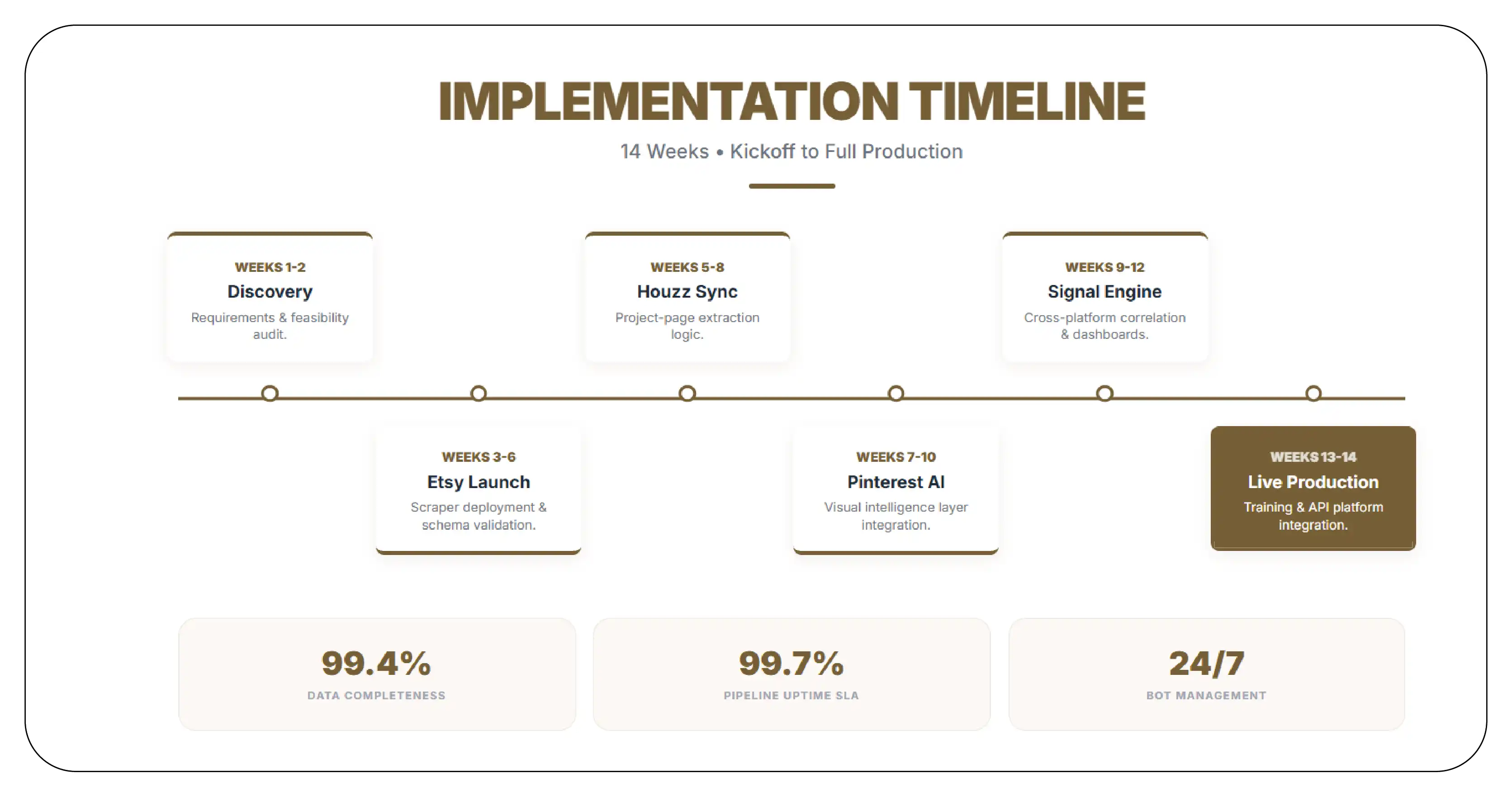
The engagement unfolded over 14 weeks from kickoff to full production, leveraging our existing infrastructure for Ecommerce Website Data Scraping:
- Weeks 1–2: Discovery, requirements, and platform-by-platform feasibility audit.
- Weeks 3–6: Etsy scraper deployment, schema validation, first delivery.
- Weeks 5–8: Houzz scraper deployment with project-page extraction.
- Weeks 7–10: Pinterest scraper with visual intelligence layer.
- Weeks 9–12: Trend signal engine, cross-platform correlation, dashboard build.
- Weeks 13–14: Stakeholder training, integration with ClientCo's merchandising platform via Web Scraping API Services.
Throughout the build, our team maintained 99.4% data completeness and a 99.7% pipeline uptime SLA. Anti-bot challenges across all three platforms were handled via rotating proxy infrastructure, request fingerprint randomization, and adaptive crawl pacing.
Results: 9-Month Business Impact
After nine months of Real Time Home Decor Trend Tracking for Etsy, Houzz & Pinterest, the impact on ClientCo's business was substantial and measurable across multiple dimensions.
| Metric |
Result |
Detail |
| Trend-to-Shelf Time |
−62% |
11 weeks → 4.2 weeks average |
| New SKU Success Rate |
3.4× |
22% → 75% hit Q1 sales target |
| Category Revenue Growth |
+41% |
Up from 8% YoY baseline |
| End-of-Season Markdowns |
−34% |
Better trend-aligned buying |
| Average Unit Retail (AUR) |
+6.8% |
From cross-platform pricing benchmarks |
| Trends Actioned |
42 |
31 (74%) outperformed baseline |
Why Product Data Scrape
Several capabilities differentiated our team from generic scraping vendors and made this engagement possible. Beyond technical execution, our deep portfolio of services in Pricing Intelligence Services, Web Scraping API Services, and broad Ecommerce Website Data Scraping gave ClientCo a partner — not just a vendor.
- Platform-specific expertise. Each of Etsy, Houzz, and Pinterest has unique technical structures, anti-bot defenses, and data idiosyncrasies. Our team has deep, current expertise on all three — not just generic scraping infrastructure.
- Visual intelligence integration. Most scraping providers stop at HTML extraction. Our pipeline includes computer vision, color analysis, and style classification as native capabilities — essential for home decor where 60% of signal is visual.
- Trend engineering, not just data delivery. The raw data is necessary but not sufficient. Our trend signal engine — velocity scoring, cross-platform correlation, anomaly detection — turns terabytes of raw product data into a small number of actionable insights.
- Compliance and ethics. All scraping was performed against publicly accessible data, respected robots directives where legally appropriate, and avoided collection of personally identifiable information.
- Production-grade SLAs. 99.7% uptime, 99.4% data completeness, defined latency targets, and dedicated technical support meant the data pipeline was a dependable system, not a fragile experiment.
Lessons Learned
The engagement surfaced several insights that apply broadly to any home decor brand or retailer considering similar intelligence infrastructure to Extract Furniture & Home Decor Website Data at scale.
- Visual data is not optional. Home decor is fundamentally aesthetic. Any trend pipeline that ignores image-derived signals will miss the majority of meaningful patterns.
- Cross-platform correlation beats single-platform monitoring. No single platform tells the full story. Pinterest leads, Etsy validates, Houzz monetizes. The interaction between them is where the highest-confidence signals emerge.
- Speed compounds. Each week of trend lead time compounds in shelf positioning, content creation, and marketing campaign timing. A 5-week lead becomes a 12-week revenue advantage when the full merchandising stack lines up.
- Pricing intelligence is undervalued. Most retailers focus on competitor websites and miss independent-seller pricing data. The Etsy ecosystem, in particular, contains pricing signals invaluable for premium positioning.
- Trend lifecycle thinking. A trend isn’t a single number — it’s a curve with discovery, validation, growth, peak, and decline phases. Our engine tracks where each trend sits in its lifecycle, helping merchandising teams enter at the right phase.
Conclusion
In home decor, the difference between trend leaders and trend followers comes down to one capability: how fast you can see what's emerging. Without real-time Emerging Home Decor Trend Intelligence across Etsy, Houzz, and Pinterest, brands miss the early-warning signals that determine seasonal success.
The ClientCo engagement proves the value of being able to scrape Etsy Houzz Pinterest decor emerging trends at scale: 62% faster trend-to-shelf time, 3.4× SKU success rate, +41% category revenue, and +6.8% AUR. The capability to scrape emerging home decor for business data transformed ClientCo from reactive to predictive — buying ahead of the market instead of chasing it.
In 2026, aesthetic-driven retail is won by the brands that move first. Product Data Scrape is ready to partner with home decor brands, furniture retailers, and merchandising teams to build trend intelligence systems combining Pricing Intelligence Services, Web Scraping API Services, and Ecommerce Website Data Scraping into one integrated platform.
FAQs
1. How early can you detect an emerging home decor trend?
Pinterest signals typically surface trends 4–7 weeks before they appear in Etsy bestseller data and 6+ months before mainstream retailer catalogs. Our cross-platform correlation engine flags high-confidence trends with measurable lead time over competitors.
2. Why scrape Etsy, Houzz, and Pinterest together?
Each platform captures a different stage of the trend lifecycle: Pinterest discovers, Etsy validates, Houzz converts. Single-platform monitoring misses the cross-platform correlations that produce the highest-confidence signals. To scrape Etsy home decor demand trends data in isolation gives you only one piece of the puzzle.
3. Is scraping these platforms legal?
Yes. We extract only publicly accessible data, never collect personal information, and respect robots directives. Our methodology aligns with established legal precedent on public web scraping in the United States and major jurisdictions.
4. How do you handle visual signals like color and style?
Our pipeline integrates computer vision natively — color palette extraction in LAB color space, material classification across 38 classes (91% accuracy), and style tagging across 24 design styles. This is essential for home decor where 60% of meaningful signal is visual, not textual.
5. Can you monitor competitors and emerging brands?
Yes. Our infrastructure tracks both your own SKUs and any defined competitor or independent-seller set. The ability to scrape Pinterest emerging home decor trends across the broader ecosystem is one of the highest-ROI components of our service.
6. What home decor categories do you cover?
Full home decor and furniture taxonomy — wall art, lighting, ceramics, vases, candles, rugs, mirrors, mattresses, sectionals, dining furniture, outdoor pieces, and seasonal collections. We can also Extract Furniture & Home Decor Website Data from adjacent retailers like Wayfair, Anthropologie, West Elm, CB2, and IKEA.
7. How is pricing structured?
Engagements scale by platform coverage, refresh frequency, and visual intelligence depth. Most home decor brand engagements fall in the mid-five to low-six figures annually, with ROI typically demonstrated within 90 days through trend-driven product launches.
8. How long does deployment take?
Full deployment runs 12–14 weeks. Accelerated 6-week pilots are available for brands needing faster time-to-value with single-platform trend monitoring.
9. Self-serve API or managed service?
Both. Our Web Scraping API Services offer direct integration for technical teams. Fully managed engagements include trend dashboards, weekly executive briefings, and dedicated support.
10. Can this combine with pricing and digital shelf monitoring?
Absolutely. Our Pricing Intelligence Services and digital shelf analytics platforms unify trend signals with pricing benchmarks, content quality, and search rank into one view — giving merchandising teams everything needed to enter trends at the right price and position.



 Singapore
 EMAIL
EMAIL
 PHONE
PHONE


.webp)
.webp "thumb")
.webp "thumb")
.webp "thumb")








.webp)