Introduction
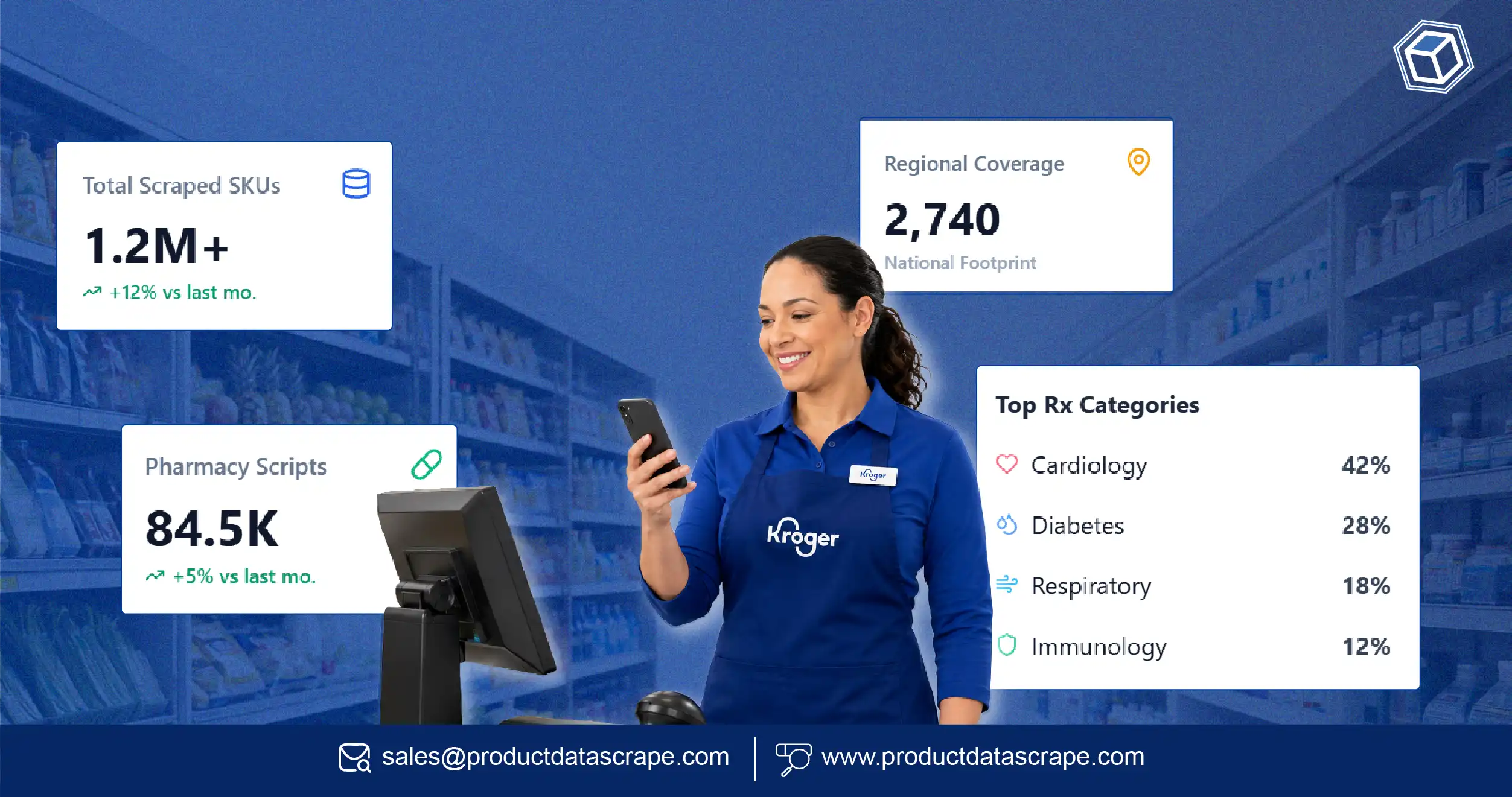
Retailers and healthcare businesses use Kroger Grocery & Pharmacy Data Scraping to track pricing, monitor inventory, analyze customer behavior, and improve market forecasting in 2026. These insights help brands optimize pricing strategies, improve product visibility, and enhance customer engagement across grocery and pharmacy categories.
According to industry estimates, over 78% of retail brands now rely on automated ecommerce analytics for competitive monitoring and inventory planning. Businesses also use Extract Kroger Grocery & Gourmet Food Data solutions to analyze grocery trends, pharmacy demand, and wellness product performance more efficiently.
This blog is designed for ecommerce retailers, healthcare analytics providers, grocery brands, and market research companies seeking scalable retail intelligence solutions. The biggest challenge for these businesses is maintaining accurate pricing visibility, stock availability tracking, and digital shelf optimization in a highly competitive online marketplace.
How Are Grocery and Pharmacy Datasets Reshaping Retail Analytics?
.webp)
Retailers increasingly depend on structured grocery and pharmacy datasets to improve forecasting and operational efficiency. Businesses use Kroger Pharmacy Data Scraping solutions to collect product-level insights, monitor prescription pricing trends, and analyze pharmacy category performance across digital platforms.
A comprehensive Kroger Grocery Store Dataset also helps brands track grocery pricing, monitor seasonal demand, and evaluate competitor assortment strategies more effectively. These datasets support smarter retail planning and inventory optimization.
Kroger Grocery & Pharmacy Dataset Trends (2020–2026)
| Year |
Grocery Product Listings |
Pharmacy Product Listings |
Retail Analytics Adoption |
| 2020 |
1.8 Million |
220,000 |
39% |
| 2021 |
2.1 Million |
265,000 |
46% |
| 2022 |
2.5 Million |
310,000 |
54% |
| 2023 |
2.9 Million |
360,000 |
63% |
| 2024 |
3.3 Million |
410,000 |
71% |
| 2025 |
3.7 Million |
465,000 |
79% |
| 2026 |
4.1 Million |
520,000 |
87% |
Businesses analyze grocery and pharmacy data to:
- Monitor product availability
- Compare competitor pricing
- Identify high-demand categories
- Improve replenishment strategies
- Forecast seasonal trends
Retail intelligence tools reduce manual research and provide real-time visibility into online product performance. In 2026, data-driven grocery analytics has become essential for improving customer satisfaction and maximizing operational efficiency.
Why Is Delivery Intelligence Critical for Online Grocery Success?
.webp)
Online grocery delivery has transformed consumer purchasing behavior. Businesses increasingly use Kroger Online Grocery Delivery Data Scraping solutions to monitor delivery availability, pricing updates, and fulfillment performance across multiple product categories.
Retailers also leverage Web Scraping API Services to automate grocery data collection and access structured product insights in real time. API-driven solutions help brands analyze delivery zones, promotional pricing, and inventory fluctuations more efficiently.
Online Grocery Delivery Growth Statistics (2020–2026)
| Year |
Online Grocery Orders |
Delivery Service Adoption |
Automated Data Collection Usage |
| 2020 |
420 Million |
28% |
34% |
| 2021 |
510 Million |
36% |
42% |
| 2022 |
620 Million |
45% |
51% |
| 2023 |
730 Million |
54% |
60% |
| 2024 |
850 Million |
63% |
69% |
| 2025 |
970 Million |
71% |
78% |
| 2026 |
1.1 Billion |
80% |
86% |
Delivery intelligence enables businesses to:
- Monitor product fulfillment speed
- Analyze delivery coverage
- Track pricing changes by region
- Improve customer experience
- Optimize logistics planning
Retailers use delivery analytics to reduce operational delays and improve customer retention. In competitive grocery markets, delivery data monitoring supports faster decision-making and better service optimization.
How Does Pricing Intelligence Improve Pharmacy Competitiveness?
Pricing transparency is essential in pharmacy and wellness retail. Businesses use Kroger Pharmacy Product Price Monitoring solutions to track medication pricing, analyze competitor discounts, and optimize promotional campaigns across pharmacy categories.
Advanced Pricing Intelligence Services help retailers monitor price fluctuations in real time and improve pricing strategies for prescription medications, wellness products, and healthcare essentials.
Pharmacy Pricing Intelligence Trends (2020–2026)
| Year |
Average Monthly Price Changes |
Pharmacy Analytics Adoption |
Dynamic Pricing Usage |
| 2020 |
11 |
32% |
21% |
| 2021 |
14 |
39% |
28% |
| 2022 |
18 |
47% |
36% |
| 2023 |
23 |
55% |
45% |
| 2024 |
29 |
64% |
53% |
| 2025 |
35 |
72% |
62% |
| 2026 |
41 |
81% |
70% |
Retail brands use pharmacy pricing intelligence to:
- Compare competitor medication prices
- Track promotional discounts
- Analyze regional price differences
- Improve profit margins
- Optimize pricing strategies
AI-powered pricing systems now help businesses forecast pricing trends and identify revenue opportunities faster. In 2026, pharmacy retailers rely heavily on automated analytics for maintaining competitive pricing visibility.
How Can Brands Improve Product Visibility Across Digital Shelves?
.webp)
Digital shelf optimization directly impacts online sales performance. Retailers increasingly use solutions to Scrape Kroger Product Listings and Prices for monitoring product rankings, promotional visibility, and competitor assortment strategies.
Businesses also depend on Digital Shelf Analytics to improve ecommerce merchandising, optimize search visibility, and increase customer engagement across online grocery and pharmacy platforms.
Digital Shelf Analytics Growth (2020–2026)
| Year |
Search Visibility Improvement |
Conversion Rate Growth |
Shelf Analytics Adoption |
| 2020 |
10% |
2.4% |
29% |
| 2021 |
14% |
3.0% |
37% |
| 2022 |
18% |
3.7% |
46% |
| 2023 |
23% |
4.5% |
55% |
| 2024 |
29% |
5.3% |
64% |
| 2025 |
35% |
6.2% |
73% |
| 2026 |
42% |
7.1% |
82% |
Brands improve digital shelf performance by:
- Optimizing product descriptions
- Monitoring keyword rankings
- Improving product image quality
- Tracking promotional campaigns
- Analyzing competitor visibility
Digital shelf intelligence helps businesses identify underperforming listings and improve product discoverability. As ecommerce competition increases, shelf analytics remains critical for maximizing online sales and customer engagement.
Why Is Inventory Visibility Important for Grocery Operations?
Inventory accuracy directly affects customer satisfaction and fulfillment efficiency. Businesses increasingly rely on Kroger Product Availability & Stock Tracking solutions to monitor inventory changes and reduce stockout risks across grocery and pharmacy categories.
Real-time inventory monitoring helps retailers maintain consistent product availability while improving replenishment planning and demand forecasting accuracy.
Inventory Monitoring Statistics (2020–2026)
| Year |
Inventory Accuracy |
Stockout Reduction |
Automated Tracking Adoption |
| 2020 |
66% |
8% |
24% |
| 2021 |
71% |
12% |
31% |
| 2022 |
76% |
17% |
40% |
| 2023 |
81% |
23% |
49% |
| 2024 |
86% |
30% |
58% |
| 2025 |
91% |
37% |
68% |
| 2026 |
95% |
44% |
77% |
Businesses use inventory intelligence to:
- Prevent stock shortages
- Improve replenishment planning
- Track regional demand changes
- Optimize warehouse operations
- Enhance delivery fulfillment
Predictive inventory analytics now enables brands to forecast stock requirements more accurately. In 2026, automated inventory visibility systems play a major role in ecommerce operational efficiency.
How Does Retail Pricing Data Support Smarter Decisions?
Retail pricing analytics helps businesses understand consumer demand and competitor behavior. Companies increasingly analyze Kroger Grocery & Pharmacy Pricing Data to improve pricing strategies, monitor promotions, and maximize profitability across grocery and healthcare categories.
Retail intelligence systems now process millions of product-level pricing updates daily. These insights help brands react quickly to market changes and optimize promotional performance.
Grocery & Pharmacy Pricing Trends (2020–2026)
| Year |
Pricing Data Processed Daily |
Promotional Campaign Growth |
Retail Analytics Investment |
| 2020 |
4 Million |
14% |
$2.1 Billion |
| 2021 |
5.5 Million |
19% |
$2.8 Billion |
| 2022 |
7 Million |
25% |
$3.6 Billion |
| 2023 |
8.8 Million |
31% |
$4.5 Billion |
| 2024 |
10.5 Million |
38% |
$5.7 Billion |
| 2025 |
12.3 Million |
46% |
$6.9 Billion |
| 2026 |
14 Million |
54% |
$8.2 Billion |
Pricing analytics supports:
- Competitive benchmarking
- Promotion monitoring
- Margin optimization
- Consumer trend analysis
- Revenue forecasting
As digital commerce expands, pricing intelligence becomes increasingly valuable for maintaining market competitiveness and operational agility.
Why Choose Product Data Scrape?
Businesses trust Product Data Scrape for scalable ecommerce intelligence and automated retail analytics solutions. Our advanced Kroger Grocery Data Scraping API enables brands to collect structured grocery, pharmacy, and wellness datasets with high accuracy and real-time monitoring capabilities.
We specialize in Kroger Grocery & Pharmacy Data Scraping services that support pricing analysis, inventory tracking, digital shelf monitoring, and competitor benchmarking. We help retailers, healthcare brands, and analytics providers improve forecasting accuracy, optimize merchandising strategies, and enhance operational performance through scalable data extraction technologies.
Our customized retail intelligence solutions provide reliable data delivery for modern ecommerce and healthcare analytics requirements.
Conclusion
Retail and healthcare businesses increasingly depend on structured data intelligence to remain competitive in fast-changing digital markets. Solutions that Extract Pharma & Wellness Data provide critical visibility into pricing trends, inventory availability, and consumer demand across grocery and pharmacy ecosystems.
Advanced Kroger Grocery & Pharmacy Data Scraping technologies help brands optimize digital shelf performance, improve fulfillment accuracy, and strengthen pricing strategies using real-time retail intelligence. We deliver scalable data extraction solutions tailored for modern ecommerce and healthcare analytics needs.
Contact Product Data Scrape today to unlock advanced Kroger retail intelligence solutions and transform your grocery and pharmacy analytics strategy!
FAQs
1. What is Kroger grocery and pharmacy data scraping?
Kroger grocery and pharmacy data scraping collects structured product information, pricing updates, inventory availability, and customer insights from Kroger’s ecommerce platform for retail and healthcare analytics purposes.
2. Why do retailers use grocery pricing intelligence solutions?
Retailers use pricing intelligence to monitor competitors, optimize promotional campaigns, improve margins, and track market trends using real-time grocery and pharmacy pricing analytics.
3. How does digital shelf analytics improve ecommerce performance?
Digital shelf analytics improves product visibility, search rankings, conversion rates, and merchandising strategies by analyzing product listings, pricing, and promotional performance across online marketplaces.
4. What industries benefit from pharmacy product data analytics?
Healthcare providers, retail pharmacies, ecommerce brands, grocery chains, and market research firms benefit from pharmacy product analytics for pricing optimization, demand forecasting, and competitive intelligence.
5. How does Product Data Scrape support grocery analytics?
Product Data Scrape provides scalable grocery and pharmacy data extraction solutions for inventory monitoring, pricing intelligence, digital shelf analytics, and ecommerce market trend analysis.


 Singapore
 EMAIL
EMAIL
 PHONE
PHONE










.webp)