How a D2C Electronics Brand Used Flipkart Seller Data Scraping to Reclaim Buy Box Share

The Client

A mid-sized D2C consumer-electronics brand selling audio accessories and smart-home devices across India. The company operated through two authorised Flipkart sellers and treated the marketplace as its single largest revenue channel — roughly 40 percent of total online sales.

Client details are anonymised at the brand's request. Figures are representative of the engagement.

The Problem: Winning the Category, Losing the Listing

The Problem: Winning the Category, Losing the Listing

The brand's Flipkart revenue had flattened over two consecutive quarters while category demand was still growing. Search rankings looked healthy. Review counts were rising. Ad spend was steady. On every metric the internal team tracked, the brand appeared to be performing.

The team's dashboard tracked one price per SKU — the price shown on the product page — and one seller, the one Flipkart happened to be displaying at the moment of capture. That single snapshot was hiding three problems at once.

Problem one: unknown sellers. Nobody at the brand knew how many sellers were actually listing their SKUs. The assumption was two. The reality, as the data would later show, was considerably higher.

Problem two: silent Buy Box loss. On Flipkart's marketplace, the seller holding the default position on a listing captures the overwhelming majority of the sale. The brand's authorised sellers were losing that position on their highest-velocity SKUs — and because the internal dashboard only captured whichever seller was displayed, the loss was invisible. The dashboard showed a price. It just wasn't the brand's price.

Problem three: price leakage. Sellers the brand had never authorised were undercutting the brand's own MAP floor. Every undercut both stole the default position and dragged the brand's perceived price down across the category.

The brand's leadership described the situation plainly: they could see the category, but they could not see their own listings.

Why the Existing Setup Could Not Solve It

The brand had an in-house scraper built by a contractor. It worked, in the narrow sense that it returned data. But it was built on the assumption that a product page has one price and one seller — the assumption almost every generic scraper makes, and the one Flipkart breaks.

It captured no seller array. It made no distinction between the standard price and the Flipkart Plus price. It did not record F-Assured status per seller. It flattened variants into a single row, so a stockout on the highest-selling storage configuration looked identical to full availability. And during the previous Big Billion Days, it had gone down for the better part of two days — the two days that mattered most.

The brand did not need more data. It needed the right shape of data.

The Solution: Full Seller-Array Flipkart Seller Data Scraping
The Solution Full Seller-Array Flipkart Seller Data Scraping

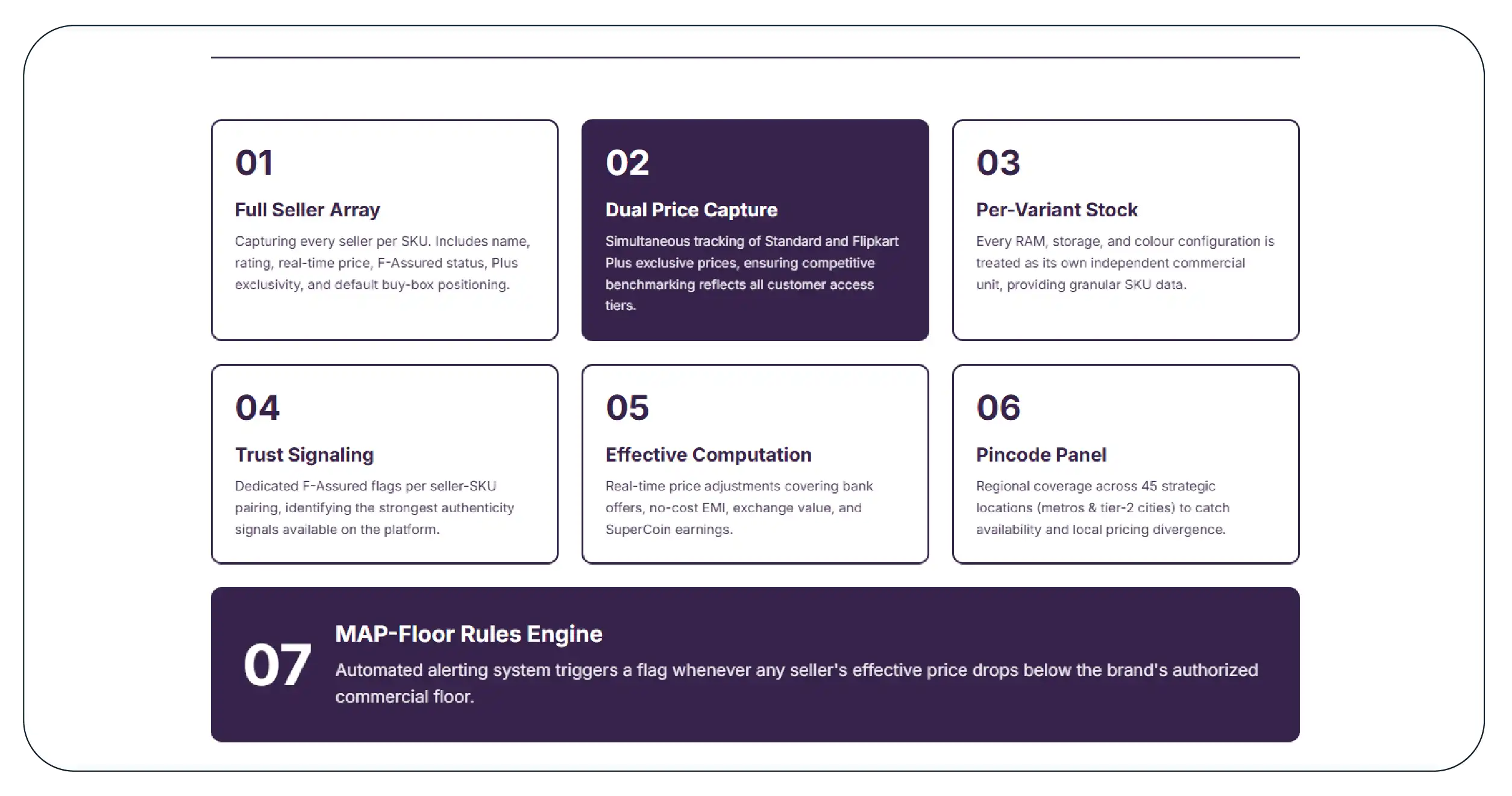
Product Data Scrape rebuilt the brand's Flipkart monitoring around a Flipkart-aware schema. The central change was simple to describe and transformative in practice: capture every seller on every SKU, every time.

The deployed pipeline covered:

  • Full seller array per SKU — seller name, seller rating, price, F-Assured status, Plus exclusivity, and whether that seller currently held the default position.
  • Dual price capture — standard price and Flipkart Plus exclusive price on every record, so competitive benchmarking reflected both customer tiers.
  • Per-variant pricing and stock — every RAM, storage, and colour configuration tracked as its own commercial unit.
  • F-Assured flags per seller-SKU — the strongest available authenticity signal on the platform.
  • Effective price computation — listed price adjusted for bank offers, no-cost EMI, exchange offers, and SuperCoin earn value.
  • Pincode panel — 45 pincodes across metros and tier-2 cities, to catch regional price and availability divergence.
  • MAP-floor rules engine — an automatic flag whenever any seller's effective price crossed below the brand's authorised floor.

Capture frequency was set to four times daily for hero SKUs and daily for the long tail, escalating to hourly during sale windows.

Sample Data: The Row That Started the Conversation

The first delivered dataset produced this record — a flagship SKU the brand believed was cleanly controlled by its own authorised sellers. Values are illustrative.

Seller Price Effective Price F-Assured Plus Price Default Seller? Authorised?
AuthorisedPartner A 3,499 3,349 Yes 3,299 No Yes
AuthorisedPartner B 3,499 3,349 Yes 3,299 No Yes
Unknown Seller 1 3,149 2,999 No Yes No
Unknown Seller 2 3,199 3,049 No No No
Unknown Seller 3 3,249 3,099 Yes No No

Three unknown sellers. The default position held by an unauthorised seller with no F-Assured badge, priced 350 rupees below the brand's MAP floor. And an effective price after bank offers that sat 500 rupees below what the brand's own authorised partners were charging.

Across the monitored catalogue, the first full pass surfaced:

  • 31 sellers listing the brand's SKUs — against an assumed 2.
  • 19 of 64 hero SKUs where the default position was held by an unauthorised seller.
  • 26 SKUs with at least one seller below the MAP floor on effective price.
  • 7 SKUs where the highest-velocity variant had been out of stock at the brand's own authorised sellers for more than ten consecutive days — while unauthorised sellers stayed in stock and took the position by default.

That last finding reframed the problem. Part of the Buy Box loss was not competitive aggression at all. It was the brand's own supply chain handing the position away.

What the Brand Did With It

Week 1–2 — Enforcement. The brand's legal team issued takedown and cease-and-desist notices against the sellers with the clearest MAP violations, using the timestamped price history from the dataset as evidence. Sixteen of the flagged listings were removed or brought back above the floor within three weeks.

Week 2–6 — Supply correction. The variant-level stock data went to the supply team. Seven high-velocity variants that had been chronically under-allocated to the authorised sellers were re-prioritised in the replenishment plan.

Week 3–10 — Pricing response. The effective-price data changed the brand's benchmarking. The team had been comparing listed prices; competitors were competing on post-offer effective price. The brand restructured its own bank-offer participation on six SKUs to close the gap without discounting the headline price.

Ongoing — Monitoring. A daily alert now fires whenever a new seller appears on a brand SKU, whenever the default position shifts away from an authorised seller, or whenever any effective price crosses the MAP floor.

The Results (First 90 Days)

Metric Before After 90 Days
Sellers listing brand SKUs 31 (16 unauthorised) 14 (3 unauthorised)
Hero SKUs where authorised seller held default position 45 of 64 58 of 64
SKUs with MAP violations on effective price 26 4
Hero variants out of stock >7 days 7 1
Flipkart channel revenue, indexed 100 122

Figures are representative of the engagement outcome.

The brand recovered the default position on 13 additional hero SKUs, cut unauthorised sellers by roughly 80 percent, and grew Flipkart channel revenue by 22 percent over the quarter — without increasing ad spend and without cutting headline prices.

Why It Worked

Nothing in this engagement was exotic. There was no proprietary model and no clever algorithm. The entire outcome rested on one decision: capture the full seller array instead of a single price.

That one schema change turned an invisible problem into a list of named sellers, specific SKUs, and timestamped price evidence — which is exactly the form a legal team, a supply team, and a pricing team can each act on.

The lesson generalises. On Flipkart, the data you do not capture is usually where the revenue is leaking.

Work With Product Data Scrape

Product Data Scrape delivers Flipkart seller data scraping with the full seller array, F-Assured status, dual-tier pricing, per-variant stock, pincode-level pricing, and MAP-violation alerting — delivered as JSON, CSV, API, or straight into your warehouse.

If you suspect your Flipkart listings are leaking revenue to sellers you cannot see, we will run a diagnostic pass on a sample of your SKUs and show you the seller array behind them.

Product Data Scrape — turning marketplace complexity into decision-ready data.

LATEST BLOG

How to Extract Flipkart Product Data with F-Assured Status, Plus Pricing, and Seller-Level Detail

Learn how to extract Flipkart product data with F-Assured status, Plus member pricing, seller-level detail and variant stock. Sample fields and workflows inside.

Why Businesses Should Scrape Weekly Zomato Restaurant Data Refreshes to Track Menu and Pricing Changes

Learn how to Scrape Weekly Zomato Restaurant Data Refreshes to monitor menus, pricing, ratings, and restaurant updates for smarter business decisions.

How Automated Product Matching by Model Number Improves Catalog Accuracy and Product Intelligence

Automated Product Matching by Model Number helps identify identical products across catalogs, improving accuracy, pricing insights, and inventory management.

Case Studies

Discover our scraping success through detailed case studies across various industries and applications.

WHY CHOOSE US?
Product Data Scrape for Retail Web Scraping

Choose Product Data Scrape to access accurate data, enhance decision-making, and boost your online sales strategy effectively.

Reliable Insights

Reliable Insights

With our Retail Data scraping services, you gain reliable insights that empower you to make informed decisions based on accurate product data and market trends.

Data Efficiency

Data Efficiency

We help you extract Retail Data product data efficiently, streamlining your processes to ensure timely access to crucial market information and operational speed.

Market Adaptation

Market Adaptation

By leveraging our Retail Data scraping, you can quickly adapt to market changes, giving you a competitive edge with real-time analysis and responsive strategies.

Price Optimization

Price Optimization

Our Retail Data price monitoring tools enable you to stay competitive by adjusting prices dynamically, attracting customers while maximizing your profits effectively.

Competitive Edge

Competitive Edge

THIS IS YOUR KEY BENEFIT.
With our competitive price tracking, you can analyze market positioning and adjust your strategies, responding effectively to competitor actions and pricing in real-time.

Feedback Analysis

Feedback Analysis

Utilizing our Retail Data review scraping, you gain valuable customer insights that help you improve product offerings and enhance overall customer satisfaction.

5-Step Proven Methodology

How We Scrape E-Commerce Data?

01
Identify Target Websites

Identify Target Websites

Begin by selecting the e-commerce websites you want to scrape, focusing on those that provide the most valuable data for your needs.

02
Select Data Points

Select Data Points

Determine the specific data points to extract, such as product names, prices, descriptions, and reviews, to ensure comprehensive insights.

03
Use Scraping Tools

Use Scraping Tools

Utilize web scraping tools or libraries to automate the data extraction process, ensuring efficiency and accuracy in gathering the desired information.

04
Data Cleaning

Data Cleaning

After extraction, clean the data to remove duplicates and irrelevant information, ensuring that the dataset is organized and useful for analysis.

05
Analyze Extracted Data

Analyze Extracted Data

Once cleaned, analyze the extracted e-commerce data to gain insights, identify trends, and make informed decisions that enhance your strategy.

Start Your Data Journey
99.9% Uptime
GDPR Compliant
Real-time API

See the results that matter

Read inspiring client journeys

Discover how our clients achieved success with us.

6X

Conversion Rate Growth

“I used Product Data Scrape to extract Walmart fashion product data, and the results were outstanding. Real-time insights into pricing, trends, and inventory helped me refine my strategy and achieve a 6X increase in conversions. It gave me the competitive edge I needed in the fashion category.”

7X

Sales Velocity Boost

“Through Kroger sales data extraction with Product Data Scrape, we unlocked actionable pricing and promotion insights, achieving a 7X Sales Velocity Boost while maximizing conversions and driving sustainable growth.”

"By using Product Data Scrape to scrape GoPuff prices data, we accelerated our pricing decisions by 4X, improving margins and customer satisfaction."

"Implementing liquor data scraping allowed us to track competitor offerings and optimize assortments. Within three quarters, we achieved a 3X improvement in sales!"

Resource Hub: Explore the Latest Insights and Trends

The Resource Center offers up-to-date case studies, insightful blogs, detailed research reports, and engaging infographics to help you explore valuable insights and data-driven trends effectively.

Get In Touch

How to Extract Flipkart Product Data with F-Assured Status, Plus Pricing, and Seller-Level Detail

Learn how to extract Flipkart product data with F-Assured status, Plus member pricing, seller-level detail and variant stock. Sample fields and workflows inside.

Why Businesses Should Scrape Weekly Zomato Restaurant Data Refreshes to Track Menu and Pricing Changes

Learn how to Scrape Weekly Zomato Restaurant Data Refreshes to monitor menus, pricing, ratings, and restaurant updates for smarter business decisions.

How Automated Product Matching by Model Number Improves Catalog Accuracy and Product Intelligence

Automated Product Matching by Model Number helps identify identical products across catalogs, improving accuracy, pricing insights, and inventory management.

How a D2C Electronics Brand Used Flipkart Seller Data Scraping to Reclaim Buy Box Share

See how Flipkart seller data scraping helped a D2C electronics brand expose unauthorised sellers, fix price leakage and reclaim Buy Box share in under 90 days.

How We Helped a Global Retail Brand Scrape AI-Recommended Prices from Competitor Data for Smarter Pricing Decisions

Learn how to Scrape AI-Recommended Prices from Competitor Data to optimize pricing, monitor competitors, and drive smarter business decisions.

Delivering Food Delivery Menu and Price Data Intelligence Across 16 Global Markets for a Food-Delivery Intelligence Startup

Explore the Wildberries Marketplace Pricing Report 2026 to uncover pricing trends, seller insights, discounts, and competitive market analysis.

Albertsons Grocery Delivery Scraper API - Market Intelligence, Inventory Monitoring, and Grocery Retail Benchmarking

ASDA Grocery Data Scraping helps track grocery prices, promotions, inventory, and competitor trends across the UK retail market.

Costco Alcohol & Liquor Price Data scraping to Track Consumer Buying Trends and Inventory Intelligence

Costco Alcohol & Liquor Price Data scraping helps brands track pricing, promotions, inventory trends, and competitor insights.

B&M Stores Pet Supplies Data Scraping for Market Research and Pet Product Trend Analysis in Retail Chains

B&M Stores Pet Supplies Data Scraping helps businesses collect pricing, stock, and product insights to optimize pet retail strategies.

Reducing Returns with Myntra AND AJIO Customer Review Datasets

Analyzed Myntra and AJIO customer review datasets to identify sizing issues, helping brands reduce garment return rates by 8% through data-driven insights.

Before vs After Web Scraping - How E-Commerce Brands Unlock Real Growth

Before vs After Web Scraping: See how e-commerce brands boost growth with real-time data, pricing insights, product tracking, and smarter digital decisions.

Scrape Data From Any Ecommerce Websites

Easily scrape data from any eCommerce website to track prices, monitor competitors, and analyze product trends in real time with Real Data API.

Fresh Citrus Price Wars - Coles vs Aldi — What Does the Data Say?

Fresh Citrus Price Wars — Coles vs Aldi: data-driven comparison of prices, trends, and savings to see which retailer wins on value for shoppers.

Retail Inflation 2025 – Comparing Grocery Baskets in Dubai vs. Abu Dhabi (Noon)

Retail Inflation 2025 – Comparing Grocery Baskets in Dubai vs. Abu Dhabi (Noon) highlights price differences and real-world grocery costs across UAE cities.

Unlock Winning Products on Pinduoduo - How Scraping Bestseller Data Reveals Top Titles, Prices & Sales Trends

Scrape Pinduoduo bestseller data to analyze top-selling products, pricing trends, sales performance, for smarter eCommerce and intelligence decisions.

FAQs

E-Commerce Data Scraping FAQs

Our E-commerce data scraping FAQs provide clear answers to common questions, helping you understand the process and its benefits effectively.

E-commerce scraping services are automated solutions that gather product data from online retailers, providing businesses with valuable insights for decision-making and competitive analysis.

We use advanced web scraping tools to extract e-commerce product data, capturing essential information like prices, descriptions, and availability from multiple sources.

E-commerce data scraping involves collecting data from online platforms to analyze trends and gain insights, helping businesses improve strategies and optimize operations effectively.

E-commerce price monitoring tracks product prices across various platforms in real time, enabling businesses to adjust pricing strategies based on market conditions and competitor actions.

Get a free sample dataset

See the exact fields, accuracy and format — for your products, on your target sites — before you spend a rupee or a dollar.

  • Sample delivered within 24 hours
  • Scoped to your real use case, not a generic demo
  • No obligation, no long contract

Tell us what you need

A specialist replies within one business day.