Quick Overview
A leading FMCG brand partnered with Product Data Scrape to improve product visibility and sales across multiple quick commerce platforms. The client struggled with frequent stock-outs, inconsistent pricing visibility, and delayed inventory updates that impacted campaign performance. By implementing Real-Time Quick Commerce Inventory Monitoring alongside Dark-store inventory tracking, the brand gained continuous visibility into SKU availability, pricing changes, and dark store performance. Within six months, product availability improved by 28%, out-of-stock incidents dropped by 35%, and campaign efficiency increased by 24%. The solution empowered faster operational decisions and strengthened the client's competitive position in the rapidly evolving quick commerce market.
The Client
The client is a multinational FMCG company with an extensive portfolio of packaged foods, beverages, and household essentials distributed across major quick commerce platforms. As consumer expectations shifted toward instant delivery, maintaining consistent inventory visibility across hundreds of dark stores became increasingly challenging. Rapid inventory turnover, frequent promotional campaigns, and aggressive competitor pricing required continuous monitoring rather than periodic reporting.
Industry reports indicate that quick commerce has experienced double-digit annual growth since 2020, increasing pressure on brands to maintain accurate inventory and pricing intelligence. To remain competitive, the client needed comprehensive Real-Time Quick Commerce Inventory & Pricing Intelligence that could capture live SKU availability, promotional pricing, and assortment changes across multiple cities. They also wanted to Track AI shelf performance to understand digital product visibility and ensure high-priority SKUs remained discoverable throughout promotional campaigns.
Before partnering with Product Data Scrape, inventory information was collected manually from multiple platforms. This process created reporting delays, inconsistent datasets, and limited visibility into regional stock movements. Marketing teams struggled to optimize advertising because inventory status frequently changed before campaign adjustments could be made. Operations teams lacked real-time alerts, resulting in missed sales opportunities, reduced customer satisfaction, and limited competitive responsiveness.
Goals & Objectives
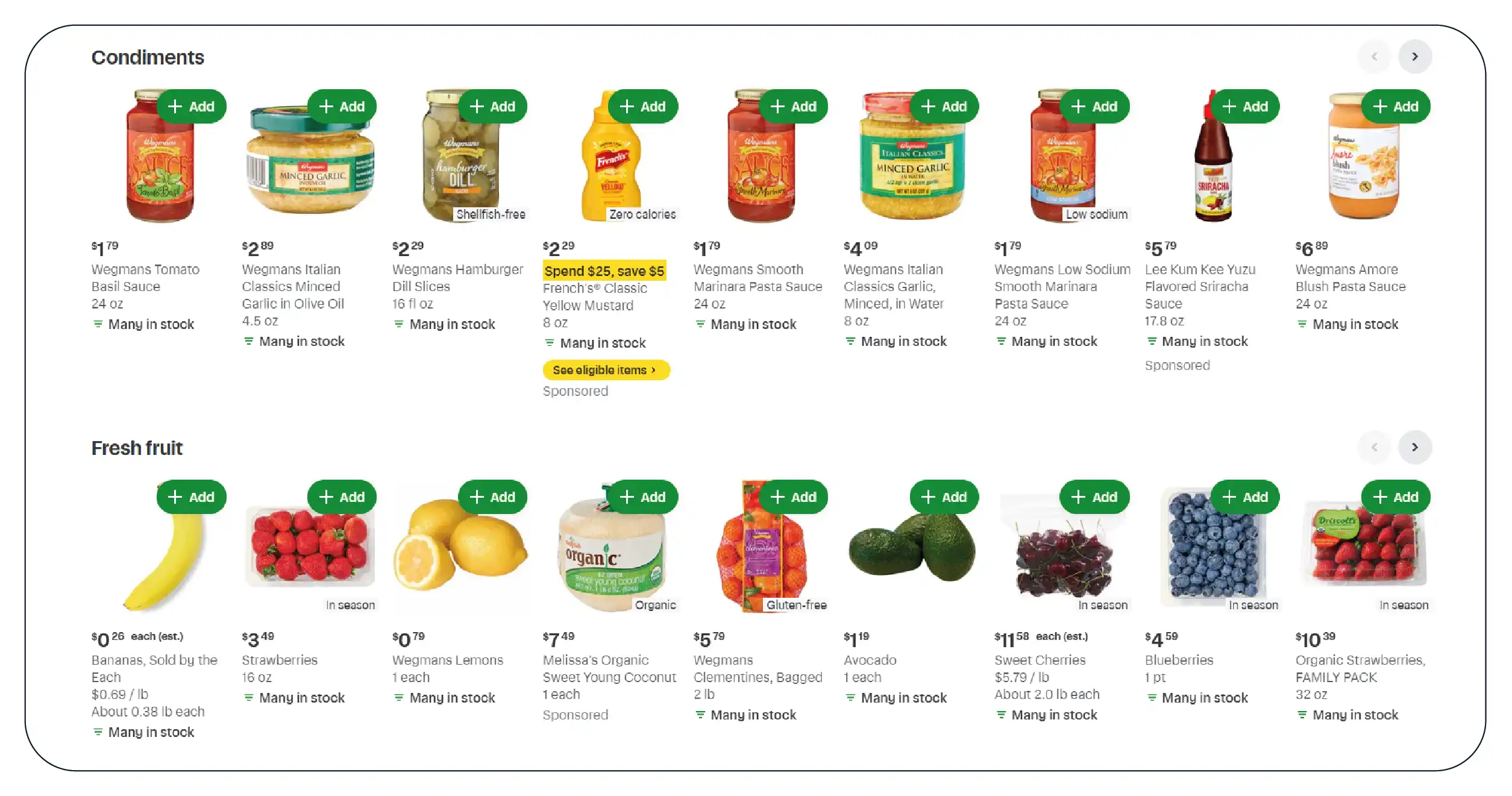
The project focused on building a scalable, automated monitoring ecosystem capable of delivering real-time inventory, pricing, and assortment intelligence across leading quick commerce platforms. The client required a solution that could support business expansion while providing highly accurate and actionable data.
The primary business goal was to establish continuous marketplace visibility using AI Agent for Quick Commerce Price and Stock Monitoring. The client wanted to reduce stock-outs, improve campaign performance, strengthen competitive pricing strategies, and enable faster operational decisions across all monitored dark stores.
The technical objective was to build a highly automated monitoring platform powered by Quick Commerce intelligence. The solution needed to integrate multiple quick commerce platforms, collect live inventory and pricing data, automate reporting workflows, generate real-time alerts, and provide centralized dashboards for business and operational teams.
Reduce out-of-stock incidents by more than 30%.
Improve inventory monitoring accuracy above 98%.
Increase real-time data refresh frequency.
Monitor SKU availability across multiple cities simultaneously.
Improve promotional campaign efficiency.
Accelerate reporting turnaround with automated dashboards.
Enable faster pricing decisions using live competitive intelligence.
Support scalable monitoring for future platform expansion.
The Core Challenge
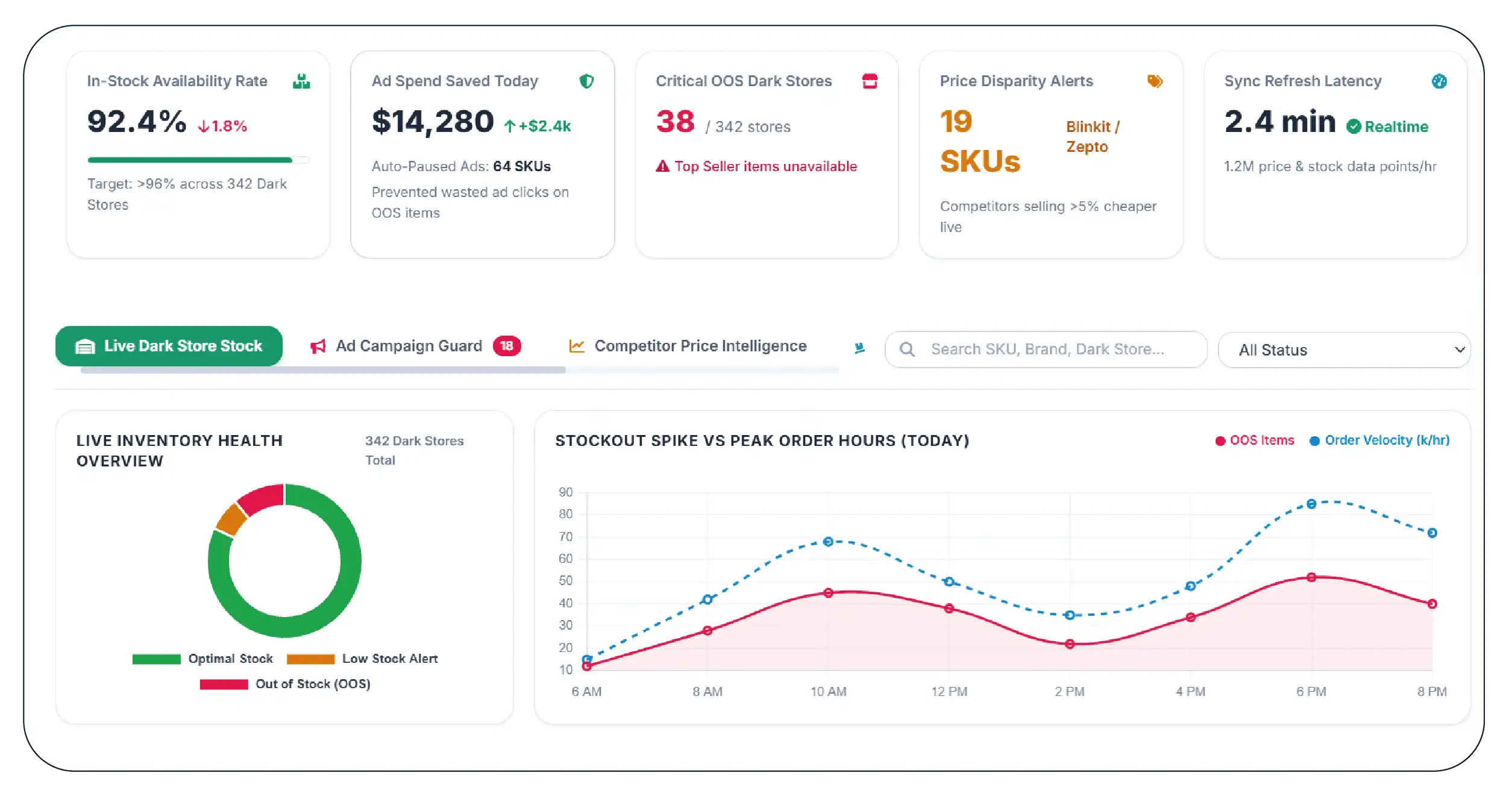
The client operated across multiple quick commerce platforms where inventory, pricing, and product availability changed every few minutes. Manual monitoring methods could not keep pace with these rapid updates, leaving business teams with outdated information. Without Live Inventory & Price Tracking Across Dark Stores, the client struggled to identify stock shortages before they affected customers and advertising campaigns.
Another major challenge involved Assortment and availability monitoring across hundreds of dark stores located in different cities. Products that were available in one location were often unavailable in another, creating inconsistent customer experiences and lost sales opportunities. Marketing teams frequently promoted products that had already gone out of stock, resulting in wasted advertising spend and lower campaign performance.
The fragmented data collection process also delayed competitor analysis. Pricing teams lacked immediate visibility into promotional changes introduced by competing brands, making it difficult to respond quickly. Operations teams depended on manually consolidated reports, which often contained outdated information by the time decisions were made.
These operational bottlenecks reduced forecasting accuracy, slowed inventory replenishment, and limited collaboration between marketing, sales, and supply chain teams. As the business expanded across additional quick commerce platforms, the need for a fully automated, real-time monitoring solution became increasingly critical for maintaining market competitiveness.
Our Solution
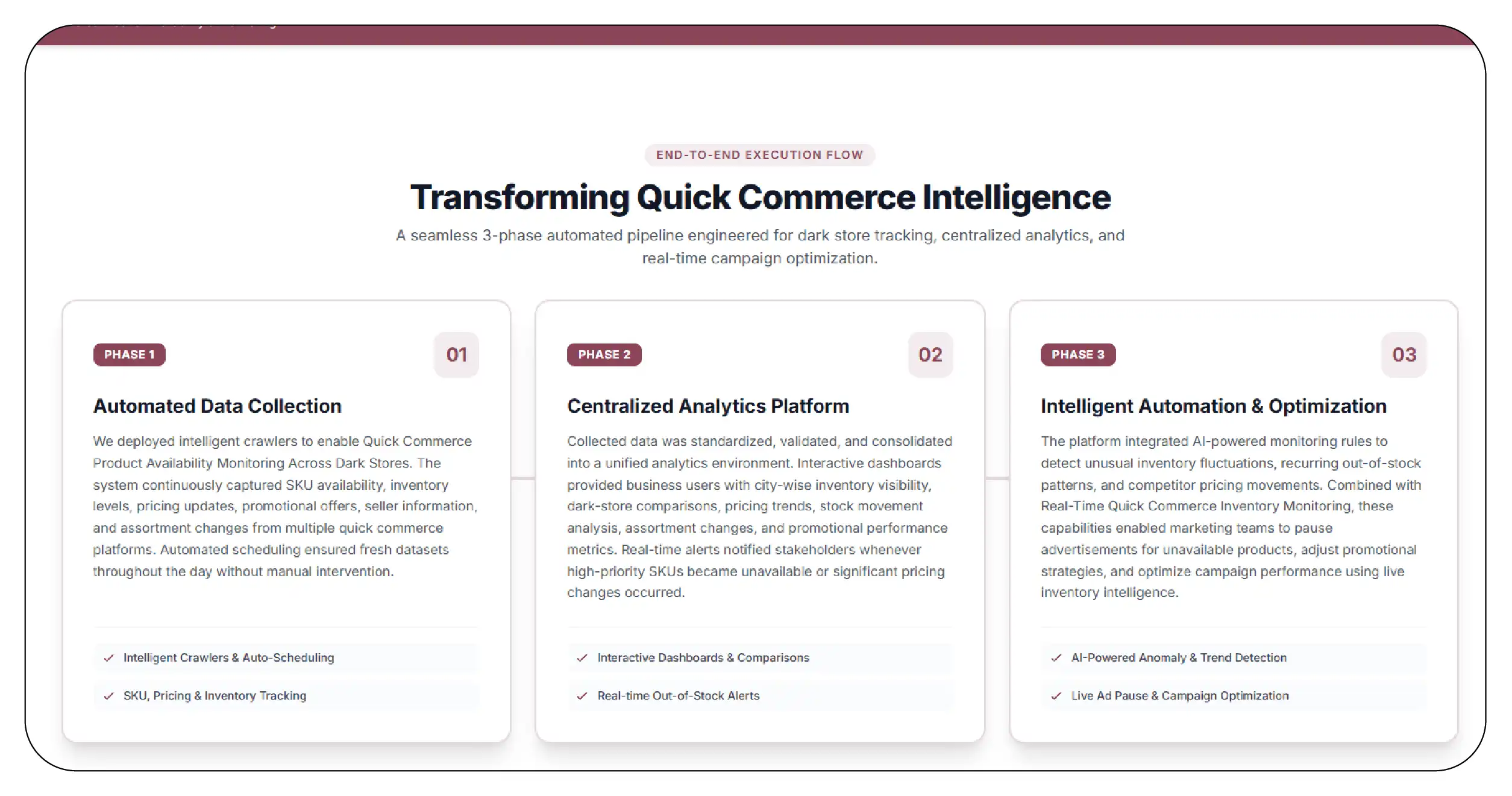
Product Data Scrape designed and deployed a scalable monitoring framework that delivered continuous visibility into inventory, pricing, assortment, and promotional performance across major quick commerce platforms. The implementation followed a phased approach to ensure seamless integration with the client's existing analytics ecosystem while minimizing operational disruption.
Phase 1: Automated Data Collection
We deployed intelligent crawlers to enable Quick Commerce Product Availability Monitoring Across Dark Stores. The system continuously captured SKU availability, inventory levels, pricing updates, promotional offers, seller information, and assortment changes from multiple quick commerce platforms. Automated scheduling ensured fresh datasets throughout the day without manual intervention.
Phase 2: Centralized Analytics Platform
Collected data was standardized, validated, and consolidated into a unified analytics environment. Interactive dashboards provided business users with city-wise inventory visibility, dark-store comparisons, pricing trends, stock movement analysis, assortment changes, and promotional performance metrics. Real-time alerts notified stakeholders whenever high-priority SKUs became unavailable or significant pricing changes occurred.
Phase 3: Intelligent Automation and Optimization
The platform integrated AI-powered monitoring rules to detect unusual inventory fluctuations, recurring out-of-stock patterns, and competitor pricing movements. Combined with Real-Time Quick Commerce Inventory Monitoring, these capabilities enabled marketing teams to pause advertisements for unavailable products, adjust promotional strategies, and optimize campaign performance using live inventory intelligence.
Technology and Business Impact
The solution incorporated automated validation pipelines, scalable cloud infrastructure, API integrations, scheduled data refreshes, intelligent alerting, and customizable dashboards. Business users gained immediate access to reliable marketplace intelligence without depending on manual reporting cycles.
By replacing fragmented workflows with automated monitoring, the client achieved faster decision-making, improved inventory visibility, better coordination between marketing and supply chain teams, and significantly stronger operational efficiency across all monitored quick commerce platforms. The scalable architecture also positioned the organization to support future expansion into new cities, product categories, and emerging quick commerce marketplaces with minimal additional implementation effort.
Results & Key Metrics
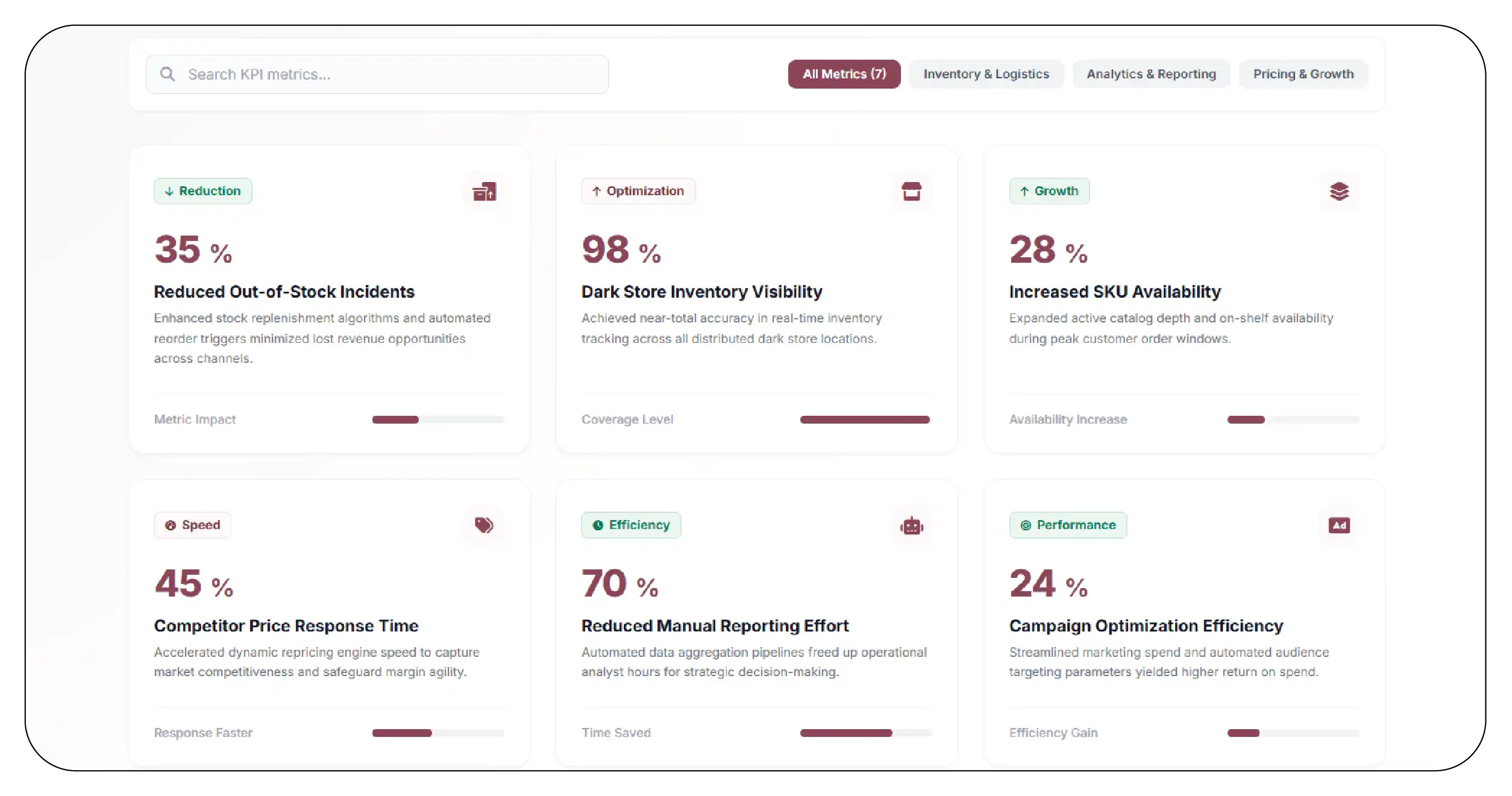
Reduced out-of-stock incidents by 35%.
Improved inventory visibility across dark stores by 98%.
Increased SKU availability by 28%.
Improved competitor price response time by 45%.
Reduced manual reporting effort by 70%.
Increased campaign optimization efficiency by 24%.
Enabled near real-time monitoring across multiple cities.
Improved inventory replenishment planning using live marketplace intelligence.
Results Narrative
The automated monitoring platform transformed how the client managed quick commerce operations. Marketing teams aligned advertising campaigns with live inventory status, significantly reducing wasted impressions on unavailable products. Supply chain teams received immediate visibility into stock shortages, allowing faster replenishment planning. Pricing teams responded more quickly to competitor promotions using real-time market intelligence. Executive dashboards replaced fragmented reports, enabling leadership to monitor operational performance from a single interface. As a result, the client improved product availability, strengthened customer satisfaction, enhanced collaboration across departments, and built a scalable operational framework capable of supporting continued growth across additional quick commerce platforms.
What Made Product Data Scrape Different
Product Data Scrape combined scalable automation with intelligent analytics to deliver continuous marketplace visibility. Unlike traditional reporting solutions, our platform provided proactive alerts, automated validation, and customizable dashboards that enabled business users to act immediately. Advanced Out-of-stock monitoring capabilities identified inventory gaps before they affected customer orders or advertising performance. The solution also integrated competitor pricing intelligence, assortment analysis, and regional inventory comparisons into a single analytics environment. This combination of automation, accuracy, and scalability helped the client improve operational efficiency while creating a future-ready monitoring framework that supported business expansion and faster strategic decision-making.
Client Testimonial
"Working with Product Data Scrape completely transformed how we manage inventory across quick commerce platforms. Their Real-Time Quick Commerce Inventory Monitoring solution provided live visibility into stock availability, pricing changes, and dark-store performance that we simply didn't have before. The automated dashboards and alerts helped our marketing, pricing, and supply chain teams work together more efficiently while reducing out-of-stock situations. We now make faster decisions backed by reliable data, improve campaign performance, and respond quickly to market changes. Their expertise has become an important part of our digital commerce strategy."
— Director of Digital Commerce, Leading FMCG Brand
Conclusion
Modern quick commerce success depends on timely, accurate marketplace intelligence. Businesses that invest in automated inventory monitoring gain stronger operational control, faster pricing decisions, and improved customer experiences. By combining live inventory visibility with Competitor price monitoring, organizations can reduce stock-outs, optimize advertising performance, and strengthen revenue opportunities across dark stores. Product Data Scrape delivered a scalable solution that transformed fragmented reporting into real-time business intelligence, enabling smarter decisions and sustainable growth.
Partner with Product Data Scrape today to unlock real-time quick commerce insights and build a smarter, data-driven strategy for inventory, pricing, and competitive excellence!
FAQs
1. Why is real-time inventory monitoring important for quick commerce?
Real-time inventory monitoring helps brands detect stock shortages immediately, improve replenishment planning, reduce lost sales, and ensure customers always see accurate product availability across dark stores.
2. How does competitor pricing intelligence improve business performance?
Continuous pricing intelligence allows businesses to react quickly to competitor promotions, optimize pricing strategies, maintain competitiveness, and improve campaign effectiveness without relying on delayed reports.
3. What operational benefits does automated monitoring provide?
Automated monitoring reduces manual data collection, improves reporting accuracy, delivers faster alerts, enhances collaboration across departments, and supports data-driven decision-making throughout daily operations.
4. Can the solution monitor multiple cities and dark stores simultaneously?
Yes. The platform scales across multiple cities, regions, and quick commerce platforms, providing centralized dashboards with location-specific inventory, pricing, assortment, and performance insights.
5. Which businesses benefit most from this solution?
FMCG brands, grocery companies, consumer goods manufacturers, distributors, retail analytics teams, and quick commerce operators benefit by improving inventory visibility, pricing intelligence, operational efficiency, and customer satisfaction through automated marketplace monitoring.



 Singapore
 EMAIL
EMAIL
 PHONE
PHONE


.webp)
.webp "thumb")
.webp "thumb")
.webp "thumb")









.webp)