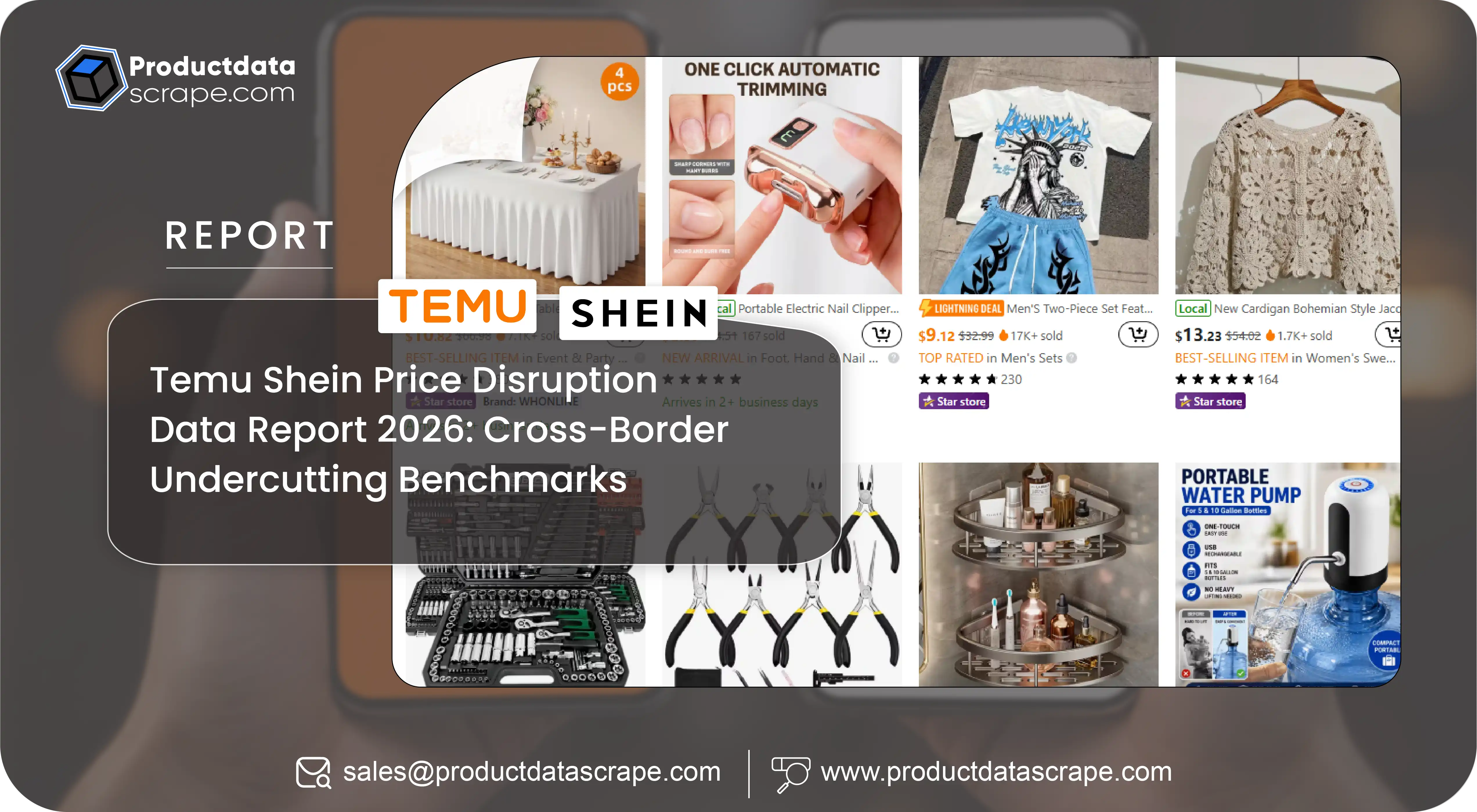
Executive Summary
Ultra-low-cost cross-border marketplaces have rewritten the price floor in category after category. Temu and Shein now list near-identical products at a fraction of domestic marketplace prices, and shoppers increasingly cross-shop them before buying anywhere else. This report from Product Data Scrape uses large-scale Temu Shein Price Disruption Data to measure how deep the undercutting runs, where assortments overlap with domestic sellers, and what the real, shipping-adjusted price gap looks like in 2026.
The figures below are representative benchmarks drawn from Product Data Scrape's managed monitoring across cross-border and domestic marketplaces. They are designed to help brand, pricing, and category teams understand cross-border pressure — not to replace a scoped audit of a specific catalog.
Why Cross-Border Undercutting Is So Hard to Match
Temu and Shein compete on a fundamentally different cost structure. By sourcing directly from manufacturers and shipping cross-border in small parcels, they strip out the layers of margin that domestic marketplaces carry, and they list enormous, fast-changing assortments that make like-for-like comparison difficult to do by hand.
The disruption is not uniform, though. In some categories the gap is enormous; in others, once delivery time and shipping are factored in, domestic sellers remain competitive. The danger for a brand or retailer is reacting to the headline price without understanding the real, shipping-adjusted gap or which of its SKUs actually face cross-border competition. Temu Shein Price Disruption Data is what separates genuine threat from noise.
What This Report Measures
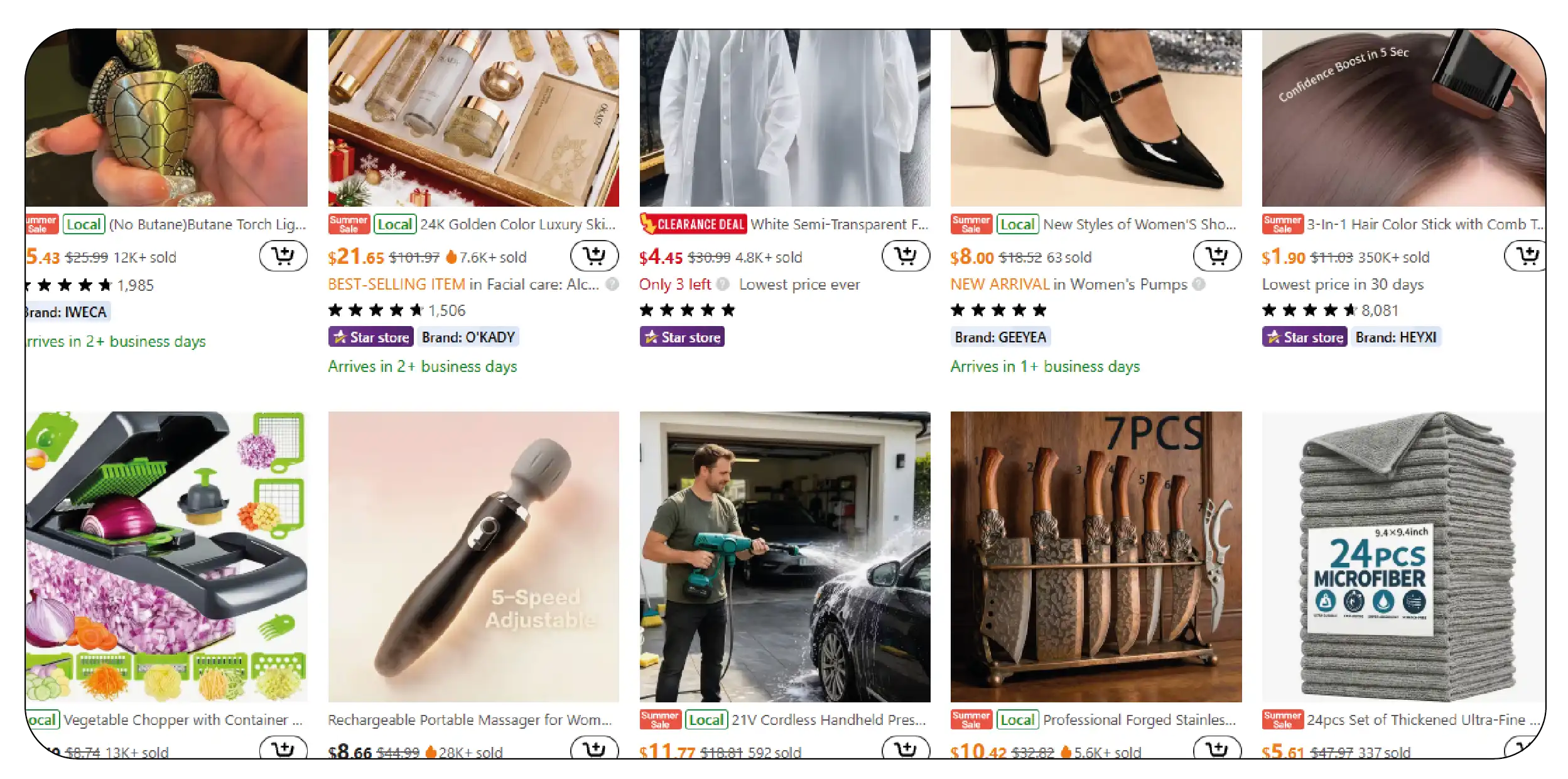
For this study, Product Data Scrape matched comparable products across Temu, Shein, and domestic marketplaces in categories where overlap is heaviest — fashion, accessories, home, and small electronics. Products are matched on attributes rather than exact identity, because cross-border listings rarely share the same identifiers, so comparisons reflect what a shopper would realistically treat as the same item.
For every matched product, the dataset captures cross-border price, domestic marketplace price, estimated delivery time, shipping cost where applicable, the shipping-adjusted effective gap, and the degree of assortment overlap by category. Rolled up, these signals produce a category-level disruption index that shows where cross-border pressure is severe and where it is manageable.
Key Findings
The 2026 monitoring data surfaces several consistent patterns across categories:
Fashion and accessories face the deepest gaps. Apparel, jewelry, and small accessories show the largest undercut, where cross-border sourcing advantages are greatest and brand loyalty is lowest.
Shipping narrows but rarely closes the gap. Factoring in delivery cost and time reduces the advantage, yet in the most disrupted categories cross-border prices still land well below domestic listings.
Delivery time is the domestic edge. Where the shipping-adjusted gap is small, faster domestic delivery becomes the deciding factor, and domestic sellers hold share on urgency.
Overlap is category-specific. Some domestic assortments overlap heavily with cross-border listings while others barely intersect, so blanket price-matching is the wrong response.
Assortments move fast. Cross-border catalogs churn quickly, so a one-time comparison goes stale within weeks and continuous monitoring is essential.
Together, these findings show that cross-border disruption is real but uneven — and that the right response is surgical, category-by-category, rather than a reflexive race to the bottom.
Sample Data: Cross-Border vs Domestic Price Comparison
The value of Temu Shein Price Disruption Data is in the shipping-adjusted comparison behind every product. Below is a representative sample of the structured output Product Data Scrape delivers.
| Category |
Sample Product |
Cross-Border Price |
Domestic Price |
Est. Delivery |
Shipping-Adj. Gap |
Overlap |
Captured |
| Fashion |
Casual Dress |
₹599 |
₹1,499 |
9–12 days |
−54% |
High |
2026-07-14 |
| Accessories |
Phone Case |
₹149 |
₹399 |
8–11 days |
−58% |
High |
2026-07-14 |
| Home |
LED String Lights |
₹299 |
₹649 |
10–14 days |
−49% |
Medium |
2026-07-13 |
| Small Electronics |
Bluetooth Selfie Stick |
₹399 |
₹799 |
9–12 days |
−46% |
Medium |
2026-07-13 |
| Jewelry |
Fashion Earrings Set |
₹199 |
₹599 |
8–10 days |
−61% |
High |
2026-07-12 |
Every row is timestamped and shipping-adjusted, so pricing teams can see the real gap a shopper faces, not just the headline sticker difference.
How Brands Use Temu Shein Price Disruption Data
Brands and retailers that monitor cross-border pricing use the data to respond precisely. First, they identify which of their SKUs actually face cross-border competition, so they defend only the products where the threat is real instead of discounting the whole catalog.
Second, they reframe value where price cannot win. In categories with deep undercutting, the data helps brands lean into speed, warranty, authenticity, and after-sale support — the things cross-border sellers cannot easily match — and communicate them at the point of sale. Third, they set defensible price floors, using the shipping-adjusted gap to decide where matching makes sense and where it simply erodes margin for no gain.
Category strategists and marketplaces use the same feed to track how fast cross-border assortments are expanding into their space, informing sourcing, private-label, and merchandising decisions. In every case, the data turns a vague sense of cross-border pressure into a measured, category-level plan.
What Changed in Cross-Border Competition in 2026
The cross-border threat is evolving quickly. Temu and Shein have expanded well beyond their original strongholds into home, small electronics, and everyday goods, widening the set of categories exposed to deep undercutting. At the same time, both have invested in local warehousing and faster fulfillment in several markets, chipping away at the delivery-time advantage that domestic sellers have relied on to hold share despite higher prices.
Regulatory attention has increased in parallel, and the rules around cross-border parcels, duties, and marketplace accountability are shifting in several regions — changes that can move the effective price gap almost overnight. For brands and retailers, this means the cross-border landscape cannot be assessed once and filed away. The categories under threat, the size of the gap, and the delivery trade-off all move quarter to quarter, so the only reliable posture is continuous measurement and a response calibrated to where the data shows the pressure is genuinely real.
Temu Shein Price Disruption Data FAQs
How do you compare products that don't share identifiers? Products are matched on attributes — type, material, size, and specification — because cross-border listings rarely share identifiers with domestic ones, so comparisons reflect what a shopper would treat as the same item.
Is the shipping-adjusted gap included? Yes. Delivery cost and time are factored in, so the reported gap reflects the real trade-off a shopper faces rather than the headline price alone.
Which categories should brands watch most closely? Fashion, accessories, and small goods show the deepest gaps, but the data flags exactly which of your SKUs face genuine overlap.
Methodology and Data Quality

The findings in this report are built from listing-level data collected by Product Data Scrape's managed pipelines, not from surveys or estimates. Products are captured directly from live marketplace pages at scale, normalized into a consistent schema, and matched across platforms so that every comparison is genuinely like-for-like. Prices, availability, and other fields are recorded with a timestamp, which makes it possible to measure change over time rather than relying on a single snapshot that is out of date the moment it is taken.
Every dataset passes automated validation before it is used. Duplicate listings are removed, outliers are flagged for review, and records that fail consistency checks are re-collected rather than left to distort the results. Because the pipelines are monitored continuously, coverage adapts as marketplaces change their page structures, so the data stays reliable even as the sites underneath it evolve. This is what separates a defensible cross-border pricing benchmark from a one-off manual scrape that cannot be repeated or trusted at scale.
Who This Report Is For
This report is written for brand and pricing teams, retail category managers, marketplace strategists, and sourcing leads. If any part of your catalog overlaps with cross-border assortments, the shipping-adjusted view here shows precisely where the pressure is real and where it is only noise.
What You Get With Product Data Scrape
Product Data Scrape delivers Temu Shein Price Disruption Data as a managed service across cross-border and domestic marketplaces, so teams do not have to build or maintain scrapers in-house. Coverage matches comparable products across platforms and captures price, delivery time, shipping-adjusted gap, and assortment overlap by category.
Data is refreshed on a cadence you choose and delivered in the format your team already uses — CSV, JSON, API feed, or dashboard. Because the pipelines are custom-built and monitored, coverage extends to new cross-border marketplaces as they enter your market.
Get Your Exposure Benchmarked
The figures in this report are representative; your real exposure depends on your catalog and the categories you sell in. Product Data Scrape will run a free sample dataset scoped to your products and target marketplaces, so you can see the exact fields, accuracy, and price gaps before committing to anything.
Request a sample to benchmark cross-border pressure on your catalog — and turn Temu Shein Price Disruption Data into a precise, category-level response that protects margin where it matters and defends share where it counts.



 Singapore
 EMAIL
EMAIL
 PHONE
PHONE












.webp)