Quick Overview
A leading grocery intelligence-focused client partnered with us to enhance market visibility and pricing intelligence across competitive retail chains. The engagement centered on improving data-driven decision-making for faster retail strategy execution. The client operates in the grocery analytics space, requiring high-frequency insights and scalable data pipelines. Through our solution, they achieved improved accuracy, faster refresh cycles, and deeper SKU-level visibility across competitors.
Client Industry: Grocery Intelligence & Retail Analytics
Service & Duration: Product Data Scrape – 4 Months
Key Impact Metrics: 65% faster insights delivery, 40% improved data accuracy, 3x scalability in data collection pipelines
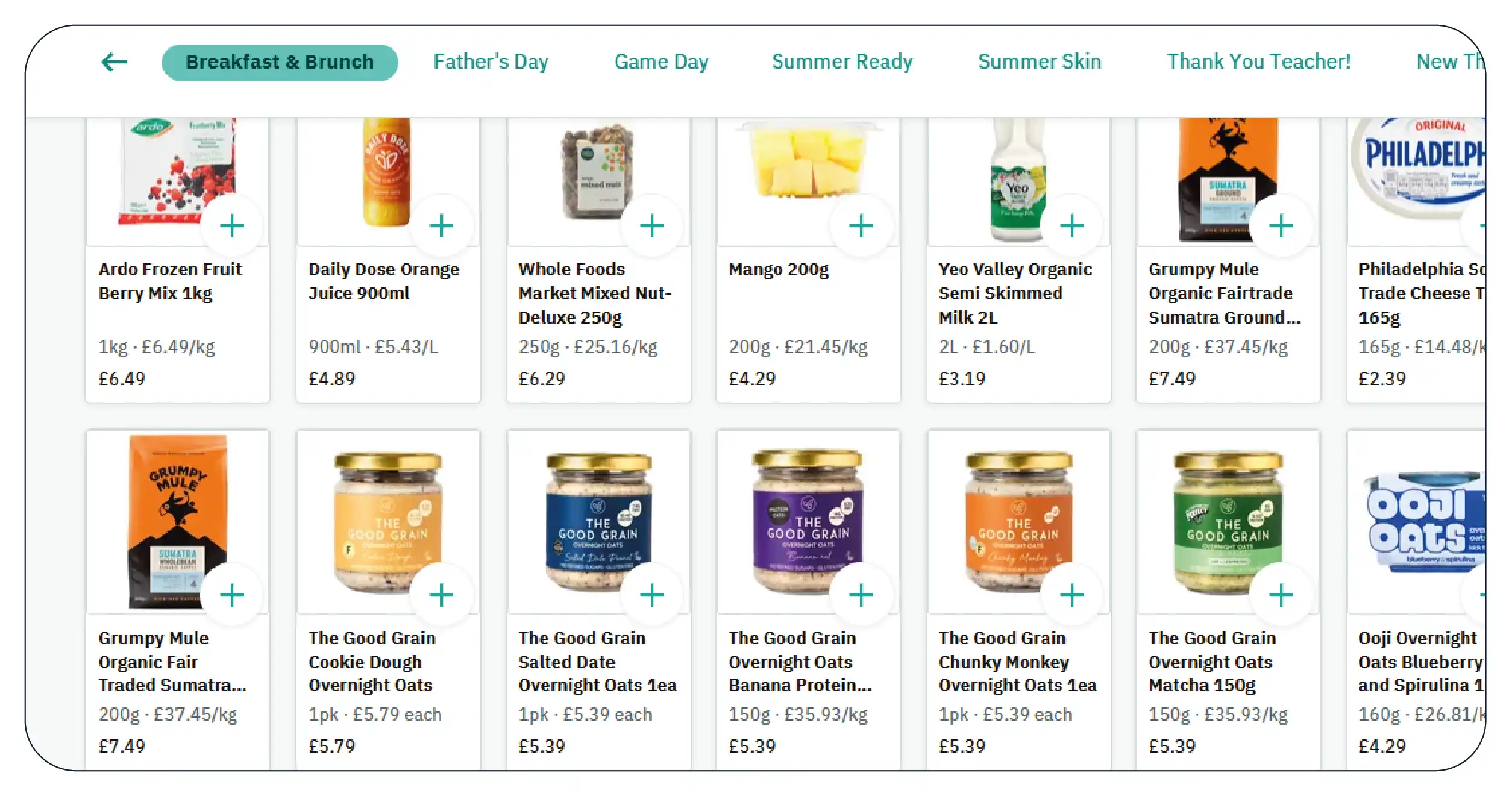
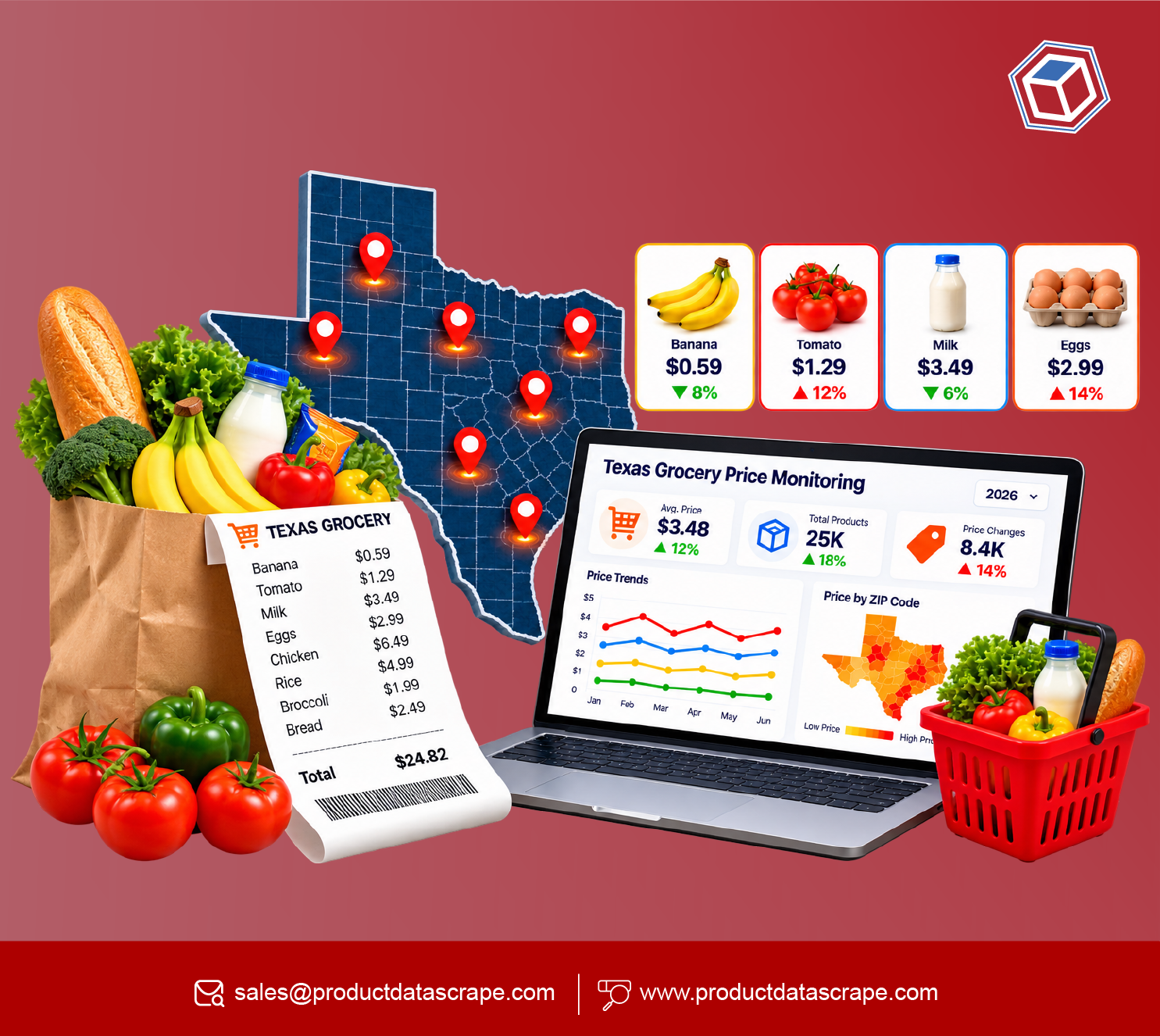
We implemented Whole Foods Competitive Benchmarking for Grocery Retailers to strengthen market comparison frameworks. We also integrated Grocery data scraping to enable real-time competitive intelligence across product categories.
The Client
The grocery retail analytics industry has been experiencing rapid disruption driven by dynamic pricing, shifting consumer preferences, and increasing competition from digital-first retailers. Our client, a mid-sized analytics provider serving multiple grocery brands, faced growing pressure to deliver faster and more precise insights.
Before partnering with us, their data pipelines struggled with inconsistency, limited SKU coverage, and delayed refresh cycles. This made it difficult for their enterprise clients to respond quickly to competitor pricing and assortment changes. The need for transformation was critical, especially as retailers demanded near real-time intelligence to stay competitive.
The market trend showed a strong shift toward automation, structured data ingestion, and continuous monitoring of competitor catalogs. Without these capabilities, the client risked losing relevance in a highly competitive analytics landscape.
Their situation involved manual aggregation from multiple sources, low data standardization, and poor scalability. They needed a robust system capable of tracking competitor pricing, availability, and product assortment at scale.
We implemented Track Whole Foods Pricing and Product Availability to address these challenges and enable structured benchmarking. Additionally, Assortment analytics was introduced to improve SKU-level insights and category performance evaluation across grocery retailers.
Goals & Objectives
Improve scalability of grocery data pipelines across multiple retail sources
Increase speed of data ingestion and refresh cycles
Enhance accuracy of SKU-level competitive intelligence
Build automated workflows for continuous data extraction and processing
Integrate structured datasets into client analytics dashboards
Enable real-time monitoring of grocery pricing and availability changes
We also focused on expanding competitive visibility using Benchmark Product Availability Against Whole Foods and enabling enriched dataset acquisition via Buy Grocery Datasets for advanced analytics use cases.
60% reduction in data latency
2x improvement in data completeness across SKUs
70% increase in automation coverage for retail data pipelines
Improved refresh frequency from daily to near real-time updates
These goals ensured the client could move from manual, fragmented reporting to a fully automated intelligence system capable of supporting enterprise-grade retail analytics operations.
The Core Challenge
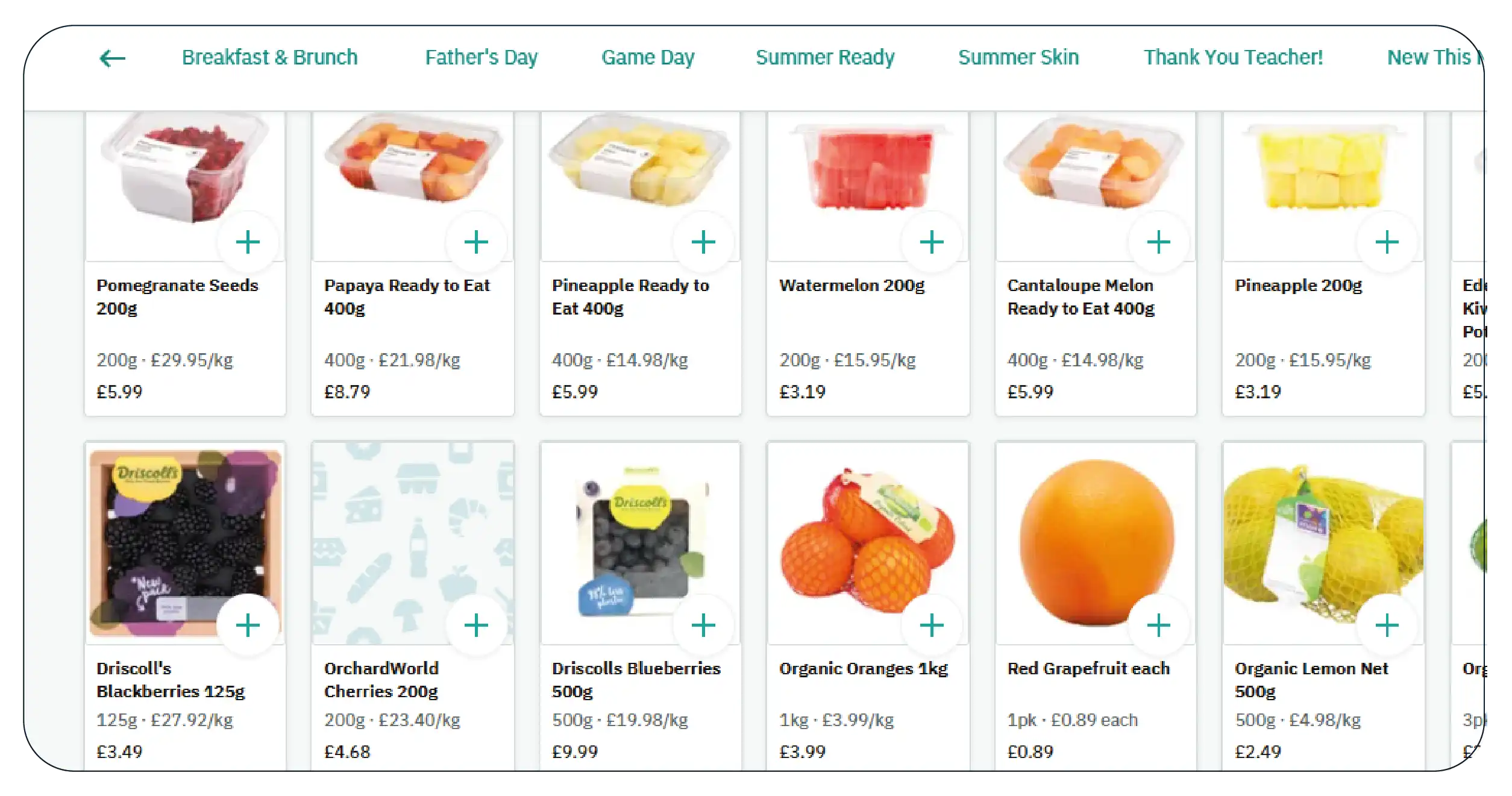
The client faced significant operational inefficiencies that limited their ability to deliver timely and accurate insights. One of the major bottlenecks was the dependency on semi-manual scraping processes, which resulted in inconsistent data outputs and delayed reporting cycles.
Another key issue was the lack of structured benchmarking frameworks, making it difficult to compare product-level data across competing grocery retailers. This directly impacted the reliability of insights provided to end clients.
Data quality issues were also prevalent, especially in SKU matching and category mapping, leading to mismatched or incomplete datasets. These gaps reduced the effectiveness of pricing intelligence and slowed down decision-making processes.
Additionally, scalability was a concern. As data volume increased, system performance degraded, affecting both speed and accuracy of insights delivery.
To address competitive intelligence gaps, we focused on benchmark private label products against Whole Foods, which allowed clearer visibility into pricing and assortment differences.
We also improved review-based insights by integrating Ratings & reviews, helping the client understand consumer sentiment alongside structured product data. This combination enabled a more holistic approach to grocery retail benchmarking.
Our Solution
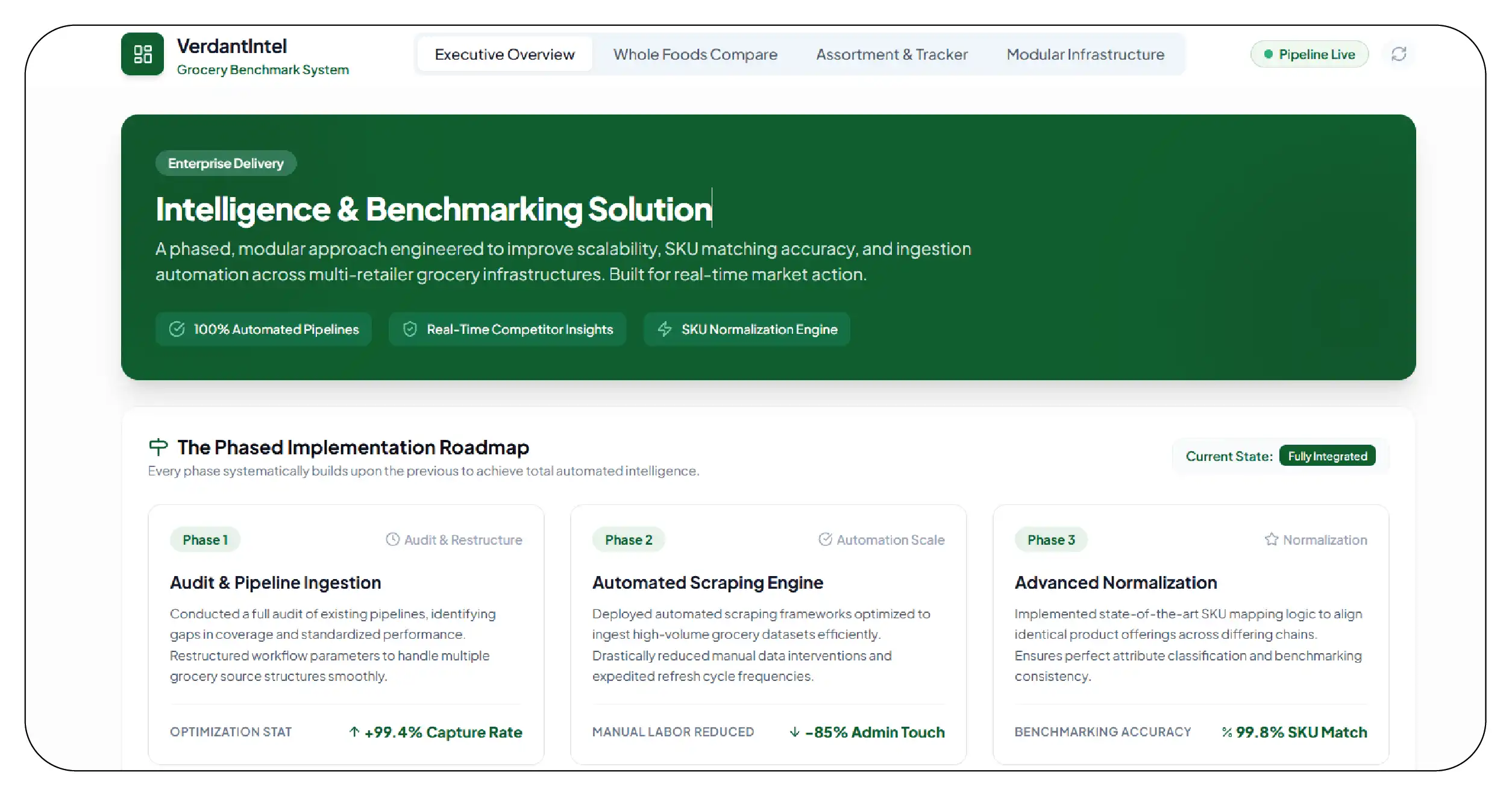
Our solution was built on a phased, modular approach designed to improve scalability, accuracy, and automation across the client's data infrastructure.
Phase 1: Pipeline Audit & Restructuring
We conducted a full audit of existing data pipelines and identified gaps in coverage, latency, and standardization. We restructured ingestion workflows to ensure consistent data capture across multiple grocery sources.
Phase 2: Automated Scraping Frameworks
We implemented automated scraping frameworks designed to handle high-volume grocery datasets efficiently. These frameworks significantly reduced manual intervention and improved data refresh cycles.
Phase 3: Advanced Normalization Logic
We introduced advanced normalization logic to ensure SKU-level consistency across retailers. This allowed accurate mapping of product attributes and improved benchmarking accuracy.
A key part of the solution involved implementing compare grocery product availability with Whole Food, enabling real-time visibility into competitor stock levels and pricing variations.
We also built a structured system for Assortment and availability, allowing granular tracking of category-level changes across grocery retailers.
Our toolset included scalable scraping engines, data validation layers, and automated pipeline orchestration frameworks. These systems worked together to eliminate bottlenecks and improve processing efficiency.
Finally, we integrated outputs into client dashboards, enabling real-time analytics and faster decision-making. Each phase directly addressed core operational challenges while building toward a fully automated intelligence ecosystem capable of supporting enterprise-level grocery benchmarking requirements.
Results & Key Metrics
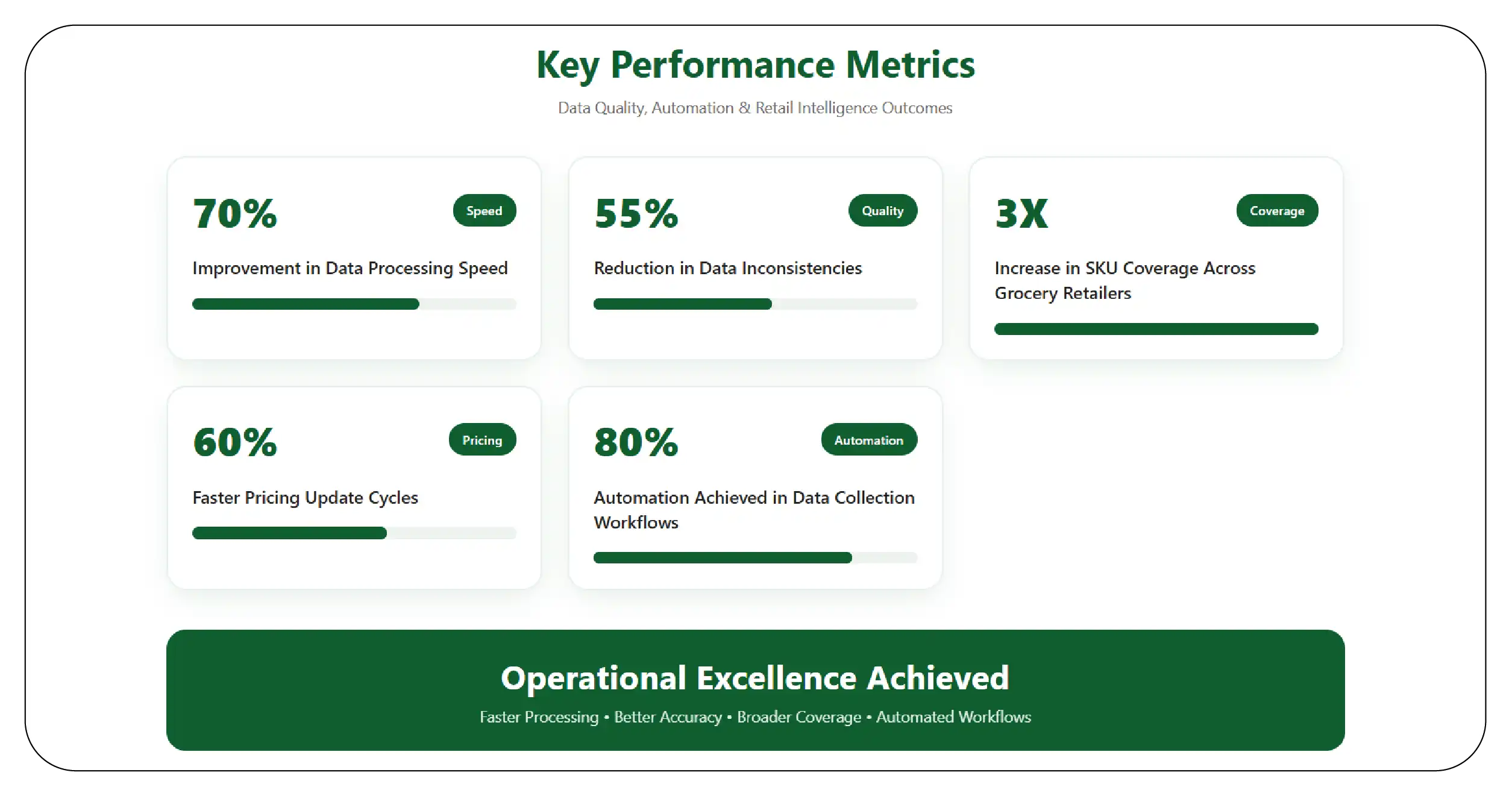
70% improvement in data processing speed
55% reduction in data inconsistencies
3x increase in SKU coverage across grocery retailers
60% faster pricing update cycles
80% automation achieved in data collection workflows
We also enabled advanced insights through Whole Foods Retail Data Analytics and strengthened pricing intelligence using Price monitoring, improving overall decision-making accuracy.
Results Narrative
The implemented solution significantly transformed the client's data operations, enabling them to move from fragmented manual processes to a fully automated intelligence system. Real-time monitoring of grocery pricing and assortment allowed faster and more reliable insights delivery to enterprise clients.
The client achieved improved market responsiveness and enhanced forecasting accuracy across retail datasets. SKU-level visibility increased substantially, allowing deeper competitive benchmarking across multiple grocery chains.
Overall, the system enabled scalable growth, reduced operational overhead, and improved the quality of insights delivered to downstream analytics platforms.
What Made Product Data Scrape Different
Our approach stood out due to its modular architecture and intelligent automation framework designed specifically for grocery retail intelligence. Unlike traditional scraping systems, our solution dynamically adapted to changing retail structures and ensured high data consistency across multiple sources.
We implemented proprietary normalization techniques and scalable pipeline orchestration to ensure uninterrupted data flow.
Key innovations included Whole Foods SKU & Assortment Comparison and enhanced benchmarking through Whole Foods Competitive Benchmarking for Grocery Retailers, enabling deeper SKU-level intelligence and faster decision cycles for the client.
Client's Testimonial
"Working with the Product Data Scrape team transformed our grocery analytics capabilities. Their ability to scale data collection and improve accuracy across complex retail datasets exceeded our expectations. We were able to significantly reduce reporting delays and improve the depth of our competitive insights. The integration of structured benchmarking and real-time monitoring helped us deliver stronger value to our enterprise clients. Their expertise in retail data engineering and automation was instrumental in modernizing our entire analytics pipeline."
— Head of Data Intelligence, Grocery Analytics Firm
Conclusion
This engagement demonstrated how advanced data engineering and automation can transform grocery retail intelligence at scale. By improving data accuracy, speed, and coverage, we enabled the client to build a resilient and future-ready analytics system.
The solution also laid the foundation for next-generation retail insights powered by real-time intelligence and structured benchmarking. Moving forward, we aim to expand capabilities in predictive analytics and cross-retailer comparison frameworks.
Through Retail media intelligence, brands can unlock deeper market understanding and optimize decision-making across channels. The success of Whole Foods Competitive Benchmarking for Grocery Retailers highlights the future of scalable retail data ecosystems.
FAQs
1. What is Product Data Scrape in grocery analytics?
It is the automated process of collecting structured grocery retail data from multiple sources for competitive intelligence and benchmarking.
2. How does Whole Foods benchmarking help retailers?
It provides insights into pricing, assortment, and availability compared to industry standards, enabling better decision-making.
3. Can grocery data scraping improve pricing strategies?
Yes, it enables real-time tracking of competitor pricing and helps optimize dynamic pricing models.
4. What datasets are used in grocery benchmarking?
Common datasets include product listings, pricing data, availability status, SKU attributes, and consumer reviews.
5. Why is automation important in retail data scraping?
Automation ensures scalability, reduces errors, and enables real-time insights across large retail datasets, improving overall analytics efficiency.



 Singapore
 EMAIL
EMAIL
 PHONE
PHONE


.webp)
.webp "thumb")
.webp "thumb")
.webp "thumb")








.webp)