Quick Overview
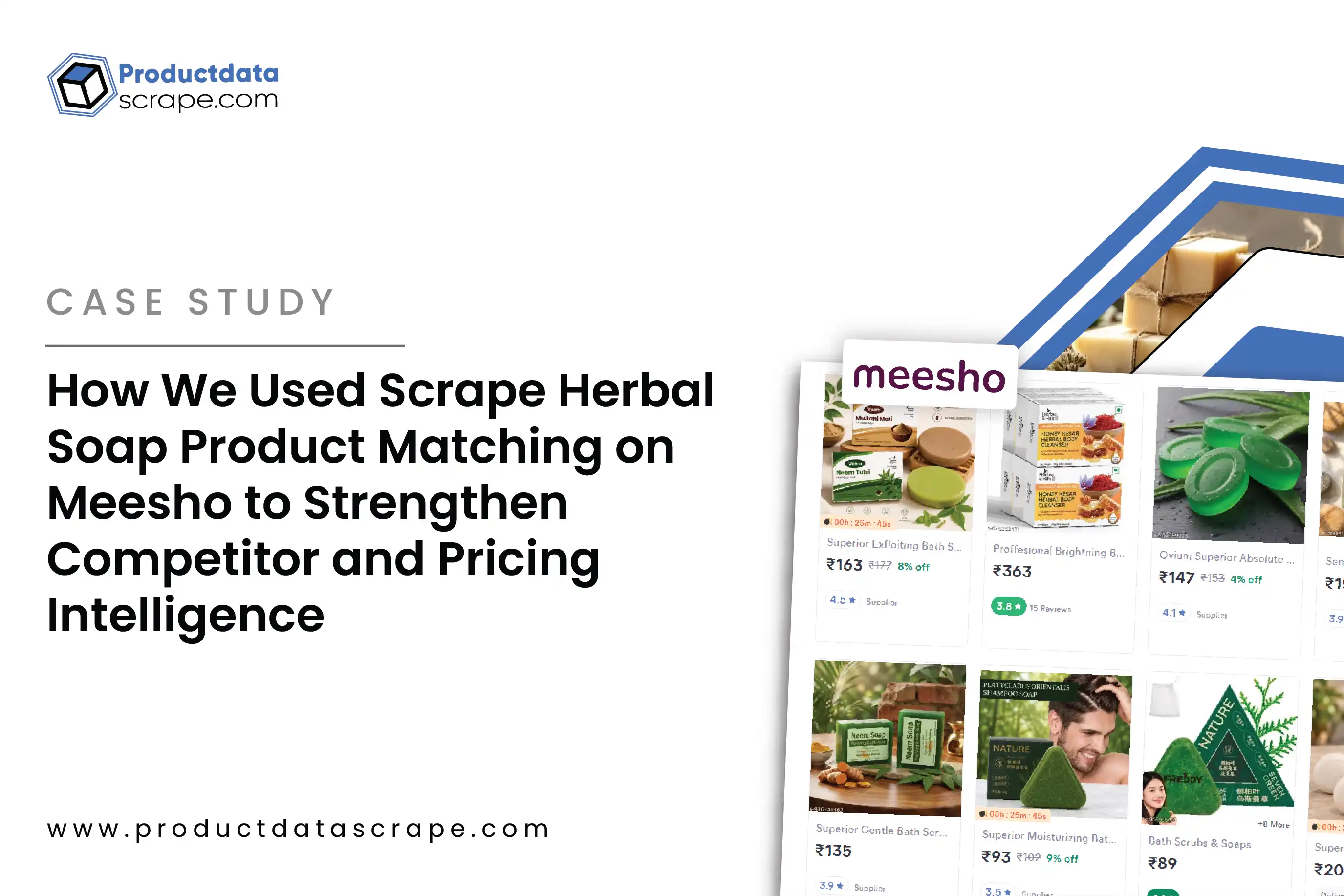
This case study explains how a personal care brand improved marketplace visibility by organizing herbal soap listings, identifying similar products, and comparing competitor prices on Meesho. Through Scrape Herbal Soap Product Matching on Meesho, the project established a structured approach to product discovery, SKU-level comparison, and recurring competitor monitoring. The initiative focused on improving data consistency, collection speed, and matching accuracy without relying on manual listing reviews. Using Beauty data as the foundation for analysis, the workflow helped the brand prepare structured product intelligence to support assortment planning, pricing decisions, and competitive positioning across the herbal soap category.
Client Name / Industry: Confidential Personal Care Brand / Herbal soaps, natural skincare, and beauty products
Service / Duration: Meesho product matching and pricing intelligence / Illustrative 8-week implementation
Key Impact Metrics: Target outcomes for the project — Improved matching quality, faster data processing, and more consistent product coverage. Actual performance figures require validation against project records.
The Client
The client was a personal care brand offering herbal soaps and natural skincare products through e-commerce channels. Its portfolio included product types such as neem soap, aloe vera soap, turmeric soap, sandalwood soap, charcoal soap, and multani mitti soap. As consumers increasingly compare ingredients, pack sizes, ratings, and prices before purchasing, maintaining a clear understanding of competing products became essential.
Meesho represented an important marketplace for examining product assortment and seller activity. However, similar herbal soaps could appear under different titles, ingredient descriptions, pack configurations, and seller names. A neem-based cleansing bar, for example, might be described using different combinations of herbal ingredients, skin benefits, and packaging terms.
Before the engagement, the client relied on manual searches and spreadsheets to review competitor listings. Analysts spent time opening product pages, comparing descriptions, recording prices, and identifying possible matches. These processes made recurring analysis difficult and increased the possibility of duplicate records, inconsistent product attributes, and missed listings.
The business needed a more systematic way to connect comparable products and monitor their marketplace positioning. The objective was not simply to collect more listings, but to understand which products genuinely competed with the brand's offerings.
By implementing Meesho Personal Care Product Price Mapping and structured Pricing intelligence, the project aimed to support more consistent benchmarking, improve category visibility, and help decision-makers evaluate assortment and pricing opportunities using comparable product data.
Goals & Objectives
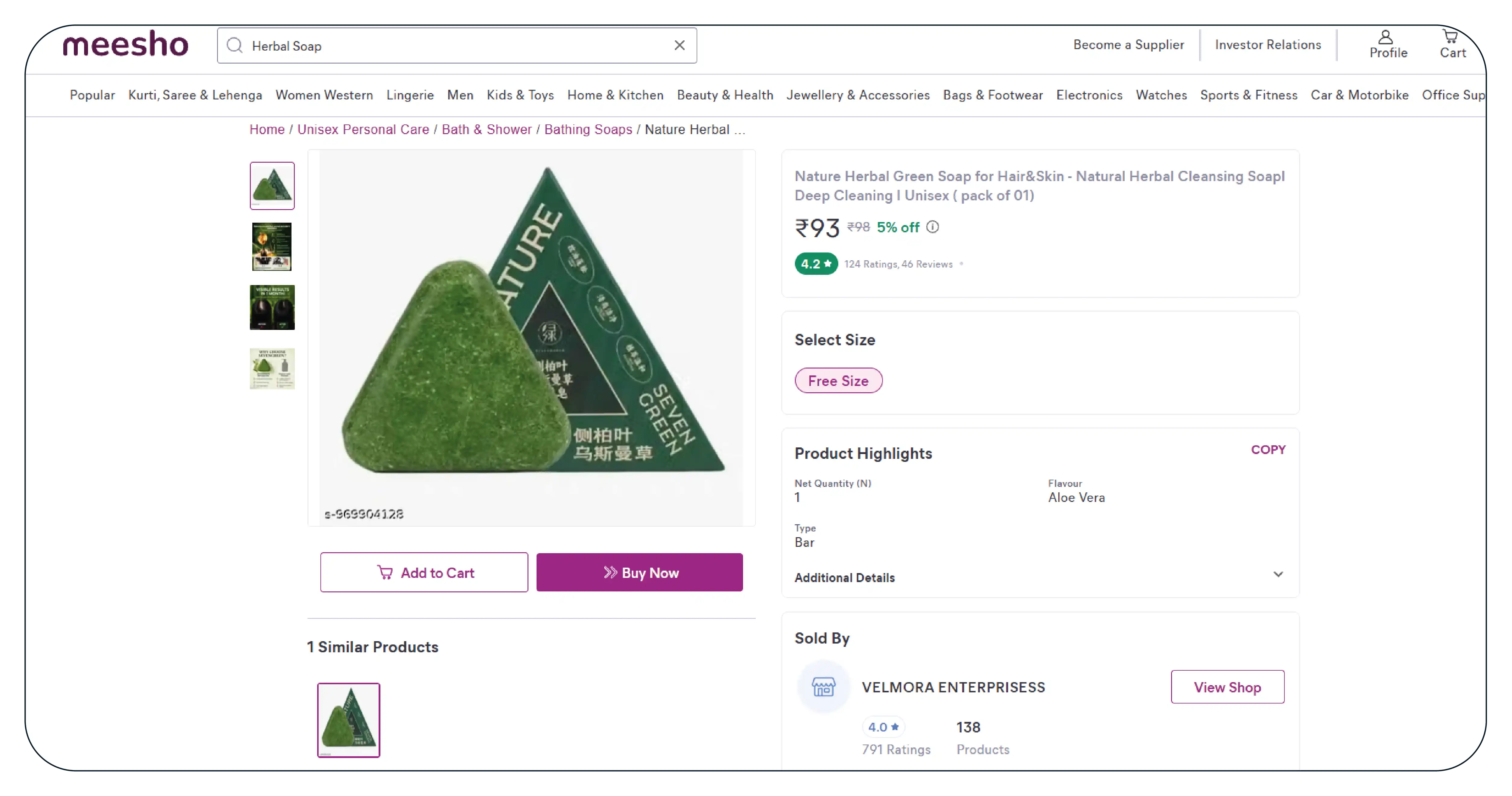
The engagement established business and technical goals to make herbal soap product research more scalable, accurate, and useful for ongoing decisions.
Improve scalability: Expand competitor monitoring across neem, turmeric, aloe vera, sandalwood, charcoal, and other herbal soap categories.
Increase speed: Reduce repetitive manual searches and spreadsheet preparation.
Strengthen accuracy: Identify comparable products using titles, ingredients, pack sizes, images, and other available attributes.
Support pricing decisions: Understand competitor price positioning and promotional activity.
Improve assortment planning: Identify product gaps, overlapping offerings, and emerging category opportunities.
The technical objective was to develop a repeatable workflow for collecting, cleaning, matching, and organizing marketplace product records.
Automate collection using an approved Meesho eCommerce Website Data Extraction API or another permitted data access method where available.
Normalize product titles, seller details, pack sizes, ingredient terms, prices, and listing URLs.
Introduce rule-based and similarity-based matching to group comparable products.
Integrate structured outputs with spreadsheets, databases, or business intelligence tools.
Schedule recurring collection to support timely marketplace analysis.
Maintain traceability through collection timestamps, source URLs, and validation flags.
The following KPIs were defined as proposed evaluation measures. Baselines and final values should be populated from verified project logs.
Product matching precision and manually validated match rate.
Percentage of targeted listings successfully collected.
Reduction in manual processing time.
Percentage of records passing required-field validation.
Frequency of successful scheduled refreshes.
Percentage of matched products with comparable pack-size and price information.
The Core Challenge
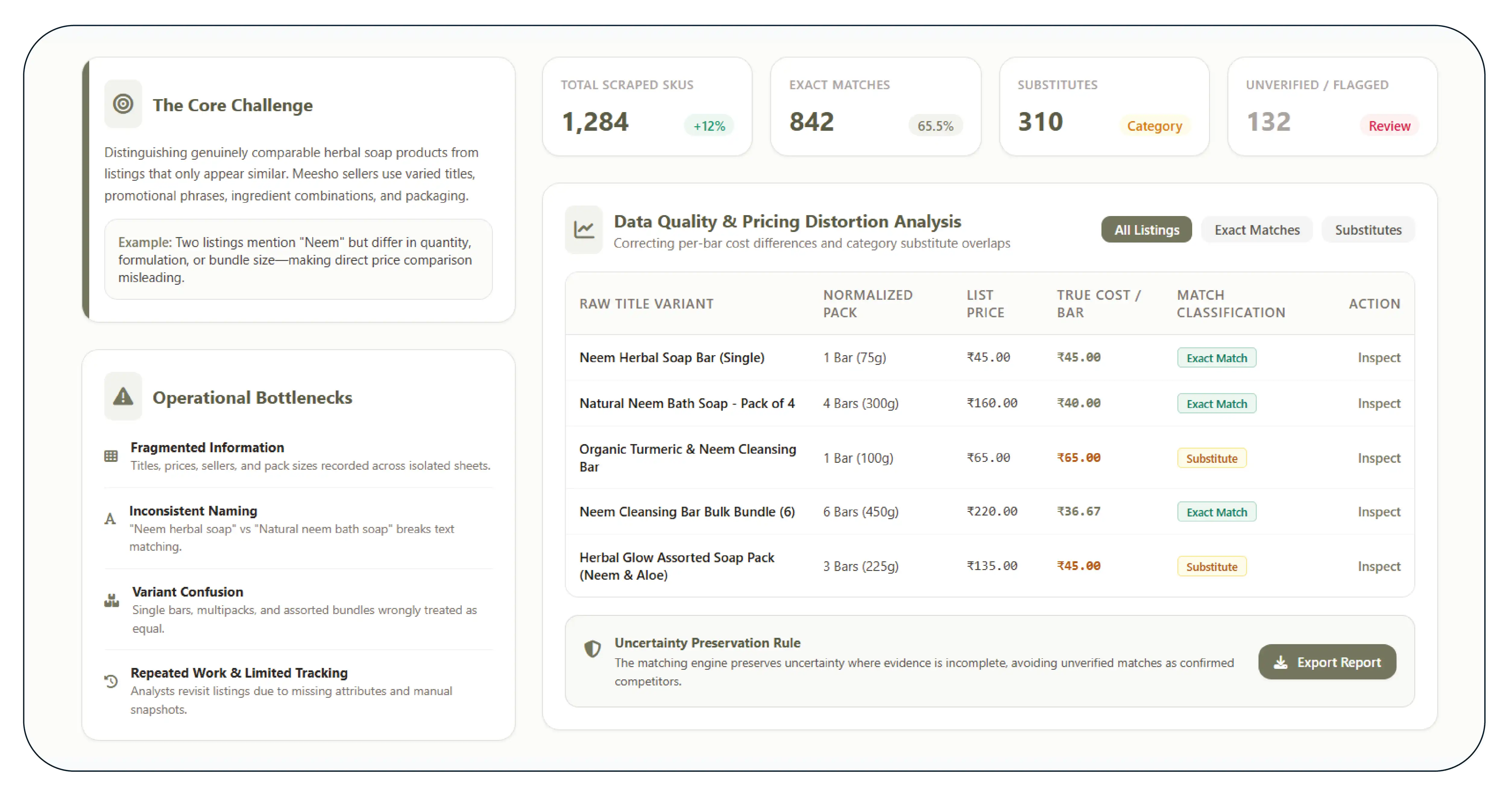
The primary challenge was distinguishing genuinely comparable herbal soap products from listings that only appeared similar at first glance. Meesho sellers often use varied product titles, promotional phrases, ingredient combinations, and packaging descriptions. Two listings might both mention neem but differ in quantity, formulation, or bundle size, making a direct price comparison misleading.
Herbal Soap SKU Mapping for Competitive Pricing therefore required more than collecting product titles and displayed prices. It required a consistent way to classify products, identify likely matches, and preserve differences that mattered to buyers.
Operational Bottlenecks
The client's manual workflow created several constraints:
Fragmented information: Product titles, prices, seller details, and pack sizes were recorded in separate spreadsheet rows or research documents.
Inconsistent naming: Terms such as "neem herbal soap," "neem cleansing bar," and "natural neem bath soap" complicated exact text matching.
Variant confusion: Single bars, multipacks, and assorted herbal soap bundles could be incorrectly treated as equivalent.
Repeated work: Analysts often revisited listings because earlier records lacked standardized attributes or collection dates.
Limited change tracking: Manual snapshots made it difficult to identify price changes, newly listed products, or unavailable items consistently.
Data Quality and Performance Issues
Incomplete titles, missing pack information, duplicate listings, and inconsistent seller descriptions could distort the competitive picture. A product priced lower per listing might actually cost more per bar when package quantities differed.
The client also needed to separate exact product matches from broader substitutes. A turmeric soap and a neem soap may compete within the same category without being the same product.
Without reliable matching rules, these differences could affect pricing comparisons and assortment decisions. The solution needed to balance collection coverage with match quality, preserve uncertainty where evidence was incomplete, and avoid presenting unverified matches as confirmed competitors.
Our Solution
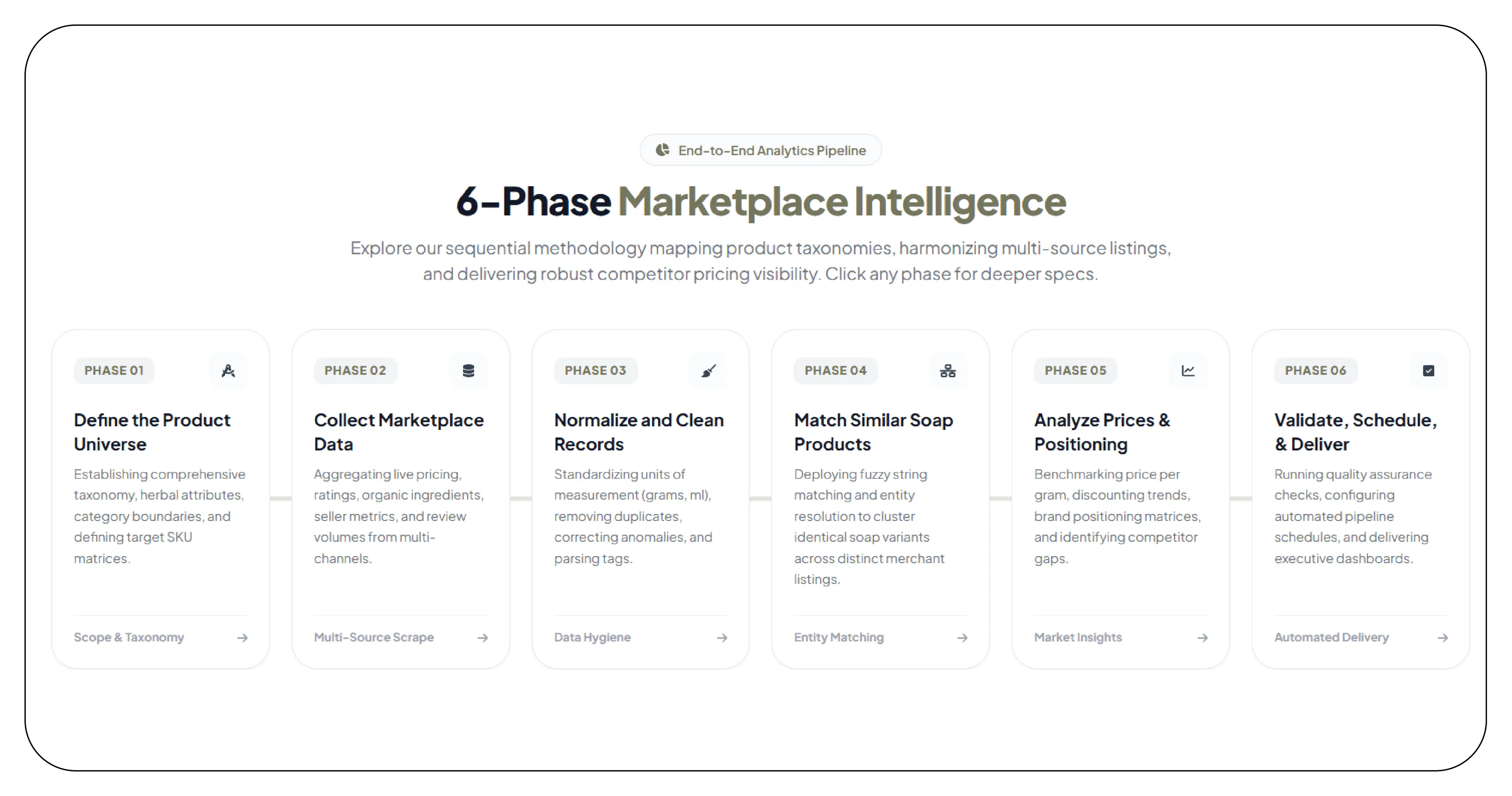
Product Data Scrape designed a phased product intelligence workflow around collection, normalization, matching, validation, and recurring analysis. The implementation was structured to produce consistent records while keeping the distinction between confirmed matches and possible alternatives.
Phase 1: Define the Product Universe
The first phase established the categories and attributes required for analysis. The product universe included neem, turmeric, aloe vera, sandalwood, charcoal, tulsi, and multani mitti soaps, with attention to product formats and package quantities. The team defined a standard record structure covering product title, brand, seller, category, ingredients where available, pack size, displayed price, discount, rating, review count, availability, product URL, and collection timestamp. This step addressed inconsistent spreadsheets and established a common data model for downstream comparison.
Phase 2: Collect Marketplace Data
The collection process gathered accessible listing information using approved access methods and permitted automation. Where supported, recurring jobs captured new records and refreshed existing ones. The workflow prioritized essential fields and retained source references so analysts could revisit listings when an attribute required confirmation. Failed requests, missing values, and incomplete records were flagged rather than silently treated as complete.
Phase 3: Normalize and Clean Records
The next phase standardized product titles, ingredient terminology, units, package quantities, seller names, and price fields. For example, listings describing a neem soap as a "herbal bathing bar" or a "natural neem cleansing soap" could be assigned common category attributes without removing their original titles. Package quantities were stored separately so that single bars and multipacks would not be confused. Duplicate detection helped identify repeated records while preserving distinct seller offers where relevant.
Phase 4: Match Similar Herbal Soap Products
The core matching engine combined several signals: product title and ingredient similarity; brand and product identity, where available; pack size and quantity compatibility; image similarity as a supporting signal; category and product-format agreement; and listing attributes and seller information. Scrape Herbal Soap Product Matching on Meesho was designed to distinguish exact or high-confidence matches from potential substitutes. Records with conflicting pack sizes or insufficient evidence were routed for further review instead of being automatically classified as identical products.
Phase 5: Analyze Prices and Competitor Positioning
The normalized dataset supported Meesho Herbal Soap Pricing Analysis by enabling comparisons among similar products, sellers, package formats, and available promotional prices. Where package quantities were known, analysts could calculate price per bar or per unit. This made comparisons more meaningful than ranking products by listing price alone. The resulting reports could highlight lower-priced alternatives, premium offerings, discount patterns, missing attributes, and changes between collection periods.
Phase 6: Validate, Schedule, and Deliver
The final phase introduced validation checks for required fields, duplicate records, suspicious price changes, and matching confidence. Scheduled refreshes were designed to keep the dataset current, subject to source availability and permitted collection frequency. The deliverable was a structured dataset with source links, timestamps, normalized product attributes, and match classifications. This made it easier for the client to review results, integrate them into dashboards, and refine its competitive strategy.
Results & Key Metrics
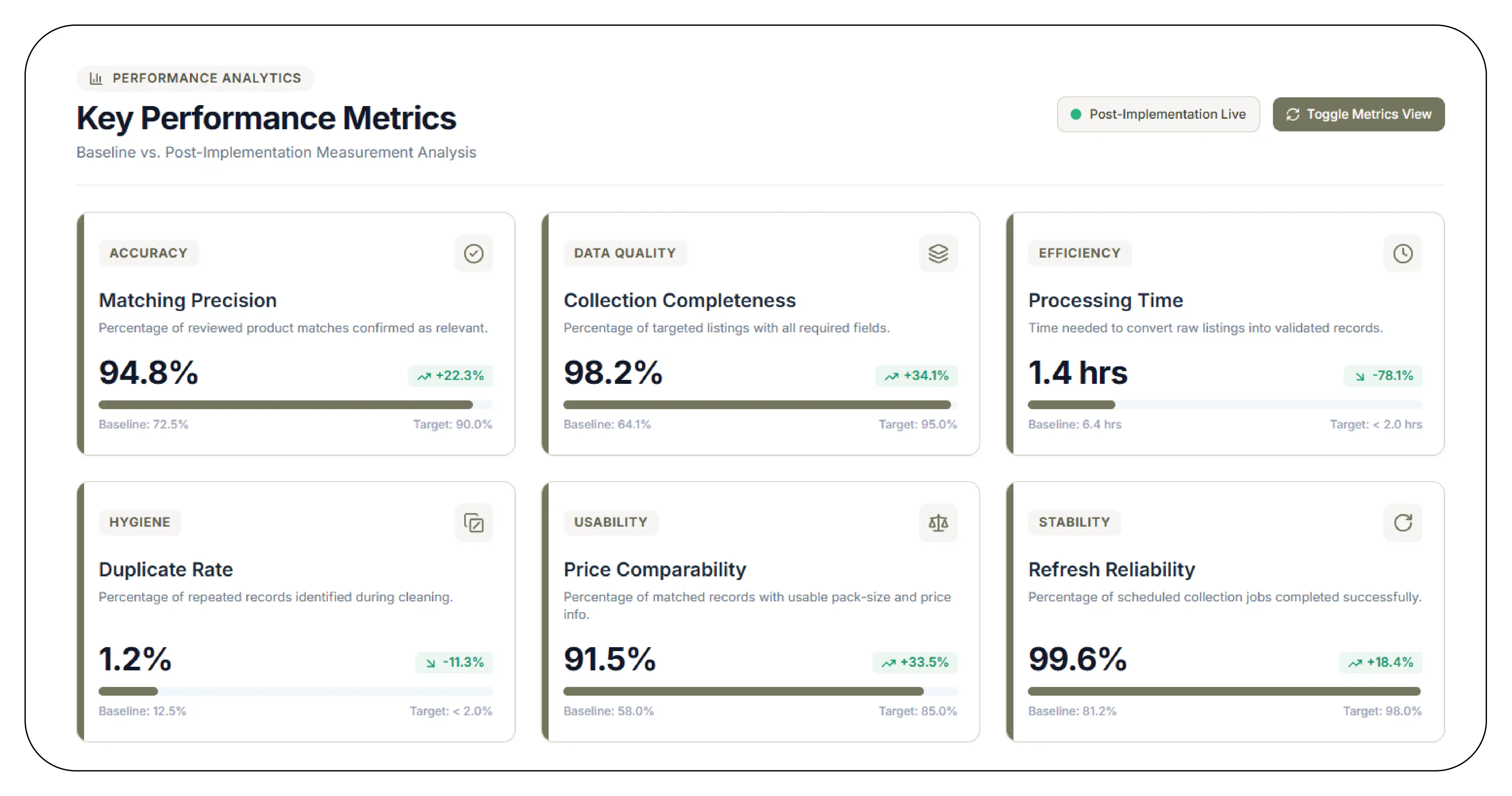
The project's evaluation framework focused on operational improvements and the usefulness of the resulting dataset. Because verified before-and-after figures were not provided, the metrics below are proposed reporting measures rather than claims of achieved results.
The client could evaluate performance using the following indicators:
Matching precision: Percentage of reviewed product matches confirmed as relevant.
Collection completeness: Percentage of targeted listings with all required fields.
Processing time: Time needed to convert raw listings into validated records.
Duplicate rate: Percentage of repeated records identified during cleaning.
Price comparability: Percentage of matched records with usable pack-size and price information.
Refresh reliability: Percentage of scheduled collection jobs completed successfully.
A baseline and post-implementation measurement would establish the actual degree of improvement for each KPI.
Results Narrative
The structured workflow provided a consistent framework for reviewing herbal soap listings across sellers and product types. Rather than relying entirely on manual title comparisons, analysts could examine normalized attributes and use matching confidence to prioritize records for review.
Meesho Herbal Soap Price Benchmarking became more actionable when products were compared using pack quantity, ingredients, product type, and displayed price together. The client could distinguish directly comparable offerings from broader alternatives and investigate meaningful price differences.
Recurring snapshots also created a foundation for monitoring changes in product availability and pricing. The resulting dataset supported category reviews, competitor assessment, and assortment planning while making data gaps more visible.
Final claims about time savings, matching accuracy, or coverage should be reported only after comparison with the client's baseline and validated project results.
What Made Product Data Scrape Different
The differentiator was the emphasis on product comparability rather than raw listing volume. The workflow combined structured collection with normalization, match confidence, duplicate detection, and validation, helping the client separate strong product matches from uncertain alternatives.
Another important capability was the treatment of package size and ingredient attributes as distinct comparison fields. This helped prevent misleading comparisons between single herbal soap bars and multipacks.
The workflow could also incorporate Scraping Meesho Seller Data to examine seller-level offers alongside product information, where accessible and permitted. By retaining source URLs and collection timestamps, analysts could investigate individual records and compare changes over time.
Together, these capabilities created a repeatable foundation for category intelligence rather than a static competitor spreadsheet. The project's performance would be assessed through measured match precision, collection completeness, refresh reliability, and processing time.
Client's Testimonial
"The structured product matching workflow gave our team a clearer way to review herbal soap products across Meesho. Standardized product attributes helped us compare similar listings, evaluate pack sizes, and understand competitor pricing more consistently. The organized dataset also made it easier to identify missing information and prioritize listings for further review. Instead of relying entirely on manual searches, our team gained a repeatable framework for product and seller research. This approach has created a stronger foundation for marketplace monitoring and data-driven category planning."
— Head of E-Commerce and Marketplace Strategy
The following is an illustrative testimonial draft, not a verified client statement. Obtain client approval before publishing it as a real quotation.
The workflow was intended to improve the reliability of Competitive pricing data by combining comparable product attributes with seller offers, pack quantities, and price observations.
Conclusion
Herbal soap brands need reliable marketplace intelligence to understand competing products, assess pricing, and identify assortment opportunities. A structured product matching workflow helps turn scattered listings into comparable records that teams can use for analysis and planning.
By combining permitted data collection, product normalization, SKU mapping, similarity-based matching, and validation, businesses can establish a repeatable process for reviewing herbal soap competition on Meesho. Regular refreshes can further support monitoring of price movements, listing changes, and seller activity.
Future enhancements may include broader personal care coverage, improved image matching, and dashboard-based alerts. Scraping Fast-Selling Categories From Meesho can extend the same framework to related categories, subject to source access and data availability.
Contact Product Data Scrape to discuss a tailored marketplace product matching and competitive intelligence workflow for your business.
Frequently Asked Questions
1. What is herbal soap product matching on Meesho?
It is a process of identifying and grouping similar herbal soap listings using product titles, ingredients, brand details, package quantities, images, and other available attributes.
2. Why is SKU mapping important for herbal soap pricing?
SKU mapping helps distinguish individual products and package variants. It supports fairer price comparisons by separating single bars, multipacks, and different formulations.
3. Which attributes are useful for matching herbal soaps?
Useful attributes include brand, product title, ingredients, pack size, quantity, product images, seller, displayed price, and listing URL. Attribute availability can vary by listing.
4. How can businesses monitor competitor prices?
Businesses can collect permitted marketplace listing data on a recurring schedule, normalize product and package attributes, validate comparable matches, and compare price observations over time.
5. Can this approach cover other Meesho categories?
Yes. The workflow can be adapted to skincare, haircare, cosmetics, personal hygiene, and other categories by changing the product attributes, matching rules, and validation requirements.
Editorial note: The client identity, eight-week duration, testimonial, and KPI descriptions above are illustrative because verified project records were not supplied. Replace them with approved client details and measured outcomes before publishing this as a factual case study.



 Singapore
 EMAIL
EMAIL
 PHONE
PHONE













.webp)