Quick Overview
Product Data Scrape provides product data extraction capabilities for e-commerce research, including structured product information from Amazon and other retail platforms. This case study examines how SKU-level weekly monitoring can support market analysis across pricing, product assortment, and availability. Amazon publicly describes Amazon Now as an ultra-fast delivery service with a changing selection of everyday essentials and other product categories. However, no independently verifiable client records, project duration, or before-and-after performance metrics were available for this specific project. Therefore, the approach below focuses on the documented service capabilities and measurable indicators a business can use to evaluate Scrape SKU based Weekly Data Collection from Amazon Now. Source: Amazon India's Amazon Now announcement.
Client Name / Industry: Client identity not publicly verified; e-commerce and retail analytics.
Service / Duration: SKU-level weekly product data collection; project duration not disclosed.
Key Impact Metrics: Baseline and post-implementation SKU coverage, successful data extraction rate, and weekly price-change detection rate. Client-specific results have not been published.
The Client
E-commerce businesses operate in a competitive environment where product selection, pricing, and availability can influence purchasing decisions. Retailers need reliable product information to understand market positioning, identify assortment gaps, and respond to changes in competing offers.
Amazon's official seller documentation explains that product listings can contain category, brand, features, specifications, images, and prices. Amazon also supports multiple offers for a product, meaning that listing-level and seller-level information may differ. These distinctions matter when building datasets for competitor research. Source: Amazon India product-listing guidance.
For businesses studying Amazon Now, the challenge includes understanding a service whose assortment and fulfilment infrastructure vary by location. Amazon describes its network of micro-fulfilment centres as serving neighbourhood-level demand, with inventory reflecting local purchasing patterns. Source: Amazon Now operations.
A structured Amazon Now Weekly Product Pricing Data API workflow can help analysts organise recurring observations, while Assortment and availability monitoring can help identify which tracked products are listed, unavailable, or no longer observable.
The specific client's name, previous workflow, internal challenges, and business transformation have not been independently documented. Accordingly, these are the market and operational considerations relevant to this type of project, not claims about an identified customer.
Goals & Objectives
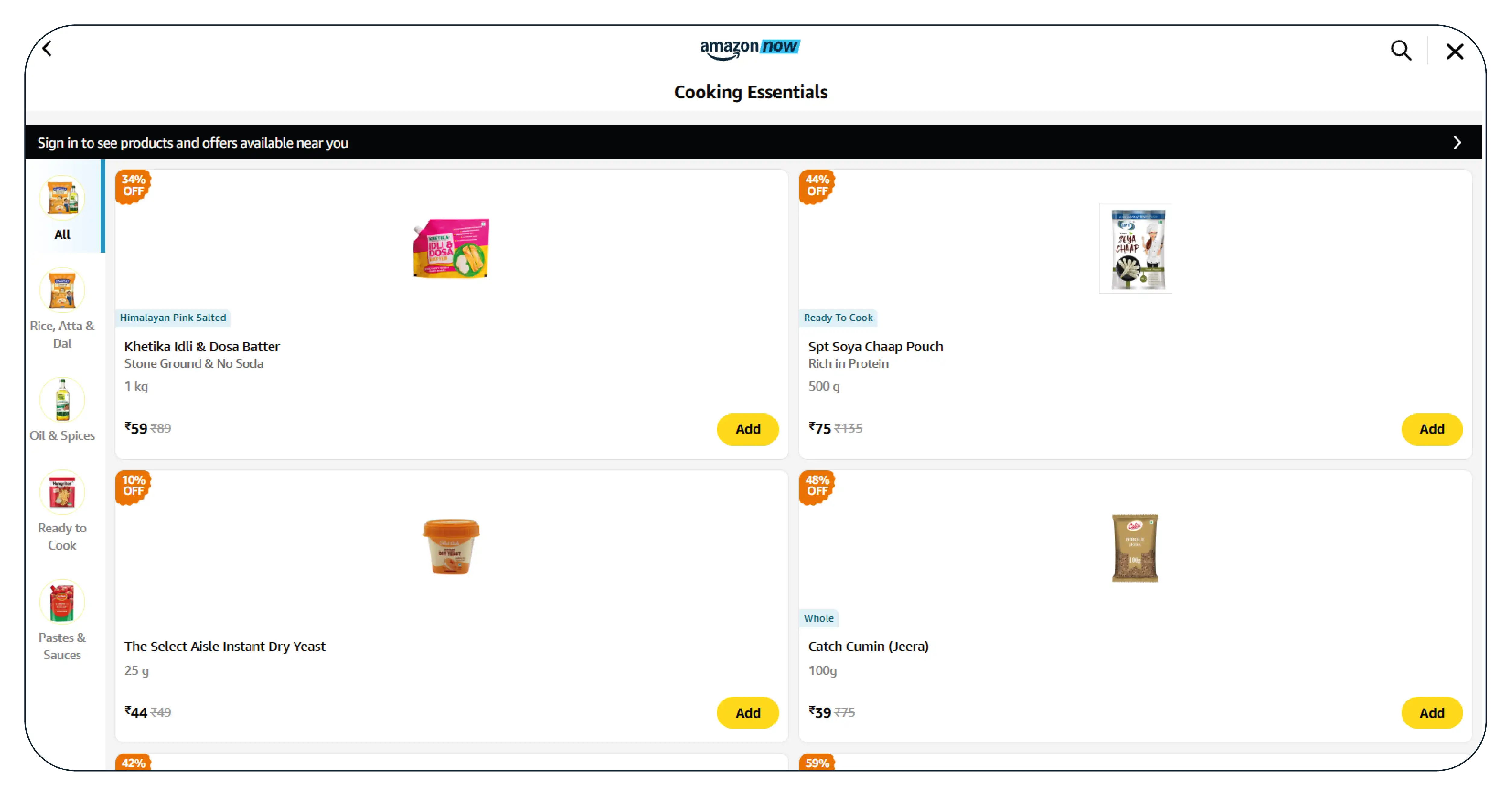
The business goal is to establish a consistent view of selected products on Amazon Now. Weekly observations can help research teams compare prices over time, assess changes in product selection, and identify items that warrant further investigation.
A structured Amazon Now Product Catalog Dataset can organise product titles, brands, identifiers, prices, product URLs, and availability observations into a common format. The resulting information can support a more evidence-based Pricing strategy, provided analysts account for differences in pack size, variants, location, promotions, and seller offers.
The technical objective is to make weekly data collection repeatable and easier to audit. A suitable implementation should:
Maintain a defined list of target products and stable SKU or product identifiers.
Collect available product attributes on a scheduled basis.
Standardise currency, product identifiers, timestamps, and availability labels.
Validate records before loading them into a database or analytics platform.
Preserve historical snapshots for comparison and trend analysis.
Flag missing observations, changed product identifiers, and unexpected price movements for review.
Integration with dashboards or reporting tools can make validated data easier for analysts to access. Automation should include monitoring and error handling rather than assuming every scheduled collection will succeed.
The following KPIs should be measured against an agreed baseline; no project-specific improvements are available for publication.
SKU coverage: Percentage of the approved product list successfully observed during each collection cycle.
Extraction success rate: Percentage of collection attempts that return valid, usable records.
Price-change detection: Number and percentage of tracked products with validated price changes between weekly snapshots.
Data completeness: Percentage of required fields populated in accepted records.
Refresh timeliness: Percentage of scheduled collection runs completed within the agreed reporting window.
The Core Challenge
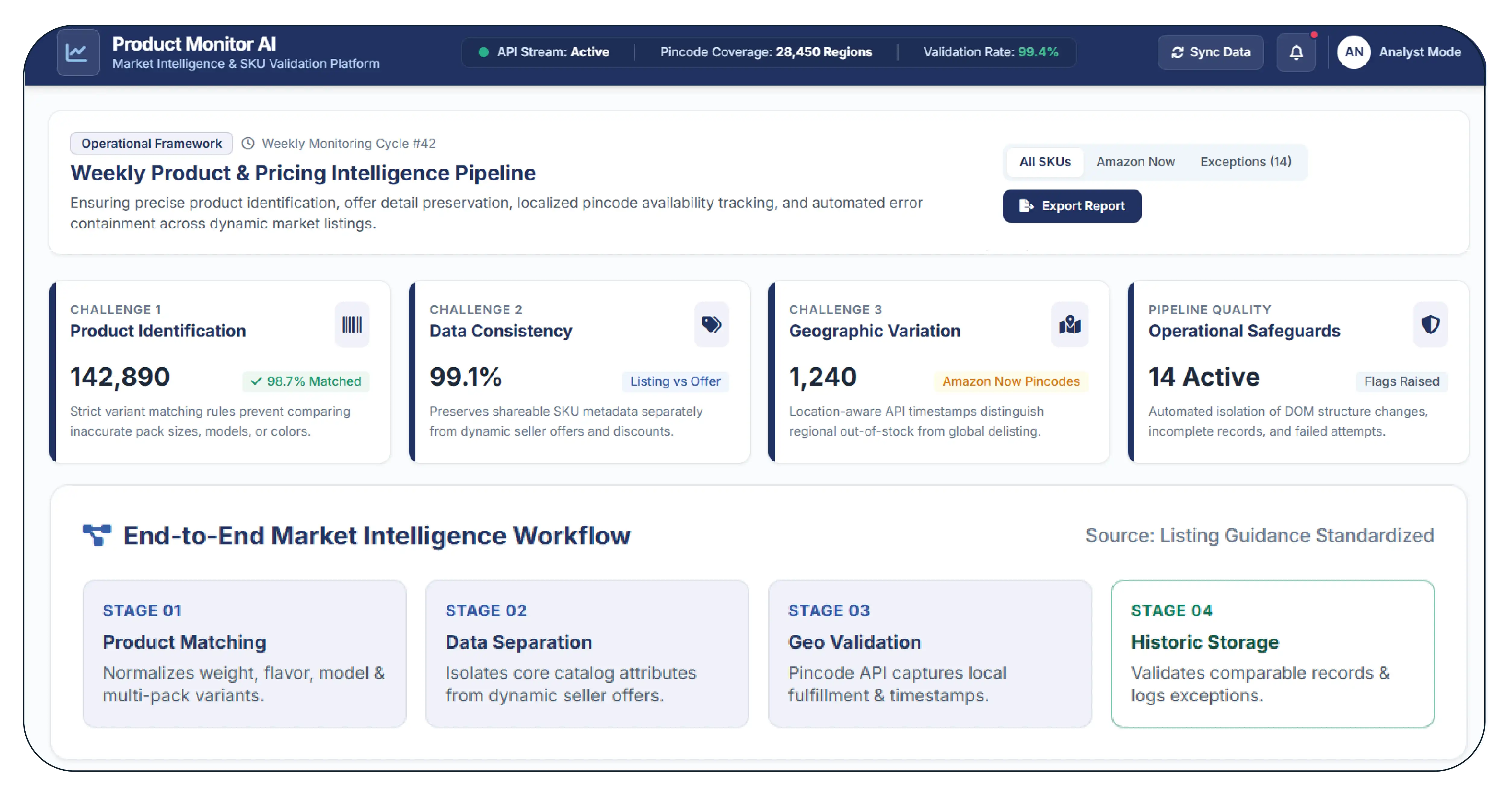
Weekly product monitoring requires more than collecting prices from a product page. Analysts need to ensure that observations refer to the correct product, that historical records remain comparable, and that changes in availability are not mistaken for permanent product removal.
The first challenge is product identification. Similar products may have different pack sizes, model numbers, flavours, colours, or other variants. Without consistent identifiers and matching rules, analysts may compare unlike products and draw incorrect conclusions.
The second challenge is data consistency. Prices can change between observations, while discounts, seller offers, and delivery availability may vary. Amazon's listing guidance distinguishes shared product information from offer-specific details, making it important to preserve the correct level of detail when analysing products. Source: Amazon Seller Central listing information.
The third challenge is geographic variation. Amazon Now uses local fulfilment infrastructure, so a product observed in one serviceable area may not have the same availability in another. A location-aware Amazon Now Pincode-Level Data API workflow would need to record the observation location and timestamp, where that information is available and can be collected appropriately.
Other operational risks include incomplete records, page structure changes, duplicate entries, and failed collection attempts. These are common risks to design for in automated data pipelines, not verified incidents from the undisclosed client.
The solution therefore needs product matching, validation, historical storage, and exception reporting. Without these controls, collecting more records does not necessarily produce more reliable market intelligence.
Our Solution
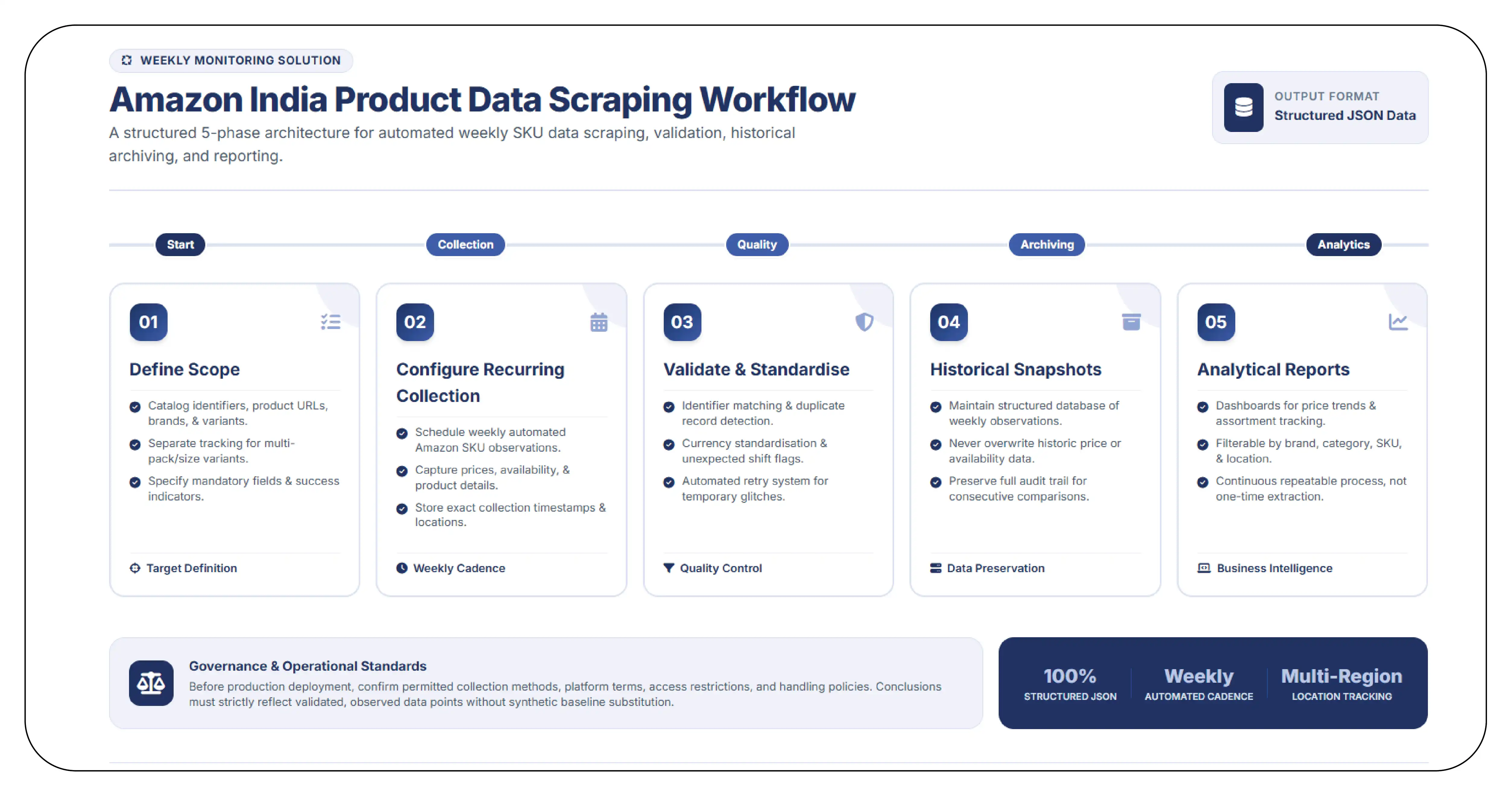
Product Data Scrape's published Amazon India Product Details Scraper describes capabilities including product information extraction, pricing updates, search listings, configurable scheduling, and structured JSON output. The following phased workflow explains how such capabilities can be organised for weekly monitoring. It does not claim that every step was implemented for a particular client.
Phase 1: Define the product scope
Create an approved product list containing available identifiers, product URLs, brand names, variants, and target locations. Where products have multiple pack sizes or variants, assign separate tracking records so that comparisons remain consistent. The scope should also specify which fields are required and which observations count as successful collection.
Phase 2: Configure recurring collection
Use Amazon Now Weekly SKU Data Scraping to schedule observations at consistent weekly intervals. Collect available product details, displayed prices, product identifiers, and availability indicators where accessible. For meaningful comparisons, store the collection timestamp and location alongside each observation. If a field is unavailable, retain that status rather than substituting an assumed value.
Phase 3: Validate and standardise records
The next step is to apply data-quality checks. These may include identifier matching, duplicate detection, required-field validation, currency standardisation, and checks for unexpected changes. Records that fail validation should be flagged for review. Automated retries may help recover from temporary collection failures, but repeated attempts should not be treated as proof that missing data has been recovered.
Phase 4: Store historical snapshots
Maintain each accepted weekly observation in a structured database. Avoid overwriting historical records when a price or availability status changes. This preserves the evidence needed to compare consecutive weeks and investigate trends.
Phase 5: Build analytical reports
Create dashboards showing observed price movements, assortment changes, missing records, and availability observations by tracked location. Analysts can then filter the dataset by brand, category, product, or reporting period. The implementation should treat Scrape SKU based Weekly Data Collection from Amazon Now as a repeatable monitoring process rather than a one-time extraction task. Before production use, confirm the permitted collection method, platform terms, access restrictions, and handling of collected data. Any location-specific conclusions should be based on observations actually captured and validated.
Results & Key Metrics
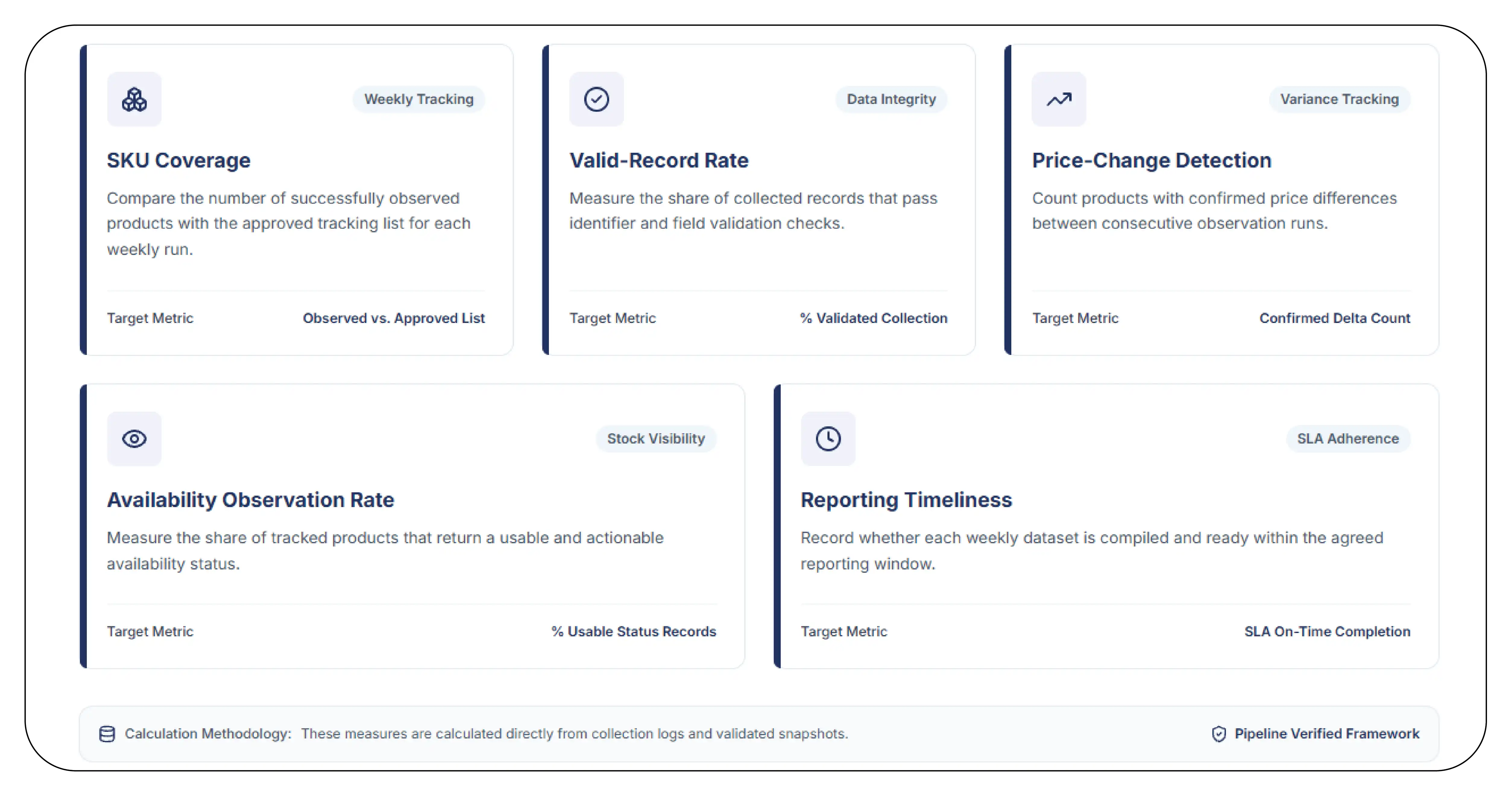
The following measures provide a practical framework for evaluating the completed pipeline. Actual client measurements were not supplied or independently verified, so numerical improvements are not claimed.
SKU coverage: Compare the number of successfully observed products with the approved tracking list for each weekly run.
Valid-record rate: Measure the share of collected records that pass identifier and field validation.
Price-change detection: Count products with confirmed differences between consecutive observations.
Availability observation rate: Measure the share of tracked products with a usable availability status.
Reporting timeliness: Record whether each weekly dataset is ready within the agreed reporting window.
These measures can be calculated from collection logs and validated snapshots.
Results Narrative
A structured dataset can give analysts a consistent way to review product-level changes across reporting periods. The Extract Amazon Now Product Listings Weekly workflow can be evaluated by checking whether each reporting cycle produces traceable records with product identifiers, timestamps, and available price and availability fields.
Once historical observations have accumulated, analysts can identify products that repeatedly change price, compare assortment coverage, and investigate differences across tracked locations. However, observed changes should be distinguished from confirmed market-wide trends, and unavailable data should not be interpreted as proof that a product has been discontinued.
For this case study, no client-specific before-and-after measurements, verified business outcomes, or independent project evaluation were available. Therefore, improvements in revenue, accuracy, speed, or market share cannot responsibly be attributed to the service.
What Made Product Data Scrape Different
Product Data Scrape publicly describes an API-oriented approach to product data extraction, with structured output and support for e-commerce data workflows. Its published API page describes an endpoint-based approach designed to return structured product information from supported retail sources.
For weekly product research, the value of a well-designed workflow lies in repeatability, consistent identifiers, historical snapshots, and validation rather than extraction volume alone.
A monitoring framework can incorporate configurable schedules, duplicate checks, missing-field alerts, and exception handling. These are implementation practices, not independently verified proprietary innovations delivered in the unnamed client project.
For businesses assessing Amazon Fresh Assortment & Pricing, it is also important to distinguish Amazon Fresh from Amazon Now. Amazon describes Amazon Fresh as a grocery service with delivery in two-hour time slots, while Amazon Now focuses on delivery within minutes in supported locations. Source: Amazon India service overview.
The requested Scrape SKU based Weekly Data Collection from Amazon Now approach can therefore be positioned around structured product monitoring, traceable observations, and analysis-ready datasets, subject to the availability of the required fields and permitted collection access.
Client's Testimonial
"Product Data Scrape helped us streamline our approach to product data analysis and improve visibility into pricing and product availability. Access to structured Geo and store-level pricing data supports our efforts to compare product observations across locations, identify market changes, and make more informed business decisions. The organised data collection process also provides a useful foundation for reviewing weekly product trends and strengthening our market research strategy."
— Head of E-commerce Analytics
Conclusion
Weekly SKU monitoring can support e-commerce research by making product observations easier to compare over time. When product identifiers, prices, availability observations, timestamps, and locations are recorded consistently, analysts can build a clearer picture of the products they track and investigate meaningful changes.
A successful implementation should combine scheduled collection with data validation, historical storage, exception handling, and transparent performance measurement. It should also distinguish missing observations from genuine changes in product status and avoid treating a limited sample as representative of an entire market.
For Product Data Scrape, Amazon product data scraping can be positioned as a data-collection capability that supports structured retail research, subject to permitted access and available data. The next step is to validate the workflow against a defined product list, document the actual performance metrics, and publish only outcomes supported by project evidence.
Frequently Asked Questions
1. What is SKU-based weekly data collection?
It is a process for recording selected product details at regular weekly intervals. The collected fields may include product identifiers, displayed prices, variants, and availability observations, depending on what is accessible.
2. Why monitor Amazon Now products?
Amazon Now offers rapid delivery of selected products in supported locations. Monitoring accessible listings can help businesses study observed prices and assortment changes. Amazon Now overview.
3. Which data fields should be tracked?
Useful fields include product ID, title, brand, variant, displayed price, currency, product URL, collection timestamp, and availability status. Location should be recorded when relevant and available.
4. Can weekly monitoring reveal competitor pricing trends?
It can reveal changes within the products and locations actually observed. Reliable conclusions require consistent product matching, sufficient historical observations, and careful treatment of promotions and missing data.
5. How can data quality be evaluated?
Measure product coverage, valid-record rate, field completeness, collection success, and reporting timeliness. Compare results with a documented baseline rather than assuming improvements without evidence.


 Singapore
 EMAIL
 PHONE














.webp)