Quick Overview
This case study outlines how a retail brand can establish a structured pricing intelligence workflow to monitor marketplace prices, identify potential policy discrepancies, and improve data accuracy. The proposed Comprehensive Marketplace Price Monitoring & Compliance Solution combines product matching, price validation, seller identification, and exception reporting to support informed decisions. The workflow can also incorporate ESG & Sustainability Data Scraping where relevant product claims and sustainability attributes are available and appropriate to the research scope. The client identity, project duration, and measured outcomes were not provided; therefore, this overview describes the proposed approach rather than claiming verified implementation results.
Client Name / Industry: Confidential retail brand / Ecommerce retail.
Service / Duration: Marketplace price monitoring and compliance data workflow / Duration to be confirmed.
Key Impact Metrics: Recommended measures include product-price matching accuracy, time required to detect pricing discrepancies, and percentage of flagged records successfully reviewed.
The Client
The client was a retail brand managing product distribution across online marketplaces and digital retail channels. Its commercial team needed a clearer view of how listed prices compared with internal pricing policies and authorized reseller records. As product catalogs and seller offers changed, maintaining consistent visibility across multiple channels became increasingly difficult. Manual reviews could identify individual discrepancies, but they were less suited to continuous monitoring across a broad assortment.
The challenge reflected wider ecommerce pressures. Retailers and brands must account for changing offers, discounts, shipping costs, product identifiers, and differences between sellers. Amazon's published marketplace pricing policy, for example, explains that pricing assessments can consider historical offer prices and prices available from other retailers. Its policy also identifies potentially misleading reference prices and other pricing practices that may affect customer trust. Source: Amazon Marketplace Fair Pricing Policy.
Before adopting a structured monitoring process, the client needed a reliable way to track MAP violations on online marketplaces and distinguish genuine discrepancies from legitimate promotions, data errors, or differences in offer conditions. Unauthorized Seller Detection was another research priority: the team needed to compare observed seller information with its own approved reseller records rather than assume every unfamiliar seller was unauthorized.
The transformation mattered because pricing data is useful only when records are comparable, exceptions are traceable, and findings can be reviewed by the appropriate business team.
Goals & Objectives
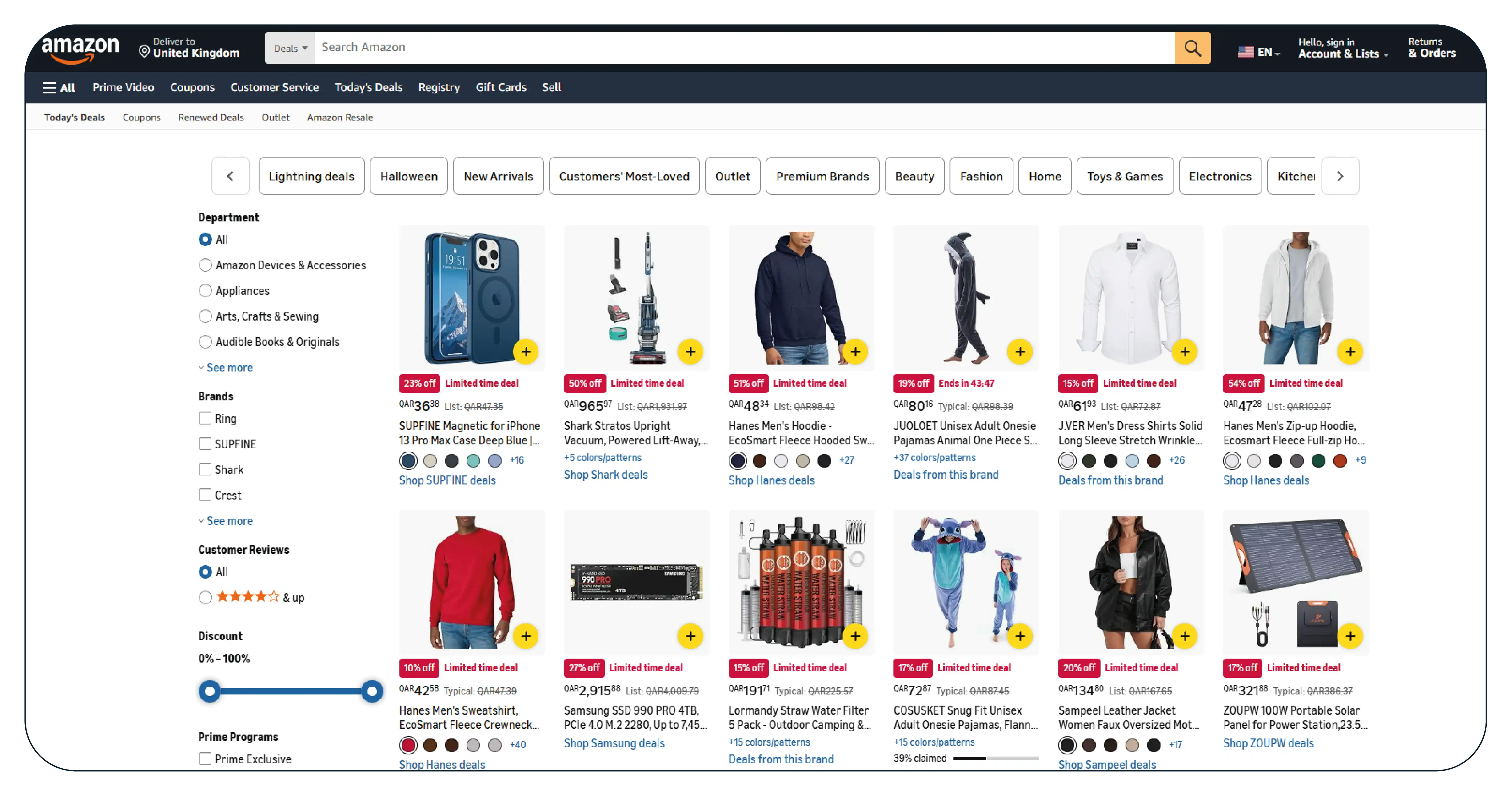
The primary goal was to create a scalable process for observing marketplace prices and identifying potential discrepancies against documented brand policies. The workflow needed to support consistent pricing decisions, reduce dependence on repetitive manual checks, and give ecommerce teams a clearer view of products requiring attention.
The proposed marketplace compliance monitoring process would help organize price observations, product identifiers, seller details, and policy thresholds into a consistent review structure. It would also support collaboration between ecommerce operations, channel management, and brand protection teams.
The technical objective was to establish a repeatable pipeline for data collection, validation, product matching, exception detection, and reporting. Where authorized source access and technical capabilities permit, scheduled collection or supported APIs could supply updated observations. Validation rules would flag missing identifiers, inconsistent prices, duplicate records, and unexpected changes before the data reached reporting systems.
The workflow would incorporate MAP and RRP compliance monitoring using the brand's documented pricing rules. MAP, or Minimum Advertised Price, concerns advertised-price policies, while RRP generally refers to a recommended retail price. These concepts are not interchangeable, and applicable contractual terms and local competition laws must be considered before interpreting a discrepancy as a violation.
The following are recommended performance indicators, not measured results from a verified client engagement.
Product matching accuracy, measured against manually validated product matches.
Price discrepancy detection time, measured from an observable price change to its appearance in the review queue.
Data completeness, measured as the proportion of records containing required fields.
Alert precision, measured as the proportion of reviewed alerts confirmed as genuine discrepancies.
Review resolution time, measured from alert creation to a documented decision.
The Core Challenge
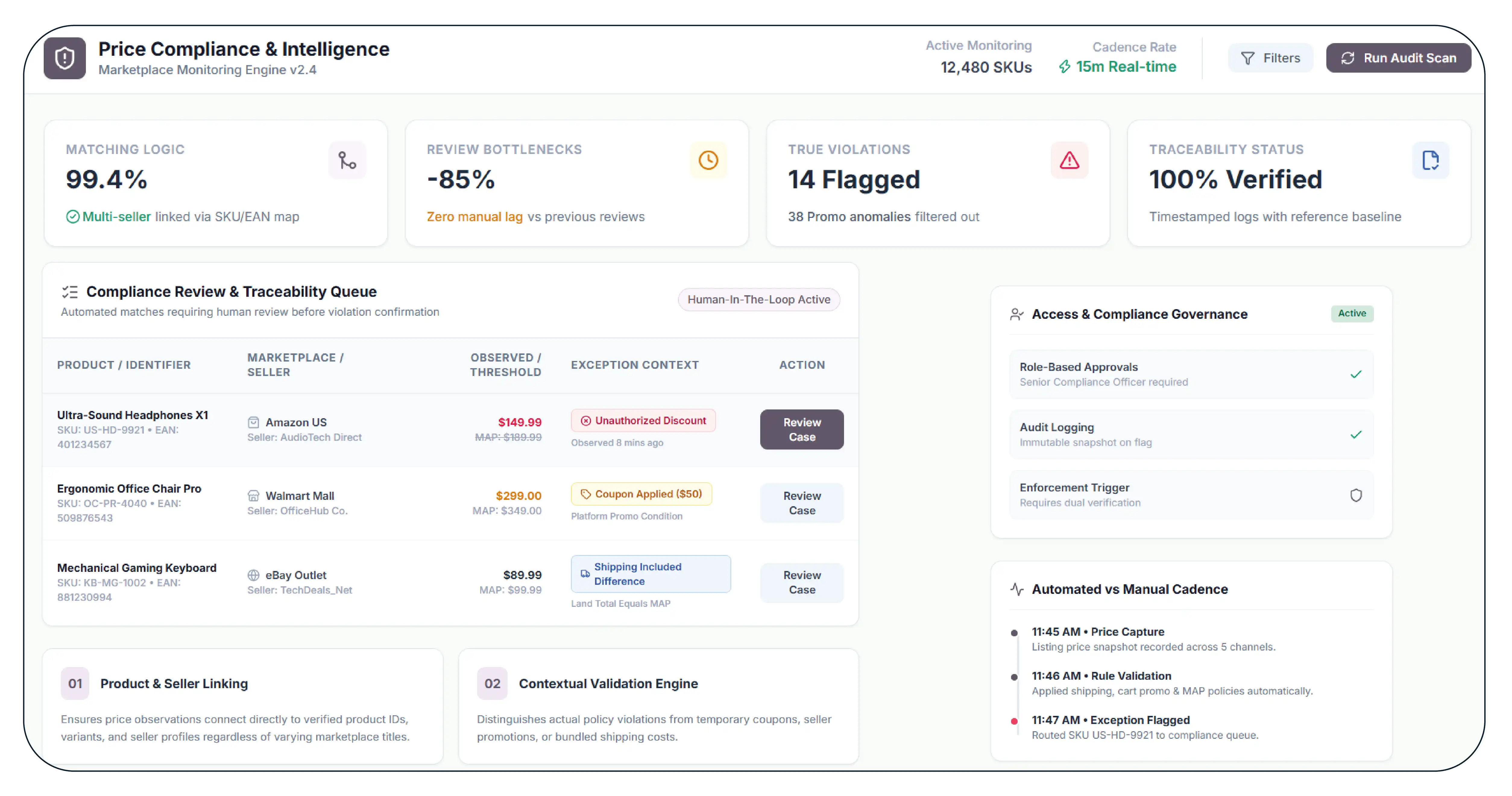
The central problem was not simply collecting prices. It was ensuring that every price observation was linked to the correct product, seller, marketplace, and applicable policy. The same product can appear in multiple offers, while product titles may vary and sellers may use different identifiers or descriptions. Without dependable matching rules, an automated process can incorrectly compare unrelated products or overlook meaningful discrepancies.
Manual monitoring introduced additional operational bottlenecks. Team members had to navigate listings, record prices, compare them with internal rules, and communicate potential issues to colleagues. Repeating these steps across many products made it difficult to maintain a consistent review cadence. Delays also meant that a price observed during one review might no longer reflect the current offer when the team investigated it.
A second challenge involved interpreting exceptions correctly. A lower displayed price does not automatically establish a policy violation. Promotions, coupons, shipping costs, marketplace-specific conditions, and differences in product variants can affect comparisons. The workflow therefore needed to distinguish a data anomaly from a potential compliance issue.
The client also needed clear reporting and traceability. Each alert had to show the observed value, reference threshold, collection time, product identifier, seller information when available, and reason for flagging. A Marketplace Price Monitoring & Compliance workflow could provide this structure, but it would require validation rules, appropriate access controls, and human review before a flagged observation was treated as a confirmed violation.
Our Solution
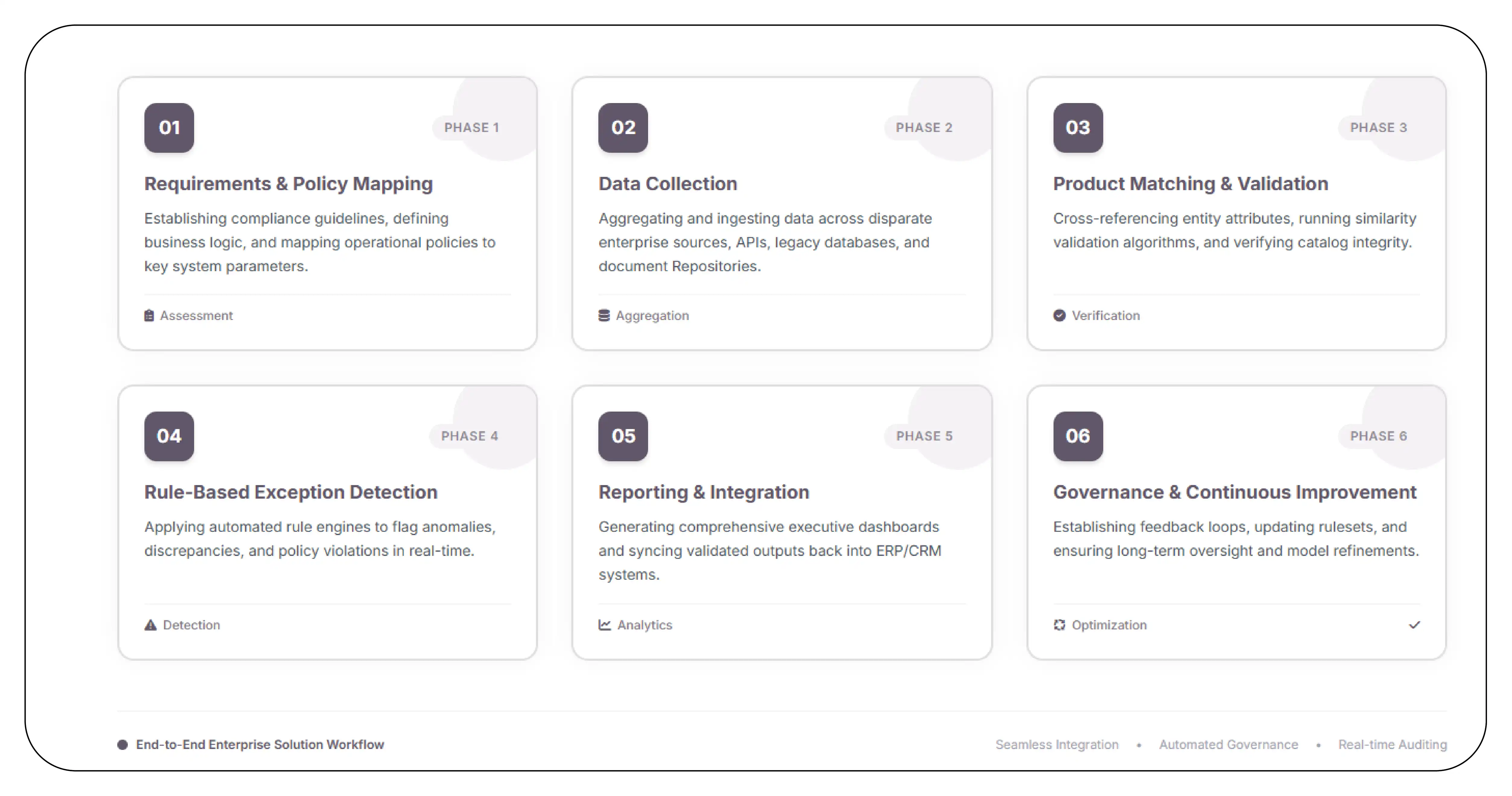
The proposed implementation used a phased workflow to turn marketplace observations into reviewable pricing intelligence. Each phase addressed a specific data-quality or operational challenge.
Phase 1: Requirements and policy mapping.
The process began by defining the target marketplaces, product assortment, authorized data sources, collection frequency, and required attributes. The client's pricing policies and approved seller records would serve as reference inputs. Different policy types would be documented separately to avoid treating recommended prices and advertised-price requirements as equivalent.
Phase 2: Data collection.
The collection layer would retrieve relevant product and offer information from permitted sources, using supported APIs or other authorized methods where appropriate. Potential fields included product identifiers, brand, model or variant, seller name, listed price, available discount information, shipping details, marketplace URL, and observation timestamp. Collection frequency would depend on source limitations, business requirements, and the volatility of the product category.
Phase 3: Product matching and validation.
Records would be matched using reliable identifiers such as GTINs or manufacturer part numbers when available. Secondary matching attributes could include brand, model, size, or variant. Validation rules would identify missing fields, duplicates, implausible values, and inconsistent product matches before comparisons were generated.
Phase 4: Rule-based exception detection.
The system would compare eligible observed prices against the client's documented thresholds and seller reference data. The Comprehensive Marketplace Price Monitoring & Compliance Solution would categorize exceptions for review rather than automatically declare every flagged offer a confirmed violation. Where seller information was incomplete, the alert would remain unresolved until additional verification.
Phase 5: Reporting and integration.
Structured records and alerts could be delivered to dashboards, spreadsheets, or internal business intelligence tools. Each alert would include its supporting evidence, timestamp, rule applied, and review status. This would give pricing teams a repeatable process for prioritizing exceptions and recording decisions.
Phase 6: Governance and continuous improvement.
Collection failures, source changes, false-positive alerts, and unresolved matches would be reviewed periodically. Access permissions and retention rules would be aligned with business requirements and applicable obligations. The workflow could also be extended to additional marketplaces after the initial data quality and operating requirements had been validated.
Results & Key Metrics
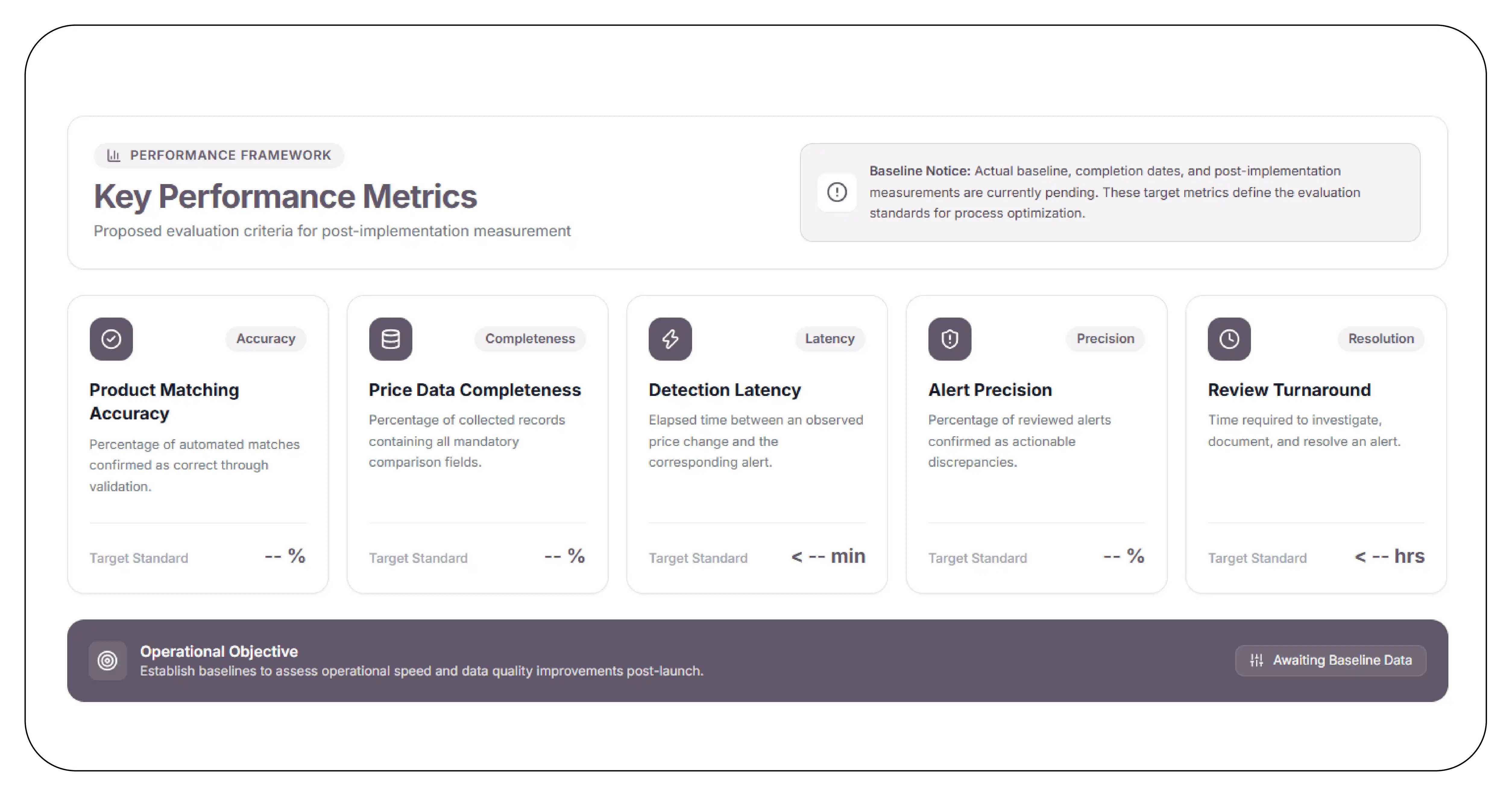
The engagement's actual baseline, completion date, and post-implementation measurements were not supplied. No numerical improvements can therefore be verified. The following metrics define how the proposed workflow should be evaluated after implementation.
Product matching accuracy: Percentage of automated matches confirmed as correct through validation.
Price data completeness: Percentage of collected records containing all mandatory comparison fields.
Detection latency: Elapsed time between an observed price change and the corresponding alert.
Alert precision: Percentage of reviewed alerts confirmed as actionable discrepancies.
Review turnaround: Time required to investigate, document, and resolve an alert.
These measures would establish a baseline and help the client assess whether the process improves operational speed and data quality.
The intended outcome was a more consistent approach to identifying and reviewing marketplace pricing discrepancies. Structured product records would make comparisons easier to reproduce, while timestamps and source references would help reviewers understand when and where a price was observed.
A documented exception workflow would also help separate data errors, legitimate promotional conditions, and potential policy issues. This distinction is essential because automated alerts identify cases for investigation; they do not independently establish contractual or legal violations.
The MAP policy compliance monitoring for brands process would support a more traceable review cycle by preserving the comparison rule, observed offer, reference threshold, and decision status. The proposed Comprehensive Marketplace Price Monitoring & Compliance Solution would be considered successful if post-implementation measurements demonstrated better data quality, faster detection, and more efficient review without increasing false-positive rates.
Actual improvements should be published only after the client has supplied validated before-and-after measurements.
What Made Product Data Scrape Different
The approach emphasizes data quality and explainable exceptions rather than treating collection volume as the primary measure of success. Product Data Scrape can structure a monitoring workflow around stable product identifiers, standardized price fields, timestamps, seller records, and validation checks. By incorporating marketplace reseller compliance analytics, businesses can trace why a record was flagged, evaluate seller activity against approved reseller records, and make more informed decisions about potential pricing discrepancies and compliance risks.
The Price monitoring process can combine scheduled collection, configurable rules, duplicate detection, and exception reporting where supported by the source environment. Its design can also separate observed data from calculated indicators, reducing the risk of confusing a raw marketplace value with an analytical conclusion. The Comprehensive Marketplace Price Monitoring & Compliance Solution can be tailored to a client's products, authorized sources, and review requirements. Specific proprietary technologies, integrations, or performance advantages should be described only when confirmed by project documentation.
Client's Testimonial
"Having structured marketplace pricing information can make it easier for our team to investigate differences between observed offers and our internal pricing policies. A consistent record of product details, seller information, timestamps, and flagged exceptions gives reviewers a clearer starting point for their investigations. We also value the distinction between an automated alert and a confirmed policy violation, as this helps keep decisions grounded in evidence. A well-designed data workflow can support better coordination between ecommerce operations and channel management while making pricing reviews more traceable."
— Head of Ecommerce Operations
Conclusion
Accurate marketplace pricing oversight depends on more than frequent data collection. Retail brands need consistent product matching, reliable price observations, clear policy rules, and a review process that distinguishes potential violations from legitimate offer differences. A structured monitoring workflow can help bring these elements together and make pricing investigations more traceable.
By organizing Competitive pricing data into validated product and seller records, businesses can create a stronger foundation for monitoring market activity and reviewing discrepancies. The proposed Comprehensive Marketplace Price Monitoring & Compliance Solution provides a framework for collecting observations, validating comparisons, generating explainable alerts, and measuring performance through defined KPIs.
For Product Data Scrape, the next step is to align the workflow with the client's marketplace coverage, authorized data sources, product identifiers, policy documentation, and reporting requirements. With validated implementation data, the brand can then assess measurable improvements and refine the process over time.
Ready to improve marketplace pricing visibility and data quality? Contact Product Data Scrape to discuss a monitoring workflow tailored to your products, channels, and compliance review needs.
FAQs
1. What is marketplace price monitoring?
Marketplace price monitoring is the structured observation of product prices across online retail channels. It helps brands compare offers, track changes, and investigate discrepancies against internal pricing rules.
2. How does MAP violation detection work?
MAP violation detection compares observed advertised prices with a brand's documented MAP thresholds. Alerts should be reviewed against applicable policies, offer conditions, and relevant legal requirements before being classified as violations.
3. Can unauthorized sellers be identified automatically?
Automated systems can flag sellers that do not match an approved reseller list. A flag alone does not prove unauthorized status; verification against reliable business records and applicable agreements is still necessary.
4. Which data fields are useful for compliance reviews?
Product identifiers, brand, seller, marketplace, observed price, shipping information, discounts, timestamp, source reference, and the applicable policy threshold can help reviewers investigate discrepancies consistently.
5. How should businesses measure monitoring performance?
Businesses should measure product matching accuracy, data completeness, detection latency, alert precision, and review turnaround. Baselines and post-launch results should be documented before claiming improvements.


 Singapore
 EMAIL
 PHONE














.webp)