Quick Overview
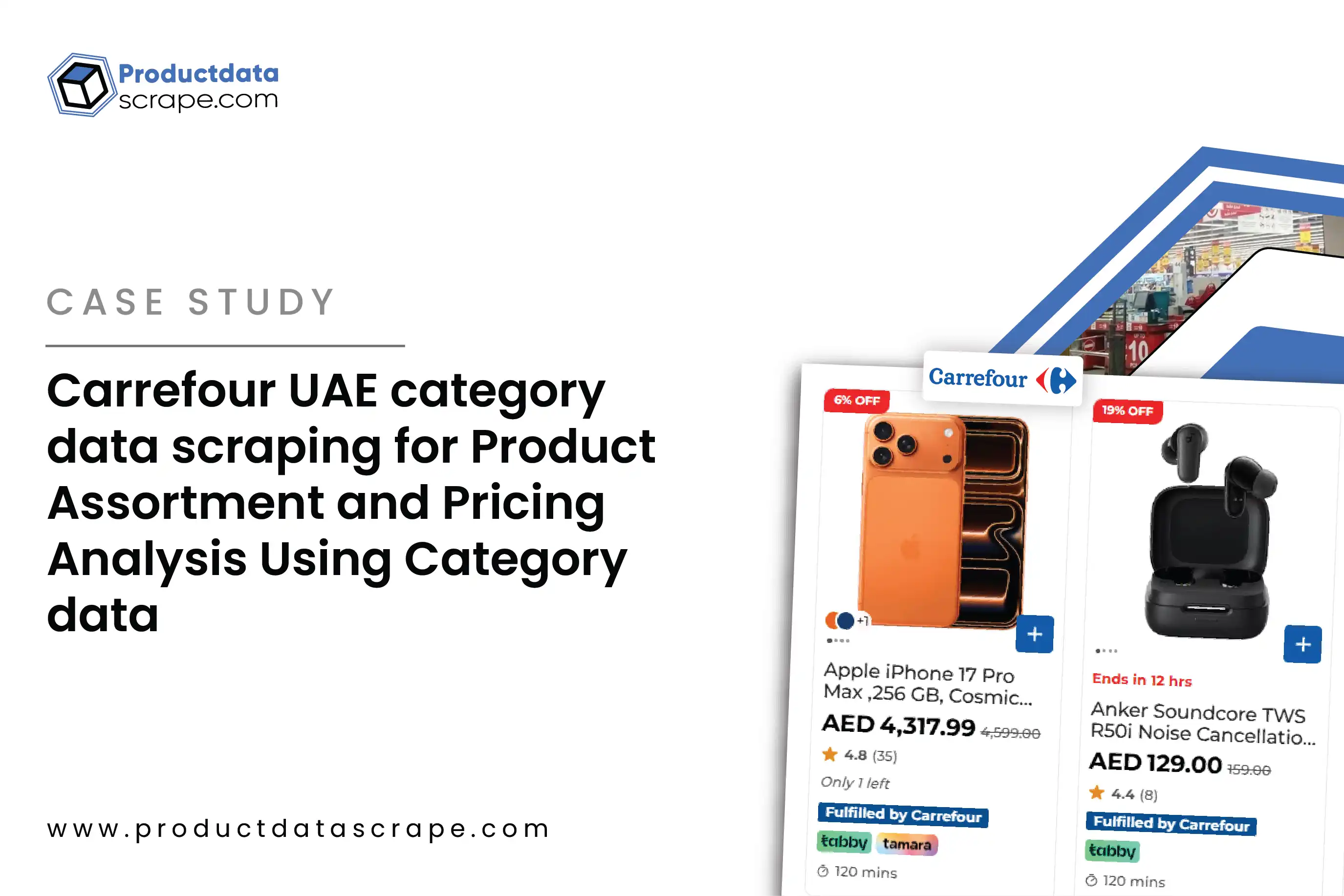
Carrefour UAE operates an online shopping platform covering grocery, fresh food, beverages, beauty, baby care, electronics, and other retail categories. Its website also displays different delivery options, making accurate product and availability information valuable for retail analysis. Source: Carrefour UAE official website. This case study outlines how Carrefour UAE category data scraping could organize publicly accessible product information into a structured dataset for category analysis and competitive intelligence. The proposed Carrefour Quick Commerce Data Scraping API would support automated collection, validation, and integration, with performance assessed against agreed data-quality, coverage, and refresh-rate KPIs.
The Client
Carrefour UAE is part of Majid Al Futtaim's retail business, which operates Carrefour in the United Arab Emirates. The official Carrefour website lists a broad assortment, including fresh food, fruits and vegetables, pantry staples, dairy, beverages, frozen food, beauty, personal care, home products, and electronics. This breadth makes category-level product information useful for assortment analysis, catalog management, and retail intelligence. Source: Carrefour UAE.
The market context is increasingly digital. In December 2024, Majid Al Futtaim announced a Carrefour 24/7 express grocery delivery service in Dubai, with delivery in 60 minutes or less and access to more than 10,000 products. These are published service details, not evidence of a particular scraping engagement. Source: Majid Al Futtaim announcement.
For retailers and data teams studying this environment, the transformation opportunity is to turn product listings into consistent, searchable records. A Carrefour UAE grocery category scraper could be designed to organize category, brand, SKU, pack size, displayed price, and availability fields where those fields are publicly accessible. Similar catalog analysis can apply to beauty retail; Sephora US Product Data Scrape is a separate example of a category-focused data use case, not evidence of a Carrefour project or partnership.
Goals & Objectives
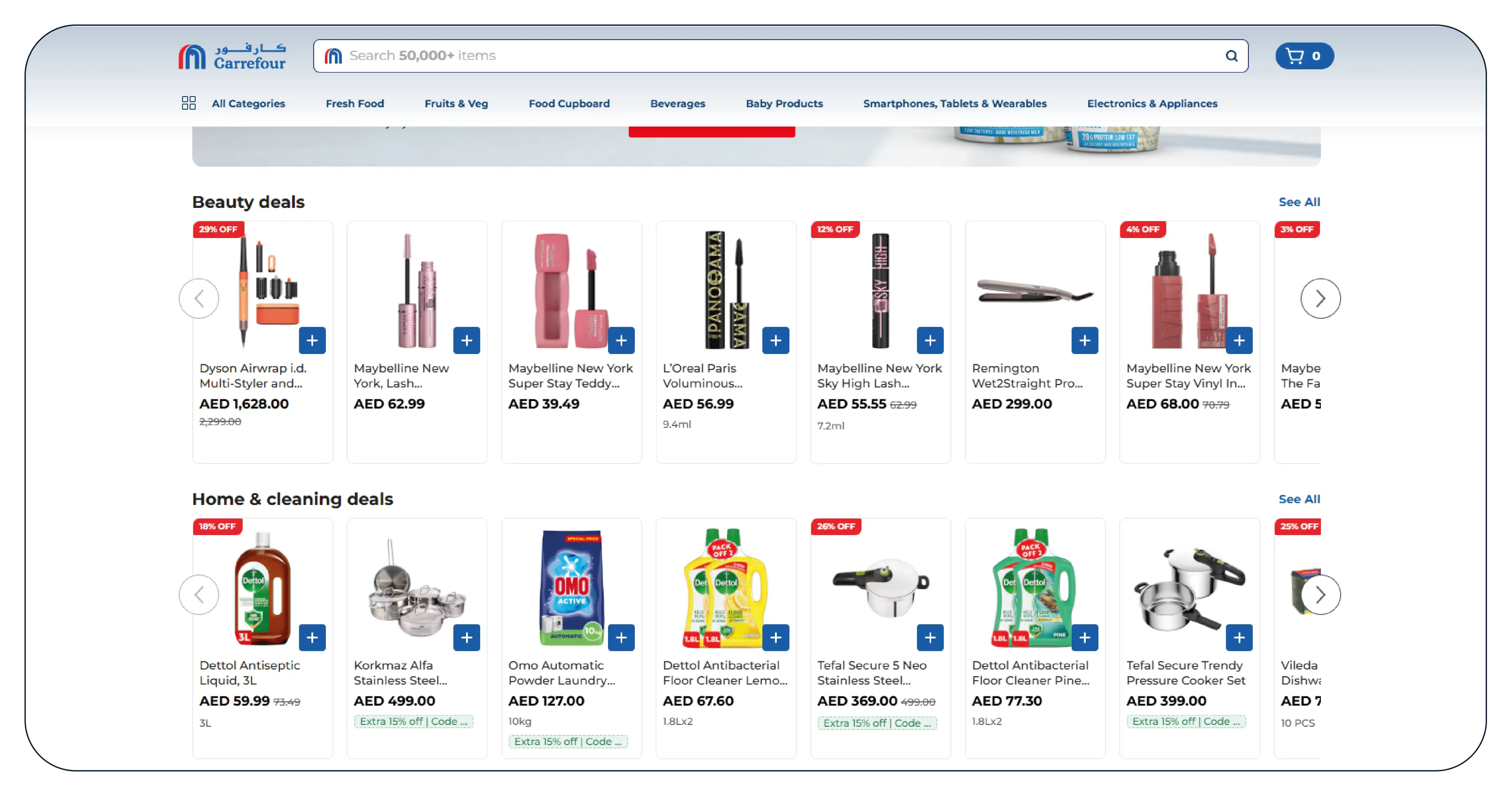
The primary business goal of Carrefour UAE category data scraping is to turn product listings into a structured source of category intelligence. A consistent dataset can help analysts compare assortments, identify missing product attributes, review displayed prices, and understand how product ranges vary across categories.
Key goals include:
Improve product-data coverage across selected categories.
Make recurring data collection more scalable.
Reduce manual catalog review.
Support evidence-based assortment and pricing analysis.
The proposed workflow would extract brand and SKU data by product category and normalize the results into an agreed schema. Fields would be selected according to availability on the source website and the project's permitted data scope. Product names, brand labels, package sizes, product identifiers, displayed prices, and availability indicators could be included when accessible and appropriate.
Technical objectives would include automating collection, validating records, managing category changes, and integrating approved outputs with a client's analytics environment. Refresh frequency would be determined by category volatility, operational requirements, and the source's permitted access conditions.
Category coverage: percentage of agreed categories processed successfully.
Record completeness: percentage of records containing required fields.
Data accuracy: sampled agreement between extracted records and source listings.
Refresh success: percentage of scheduled collection runs completed.
Integration reliability: percentage of valid records delivered to the destination system.
These are proposed evaluation measures, not reported project results.
The Core Challenge
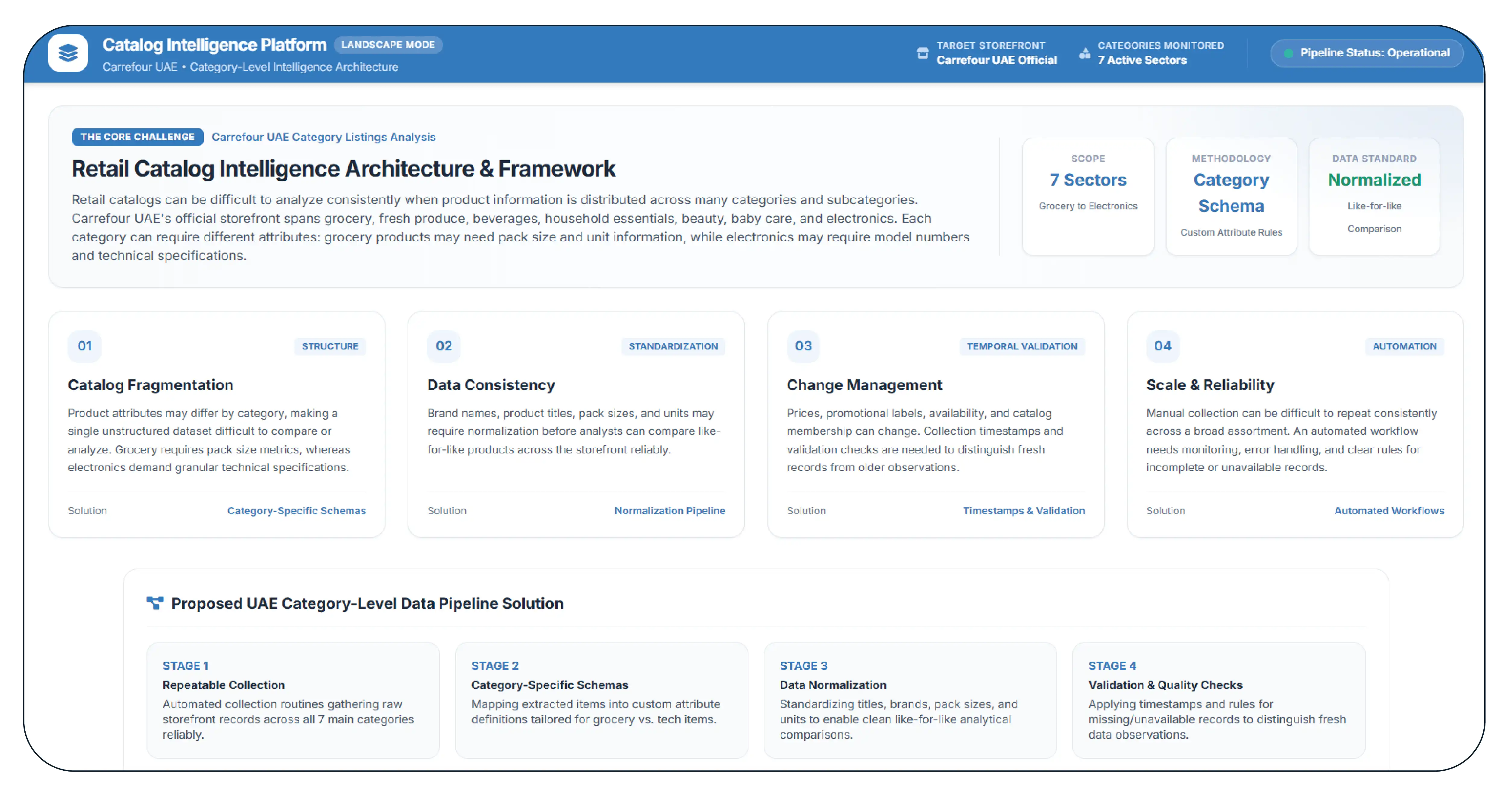
Retail catalogs can be difficult to analyze consistently when product information is distributed across many categories and subcategories. Carrefour UAE's official storefront spans grocery, fresh produce, beverages, household essentials, beauty, baby care, and electronics. Each category can require different attributes: grocery products may need pack size and unit information, while electronics may require model numbers and technical specifications. Source: Carrefour UAE category listings.
A category intelligence project must therefore address several potential operational challenges without assuming that Carrefour itself has confirmed them.
Catalog fragmentation: Product attributes may differ by category, making a single unstructured dataset difficult to compare or analyze.
Data consistency: Brand names, product titles, pack sizes, and units may require normalization before analysts can compare like-for-like products.
Change management: Prices, promotional labels, availability, and catalog membership can change. Collection timestamps and validation checks are needed to distinguish fresh records from older observations.
Scale and reliability: Manual collection can be difficult to repeat consistently across a broad assortment. An automated workflow needs monitoring, error handling, and clear rules for incomplete or unavailable records.
The proposed UAE Category-Level Catalog Intelligence approach would address these general data-engineering challenges through category-specific schemas, repeatable collection, and quality checks. These are project design considerations, not verified shortcomings in Carrefour's internal systems.
Our Solution
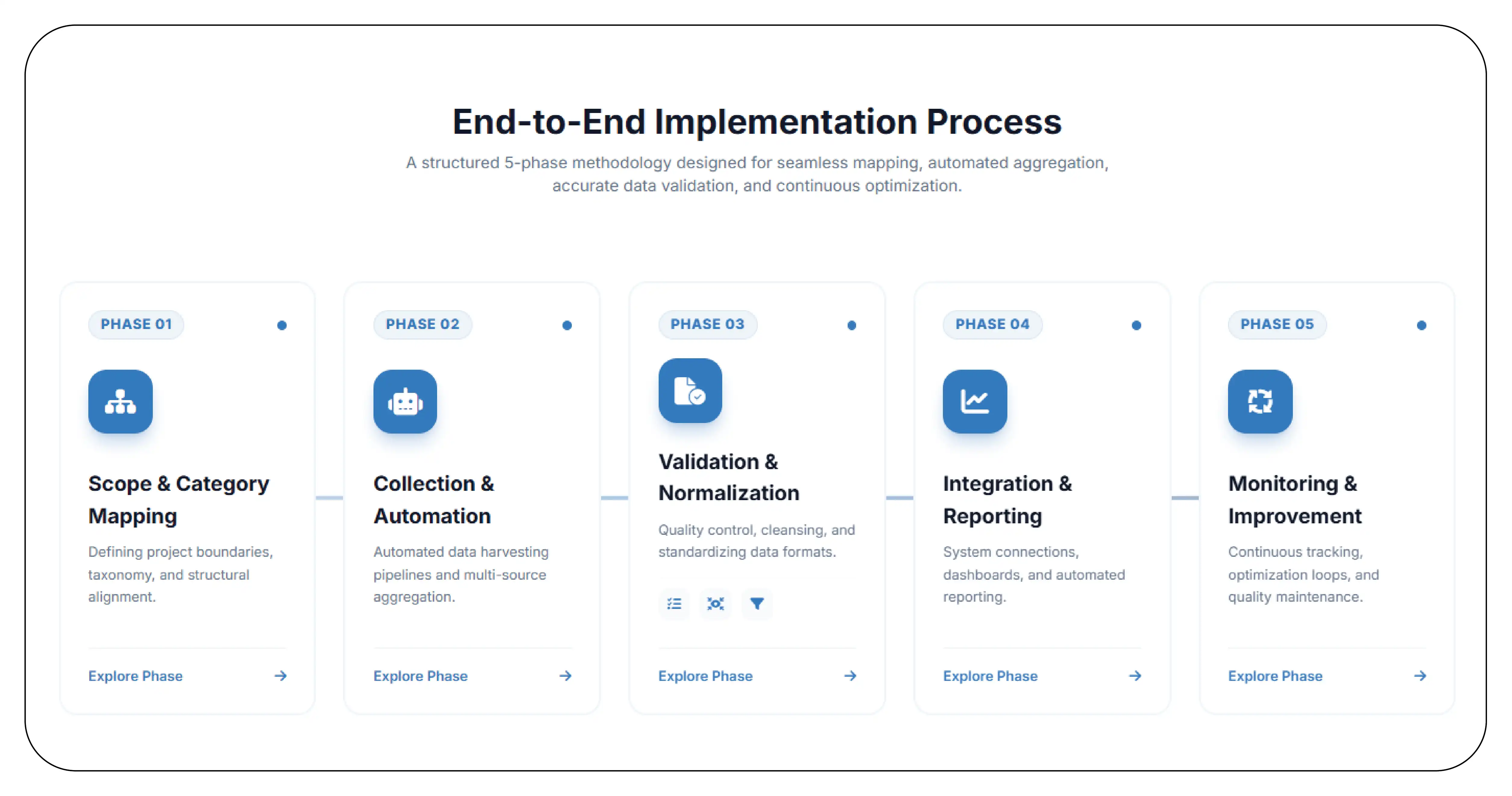
The proposed Carrefour UAE category data scraping workflow would use phased implementation so that collection rules, data quality, and downstream integration can be evaluated before expanding coverage.
Phase 1: Scope and Category Mapping
First, define the target categories and permitted data fields. The initial scope could cover grocery essentials such as dairy, beverages, pantry staples, and snacks, followed by non-food categories where required. Carrefour UAE's public website lists these and other product groups. View Carrefour UAE categories. Each category would receive a field specification, including required attributes, optional attributes, and rules for missing values.
Phase 2: Collection and Automation
Configure a collection process for the approved public pages or authorized data endpoints. The process would capture only the fields within the agreed scope and respect applicable website terms, access controls, and rate limits. Each record would include a collection timestamp so users can identify when the information was observed. The UAE Category-Wise Product Dataset would organize records by category and standardize common fields such as product title, brand, pack size, displayed price, product URL, and availability status when present and accessible.
Phase 3: Validation and Normalization
Apply validation rules to detect missing fields, duplicate records, inconsistent units, and malformed prices. Preserve the original source values alongside normalized fields where practical. This supports traceability and helps reviewers investigate discrepancies rather than silently changing source information.
Phase 4: Integration and Reporting
Deliver validated data through structured files, a database, or an agreed API integration. Dashboards could show category coverage, price observations, availability signals, and changes between collection runs. Any comparisons would need matching rules for product size, variant, and unit to avoid misleading conclusions.
Phase 5: Monitoring and Improvement
Monitor collection success, schema changes, and data-quality KPIs. Review exceptions, update category mappings when required, and adjust refresh schedules based on business priorities and permitted access. This design provides a clear path from raw catalog observations to reusable retail intelligence without claiming that these phases have already been implemented for Carrefour.
Results & Key Metrics

The proposed UAE Retail Catalog Extraction workflow would be evaluated using baseline measurements and results collected during a controlled pilot. No independently verified numerical results are available for this specific Carrefour project, so performance improvements should not be stated as achieved.
Category coverage: share of in-scope categories successfully collected.
Required-field completeness: share of records containing all mandatory attributes.
Validation accuracy: share of sampled records matching the source at review time.
Refresh reliability: share of scheduled runs completed successfully.
Duplicate rate: share of records identified as duplicates after normalization.
Delivery timeliness: time between scheduled collection and dataset availability.
These indicators would establish a measurable basis for assessing quality and operational performance.
Results Narrative
For Carrefour UAE category data scraping, the defensible outcome at this stage is a defined measurement framework rather than a claim of completed business impact. Once a pilot is authorized and executed, the team could compare baseline and post-implementation measurements for coverage, completeness, accuracy, and delivery time. Category-level reports could then help analysts identify gaps in product information and review changes in displayed prices or availability. Any published case study should include the actual measurement period, category scope, sample size, and calculation method. Conversion gains, cost savings, or speed improvements should only be reported when supported by approved project records.
What Made Product Data Scrape Different
A key differentiator in the proposed workflow is its category-aware data model. Rather than forcing every product into an identical template, the solution would combine shared fields—such as product title and brand—with category-specific attributes where available. The Sephora API Skincare Expansion keyword represents a separate beauty-catalog use case; Sephora's official US website provides a brand directory that can serve as a public reference for beauty brand research. Source: Sephora US brand directory. For Carrefour, the design would emphasize repeatable validation, timestamped observations, duplicate handling, and monitoring for source changes. These are proposed technical differentiators, not claims of proprietary technology already deployed.
Client's Testimonial
"Having access to structured product information is important for understanding category trends, reviewing product assortments, and supporting data-driven retail decisions. A well-organized approach to e-commerce data scraping in the UAE can help teams streamline product data analysis, improve catalog visibility, and make information easier to use across business operations. Consistent data validation and reliable delivery are essential for turning raw product listings into actionable retail insights."
— E-commerce Data & Analytics Manager
Conclusion
Structured retail data can help businesses understand product assortments, monitor catalog changes, and make category analysis more repeatable. Carrefour UAE's public online storefront demonstrates the breadth of categories that retail intelligence teams may need to organize, from grocery essentials to beauty and electronics. Carrefour UAE official website. A carefully scoped scraping workflow can establish consistent schemas, validation rules, and measurable data-quality KPIs. Catalog Enrichment Services could complement this approach by standardizing product attributes and identifying missing information. Any final account of project outcomes should be based on executed work, measured results, and client-approved evidence.
Frequently Asked Questions
1. What is Carrefour UAE category data scraping?
It is the structured collection of permitted product information from selected Carrefour UAE online categories for catalog analysis, pricing research, and assortment monitoring. The exact fields depend on source availability and project scope.
2. Which product categories can be included?
Potential categories include dairy and eggs, fruits and vegetables, beverages, pantry staples, snacks, beauty, baby care, and electronics. These categories appear on Carrefour UAE's public storefront. Browse official categories.
3. Which product attributes can be collected?
Depending on accessibility, the dataset may include product titles, brand names, product identifiers, pack sizes, displayed prices, product URLs, and availability indicators. Not every field is necessarily available for every listing.
4. Can the data be refreshed automatically?
Yes, a properly authorized workflow can be scheduled for recurring collection. Refresh frequency should account for business needs, technical reliability, and the source website's applicable terms and restrictions.
5. How is data quality measured?
Common measures include required-field completeness, duplicate rate, validation accuracy, category coverage, and successful refresh rate. These should be calculated from actual collection logs and reviewed samples, not estimated or presented as achieved results without evidence.


 Singapore
 EMAIL
 PHONE










.webp)