Introduction
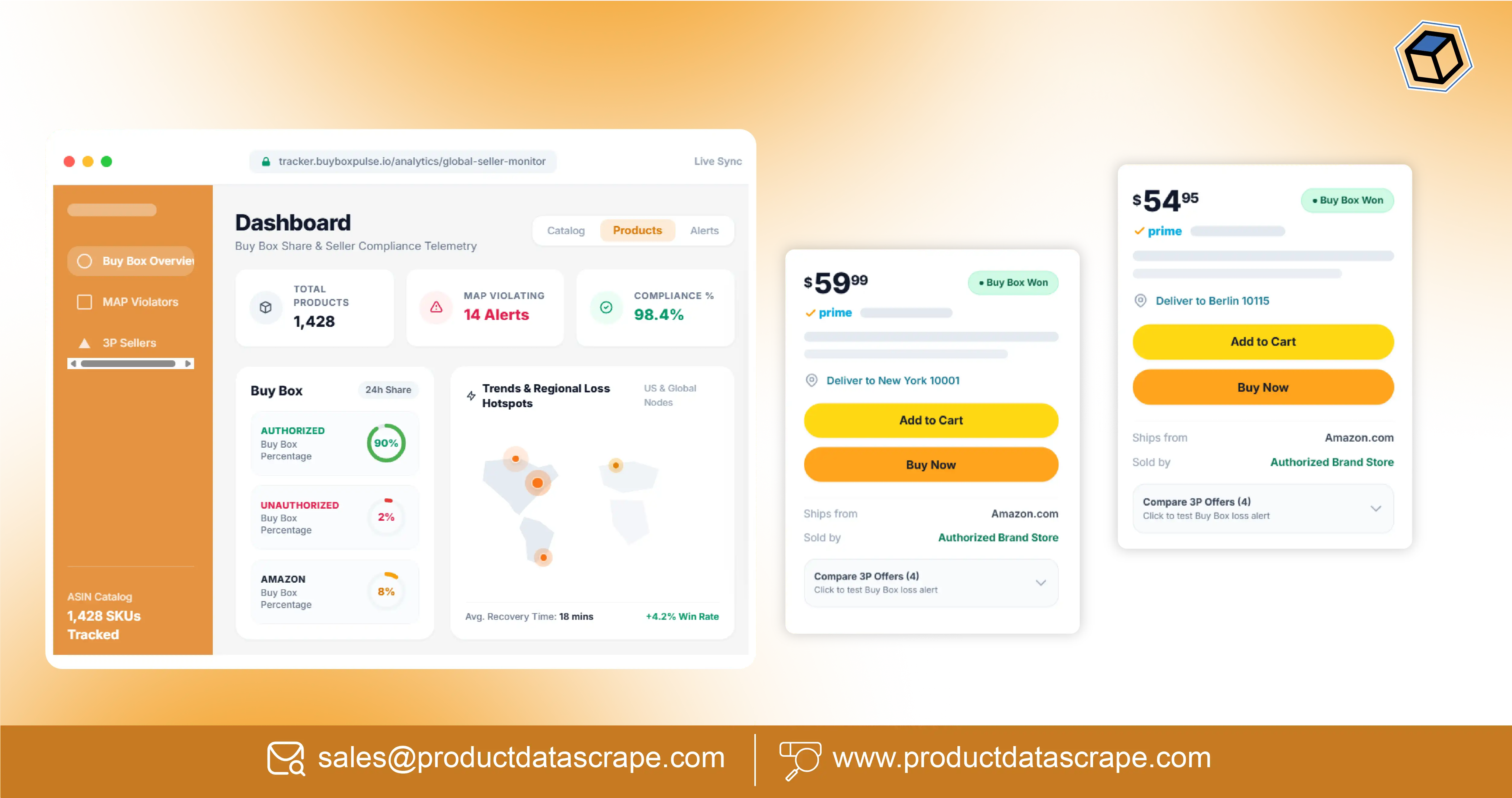
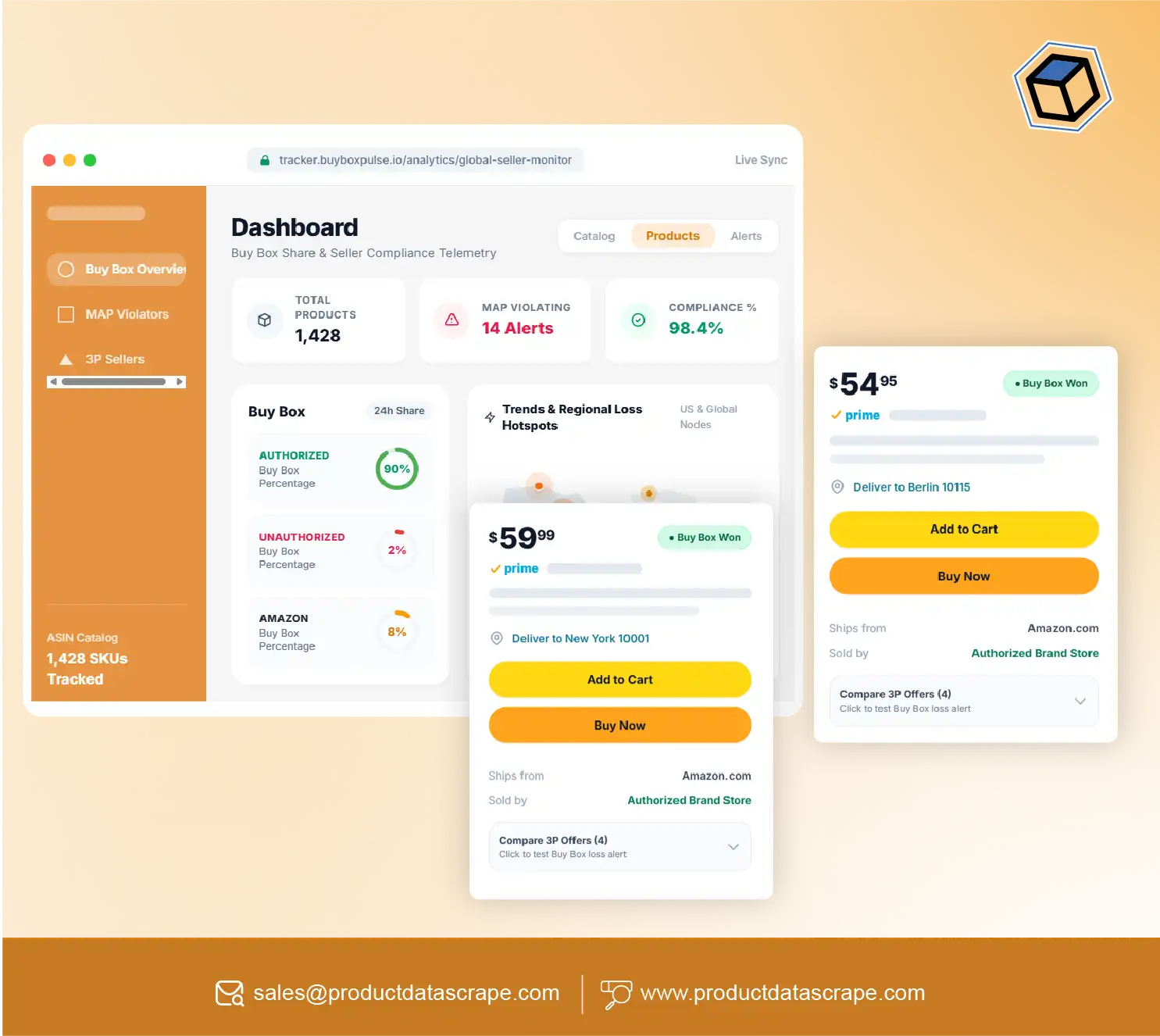
Losing Amazon's Buy Box, now called the Featured Offer, can reduce a seller's visibility and competitiveness on product detail pages. Amazon & Buy Box Seller Data Tracking helps brands, retailers, and marketplace sellers monitor competing offers, identify ownership changes, compare prices, and investigate factors affecting Featured Offer performance.
Amazon evaluates competing offers using customer-focused factors such as total price, delivery speed, product availability, and customer experience. Therefore, sellers need more than basic price comparisons to understand why their offers lose visibility. Scraping the Buy Box data for Sellers helps organize offer-level information, seller details, pricing changes, and historical observations into structured datasets.
For businesses managing large product catalogs across Amazon US and international marketplaces, continuous monitoring can reveal competitive changes that manual checks may overlook. It also helps pricing teams investigate whether a Buy Box loss coincides with a competitor price reduction, delivery promise change, or availability issue.
With structured marketplace intelligence, businesses can improve competitor benchmarking, evaluate pricing strategies, and make more informed decisions about their Amazon operations.
How Has Amazon's Third-Party Marketplace Business Grown Between 2020 and 2026?
Amazon's third-party seller ecosystem has become an important part of its overall business. Its annual reports show increasing revenue from third-party seller services, which include commissions, related fulfillment and shipping fees, and other seller services.
The following figures provide business context for seller competition. They represent Amazon's third-party seller services net revenue, not the total merchandise value sold by third-party sellers.
| Year | Third-party seller services revenue (US$ billion) |
|---|
| 2020 | 80.46 |
| 2021 | 103.37 |
| 2022 | 117.72 |
| 2023 | 140.05 |
| 2024 | 156.15 |
| 2025 | 172.16 |
| 2026 (January–September) | 134.85 |
Sources: Amazon annual reports for 2020–2025 and Q1–Q3 2026 financial results. The 2026 figure is a nine-month total, not a full-year result.
Amazon also reported that third-party sellers accounted for 61% of worldwide paid units in Q3 2026, compared with 62% in Q3 2025. This demonstrates the substantial contribution of independent sellers to marketplace transactions.
For sellers, this scale makes competitor monitoring particularly relevant. Multiple offers can compete for the same ASIN, and changes in price, shipping, availability, and customer experience can influence which offer Amazon displays.
Amazon's October 2026 guidance also confirms that the Featured Offer selection process continues to evaluate offers based on customer-focused criteria. Sellers should therefore monitor several competitive indicators rather than relying on price alone.
How Can Seller-Level Monitoring Reveal the Reasons Behind Offer Losses?
Amazon sellers often compete against several merchants offering the same ASIN. A product may remain active while its Featured Offer changes between competing sellers. Without seller-level monitoring, businesses may notice a decline in their Featured Offer percentage but struggle to identify the competitive changes behind it.
Amazon Seller-Wise Buy Box Monitoring helps businesses organize seller identities, competing prices, fulfillment methods, delivery promises, and offer status. This information makes it easier to investigate which sellers repeatedly become the Featured Offer and how their offers differ.
An Amazon Product Data Scraper can collect accessible listing and offer information into structured records. Sellers can compare their own offers with competing offers and identify changes that deserve attention.
Amazon's official guidance identifies total price, including shipping, delivery promises, and customer experience as important Featured Offer considerations. Amazon also announced changes to its eligibility requirements in 2026, removing the separate seller eligibility step globally by September 2026. However, being considered does not guarantee selection.
Useful monitoring fields include:
- ASIN and marketplace identifier.
- Seller ID and offer condition.
- Item price and shipping charges.
- Fulfillment channel and delivery promise.
- Featured Offer seller and displayed price.
- Observation timestamp and offer-change event.
For businesses managing hundreds or thousands of ASINs, these fields help prioritize products experiencing repeated offer changes. Rather than automatically reducing prices, pricing teams can investigate delivery competitiveness, stock availability, and total landed price.
This creates a more informed approach to seller performance management and reduces the risk of reacting to incomplete competitor information.
Why Should Businesses Compare Product Prices Beyond the Lowest Offer?
A low advertised price does not always represent the most competitive customer offer. Amazon considers total price, including shipping, when evaluating the Featured Offer. Delivery promises and other customer-focused factors also matter.
Amazon Product Price Position Scraping helps businesses compare their listed prices with competing offers for the same ASIN. It can capture item prices, shipping charges, offer conditions, seller identities, and displayed Featured Offer information where accessible.
These observations help retailers understand whether their products are priced above, below, or close to competing offers. They can also investigate whether a competitor's apparent price advantage comes from lower shipping charges or a different product condition.
Structured E-Commerce Datasets make these comparisons easier across large catalogs. Instead of manually checking individual listings, businesses can organize product and offer information into consistent records.
| Data point | Why it matters |
|---|
| ASIN | Identifies the product |
| Seller ID | Identifies the competing merchant |
| Item price | Supports price benchmarking |
| Shipping price | Helps calculate total offer cost |
| Condition | Separates new and used offers |
| Fulfillment method | Provides delivery context |
| Featured Offer price | Establishes the displayed benchmark |
| Timestamp | Records when the observation occurred |
For accurate comparisons, businesses should avoid combining different product conditions, bundles, pack sizes, or configurations. A cheaper offer for a different product configuration should not be treated as a direct competitor.
Pricing teams can also establish internal minimum-margin thresholds before adjusting prices. This prevents automated responses from creating unnecessary price reductions that undermine profitability.
How Can International Seller Intelligence Improve Marketplace Decisions?
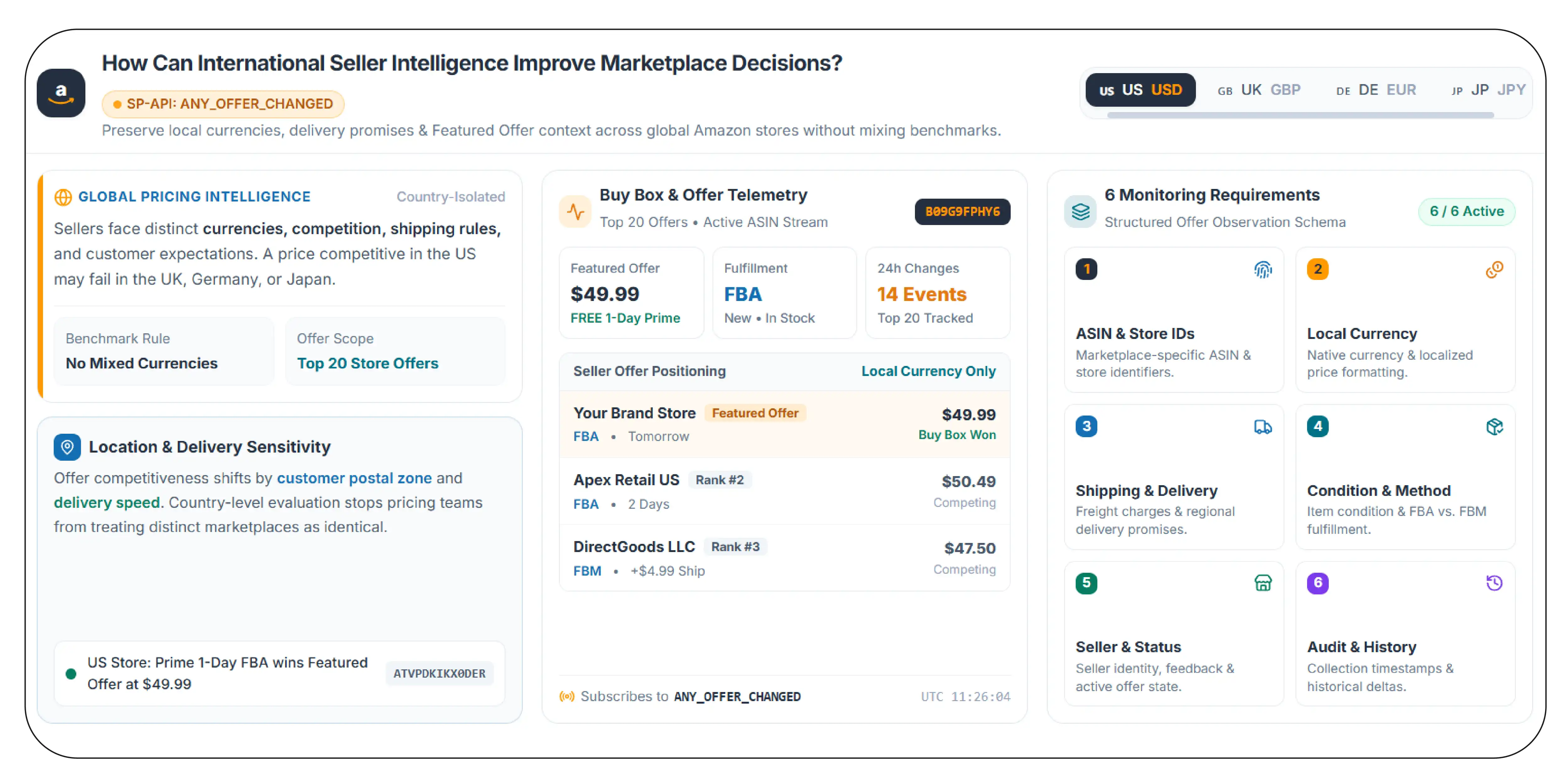
Amazon sellers operating across international marketplaces face different currencies, competitive conditions, shipping arrangements, and local customer expectations. A price that is competitive in the United States may not be suitable for the United Kingdom, Germany, Japan, or another marketplace.
Amazon Global Seller Pricing Intelligence helps businesses compare seller offers across selected Amazon stores while preserving marketplace-specific information. It supports research into competing seller prices, product availability, fulfillment options, and Featured Offer changes.
Businesses can use this information to identify differences in seller positioning across countries. For example, a brand operating in multiple marketplaces can compare how its products are positioned against competing offers in each store without mixing local currencies or delivery conditions.
A structured system can Monitor Amazon Buy Box Data by collecting relevant offer observations and recording changes over time. Amazon's Selling Partner API provides an official notification called ANY_OFFER_CHANGED, which reports changes among the top 20 offers, including Featured Offer changes and Buy Box price changes for products on which the subscribed seller has active offers.
International monitoring should account for:
- Marketplace-specific ASIN and marketplace identifiers.
- Local currency and price representation.
- Shipping charges and delivery promises.
- Product condition and fulfillment method.
- Seller identity and offer status.
- Collection timestamps and historical changes.
Businesses should also recognize that an offer's competitiveness can vary according to customer location and delivery availability. A single global price benchmark cannot explain every Featured Offer outcome.
Country-level analysis provides better context for pricing teams, helping them evaluate competitive positioning without treating all Amazon marketplaces as identical.
What Should a Reliable Marketplace Pricing Dataset Contain?
Effective marketplace research depends on consistent product and seller records. If a business collects prices without recording the associated ASIN, seller identity, fulfillment method, and observation time, it becomes difficult to explain why a competitive position changed.
An Amazon Marketplace Pricing Dataset should connect product-level information with individual seller offers and historical observations. This allows businesses to compare competing offers, investigate pricing changes, and evaluate marketplace conditions.
Amazon & Buy Box Seller Data Tracking helps organize this information into a structured reporting framework for pricing analysts, brands, distributors, and e-commerce teams.
Recommended dataset components include:
| Dataset category | Important fields | Business application |
|---|
| Product identity | ASIN, title, brand | Product matching |
| Marketplace | Marketplace ID, country | Regional analysis |
| Seller identity | Seller ID, merchant name | Seller benchmarking |
| Offer pricing | Item price, shipping price | Price comparison |
| Offer details | Condition, fulfillment channel | Offer segmentation |
| Featured Offer | Seller, price, status | Ownership monitoring |
| Competition | Offer count, lowest price | Competitive analysis |
| Historical data | Timestamp, change event | Trend analysis |
Amazon's official pricing documentation also identifies competitive price thresholds, Featured Offer prices, and average selling prices as pricing information available through its Selling Partner API. Access and returned fields depend on the applicable API operation, permissions, and subscription conditions.
Data quality is equally important. Businesses should standardize currency fields, retain original source values, remove duplicate observations, and distinguish missing information from confirmed unavailable offers.
A historical dataset should never overwrite previous observations. Keeping dated records allows analysts to reconstruct competitive changes and compare current conditions with earlier marketplace activity.
These practices make the dataset more useful for reporting, repricing analysis, and seller performance investigations.
How Does Ownership Analysis Help Businesses Understand Competitive Changes?
The Featured Offer identifies an offer Amazon highlights on a product detail page. When multiple sellers compete for the same ASIN, ownership can change as competing offers and customer-focused conditions change.
Amazon Buy Box Ownership Analysis helps businesses track which seller holds the Featured Offer at different observation times. It can also connect ownership changes with price differences, shipping costs, fulfillment information, and other accessible offer attributes.
Amazon's ANY_OFFER_CHANGED notification specifically identifies changes involving the Featured Offer winner or Featured Offer price. Its documentation also describes the top competitive offers and their landed-price information.
developer-docs.amazon.com
For sellers, ownership analysis can answer important commercial questions:
- How frequently does a competing seller hold the Featured Offer?
- Does ownership change after a price adjustment?
- Are competing offers associated with different shipping costs?
- Does the Featured Offer change when a product becomes unavailable?
- Are ownership changes concentrated around promotional periods?
Amazon provides a Featured Offer percentage in Seller Central Business Reports. The metric represents the proportion of product page views in which a seller's listings were the Featured Offer, relative to total page views for those products.
This metric is particularly useful when combined with historical offer observations. Sellers can compare changes in their Featured Offer percentage with recorded competitive activity rather than relying on isolated snapshots.
However, ownership data alone does not prove why a seller won or lost. Businesses should treat price, delivery, availability, and customer experience as investigation variables rather than assuming one factor caused every change.
This approach helps businesses identify recurring patterns, investigate performance changes, and make better-informed adjustments to their marketplace strategy.
Why Is ASIN-Level Monitoring Essential for Large Product Catalogs?
Large Amazon catalogs contain products with different sellers, conditions, variations, and competitive environments. Monitoring only account-wide performance can hide important changes affecting individual products.
Amazon ASIN-Level Offer Monitoring helps businesses organize competitive information around individual Amazon Standard Identification Numbers. This allows analysts to evaluate the offers associated with a specific product instead of relying on broad account-level averages.
Amazon & Buy Box Seller Data Tracking can create a historical view of seller offers, Featured Offer prices, offer counts, and ownership changes at the ASIN level.
Amazon's Selling Partner API provides product pricing operations and offer-change notifications. The ANY_OFFER_CHANGED notification can include information about the top 20 competitive offers for the relevant product and condition. However, sellers receive these notifications only for products on which they have active offers.
A practical ASIN monitoring workflow includes:
- Product identification: Maintain a validated ASIN list for relevant products.
- Offer collection: Record accessible seller and pricing information.
- Ownership recording: Capture Featured Offer changes and timestamps.
- Competitive comparison: Evaluate total prices and delivery conditions.
- Historical analysis: Identify repeated ownership changes and pricing movements.
- Business validation: Compare marketplace findings with internal margins, inventory, and sales data.
Businesses should prioritize products based on their commercial importance, margin exposure, and competitive activity. This helps teams focus their analysis on ASINs where offer changes may require investigation.
Historical ASIN-level records also make it easier to distinguish a temporary competitive change from a recurring pattern. When combined with internal sales and inventory data, they support more informed repricing and catalog management decisions.
Why Choose Product Data Scrape?
Product Data Scrape provides customized e-commerce data extraction solutions for brands, retailers, distributors, and marketplace sellers. Our data collection services help businesses organize product information, seller details, competing prices, and Featured Offer changes into structured datasets. The Amazon.com Product Data Scraping API approach supports marketplace research, competitive benchmarking, and historical pricing analysis through project-specific collection workflows. Businesses can use these insights to investigate seller competition, identify pricing gaps, and improve product-level monitoring. Our focus includes data consistency, source traceability, product matching, and delivery formats suited to business analytics and reporting requirements.
Conclusion
Amazon sellers need accurate competitive information to understand Featured Offer losses and improve marketplace performance. Historical seller observations, pricing comparisons, and ownership analysis help businesses investigate competitive changes and make informed decisions.
Businesses can track buy box history on Amazon.com to identify recurring ownership changes, evaluate competing offers, and strengthen pricing strategies.
Ready to improve your Amazon marketplace intelligence? Contact Product Data Scrape today to discuss customized seller monitoring and product data extraction solutions for US and global marketplaces!
FAQs
1. What is Amazon Buy Box tracking?
It involves monitoring Featured Offer ownership, competing seller prices, shipping costs, and offer changes to understand marketplace competitiveness and identify potential performance issues.
2. Why do Amazon sellers lose the Featured Offer?
Competitive pricing, shipping costs, delivery promises, product availability, and customer experience can influence Amazon's Featured Offer selection for individual products.
3. Can businesses monitor competing Amazon sellers?
Yes. Accessible marketplace offer information can help businesses compare seller identities, prices, fulfillment methods, product conditions, and Featured Offer changes.
4. Can Buy Box information be collected historically?
Yes. Timestamped observations and supported API notifications can help businesses maintain historical records of offer changes and Featured Offer ownership.
5. How can Product Data Scrape help Amazon sellers?
Product Data Scrape provides structured marketplace data collection solutions that support seller monitoring, price comparisons, Featured Offer analysis, and competitive intelligence.



 Singapore
 EMAIL
 PHONE













.webp)