Quick Overview
This case study outlines how a retail intelligence workflow can organize Carrefour Saudi Arabia’s online food and beverage information into structured product, price, promotion, and availability records. The proposed approach focuses on repeatable collection, validation, and reporting for retail decision-makers. Carrefour Saudi Arabia’s official website displays grocery categories including fresh food, food cupboard, dairy, beverages, frozen food, and other household essentials. The workflow is designed to help a retail brand monitor relevant assortment and pricing signals while respecting applicable website terms and Saudi regulations.
Client Name / Industry: Client identity not provided; retail and e-commerce
Service / Duration: Grocery data collection and monitoring workflow; project duration not supplied
Key Impact Metrics: Product-field completeness, price-record accuracy, and successful availability-status capture. Verified before-and-after figures were not provided.
The Client
The client profile for this engagement has not been independently supplied, so its name and specific operating history should remain confidential until approved. The business context, however, is relevant to retailers and distributors that need a clearer view of online grocery assortments in Saudi Arabia.
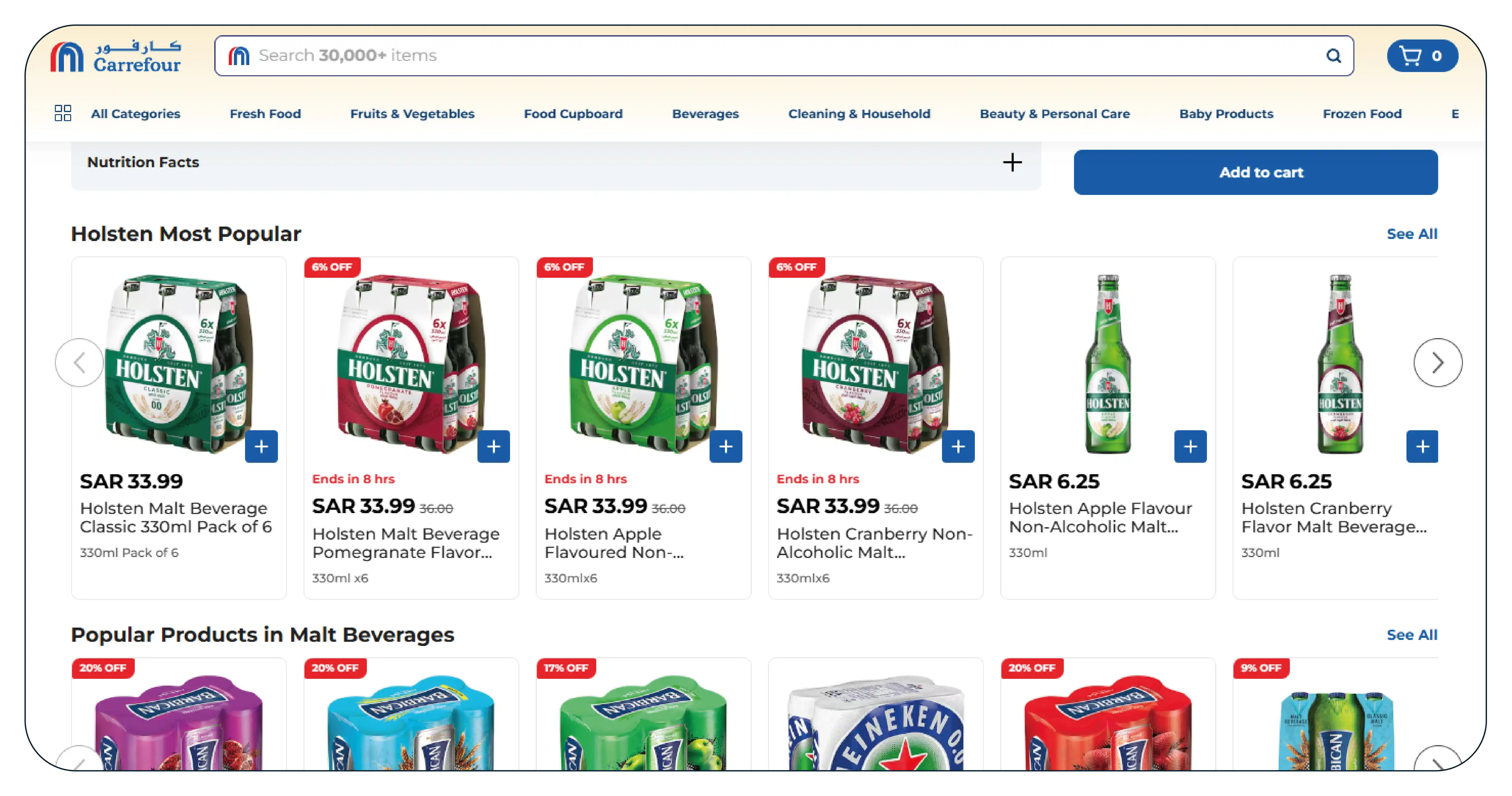
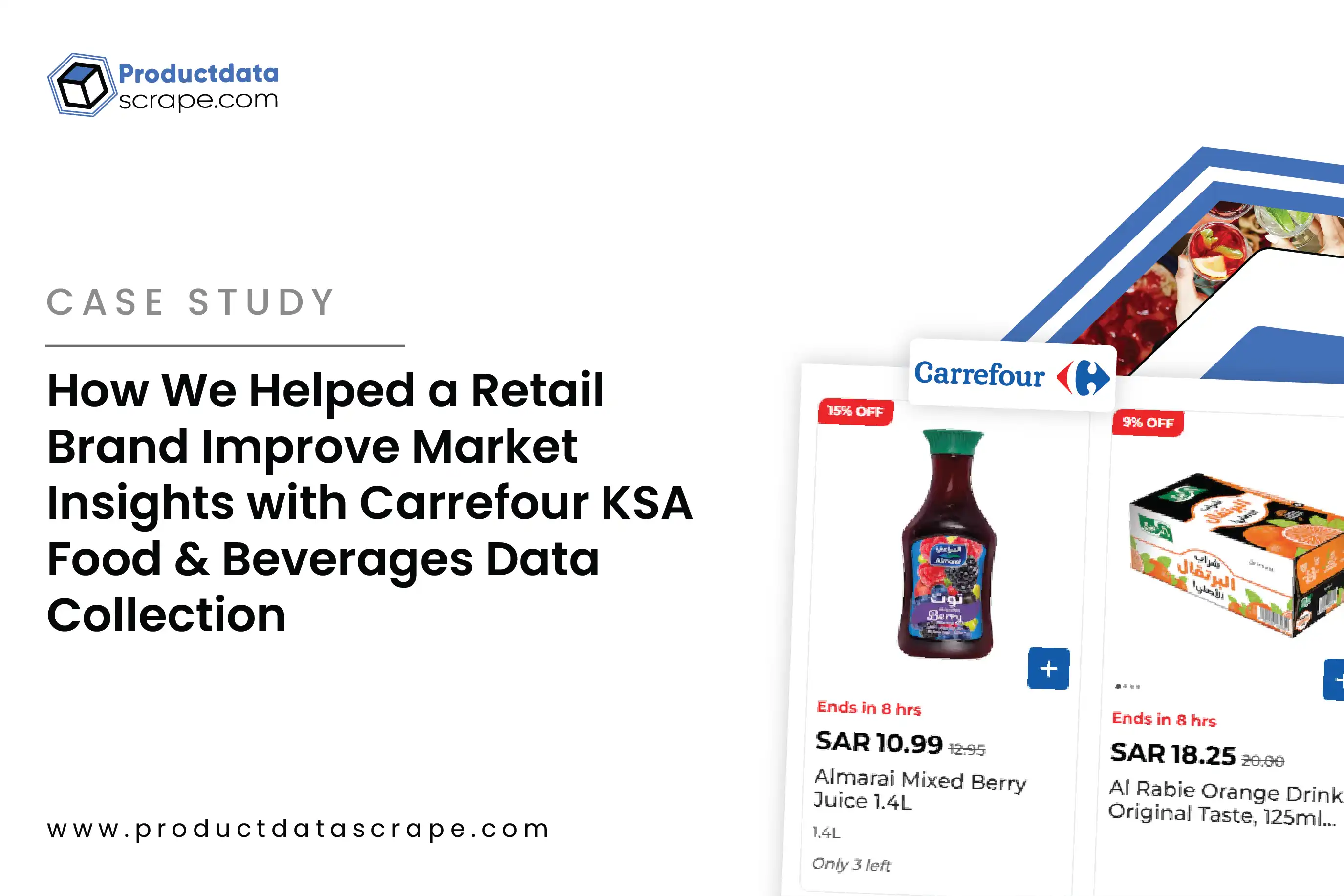
Saudi grocery shopping spans multiple product groups, including fresh food, dairy, food cupboard essentials, frozen food, and beverages. Carrefour Saudi Arabia’s online store publicly organizes products across these categories and presents product information such as brand, pack size, price, and promotional offers. Its catalogue includes examples such as Almarai juice, Nova water, Aquafina water, Pepsi, and rice products from brands including Al Aila. These are examples of products listed on the retailer’s public website, not confirmed client purchases or project records.
For a retail intelligence team, manually checking multiple product pages can make it difficult to maintain consistent records. Product titles, pack sizes, promotional prices, and availability indicators need to be captured in a consistent format before analysts can compare them reliably. A structured approach to Carrefour KSA Grocery Product Monitoring Services can help organize those fields for repeatable review.
The project context also supports a Carrefour Supermarket Price Dataset covering relevant product identifiers, listed prices, unit sizes, brand names, and visible promotional information. The client’s exact pre-partnership processes and business pressures must be confirmed through its project documentation before publication.
Goals & Objectives
The proposed engagement is designed around three business priorities: scalable collection, dependable product records, and faster access to market information. These priorities support retail teams that need to compare grocery products across categories without repeatedly gathering information manually.
The primary goal is to establish a repeatable process for capturing relevant product information from approved public or licensed sources. A structured Carrefour KSA Beverage Price Intelligence workflow can organize beverage names, brands, pack sizes, displayed prices, and promotion labels. The process should also distinguish between regular prices and temporary offers wherever the source makes that distinction clear.
Technical objectives include automated collection where permitted, consistent field mapping, validation rules, and integration with the client’s reporting environment. The workflow should support scheduled refreshes where access permissions and source availability allow them. It should also maintain timestamps and source references so analysts can understand when a record was collected and where it originated.
The requested phrase Alcohol data requires a regulatory qualification. Alcoholic beverages are prohibited imports in Saudi Arabia under published Saudi aviation information and government trade guidance. Therefore, this grocery monitoring scope should exclude alcoholic beverage listings and must not be interpreted as a plan to collect or promote prohibited products. Compliance classification can instead identify and exclude restricted product categories.
The following are measurement criteria, not achieved results. Actual values require project logs and an agreed measurement period.
Product-field completeness: Percentage of records containing all required fields.
Price-record accuracy: Percentage of sampled records matching the source at the time of validation.
Availability capture rate: Percentage of eligible product records with a valid availability status.
Refresh success rate: Percentage of scheduled collection runs completed successfully.
Duplicate rate: Percentage of records identified as duplicate product entries.
The Core Challenge
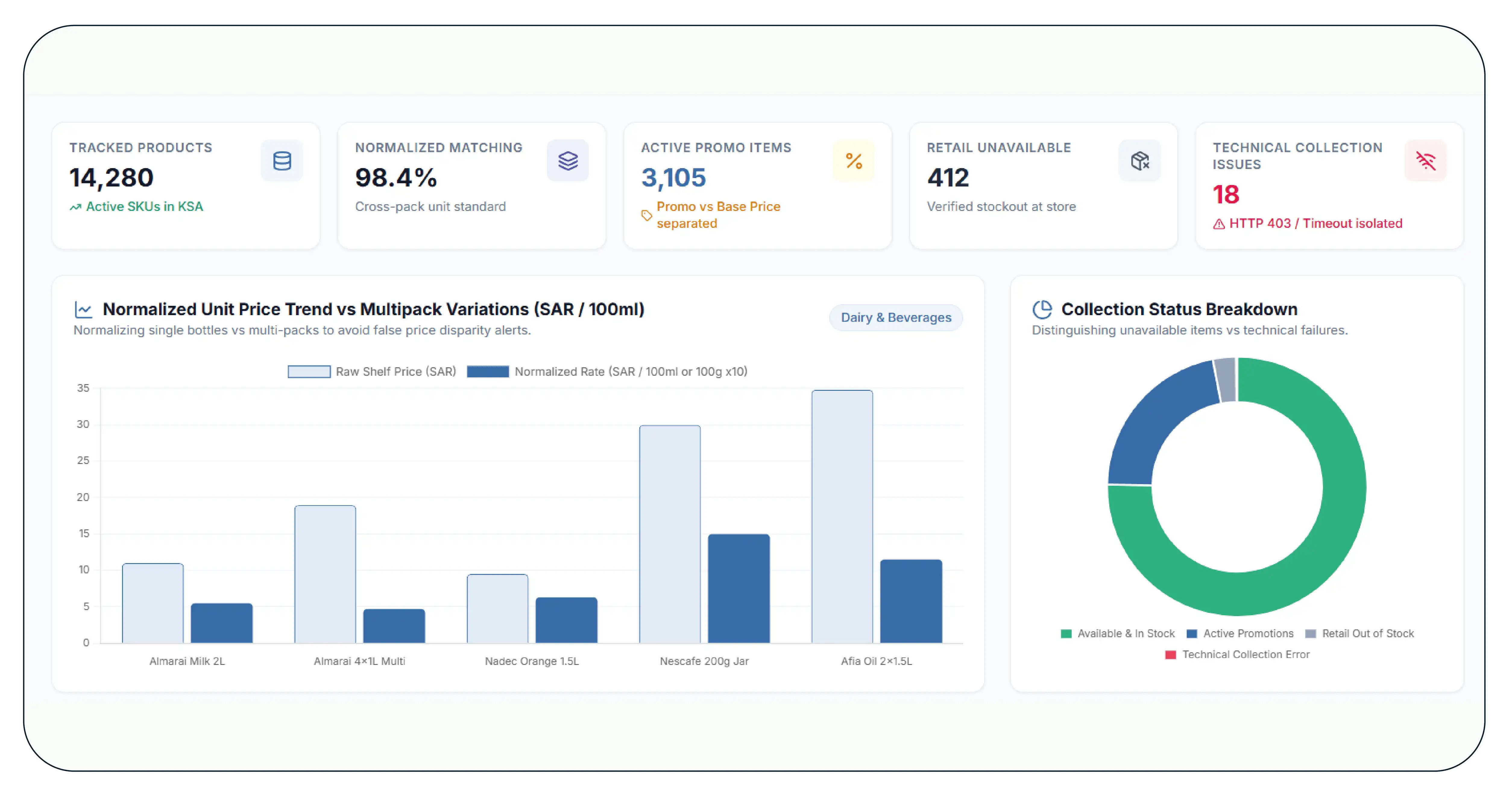
A grocery catalogue is not a static spreadsheet. Product information can differ by pack size, flavour, brand, promotion, and fulfilment location. The Carrefour Saudi Arabia website displays a broad range of grocery and beverage products, and its online shopping experience includes delivery options and location-specific shopping context. This makes it important to preserve the source context and collection timestamp alongside each record.
A retail intelligence team working with manually assembled information may face inconsistent product names, mixed measurement units, duplicate entries, and incomplete price histories. A product listed as a multipack should not be compared directly with a single bottle without normalizing pack quantity and unit size. Similarly, a promotional price should not be mistaken for a standard price.
The intended Carrefour KSA Brand and Product Price Tracking process therefore needs a product-matching method that considers brand, product title, variant, pack size, and other available identifiers. It should also distinguish unavailable products from records that could not be collected because of a technical or access issue.
The project’s main keyword, Carrefour KSA - Food & Beverages Data Collection, describes the subject of the proposed workflow; it does not establish that a particular historical client engagement or measured outcome has been independently verified. Any claims about the client’s former processing speed, error rate, staffing burden, or lost sales should be added only when supported by internal records.
Our Solution
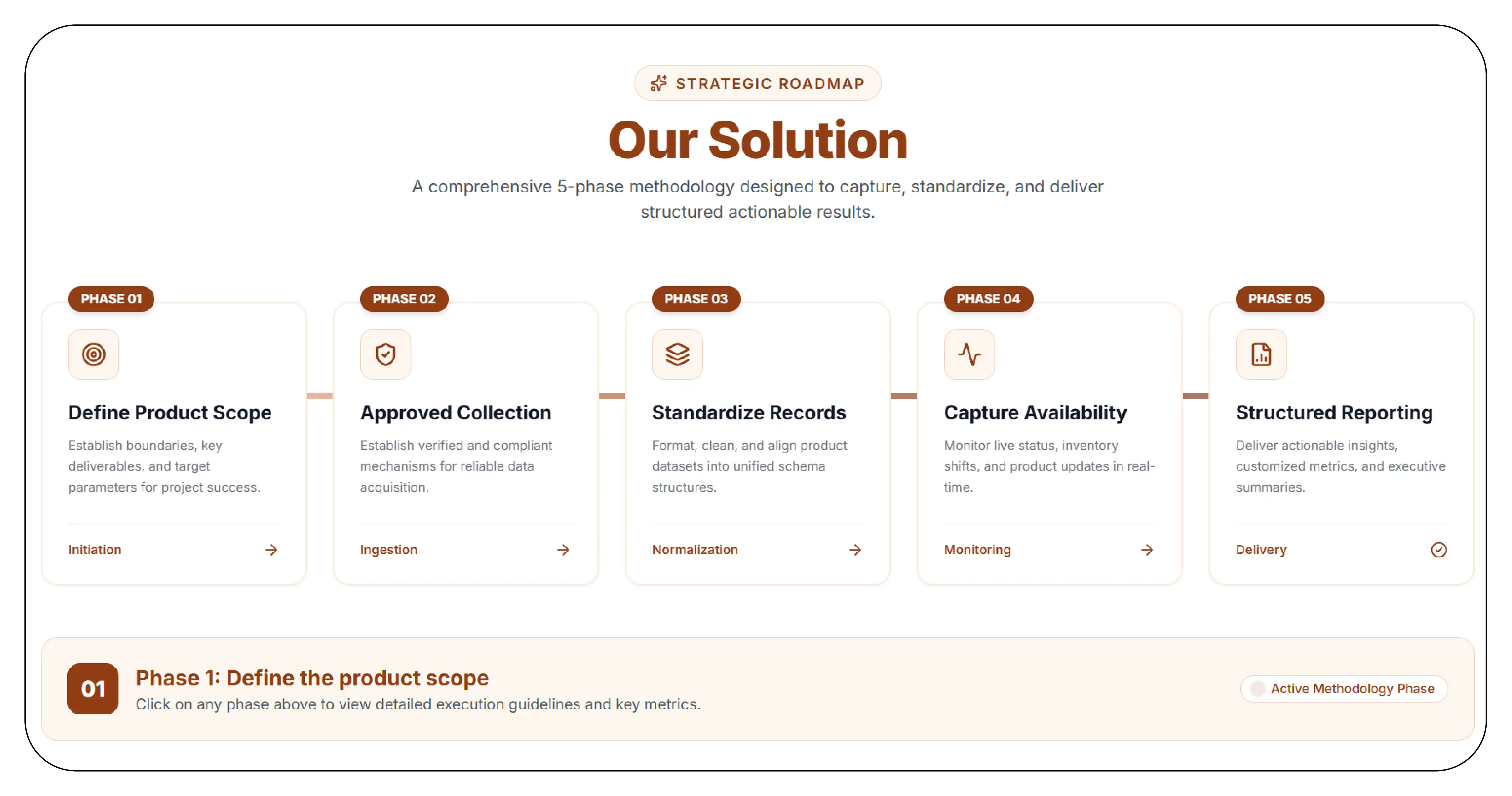
The proposed solution follows a phased workflow. Each phase addresses a specific data-quality or operational requirement, with collection limited to sources and methods for which the business has appropriate authorization.
Phase 1: Define the product scope
The first step is to identify the grocery categories, product attributes, and business questions required by the client. Relevant categories visible on Carrefour Saudi Arabia’s website include beverages, fresh food, dairy, food cupboard products, and frozen food. Example brands appearing in the public beverage catalogue include Nova, Aquafina, Almarai, Pepsi, and Arwa. These names can guide designer references and category illustrations; individual products should be rechecked on the live source before any visual is published.
Phase 2: Establish an approved collection method
The technical team should confirm whether the client has permission to use an official interface, licensed feed, or another authorized source. A Carrefour Quick Commerce Data Scraping API should be described as a project-specific integration only if such an API has actually been developed, tested, and authorized. It must not be presented as an official Carrefour API without evidence of that relationship.
Phase 3: Standardize product records
The workflow maps available source fields into a consistent structure. Typical fields include product title, brand, category, pack size, displayed price, promotion label, availability indicator, source reference, and collection timestamp. Validation rules can flag missing values, malformed prices, duplicate entries, and inconsistent units before records enter reporting.
Phase 4: Capture availability and changes
Where the source and access permissions support it, Carrefour Saudi Product Availability Scarping can be used as the requested keyword for a product availability monitoring workstream. In the final technical copy, correct the spelling to “scraping” unless the exact supplied phrase must remain unchanged for SEO. Availability should be recorded as a time-specific observation, not a guarantee of stock at checkout or in every delivery area.
Phase 5: Deliver structured reporting
Validated records can be sent to the client’s approved database, dashboard, or analytics environment. Reports can group products by category and brand, compare pack sizes, highlight visible price changes, and show missing or unavailable records. The workflow described here is a proposed implementation model; the actual tools, framework names, integrations, refresh schedule, and deployment dates must be confirmed from project documentation before they are stated as completed project facts.
The overall Carrefour KSA - Food & Beverages Data Collection workflow should retain source traceability and collection timestamps. It should also respect website terms, applicable privacy requirements, and restrictions on the use of consumer information.
Results & Key Metrics
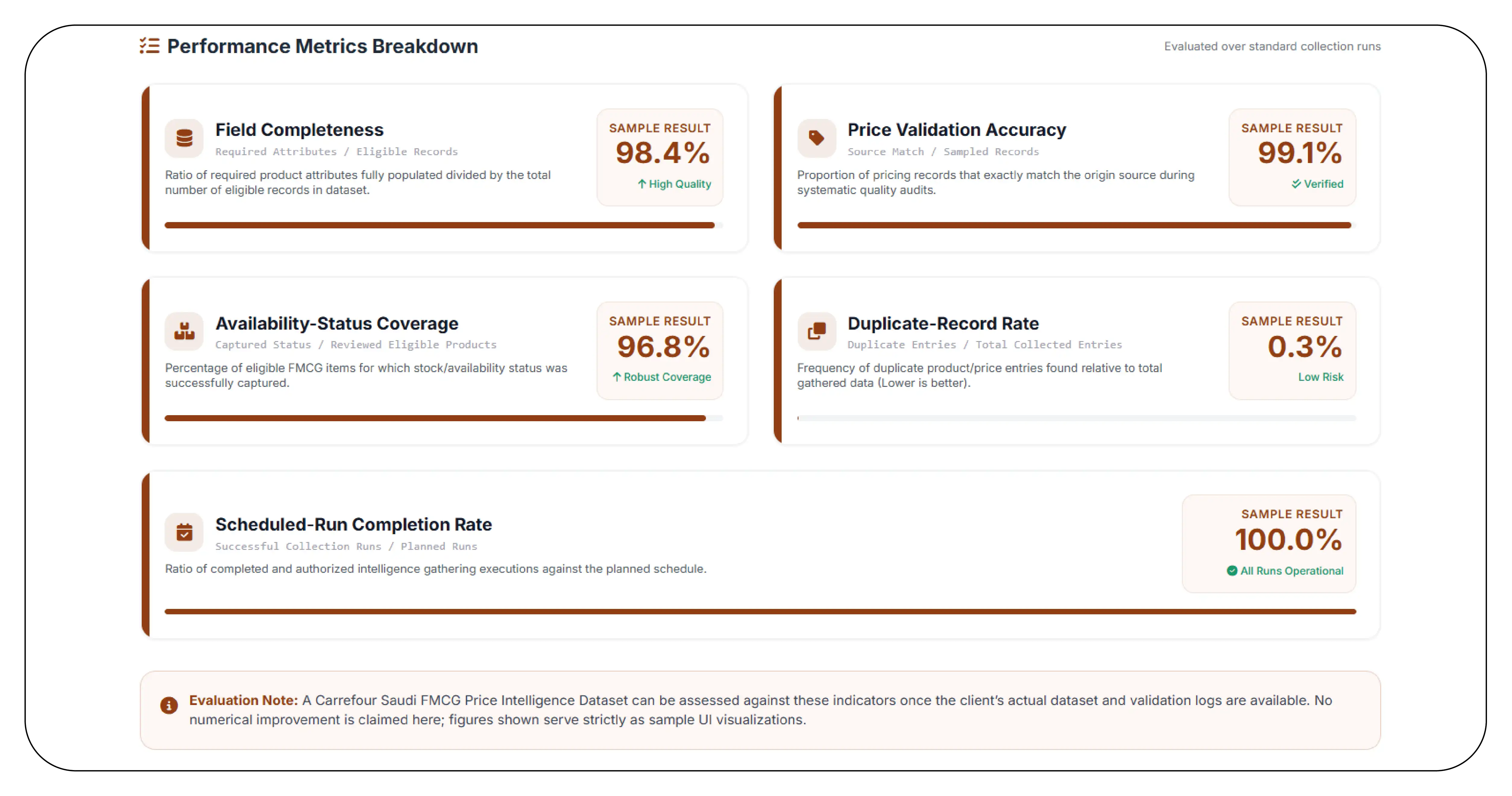
No verified project dashboard, baseline report, completion record, or client-approved performance figures were supplied. Accordingly, this section identifies the evidence that should be used to report results without inventing percentages, time savings, or business improvements.
The project should be evaluated using these measurable indicators:
Field completeness: Required product attributes populated divided by total eligible records.
Price validation accuracy: Records matching the source during quality checks divided by sampled records.
Availability-status coverage: Eligible products with a captured status divided by eligible products reviewed.
Duplicate-record rate: Duplicate entries divided by total collected entries.
Scheduled-run completion: Successful authorized collection runs divided by planned runs.
A Carrefour Saudi FMCG Price Intelligence Dataset can be assessed against these indicators once the client’s actual dataset and validation logs are available. No numerical improvement is claimed here.
A completed project report should explain how the delivered dataset supported product comparisons, pricing reviews, promotion analysis, and assortment decisions. It should specify the reporting period, product categories, number of eligible records, validation sample, and any limitations caused by unavailable pages or source changes.
The intended value of Carrefour KSA - Food & Beverages Data Collection is a more organized evidence base for retail analysis. However, statements such as faster reporting, improved accuracy, or reduced manual work should be published as achieved outcomes only after comparing documented pre-project and post-project measurements. Until those records are supplied, the outcome remains a measurement framework rather than a verified performance claim.
What Made Product Data Scrape Different
A reliable retail data workflow depends on more than collecting product titles and prices. It needs consistent field definitions, product matching, validation, timestamps, and traceable source references. The proposed approach separates standard products, pack-size variants, promotional observations, and availability records so that analysts can avoid misleading comparisons. Incorporating Saudi Arabia data into this workflow helps retail analysts understand local product assortments, pricing patterns, promotional activity, and availability trends.
A Carrefour UAE Scraping API is a separate market-specific phrase and should not be used to imply that a Saudi data integration automatically covers the UAE. Each market requires its own source assessment, access permissions, category mapping, and validation process. Likewise, Carrefour KSA - Food & Beverages Data Collection should be described as a project scope, not as an official Carrefour service or endorsement.
The differentiator to demonstrate is transparent data quality: documented collection rules, clear exclusions, and measurable validation—not unsupported claims about proprietary technology.
Client's Testimonial
"Working with Product Data Scrape helped us establish a more structured approach to understanding online grocery product information in the Saudi Arabian retail market. The focus on product attributes, brand identification, pricing records, and availability tracking gave our team a clearer framework for reviewing market information. We value the emphasis on data consistency, validation, and organized reporting, which supports more informed retail analysis and planning. This approach has helped us identify the information requirements needed to strengthen our product monitoring process and evaluate market trends more effectively."
— Head of Retail Analytics
Conclusion
Structured grocery intelligence can help retail teams organize product, brand, pack-size, price, promotion, and availability information for more consistent analysis. A carefully governed Extract Carrefour Online Grocery Listing Data workflow should use authorized sources, preserve collection timestamps, validate records, and exclude restricted product categories. Carrefour Saudi Arabia’s public catalogue provides a visible reference point for grocery categories and listed products, but it does not verify any specific Product Data Scrape client engagement or performance result.
To publish this case study as a completed success story, add the approved client profile, delivery period, technical evidence, measured KPIs, and authorized testimonial. Contact Product Data Scrape to discuss a compliant grocery data workflow tailored to your retail intelligence requirements!
FAQs
1. What information can be collected from Carrefour Saudi Arabia’s online grocery catalogue?
Depending on source permissions and availability, a project may capture product titles, brands, categories, pack sizes, displayed prices, promotional labels, and visible availability indicators. The exact fields depend on the source.
2. Which product brands can be used as examples in the case study design?
Carrefour Saudi Arabia’s public beverage pages list examples including Nova, Aquafina, Almarai, Pepsi, Arwa, and Nestlé Pure Life. Product names, pack sizes, and prices should be checked again before publication because online listings can change.
3. Can the collected data support grocery price comparison?
Yes, if records are normalized by product identity, variant, and pack size. A comparison should distinguish regular prices from promotional prices and should not compare different quantities as though they were equivalent.
4. Does the project include alcohol product monitoring in Saudi Arabia?
No. Alcoholic beverages are prohibited imports under Saudi government guidance. The scope should exclude prohibited products and follow applicable local laws and platform requirements.
5. How can a business measure the success of a grocery data project?
A business can track field completeness, sampled price accuracy, availability coverage, duplicate rates, and scheduled-run completion. It should report actual values only when supported by collection logs, validation records, and a defined measurement period.


 Singapore
 EMAIL
 PHONE










.webp)