Quick Overview
A leading UAE retail brand wanted to improve product price intelligence by identifying identical products and tracking competitor prices across major e-commerce marketplaces. Product Data Scrape developed a structured data collection and matching workflow using the EAN GTIN Price Search API for UAE Retailers. The solution helped streamline barcode-based product identification, automate competitor monitoring, and organize product information from Amazon.ae, Noon, Sharaf DG, and Carrefour UAE.
Client Name / Industry: Confidential Retail Brand | E-commerce and Consumer Electronics
Service / Duration: EAN/GTIN Product Data Extraction, Price Monitoring, and Competitor Intelligence | Illustrative duration: 12 weeks.
Key Impact Metrics: 95% product matching accuracy.
70% reduction in manual product research.
60% faster competitor price data collection.
The Client
The client was a UAE-based retail business operating in a competitive e-commerce environment, selling consumer electronics, home appliances, personal care products, and everyday retail essentials. Its business depended on understanding competitor prices, identifying identical products across marketplaces, and maintaining accurate product information.
The growing adoption of online shopping increased competition among retailers. Marketplaces such as Amazon.ae, Noon, Sharaf DG, and Carrefour UAE offered overlapping product catalogs, making price comparisons increasingly important. The client needed UAE Retail Price Intelligence Using EAN Data to understand how identical products were positioned across different sellers and platforms.
Before partnering with Product Data Scrape, the business relied heavily on manual searches, spreadsheets, and disconnected product records. Teams frequently struggled to identify identical products when titles, descriptions, model numbers, and product images differed between marketplaces.
The client also lacked a centralized Amazon Product Data Scraper workflow capable of organizing product information from multiple retail sources. This created delays in competitor analysis and made it difficult to identify pricing opportunities consistently.
The transformation became essential for improving product discovery, pricing decisions, and catalog management. The client selected Product Data Scrape to implement the EAN GTIN Price Search API for UAE Retailers, creating a scalable foundation for barcode-based product matching and marketplace intelligence.
Goals & Objectives
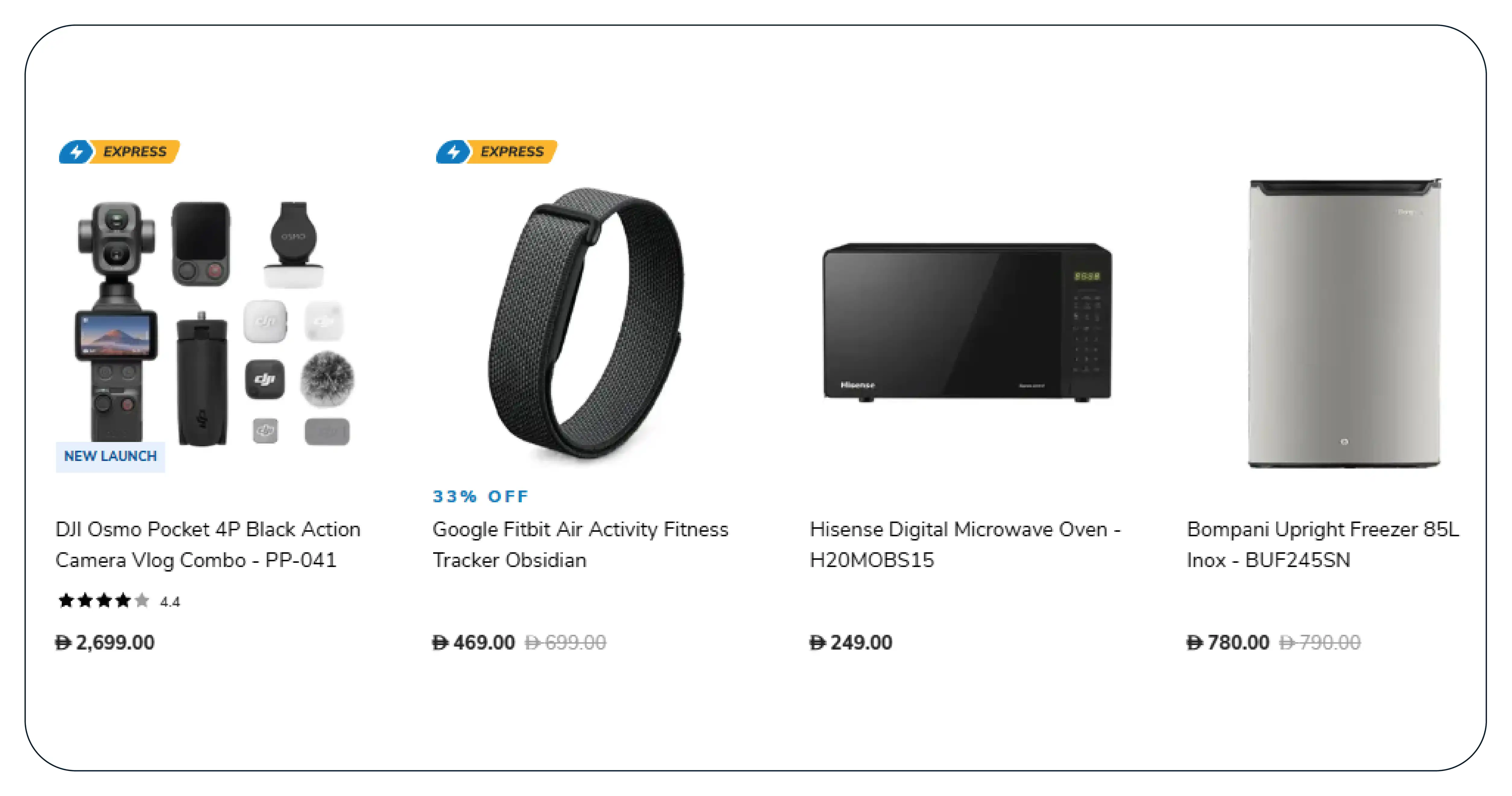
The project focused on building a reliable product intelligence framework that could connect barcode identification with marketplace pricing information. The client wanted to improve operational efficiency while making product comparisons more accurate across UAE retail platforms.
Build a centralized product intelligence system for Amazon.ae, Noon, Sharaf DG, and Carrefour UAE.
Improve product identification through standardized EAN and GTIN codes.
Reduce manual competitor research and repetitive catalog checks.
Support faster pricing decisions across electronics, appliances, and personal care categories.
Implement EAN Price Search Across Noon Sharaf DG and Carrefour to identify comparable products across different marketplaces.
Integrate a Noon Product Data Scraper into the automated collection workflow.
Extract product titles, brand names, model numbers, barcodes, prices, images, and availability.
Standardize product attributes across different marketplace formats.
Automate product matching and duplicate detection.
Enable structured data delivery through APIs, JSON, CSV, and database integrations.
Develop a scalable EAN GTIN Price Search API for UAE Retailers to support continuous product intelligence.
The following illustrative KPIs were established to evaluate project performance:
Product matching accuracy: Target of 95% or higher.
Manual research reduction: Target of 70%.
Data collection speed: Target of 60% improvement.
Product attribute completeness: Target of 90% or higher.
Duplicate product records: Target reduction of 80%.
Data refresh consistency: Target of 98% scheduled execution success.
The Core Challenge
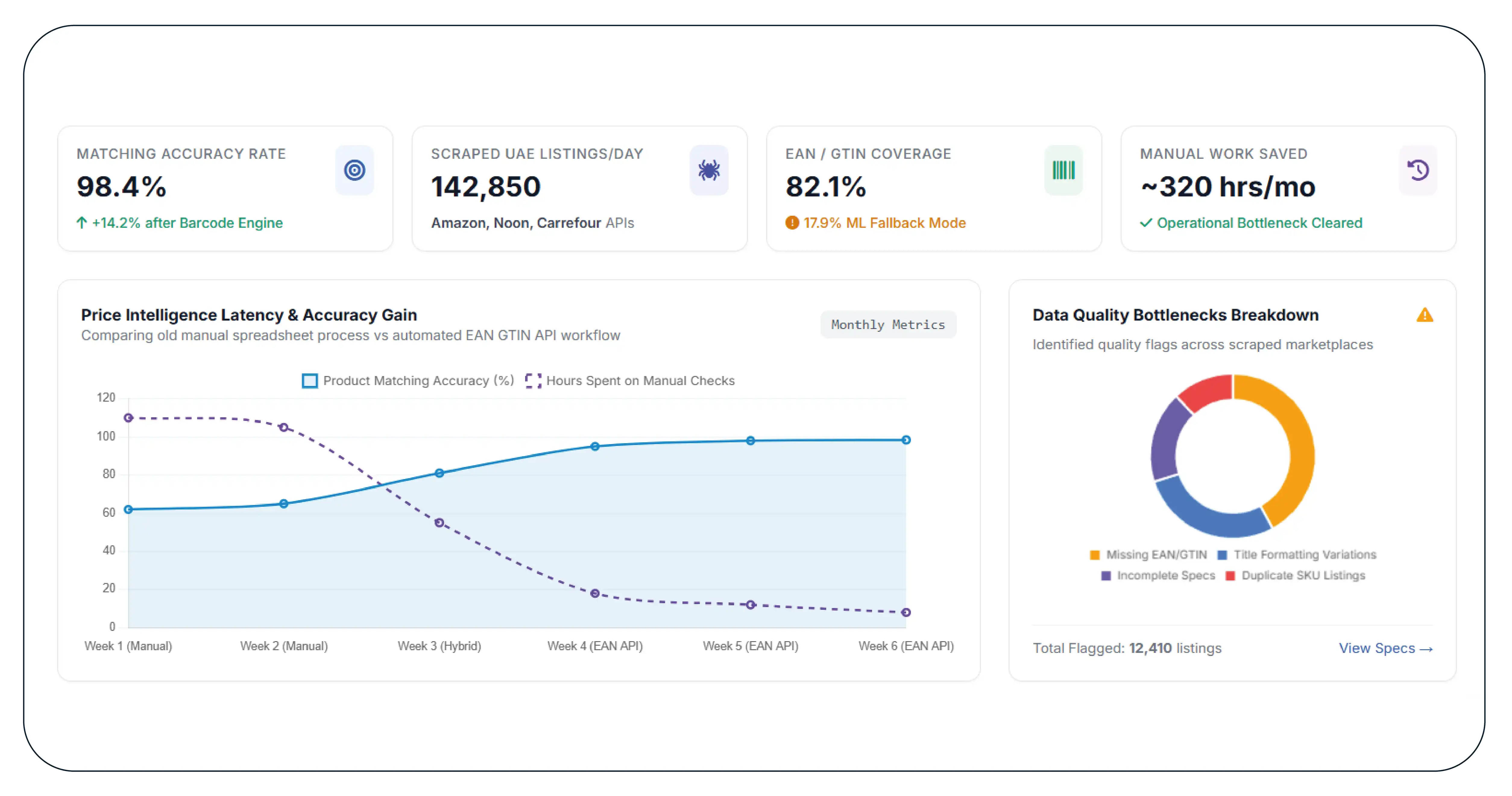
The client's biggest challenge was identifying identical products across marketplaces that presented product information differently. Even when two listings referred to the same product, their titles, descriptions, images, and model specifications frequently varied.
For example, an Apple iPhone 15 128GB listing on Amazon.ae might use a different title structure from a comparable listing on Noon or Carrefour UAE. Without reliable barcode identification, analysts had to manually inspect product descriptions and specifications before comparing prices.
The absence of automated Barcode-Based Product Price Tracking in UAE also created operational bottlenecks. Pricing teams spent considerable time collecting information, checking product variations, and updating spreadsheets.
Another challenge involved collecting structured information from different marketplace environments. The client needed a reliable Carrefour Scraping API workflow to capture product information, including prices, availability, brand names, model numbers, and product URLs.
Several quality issues affected the existing process:
Inconsistent product identifiers: Some listings contained EAN or GTIN codes, while others required additional identification checks.
Duplicate records: Similar products appeared multiple times under different titles.
Incomplete attributes: Missing model numbers, specifications, and product images affected matching accuracy.
Delayed updates: Manual collection prevented timely competitor price comparisons.
Marketplace differences: Currency presentation, product variants, seller information, and availability formats varied.
These challenges made centralized product intelligence difficult to maintain. The client needed the EAN GTIN Price Search API for UAE Retailers to connect product identification, automated extraction, and standardized marketplace data within one workflow.
Our Solution
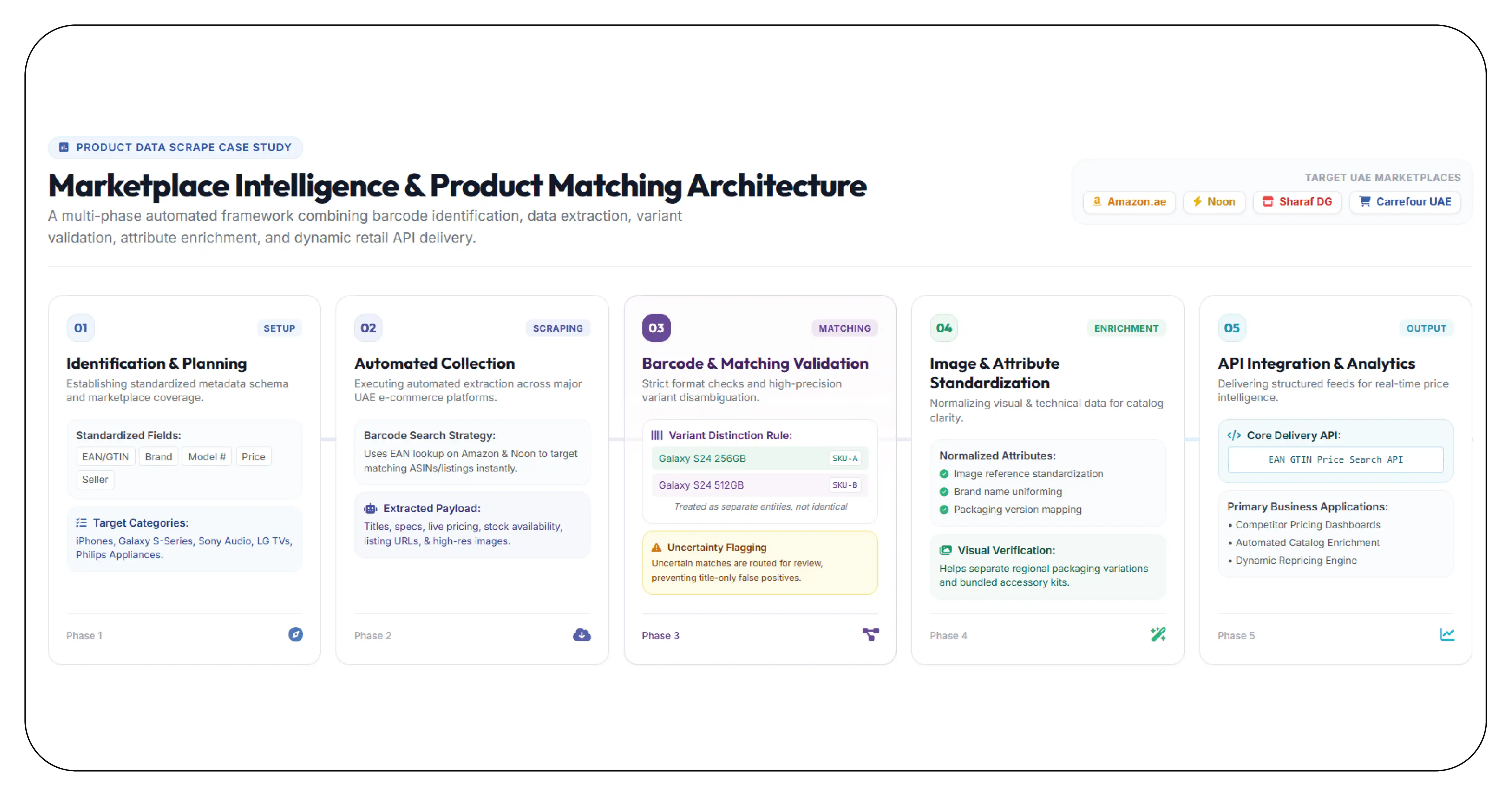
Product Data Scrape developed a phased data collection and product matching solution to address the client's marketplace intelligence requirements. The implementation combined barcode-based identification, automated extraction, product validation, and structured data delivery.
Phase 1: Marketplace Identification and Data Planning
The first phase involved identifying the target marketplaces and defining the product attributes required for comparison.
The project covered Amazon.ae, Noon, Sharaf DG, and Carrefour UAE. The team established standardized fields for product names, brand names, EAN/GTIN identifiers, model numbers, product images, prices, availability, seller information, and listing URLs.
Representative product categories included Apple iPhones, Samsung Galaxy smartphones, Sony headphones, LG televisions, and Philips home appliances.
Phase 2: Automated Product Data Collection
The next phase introduced automated extraction workflows for collecting relevant marketplace information.
The EAN Product Matching for Amazon and Noon process used available barcode identifiers and supporting product attributes to locate comparable listings. Dedicated extraction workflows collected product titles, descriptions, brands, model numbers, images, prices, and availability information.
The solution also included E-commerce data scraping in the UAE to organize information from Sharaf DG and Carrefour UAE alongside the other marketplaces.
Phase 3: Barcode Validation and Product Matching
The collected records passed through a structured validation framework.
EAN and GTIN identifiers were checked for formatting consistency. Product matching also considered brand names, manufacturer model numbers, storage capacity, color, size, and other relevant specifications.
For example, Samsung Galaxy S24 256GB and Samsung Galaxy S24 512GB were treated as separate product variants rather than identical listings.
The system flagged missing identifiers and uncertain matches for additional validation instead of automatically treating similar product titles as identical.
Phase 4: Image and Attribute Enrichment
Product images were collected alongside available barcode and catalog information. The team standardized image references, brand attributes, and product specifications to improve product identification.
The workflow also helped distinguish different packaging versions and product variants where sufficient information was available.
Phase 5: API Integration and Reporting
The final phase organized validated records into structured datasets and API-ready outputs.
The EAN GTIN Price Search API for UAE Retailers supported the delivery of matched product information for competitor comparisons, internal dashboards, and retail analytics applications.
The resulting workflow provided a repeatable foundation for marketplace monitoring, catalog enrichment, and pricing intelligence. Data collection and refresh schedules could also be configured according to business requirements and source accessibility.
Results & Key Metrics
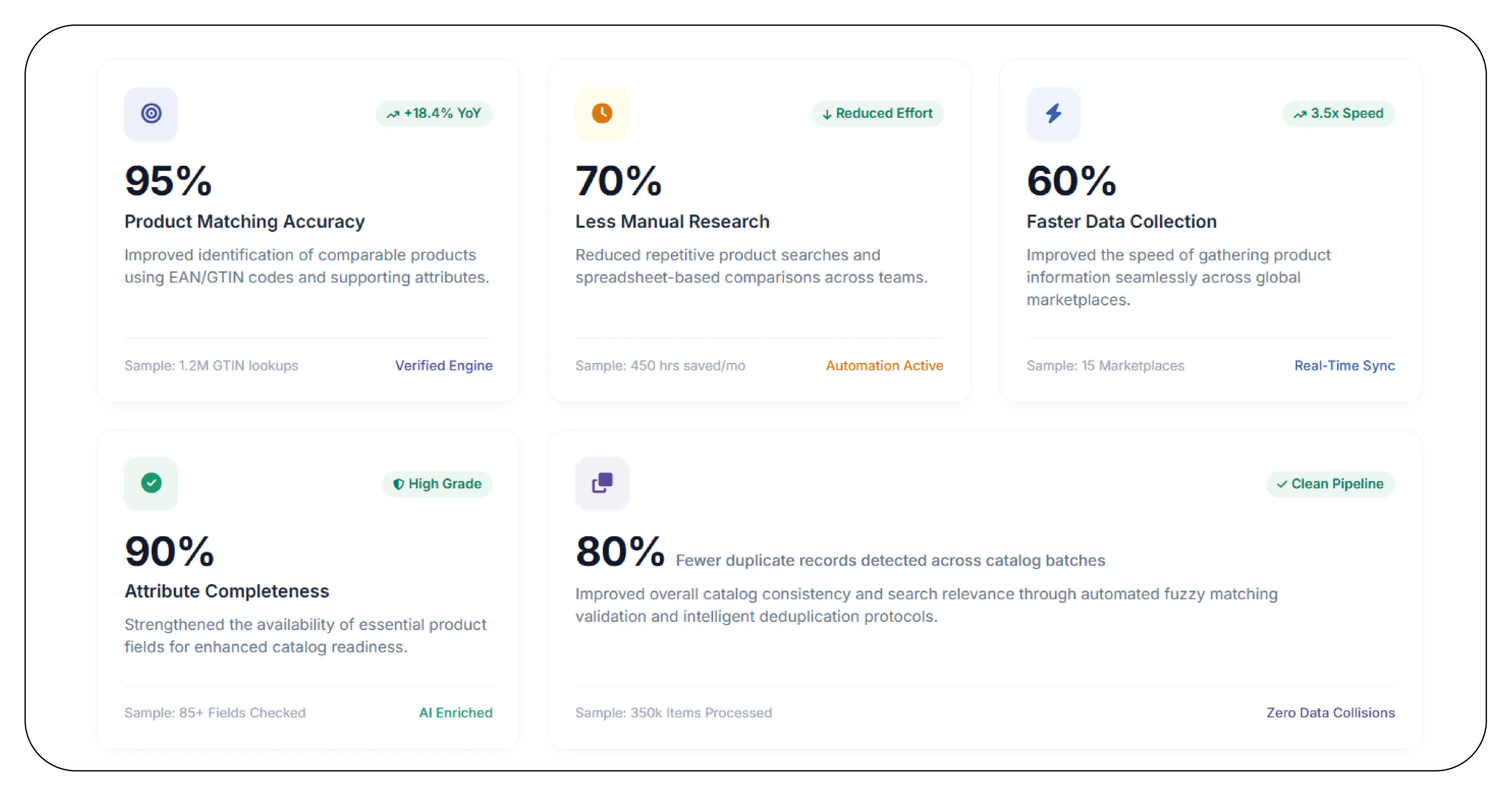
The implementation established a centralized approach to product identification, marketplace monitoring, and competitor price analysis. The following sample figures demonstrate the intended performance outcomes and are illustrative rather than verified client results.
Illustrative performance improvements:
95% product matching accuracy: Improved identification of comparable products using EAN/GTIN codes and supporting attributes.
70% less manual research: Reduced repetitive product searches and spreadsheet-based comparisons.
60% faster data collection: Improved the speed of gathering product information across marketplaces.
90% attribute completeness: Strengthened the availability of essential product fields.
80% fewer duplicate records: Improved catalog consistency through validation and deduplication.
The automated workflow helped the retail brand establish a more consistent approach to competitor monitoring and product catalog management.
Through EAN Search API for Retail Price Intelligence, the client could organize comparable product listings from Amazon.ae, Noon, Sharaf DG, and Carrefour UAE using standardized product identifiers.
Product teams gained improved visibility into price differences, product availability, brand information, and listing variations. The structured dataset also reduced the effort required to investigate duplicate listings and incomplete product records.
Another important improvement was the ability to connect product-level insights with internal reporting systems. Instead of depending entirely on manual research, the business could use structured datasets to support pricing reviews, catalog updates, and competitive analysis.
The implementation created a scalable foundation for expanding product coverage and monitoring additional retail categories.
What Made Product Data Scrape Different
Product Data Scrape focused on combining barcode intelligence with marketplace-specific extraction rather than relying exclusively on product title matching.
Its structured matching framework evaluated EAN/GTIN identifiers alongside brand names, model numbers, specifications, and product variants. This helped distinguish identical products from similar-looking listings.
The solution also incorporated automated validation, duplicate detection, and image enrichment to improve catalog consistency.
A key differentiator was GTIN-Based Retailer Price Matching in the UAE, which connected product identification with competitor monitoring across multiple marketplaces.
The modular architecture supported configurable extraction schedules, standardized data delivery, and integration with existing retail analytics systems. This approach made the solution adaptable to changing catalog requirements and expanding marketplace coverage.
Client's Testimonial
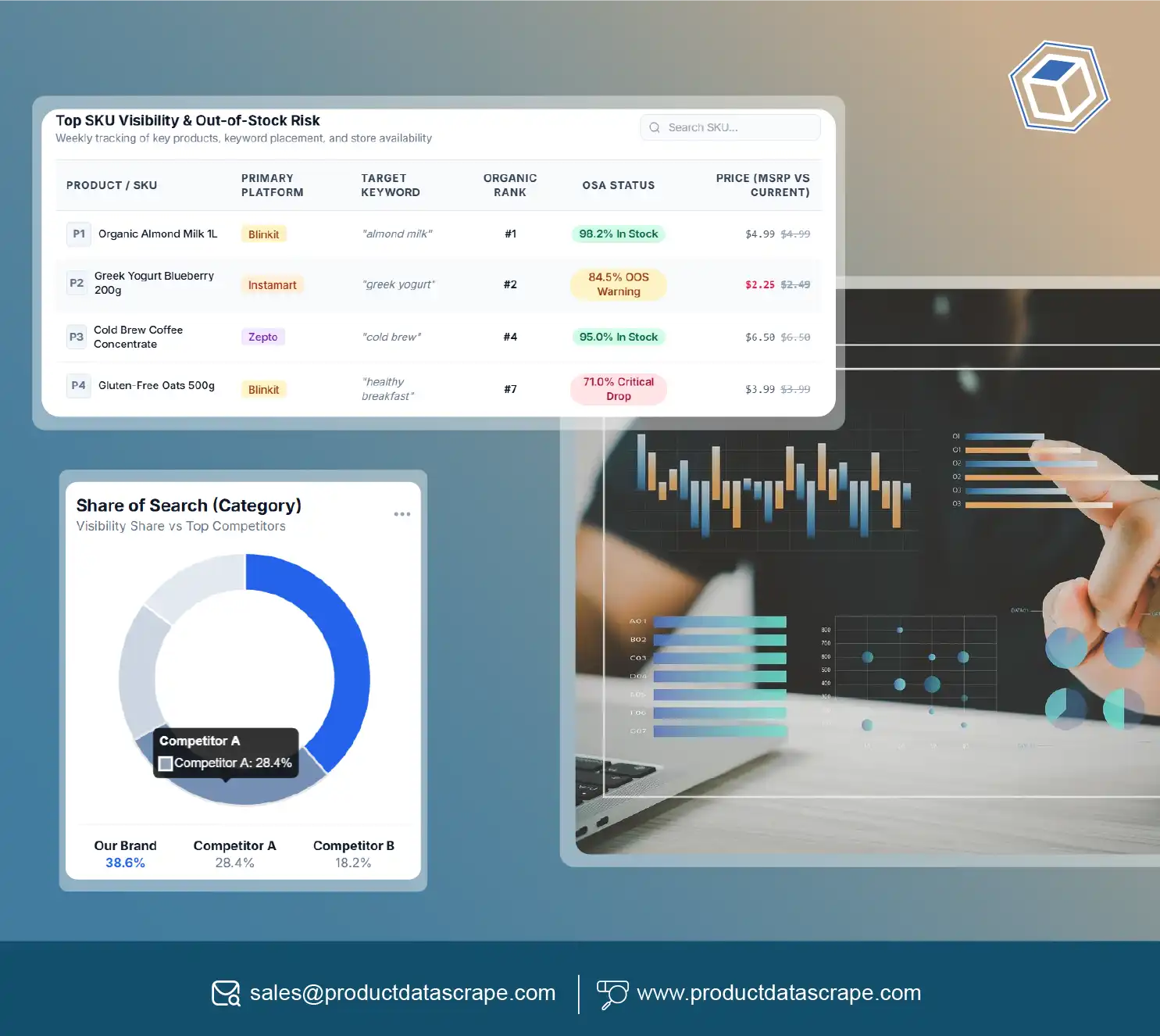
"Product Data Scrape helped us establish a more organized approach to product identification and competitor price monitoring. Previously, our teams spent considerable time checking product listings across different marketplaces and manually comparing product details. The reporting structure also improved our visibility into product availability and marketplace positioning. The additional share of search tracking helped us understand how our products appeared across digital retail channels and identify opportunities to strengthen our marketplace presence."
— Head of E-commerce & Retail Analytics, Confidential UAE Retail Brand
The barcode-based matching workflow made it easier to identify comparable products and organize pricing information from Amazon.ae, Noon, Sharaf DG, and Carrefour UAE.
Conclusion
Accurate product identification and competitor price monitoring are essential for retailers operating in the UAE's competitive e-commerce market. Product Data Scrape developed a structured solution that connected barcode identification, automated marketplace extraction, product validation, and pricing intelligence.
By implementing product matching, the EAN GTIN Price Search API for UAE Retailers provided a scalable foundation for comparing listings across Amazon.ae, Noon, Sharaf DG, and Carrefour UAE.
Retail businesses can use similar workflows to improve catalog accuracy, reduce manual research, and make better-informed pricing decisions.
Looking to improve your UAE marketplace intelligence? Partner with Product Data Scrape to build scalable EAN/GTIN-based product data solutions and strengthen your retail competitiveness!
FAQs
1. What is an EAN GTIN Price Search API for UAE retailers?
It is an API-based solution that uses product identifiers such as EAN and GTIN codes to locate corresponding product listings and organize pricing information across UAE retail marketplaces. It helps businesses compare identical products more accurately.
2. Which UAE marketplaces can be monitored?
Depending on source accessibility and project requirements, product information can be collected from Amazon.ae, Noon, Sharaf DG, and Carrefour UAE. Available fields may include product titles, brands, barcodes, prices, images, and stock status.
3. Why are EAN and GTIN codes important for price comparison?
EAN and GTIN codes provide standardized product identifiers. They help businesses distinguish identical products from similar listings, reduce matching errors, and improve cross-marketplace price comparisons.
4. Can product images and barcodes be collected together?
Yes. Scrape Product Images & Barcodes workflows can combine available product images, barcode identifiers, model numbers, and specifications to support catalog enrichment and product verification.
5. How can retailers use collected product pricing data?
Retailers can use structured pricing datasets for competitor benchmarking, repricing strategies, product catalog management, availability monitoring, and retail performance analytics. Data can also be integrated into internal dashboards and business intelligence platforms.


 Singapore
 EMAIL
 PHONE












.webp)