Introduction
Weekly wine-price monitoring helps retailers, importers, distributors, and wine brands detect competitor discounts, identify changing product availability, and make informed pricing decisions. Extract Weekly French & Italian wine product data through authorized sources, match products by SKU and bottle attributes, and compare dated observations to distinguish genuine price changes from differences in vintage, bottle size, or promotion.
For businesses using a Wine.com Data Scraping API, access permissions must be confirmed before collection begins. Wine.com’s published terms prohibit automated data scraping, whether commercial or noncommercial. Businesses should therefore obtain written authorization or use an explicitly permitted data-access method rather than assume that a publicly accessible product page can be scraped. Source: Wine.com Terms of Service.
The market context makes accurate product tracking important. The International Organisation of Vine and Wine (OIV) reported that France produced 36.1 million hectolitres of wine in 2025, while Italy produced 44.4 million hectolitres. Both countries remain important sources for international wine portfolios, but production conditions, consumer demand, and trade patterns change over time. Source: OIV, State of the World Wine Sector in 2025.
A useful monitoring system should capture product identity, observed price, currency, bottle volume, vintage, promotional status, availability, retailer, source, and collection timestamp. This structure enables wine businesses to compare like-for-like products and identify discount opportunities without confusing unrelated products.
How can retailers identify meaningful price changes?
An Italian Wine Product Scraper workflow should match individual products before comparing prices. A wine name alone is not a reliable identifier because the same producer may sell multiple vintages, bottle formats, appellations, and product variations. A valid comparison should use a stable product identifier wherever available, supported by producer, label, vintage, bottle size, and other distinguishing attributes.
Web Scraping Wine Pricing Trends can then organize observations into a weekly time series. Each observation should retain the retailer, displayed price, currency, regular price where available, promotional price, and collection date. Analysts can calculate the absolute price difference and percentage change against the previous observation.
For example, a weekly comparison should flag a price reduction only when the same SKU has been matched confidently. A missing product should be classified as unavailable or not observed, rather than assigned a price of zero. Similarly, a promotion should not be recorded as a discount unless the source provides enough evidence to identify the previous or reference price.
The wider market has experienced substantial production variability. OIV data shows that French production declined from 47.2 million hectolitres in 2023 to 36.1 million in 2024 and remained at 36.1 million in 2025. Italy's production moved from 38.3 million hectolitres in 2023 to 44.1 million in 2024 and 44.4 million in 2025. These are production figures, not retail-price movements, but they provide context for monitoring supply-sensitive product categories. Source: OIV.
| Year | France wine production (million hectolitres) | Italy wine production (million hectolitres) |
|---|
| 2020 | 46.7 | 49.1 |
| 2021 | 37.6 | 50.2 |
| 2022 | 46.0 | 49.8 |
| 2023 | 47.2 | 38.3 |
| 2024 | 36.1 | 44.1 |
| 2025 | 36.1 | 44.4 |
| 2026 | Full-year figure not yet available | Full-year figure not yet available |
Source: OIV, May 2026. Values for 2025 are preliminary estimates. OIV report.
Retailers should use this market context alongside actual weekly observations rather than infer shelf-price changes from production statistics alone.
Why should weekly observations preserve historical context?
A Weekly French & Italian Wine SKU Dataset should preserve historical records rather than overwrite last week's price. Without dated observations, analysts cannot determine when a discount began, whether it lasted for several weeks, or whether a competitor restored the regular price.
This is particularly relevant for Digital Shelf Analytics, where a product's displayed price and availability can vary by retailer, market, delivery location, and promotional period. A robust dataset stores each observation with a timestamp and source reference, allowing analysts to compare equivalent observations over time.
The collection schedule should reflect business requirements and the permitted access conditions of each source. Weekly collection may be suitable for tracking recurring promotions, while faster updates might be justified for selected high-priority products when the source permits them. A fixed weekly schedule does not guarantee that every short-lived discount will be observed; a promotion that starts and ends between collection runs can be missed.
The following framework uses published wine production data to establish the historical market context. It does not present production as evidence of specific retail discounts.
| Year | France production | Italy production | Why retain the year |
|---|
| 2020 | 46.7 mhl | 49.1 mhl | Preceding years provide a baseline for later comparisons |
| 2021 | 37.6 mhl | 50.2 mhl | Records differing national production outcomes |
| 2022 | 46.0 mhl | 49.8 mhl | Supports a longer historical reference |
| 2023 | 47.2 mhl | 38.3 mhl | Shows a sharp Italian production decline |
| 2024 | 36.1 mhl | 44.1 mhl | Shows contrasting production changes |
| 2025 | 36.1 mhl | 44.4 mhl | Provides the latest published full-year estimates |
| 2026 | Not yet available as a full-year total | Not yet available as a full-year total | Add verified figures when published |
Source: OIV. View the official report.
For commercial analysis, the more useful weekly record includes the current price, previous observed price, percentage change, promotion indicator, and number of consecutive observations at the same price. These fields help distinguish persistent price positioning from temporary promotions.
Businesses should also retain collection failures and source changes. If a page cannot be accessed or a product identifier changes, the system should flag the gap for review rather than silently treating missing data as a genuine market event.
Which product attributes make wine comparisons accurate?
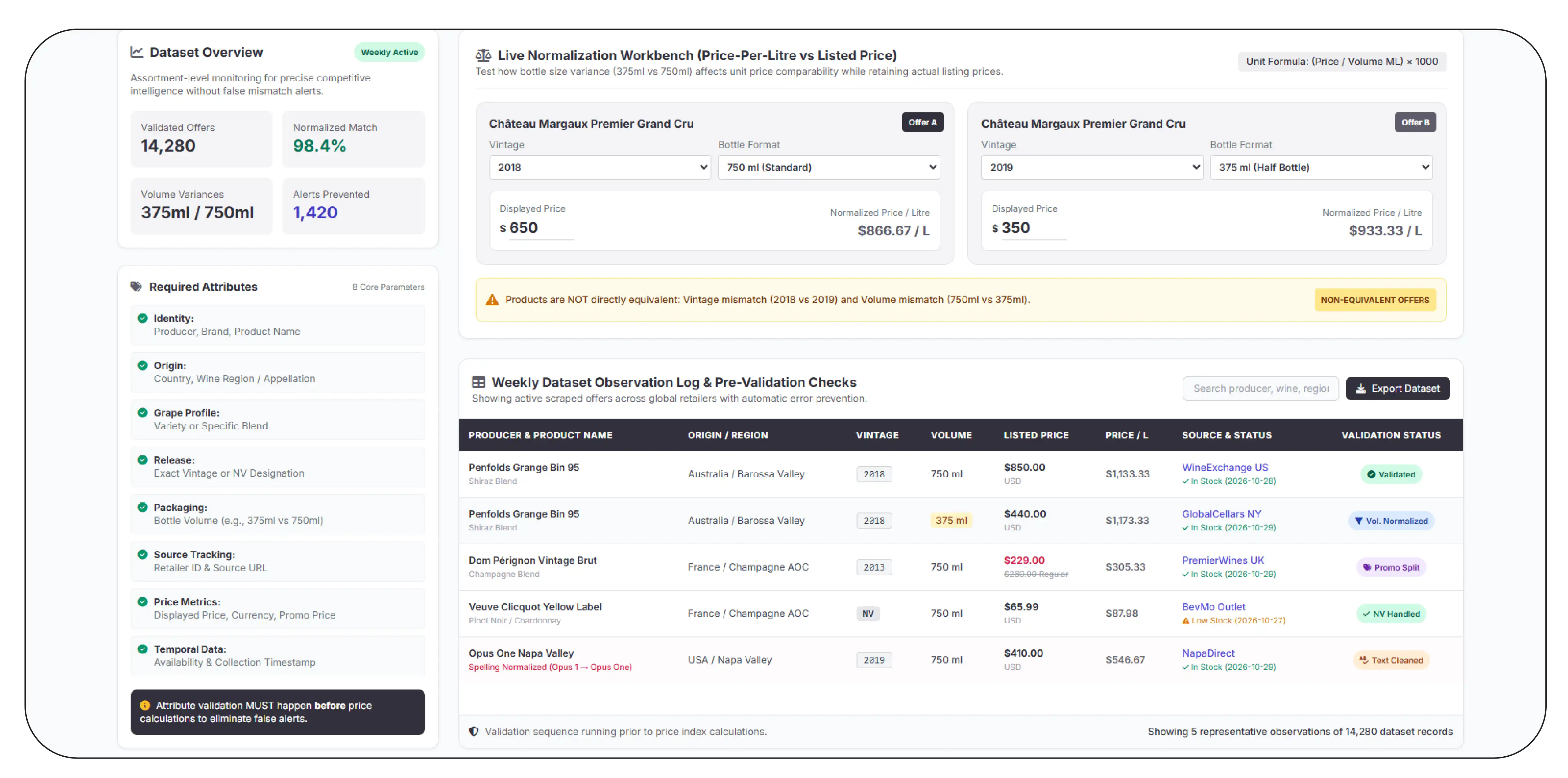
A Weekly Wine Product Attribute Dataset should include enough detail to distinguish products that look similar but are not commercially equivalent. A bottle of the same wine from a different vintage, a 375 ml half-bottle, and a 750 ml bottle should not be treated as identical offers without a clear normalization method.
Recommended attributes include:
- Producer, brand, and product name.
- Country of origin and wine region or appellation, when provided.
- Grape variety or blend, when documented.
- Vintage or non-vintage designation.
- Bottle size and packaging format.
- Retailer product identifier and source URL.
- Displayed price, currency, and promotional price.
- Availability status and collection timestamp.
Bottle volume is particularly important when comparing prices. A price-per-litre measure can make different bottle sizes more comparable, but only when the product identity and volume are known. It should not replace the displayed bottle price because consumers still pay the listed amount for the package.
The OIV's 2025 report describes a wine market affected by climatic variability, softer demand, and trade uncertainty. It estimates global wine production at 227 million hectolitres in 2025, only 0.6% above 2024's historically low level and 9.4% below the five-year average. Source: OIV. This context supports careful assortment-level monitoring, but it does not establish a price for any individual bottle.
| Attribute | Validation rule | Common error prevented |
|---|
| Producer and wine name | Normalize spelling while retaining original text | False product matches |
| Vintage | Match exact vintage or clearly mark non-vintage | Comparing different releases |
| Bottle volume | Store the numerical volume and unit | Comparing unequal packages |
| Currency | Preserve source currency | Invalid cross-market comparisons |
| Promotion | Store displayed and reference prices separately | Mistaking regular prices for discounts |
| Availability | Use a defined status and timestamp | Treating missing data as stockout |
| Source | Keep the authorized source reference | Untraceable observations |
Attribute validation should happen before price calculations. This reduces false alerts and helps pricing teams focus on genuine competitive changes.
How should wine-price monitoring distinguish promotions from ordinary changes?
French and Italian Wine Price Monitoring should distinguish a true discount from a change caused by a different product, bottle size, delivery location, or retailer. The repeated phrase Extract Weekly French & Italian wine product describes the collection objective, but collection alone is not enough: each observation needs validation and comparison rules.
The first step is to establish a baseline for each matched product. The baseline might be the previous week's observed price, the median price over a defined period, or a displayed regular price when the retailer provides one. The selected baseline should be documented because each method answers a different question.
The second step is to classify the change. A price drop may be a temporary promotion, a permanent price adjustment, a currency-related difference, or a change in the product record. A price increase may reflect a changed offer, but it should not automatically be interpreted as inflation or a supplier cost increase.
OIV's 2025 report estimates that world wine exports declined by 4.7% in volume to 94.8 million hectolitres, while export value fell by 6.7% to €33.8 billion. The average export price declined by 2.1% to €3.56 per litre. These figures describe international trade, not individual retailer prices, so they should inform market context rather than be used as direct shelf-price benchmarks. Source: OIV.
| Monitoring field | Recommended calculation or rule |
|---|
| Absolute price change | Current observed price minus baseline price |
| Percentage change | Absolute change divided by baseline price, multiplied by 100 |
| Unit price | Price divided by verified product volume |
| Discount amount | Reference price minus promotional price, if both are provided |
| Promotion duration | Number of consecutive dated observations supporting the offer |
| Alert status | Flag only after identity and data-quality checks |
A weekly report should include the product, retailer, old and new prices, percentage change, promotion status, availability, and confidence level. This enables category managers to investigate meaningful changes instead of responding to every data fluctuation.
How can businesses track changes in product assortment?
Weekly Italian Wine Product Assortment Tracking should capture additions, removals, changes in availability, and changes in product attributes across monitored retailers. The objective is to understand not only what a bottle costs, but also whether the retailer continues to list the product and which alternatives are offered.
An assortment record should distinguish a confirmed product removal from a temporary stockout or a failed collection. A product absent from one weekly observation is not necessarily discontinued. Reliable classification may require repeated observations or confirmation from an authorized source.
For Italian wine ranges, useful segmentation may include producer, region, appellation, grape variety, vintage, bottle size, and price band. French wine ranges can be classified with comparable fields, while preserving their own region and appellation structures. Standardized attributes allow category managers to compare assortment breadth without assuming that every product is directly interchangeable.
The global market context reinforces the importance of keeping assortment and supply evidence separate. OIV reported that global vineyard area fell to 7.0 million hectares in 2025, down 0.8% from 2024 and marking a sixth consecutive year of contraction. France's vineyard area declined to 740,000 hectares in 2025, while Italy's was estimated at 726,000 hectares. Source: OIV. These are vineyard-area figures, not evidence that any particular retailer reduced its selection.
| Assortment event | Evidence needed | Recommended interpretation |
|---|
| New listing | First verified observation and product identity | Potential assortment addition |
| Missing listing | Failed or absent observation | Investigate before classifying |
| Stockout | Explicit unavailable status from source | Availability issue at observation time |
| Product replacement | Matching evidence for old and new listings | Possible range change |
| Vintage change | Verified change in vintage | Separate product variant |
| Pack-size change | Verified volume or packaging difference | Reassess comparability |
Assortment tracking helps retailers identify gaps, distributors assess listing continuity, and brands understand their observed online presence. The strongest reports combine product matching, repeated observations, and transparent event definitions.
What should a reliable French wine product data workflow include?
French Wine SKU Data Extraction should follow a documented process that combines authorized source access, product matching, validation, historical storage, and reporting. The repeated phrase Extract Weekly French & Italian wine product reflects the intended frequency and product scope; it should not be taken to mean that every website can be scraped or that every listed field is accessible.
A practical workflow begins by selecting target retailers and confirming that the chosen collection method is permitted. Product records are then collected with their source identifiers and timestamps. The data pipeline normalizes names, currencies, volumes, vintages, and availability statuses before comparing observations.
For Wine.com specifically, its terms prohibit automated scraping. Businesses should not deploy an automated extractor against that site without written permission or a clearly authorized access route. The same principle applies to other retailers: public visibility does not itself grant permission to automate collection. Source: Wine.com Terms of Service.
A reliable workflow should also document what happens when source pages change, products disappear, or fields cannot be verified. Human review is useful for ambiguous matches, unusual price changes, and product variants that automated rules cannot confidently distinguish.
| Workflow stage | Key action | Quality outcome |
|---|
| Source approval | Confirm permission and access method | Compliant collection |
| Product discovery | Identify target SKUs and retailers | Defined coverage |
| Data capture | Save permitted fields and timestamps | Traceable observations |
| Standardization | Normalize units, currencies, and names | Comparable records |
| Matching | Validate vintage, volume, and product identity | Fewer false matches |
| Change detection | Calculate differences against a documented baseline | Meaningful alerts |
| Reporting | Present price, promotion, and availability changes | Actionable decisions |
A final weekly report should prioritize significant changes, show the evidence behind each alert, and make missing data visible. That gives pricing and category teams a repeatable basis for deciding which competitor changes deserve action.
Why choose Product Data Scrape?
A wine-monitoring project needs consistent product identifiers, clear collection schedules, validated price fields, and transparent change reports. Liquor Web Scraping APIs can be considered only where the relevant source explicitly permits the access method or the business has obtained the required authorization.
The right workflow helps wine retailers, distributors, and brand teams distinguish actual discounts from product mismatches and missing observations. It can also organize French and Italian wine portfolios by producer, vintage, bottle size, and retailer, subject to source coverage.
A quality-focused approach prioritizes traceability, reliable comparisons, and useful reporting over raw collection volume. This enables business teams to investigate important changes with the evidence and context needed for sound decisions.
Conclusion
Weekly wine monitoring works best when price observations are matched to the correct SKU and supported by timestamps, product attributes, and source evidence. Assortment and availability monitoring adds another layer by helping teams distinguish changing prices from missing listings and stockouts.
Market statistics from the OIV show that production, vineyard area, and international trade can change materially from year to year, but these figures cannot substitute for observed retailer prices. A dependable system must rely on authorized, product-level data and clearly documented comparison rules.
Extract Weekly French & Italian wine product data with a workflow designed around your retailers, target SKUs, and business decisions. Contact Product Data Scrape to discuss authorized data collection, wine-price monitoring, assortment analysis, and structured reporting tailored to your requirements.
FAQs
1. How often should wine prices be checked?
Weekly monitoring is useful for recurring comparisons, but short promotions may begin and end between checks. Choose frequency based on business needs, source permissions, and collection feasibility.
2. Which attributes are essential for comparing French and Italian wines?
Match producer, product name, vintage, bottle volume, currency, retailer, and observed date. Add appellation or grape variety where available to reduce incorrect product comparisons.
3. Can Wine.com be scraped automatically?
Wine.com’s published terms prohibit automated data scraping. Obtain written authorization or use a specifically permitted access method before attempting any automated collection from the site.
4. How can a business distinguish a discount from a price change?
Compare matched SKUs against a documented baseline. Keep reference and promotional prices separate, and validate product identity, currency, package size, and observation dates before flagging a discount.
5. Can Product Data Scrape help design a wine-monitoring workflow?
Product Data Scrape can discuss a workflow around authorized sources, product matching, historical records, and reporting requirements. Specific coverage depends on source permissions, data availability, and project scope.


 Singapore
 EMAIL
 PHONE











.webp)