Introduction
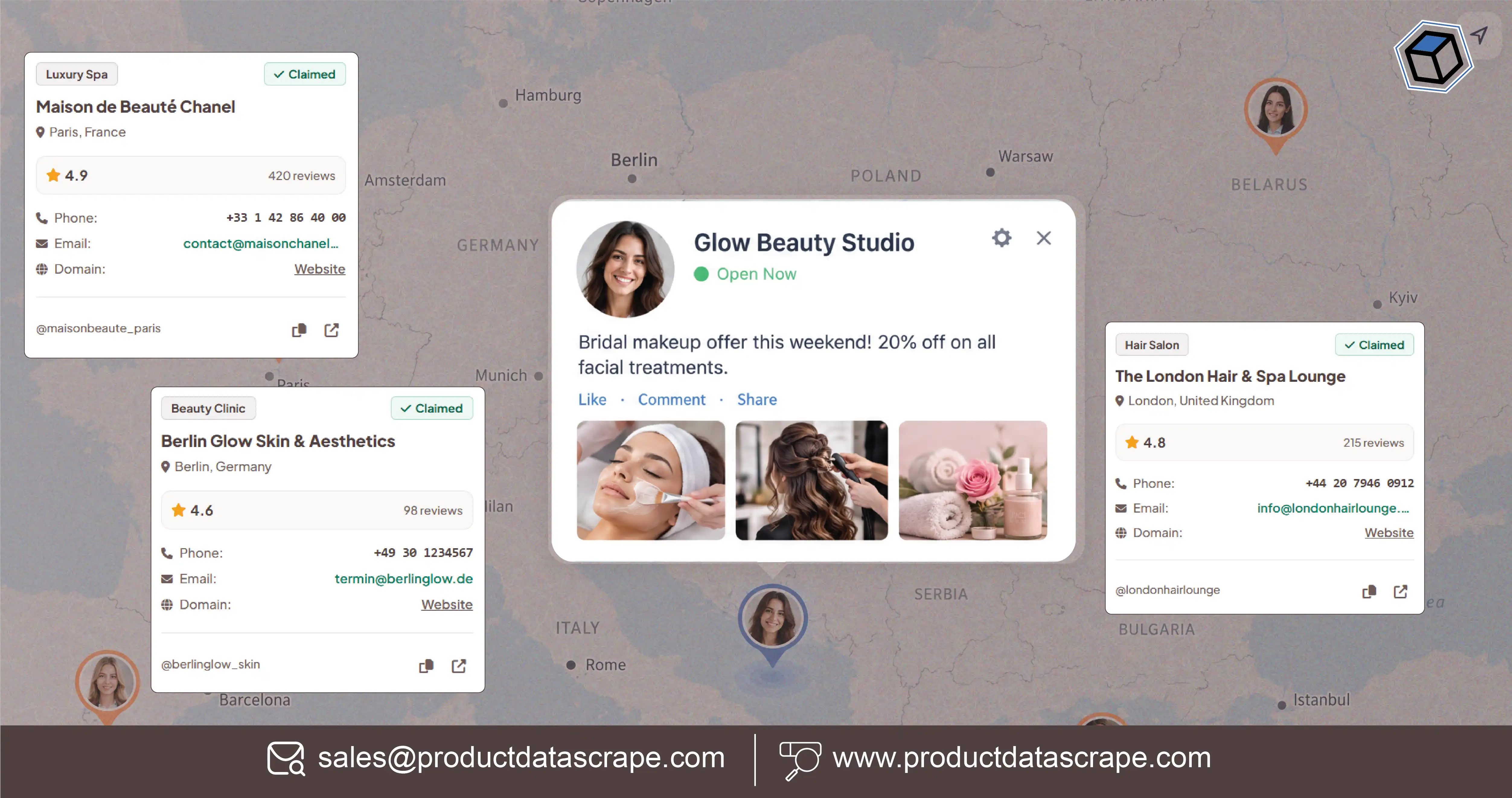
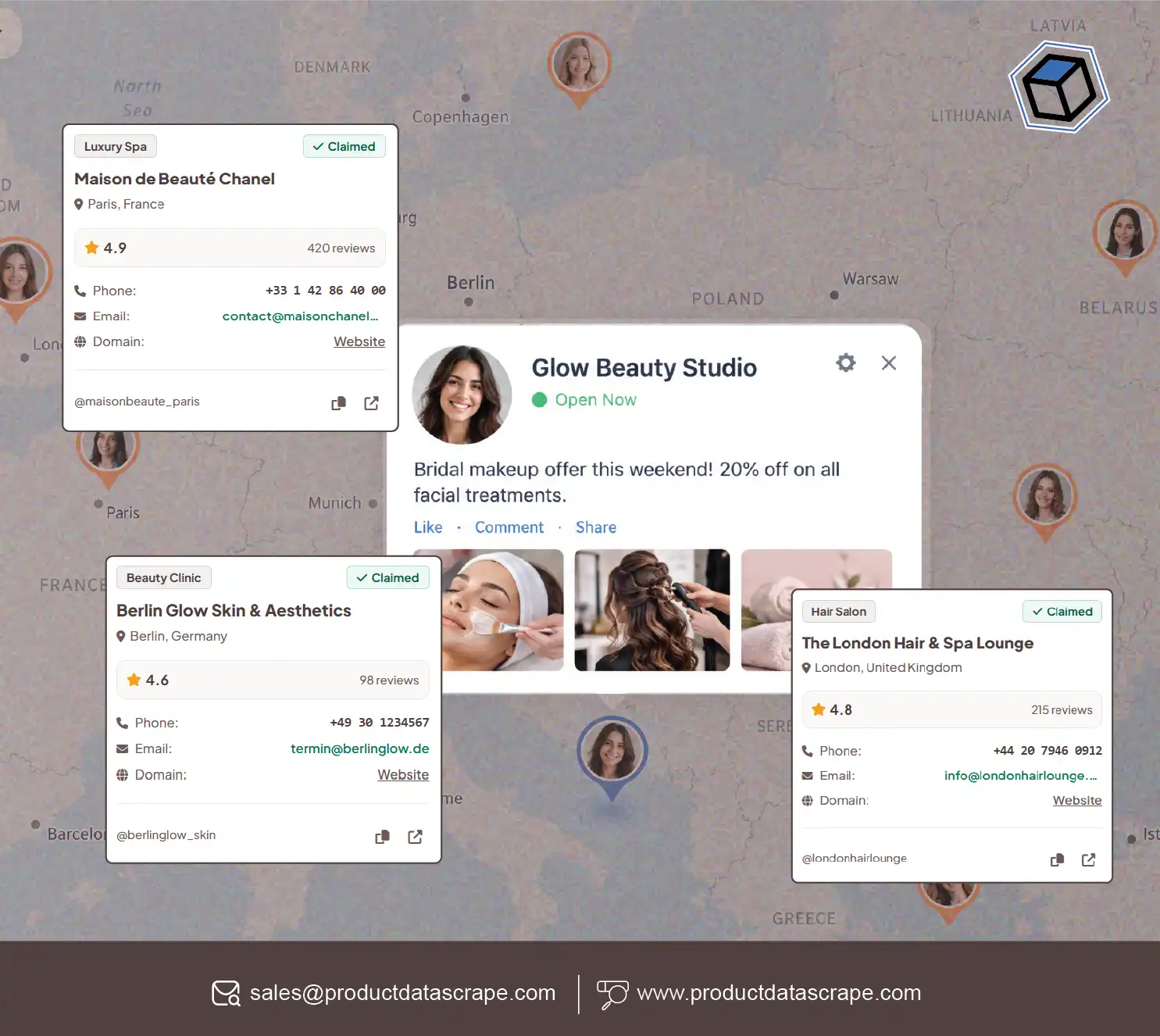
Finding beauty salons and spas across multiple European locations requires accurate business information, consistent categories, and a reliable verification process. Google Maps Beauty Business listings Scraping is a search term commonly used for this requirement, but businesses must respect Google Maps' restrictions on extracting and storing its content. A compliant research workflow can combine authorized data sources, official salon websites, business registries, and permitted mapping services to develop a useful location intelligence dataset.
For beauty brands, cosmetics distributors, salon software companies, and market research agencies, the challenge is not simply finding more businesses. It is identifying relevant establishments, distinguishing active businesses from outdated listings, and organizing location information for sales planning and market analysis.
Product intelligence can also complement location research. Price Matching Repricing and Google Shopping Data can help teams analyze product offers and pricing across eligible retail sources, while business location datasets provide a different perspective on where beauty services operate.
The European cosmetics market provides useful context. Cosmetics Europe reported retail sales of €104 billion across Europe in 2024, covering the EU-27, the United Kingdom, Norway, and Switzerland. Its subsequent industry figures valued the market at €110 billion in 2025. These are industry-wide retail estimates, not measurements of beauty salon revenue or Google Maps listings. Sources: Cosmetics Europe 2024 Annual Report and Cosmetics Europe industry figures.
For decision-makers, the practical goal is to create a verified, source-traceable view of beauty businesses without confusing map data with independently sourced business information.
How Can Beauty Businesses Be Identified and Verified Across Locations?
Scrape Google Maps Skincare Listings is a search phrase associated with discovering skincare clinics, facial treatment studios, beauty salons, and related establishments. In practice, organizations should use permitted discovery methods and authorized data sources rather than automatically extracting Google Maps content into an external database.
The first step is to define the target business categories. A skincare clinic may specialize in facials and skin treatments, while a beauty salon may offer waxing, nail care, makeup, or other services. Spas may provide wellness treatments that overlap with beauty services. Treating all these businesses as one category can distort market coverage and sales targeting.
A structured research workflow should capture information only from sources that permit its intended use. Depending on the source and applicable terms, relevant fields may include business name, business category, official website, publicly listed contact details, city, postal code, and verification status.
Catalog Enrichment Services can support a complementary product-data workflow by standardizing cosmetic product names, brands, package sizes, and product identifiers. However, enriching a salon directory and enriching a cosmetics product catalog are separate tasks and should maintain distinct schemas.
A practical verification process involves three stages:
- Identity verification: Check whether the business name and location correspond to an identifiable establishment.
- Operational verification: Look for recent evidence from an official website, booking page, or other authorized source that the business remains active.
- Category verification: Confirm that the services offered match the intended research category.
A map pin alone does not establish that a salon is currently operating. Similarly, a website that remains accessible does not necessarily prove that the business is accepting customers.
| Verification field | Recommended check | Business value |
|---|
| Business identity | Compare name and official web presence | Reduces duplicate or ambiguous records |
| Location | Check the published address against an authorized source | Improves territory assignment |
| Service category | Review the business's stated services | Improves prospect relevance |
| Operational status | Seek recent, credible evidence | Reduces outdated prospects |
| Source and date | Record provenance and last verification date | Makes records auditable |
For sales teams, the outcome should be a defensible prospect list rather than an unverified collection of map results. Each record should carry its source, verification date, and unresolved issues.
How Can Beauty and Cosmetics Research Cover European Markets?
A European Cosmetics Store Location Dataset can help businesses organize information about cosmetics retailers, beauty supply stores, skincare specialists, and other relevant establishments across selected European countries. The dataset should define whether it represents physical stores, e-commerce businesses, service providers, or a combination of these categories.
European coverage creates additional data-management requirements. Business names may appear in local languages, addresses follow different conventions, and service categories may not translate directly between markets. A French beauty institute, a German cosmetics retailer, and a Korean skincare specialist operating in Europe may all belong to different commercial segments.
Scrape Beauty & K-Beauty Product Data describes a related product research requirement. K-beauty generally refers to Korean beauty products and routines, including skincare and cosmetics. Product research can capture brand, product title, size, ingredients where available, product identifiers, retailer, and displayed offer details from authorized sources.
The business location dataset and product dataset should be connected only through verified relationships. For example, a retailer may sell a particular Korean skincare brand, but its location record should not automatically imply that every product from that brand is stocked there.
The scale of European cosmetics activity makes market segmentation useful. Cosmetics Europe reported that skincare generated €30.1 billion in retail sales in 2024, while toiletries accounted for €24.7 billion. These figures refer to product-market categories across the geographic scope of its report, not the revenue of physical skincare stores. Source: Cosmetics Europe Annual Report 2024.
A useful European research plan should specify:
- Countries and regions included in the project.
- Business types, such as salons, spas, skincare clinics, and cosmetics retailers.
- Preferred languages and address formats.
- The authorized sources permitted for each field.
- Whether the project also includes e-commerce products and retailer offers.
- Refresh schedules and business verification criteria.
| Research dimension | Suggested standardization |
|---|
| Country | ISO country code |
| City and postal code | Preserve the original value and normalize where appropriate |
| Business category | Shared taxonomy with source-specific category mapping |
| Product brand | Standardized brand name with original spelling retained |
| Currency | ISO currency code |
| Verification | Status, source, and last-checked date |
For international teams, these standards make it easier to compare markets without assuming that every country has identical business classifications or data coverage.
What Is Required for EU-Wide Business Coverage?
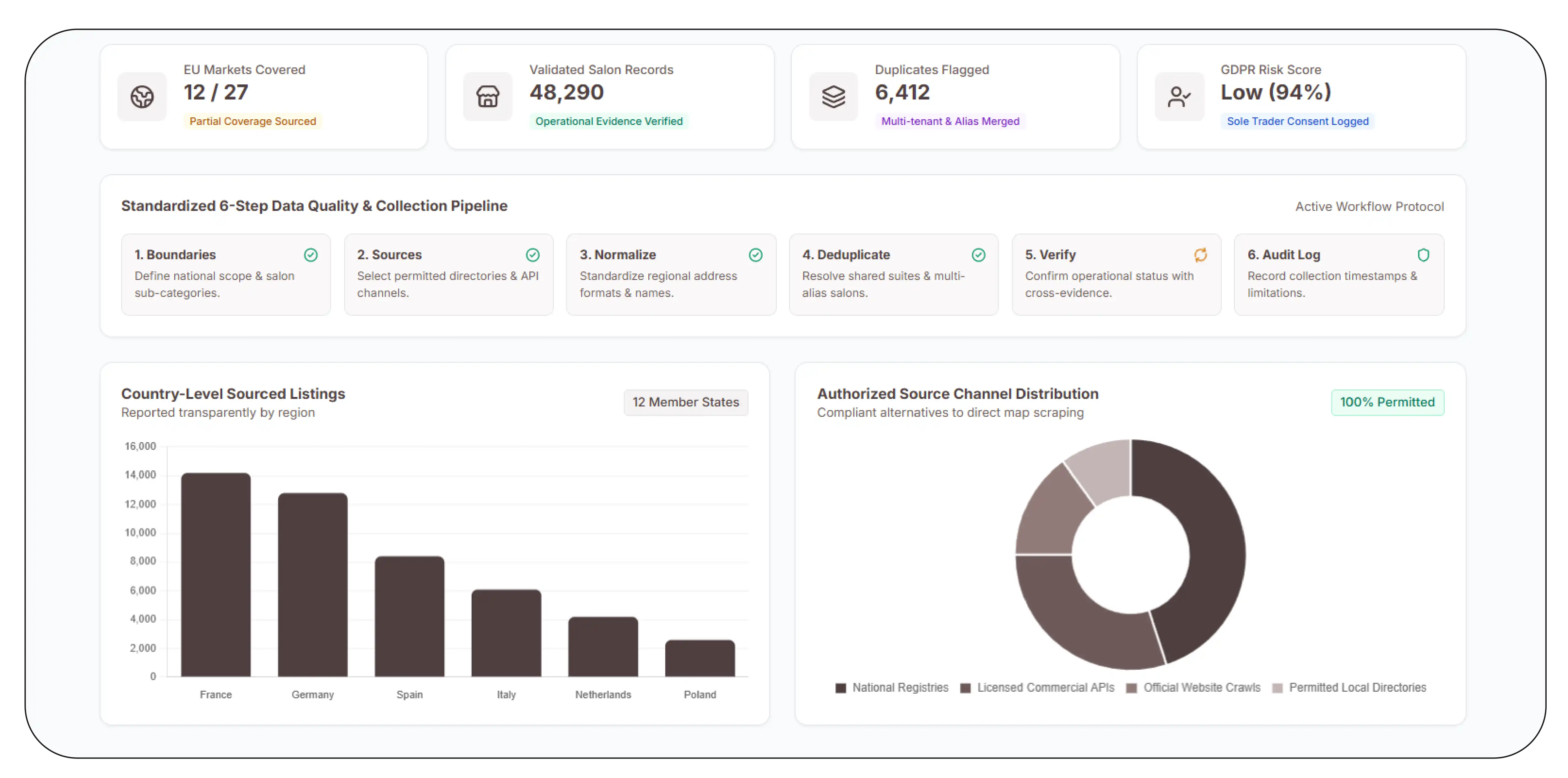
EU-Wide Beauty Salon Listings Extraction is often used to describe the collection of salon and spa business information across multiple European Union markets. A dependable project should instead begin by defining permitted sources, business categories, geographic boundaries, and validation rules.
Google Maps Beauty Business listings Scraping should not be treated as unrestricted permission to export map listings. Google's published Maps Platform terms prohibit scraping or extracting Maps content for use outside its services in covered circumstances, including copying and saving business names and addresses. Organizations should review the current terms applicable to their account, product, region, and intended use before designing a collection workflow. Source: Google Maps Platform terms.
Where external storage or reuse is required, businesses can investigate authorized business directories, licensed datasets, official business websites, applicable national registries, or provider APIs whose terms permit the intended use. No single source should be assumed to cover every salon across the EU.
EU-wide research also needs consistent quality controls. A salon that uses multiple names, operates from a shared building, or maintains separate treatment rooms may appear in more than one source. Conversely, a recently opened business may not yet appear in a particular directory.
A strong workflow should include:
- Define country-level coverage and category rules.
- Select permitted sources for each target market.
- Normalize names, addresses, and business categories.
- Identify potential duplicates using source identifiers and available attributes.
- Verify operational status through appropriate evidence.
- Record collection dates, permissions, and limitations.
Privacy and outreach requirements also matter. Business information can include personal data, particularly when a sole trader's name, direct contact information, or identifiable individual is involved. The GDPR's applicability and lawful-basis requirements should be assessed for the actual processing activity. Source: European Commission GDPR overview.
Coverage should be reported transparently. A dataset covering selected cities should not be described as comprehensive EU-wide coverage. Similarly, an address collected from a directory should not be marked verified unless a defined validation step supports that status.
How Should Beauty Business Categories Be Standardized?
A Google Maps Beauty Category Listing Scraper is a phrase associated with categorizing salons, spas, skincare clinics, nail studios, and cosmetics retailers. A compliant alternative is to build a category-normalization pipeline from authorized sources and retain each source's original classification.
Category inconsistency is a major practical obstacle in multi-country research. One source might label an establishment as a beauty salon, another as a skin care clinic, and a third as a spa. These labels can overlap, but they do not necessarily describe identical services.
The solution is a controlled taxonomy. Each record should have a primary category, optional secondary categories, and supporting evidence. The taxonomy should be designed around the business decision: a cosmetics wholesaler searching for retail partners may need beauty stores, while a skincare equipment supplier may prioritize treatment clinics.
Useful category groups include:
- Beauty salons and general beauty services.
- Skincare clinics and facial treatment providers.
- Day spas and wellness establishments.
- Nail studios and nail-care specialists.
- Cosmetics and beauty supply retailers.
- Hair salons, where relevant to the target market.
These are proposed research categories, not a claim that every mapping platform uses precisely these labels.
Category assignment should rely on published service descriptions or other authorized evidence. If the source does not establish whether a business offers skincare treatments, the record should remain unconfirmed rather than receiving an inferred category.
| Data-quality issue | Recommended treatment |
|---|
| Different labels for equivalent services | Map to a common category while retaining the original label |
| One business offers multiple services | Allow a primary category and documented secondary categories |
| Ambiguous description | Mark for review rather than guessing |
| Duplicate business records | Compare authorized identifiers and address evidence |
| Missing category | Preserve as unknown until verified |
Category mapping should be version-controlled. If the business later expands the taxonomy, earlier records can be remapped consistently without losing the original classification.
For prospecting teams, this approach improves targeting and reduces the time spent reviewing businesses that do not match the intended service segment.
How Can Businesses Map Beauty Market Opportunities Across Europe?
An EU Beauty Market Mapping Dataset can bring together verified business locations, market boundaries, service categories, and relevant commercial indicators to support territory planning and competitor research. Its usefulness depends on the quality and coverage of the underlying sources, not on the number of rows collected.
Google Maps Beauty Business listings Scraping may appear in search queries for this purpose, but organizations must ensure that their data acquisition method complies with the applicable platform terms. Market mapping can instead use licensed business datasets, official business information, and authorized geospatial sources.
Market mapping should answer specific commercial questions. A cosmetics distributor may want to identify cities with relevant beauty retailers. A salon software company may need to understand which territories contain potential customers. A beauty equipment supplier may prioritize clinics offering particular treatments.
These questions require different data fields and validation rules. The project should define its target customer before collecting information.
Cosmetics market data provides useful context for prioritization. Cosmetics Europe reported European cosmetics and personal care retail sales of €104 billion in 2024 and €110 billion in 2025. Its geographic definition includes the EU-27, the United Kingdom, Norway, and Switzerland, so the figures should not be presented as EU-only totals. Sources: 2024 report and industry overview.
What do verified figures from 2020 to 2026 tell us?
The available statistics below illustrate the broader context. They are not estimates of the number of salons, spa locations, or Google Maps listings.
| Year | Verified data point | Interpretation |
|---|
| 2020 | No directly comparable salon-listing count is asserted here. | Use a consistent baseline before comparing business coverage. |
| 2021 | No directly comparable EU-wide salon count is asserted here. | Avoid substituting general retail figures for location counts. |
| 2022 | No directly comparable EU-wide salon count is asserted here. | Define business categories before measuring market size. |
| 2023 | No directly comparable EU-wide salon count is asserted here. | Check source continuity before interpreting year-over-year changes. |
| 2024 | EU cosmetics and personal care retail sales reached €104 billion in the geographic scope reported by Cosmetics Europe. | Indicates the scale of the wider cosmetics sector. |
| 2025 | Cosmetics Europe reported €110 billion in European cosmetics and personal care retail sales. | Provides a newer industry benchmark, not a salon revenue estimate. |
| 2026 | Eurostat's 2026 digitalisation publication reported that 24% of EU businesses had conducted e-sales in 2025. | Shows the continued relevance of digital sales channels to business research. |
Sources: Cosmetics Europe 2024 Annual Report, Cosmetics Europe industry overview, and Eurostat Digitalisation in Europe 2026.
These statistics do not establish how many salons exist in a particular city. To answer that question, analysts need a dedicated, clearly defined dataset of businesses with documented sources and collection dates.
A practical market-mapping output can include verified business counts by category and territory, source coverage, duplicate rates, verification status, and the date each record was checked. These measures make market comparisons more useful and prevent unsupported claims about market size.
How Can Business Listings Be Enriched and Maintained?
Google Maps Beauty Listing Enrichment describes the process of improving business records with verified attributes, consistent classifications, and source documentation. When the original source does not permit exporting or storing its content, enrichment should use independently authorized sources instead.
A basic directory entry may contain a business name and location but lack information needed for commercial qualification. Enrichment can help fill gaps using permitted official websites, licensed business databases, and other appropriate sources.
The most useful fields depend on the buyer's purpose. A salon software provider may prioritize the official website, business category, location, and published booking channel. A cosmetics distributor may care more about retail status, brand specialization, and whether the establishment is a relevant sales prospect.
Enrichment should not mean guessing missing details. If a business has no published email address, the system should record that the email is unavailable rather than generate a likely address. If operating status cannot be verified, the record should be marked unconfirmed.
A controlled enrichment workflow includes:
- Identify records with missing or outdated attributes.
- Select an authorized source appropriate to each missing field.
- Compare the source information with the existing record.
- Validate formatting and preserve the original evidence.
- Record the source URL, verification date, and confidence status.
- Schedule rechecks based on the business's needs and the permitted source's update characteristics.
Which metrics should be monitored?
| Metric | How to measure it | Why it matters |
|---|
| Completeness | Required fields populated divided by required fields expected | Reveals information gaps |
| Verification coverage | Records that passed defined checks divided by records reviewed | Shows how much of the dataset has been verified |
| Duplicate rate | Confirmed duplicate records divided by total records | Highlights catalog or directory quality issues |
| Freshness | Age of the latest successful verification | Indicates whether records may be outdated |
| Source traceability | Records with documented provenance divided by total records | Supports audits and correction workflows |
These are recommended measurement definitions, not reported performance figures for a specific provider.
The most important principle is to maintain the distinction between observed, verified, inferred, and unavailable information. This helps sales and market research teams understand what the dataset actually supports.
Why Choose Product Data Scrape?
Product Data Scrape can be considered for projects that require structured product intelligence, data normalization, and research workflows tailored to specific business needs. For beauty-sector organizations, the priority is to establish clear source permissions, consistent field definitions, and measurable quality requirements before scaling collection.
A well-scoped project should identify target markets, business categories, product fields, authorized sources, delivery formats, and update schedules. Daily Cosmetics Ecommerce Data Scraping can help businesses maintain structured product information, while clearly defined processes ensure that duplicates, missing information, and uncertain records are identified and handled consistently.
Teams should evaluate a proposed solution against its documented capabilities, source coverage, compliance approach, and validation process. The aim is to produce useful, traceable information rather than promise complete coverage without evidence.
Conclusion
Effective Monitoring EU Marketplace activities combine reliable source selection, standardized business categories, validated records, and transparent reporting. Cosmetics market statistics can provide commercial context, but accurate local research requires independently verified business-level evidence.
Organizations should prioritize source permissions, operational verification, duplicate detection, and clearly defined coverage before using location data for prospecting or market expansion. Google Maps Beauty Business listings Scraping should never be assumed to permit unrestricted extraction or reuse of Google Maps content.
Ready to improve your beauty market research? Contact Product Data Scrape to discuss a tailored, compliance-aware data collection and enrichment workflow for your European market intelligence requirements!
FAQs
1. What is beauty business listing research?
Beauty business listing research identifies and verifies relevant salons, spas, skincare clinics, and beauty retailers using authorized sources, consistent categories, and documented verification procedures.
2. Can Google Maps listings be scraped and stored?
Google Maps terms restrict extracting and storing its content outside permitted uses. Review the applicable terms and use authorized alternative sources when external storage is required.
3. Which fields are useful in a beauty business dataset?
Useful fields include business name, category, location, official website, published contact information, source, verification status, and last-checked date, where collection and use are permitted.
4. How can businesses reduce duplicate salon records?
Compare authorized identifiers, normalized business names, addresses, and official website details. Flag uncertain matches for review instead of automatically merging potentially different businesses.
5. How can Product Data Scrape support beauty market research?
Product Data Scrape can be evaluated for structured data collection and enrichment requirements, with scope, source permissions, validation criteria, and delivery expectations defined before implementation.


 Singapore
 EMAIL
 PHONE












.webp)