Introduction
A modular product-detail scraper for e-commerce sites helps retailers, brands, and market intelligence teams collect, standardize, validate, and compare product information across multiple online stores. By separating website-specific extraction rules from shared data-cleaning processes, businesses can resolve inconsistent product names, prices, specifications, availability, and product identifiers while building reliable datasets for competitive analysis and retail decision-making.
For companies monitoring multiple marketplaces and retailer websites, a Modular product-detail scraper for e-commerce sites provides a structured approach to collecting product information without relying on a single extraction template for every website. A Multi-site scraper for e-commerce stores can accommodate different page layouts, product attributes, currencies, and catalog structures while preserving a consistent output format.
The need for reliable product information is particularly relevant as online shopping expands. Eurostat reported that 77% of internet users in the European Union purchased goods or services online in 2024, compared with 59% in 2014. Meanwhile, the US Census Bureau reported that e-commerce represented 16.6% of total US retail sales in the fourth quarter of 2025, on a seasonally adjusted basis. These figures describe different markets and measures, but both illustrate the commercial importance of digital retail. Sources: Eurostat and US Census Bureau.
For e-commerce directors, pricing analysts, category managers, and data engineering teams, the practical challenge is not simply collecting more product records. It is making information from different retailers comparable, traceable, and useful.
How Can Retailers Compare Products Across Different Websites?
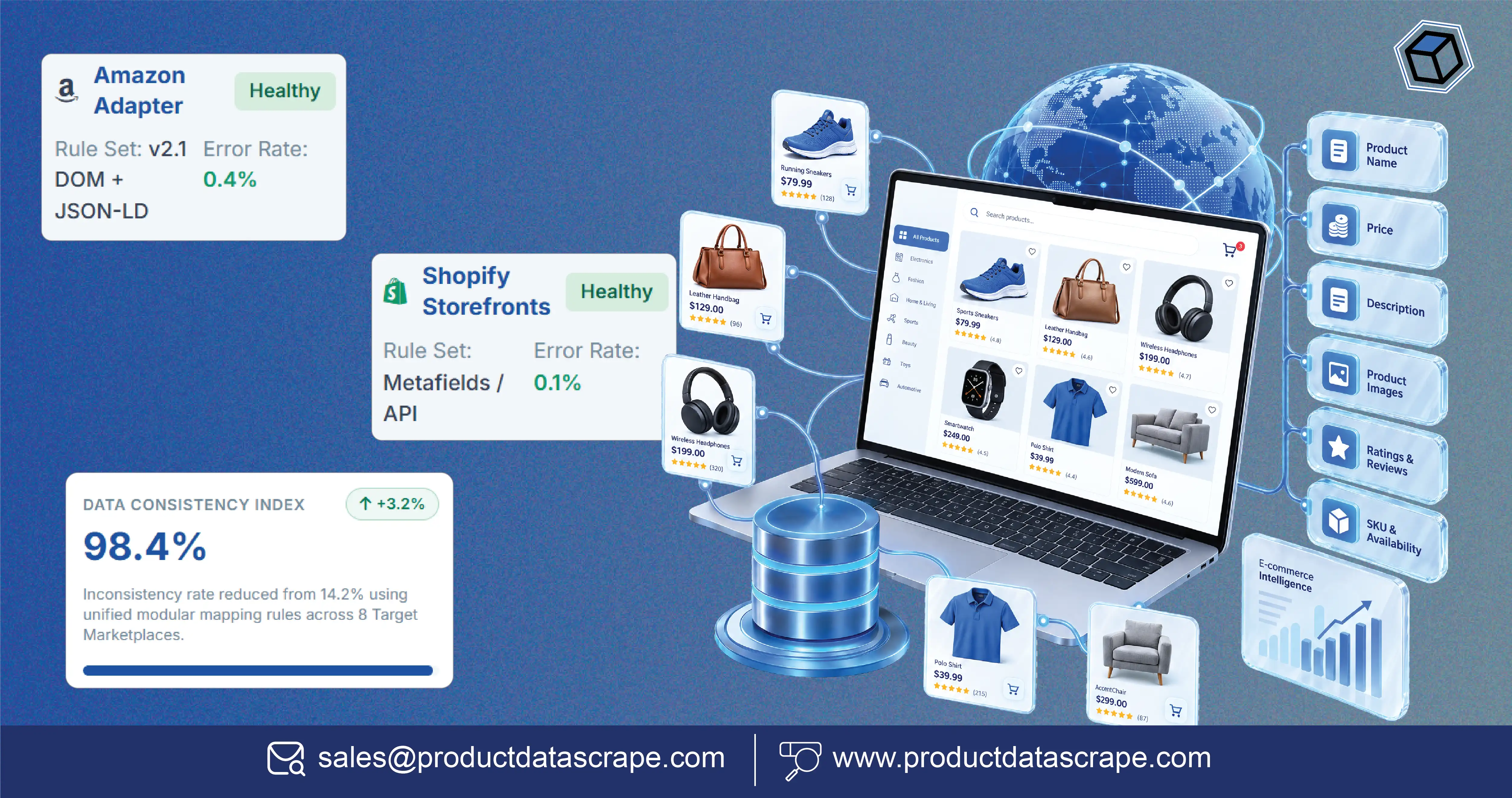
Multi-Website Product Catalog Scraping enables businesses to gather product titles, brand names, prices, product identifiers, descriptions, images, and availability information from multiple retailer websites. The extracted information supports catalog comparison, assortment analysis, and the identification of products that may be listed differently across stores.
The main difficulty is that retailers do not necessarily describe the same product in the same way. One store may use a manufacturer's full product name, while another shortens the title or emphasizes a model number. Product variations can also appear as separate listings, grouped variants, or independent stock-keeping units (SKUs).
A reliable process should therefore begin with a shared product schema. Each retailer's data is mapped into standardized fields before records are compared.
For example, a product record might contain the following fields:
- Product identity: brand, manufacturer part number, GTIN where available, and retailer SKU.
- Commercial information: displayed price, currency, discount, and availability.
- Product attributes: size, color, dimensions, material, model, and technical specifications.
- Source information: retailer name, product URL, collection timestamp, and extraction status.
Retailers can then compare Competitive pricing data without confusing different sizes, bundles, or models. A lower displayed price should not automatically be treated as a better offer if the compared products differ in quantity, included accessories, condition, or other meaningful attributes.
Google's official product data specification reinforces the importance of accurate product identifiers and variant information. It warns that missing or incorrect identifiers, variant attributes, and conflicting information can cause product disapprovals or display issues in Merchant Center. Source: Google Merchant Center product data specification.
A practical matching workflow uses exact identifiers first, followed by normalized brand and model combinations. Fuzzy title matching can help identify potential matches, but uncertain matches should be flagged for validation rather than automatically merged.
Why Does a Modular Architecture Work Better for Multiple Retailers?
Modular Scraping for Multiple Online Stores separates website-specific extraction logic from reusable processing components. This makes it easier to maintain collection workflows when retailers change their page structures, introduce new product attributes, or update their presentation of prices and stock information.
A monolithic scraper often depends on a single set of assumptions about how a product page is organized. If one retailer changes its HTML structure, the resulting failure can affect a large portion of the collection process. A modular architecture limits that dependency by giving each website its own adapter while keeping common validation and normalization rules centralized.
A typical architecture includes these components:
- Source adapters: Handle retailer-specific page structures, navigation, pagination, and supported data access methods.
- Extraction layer: Collects the fields available from product pages, category listings, or permitted structured data.
- Normalization engine: Converts prices, units, labels, and attribute formats into agreed standards.
- Validation layer: Detects missing values, invalid formats, conflicting fields, and suspicious changes.
- Storage and delivery: Publishes validated records to databases, data warehouses, dashboards, or scheduled exports.
The separation matters because a website-specific repair should not require rewriting every downstream process. If a retailer changes its product title markup, the relevant adapter can be updated while the common schema and reporting logic remain intact.
| Component | Primary responsibility | Quality control |
|---|
| Website adapter | Extract retailer-specific fields | Required-field checks |
| Normalization engine | Standardize formats and units | Schema validation |
| Product matcher | Link equivalent products | Identifier and match-confidence checks |
| Change detector | Identify differences between collection runs | Price and attribute comparisons |
| Data delivery layer | Provide usable datasets | Freshness and completeness checks |
The architecture should also distinguish collection failures from genuine changes in retailer data. A missing price might mean that a product is unavailable, the page has changed, or the extraction process has failed. Treating all three conditions as equivalent can corrupt business reports.
For enterprise teams, the objective is maintainability rather than complexity. Each module should have a clear responsibility, measurable quality criteria, and an observable failure state.
What Should a Reliable Product Dataset Contain?
A standardized Product Detail Dataset for Online Stores should preserve both the retailer's original information and the normalized values required for analysis. Retaining the source representation makes it possible to investigate discrepancies instead of losing important context during data cleaning.
Product information is rarely limited to a title and price. Depending on the category, analysts may need technical specifications, package quantities, dimensions, product variants, customer ratings, shipping details, or availability indicators.
Google's documentation on product structured data identifies information such as product price, availability, shipping, return policies, and review ratings as potential elements of product search experiences. Google also explains that product variants can be represented so search systems better understand the relationship between related products. These are useful reference points when designing a retail data schema, although the fields collected should reflect the business's actual requirements. Source: Google Search Central.
A practical dataset can be divided into five groups:
- Identity fields: Product ID, brand, GTIN, MPN, model, and retailer SKU.
- Descriptive fields: Title, product description, category, features, and specifications.
- Offer fields: Current price, original price when explicitly available, currency, and discount information.
- Availability fields: In-stock status, out-of-stock status, or the retailer's displayed availability message.
- Provenance fields: Source URL, retailer, collection time, validation status, and processing version.
A further distinction is essential: the retailer's original value should not be overwritten simply because a normalized version is needed. For instance, a displayed dimension of 1.5 metres can be preserved alongside a normalized value of 150 centimetres. This supports comparison while maintaining traceability.
Quality controls should test whether prices are numeric, currencies are recognized, URLs are valid, identifiers follow expected formats, and required attributes are populated. Category-specific rules are equally important. Apparel may require size and color, while electronics may require model numbers and storage capacity.
Dataset quality should be measured using clearly defined indicators:
| Quality indicator | What it measures | Why it matters |
|---|
| Field completeness | Percentage of required fields populated | Identifies missing product information |
| Match confidence | Strength of evidence linking two listings | Reduces incorrect product comparisons |
| Freshness | Time elapsed since the last successful collection | Shows whether information is current enough |
| Validation failure rate | Share of records failing defined rules | Highlights collection or normalization problems |
| Duplicate rate | Share of records incorrectly repeated | Protects catalog and reporting accuracy |
These metrics should be calculated from actual collection results rather than assumed in advance. Establishing a baseline allows data teams to set realistic improvement targets and investigate recurring errors.
How Can Product Listing Differences Be Detected and Corrected?
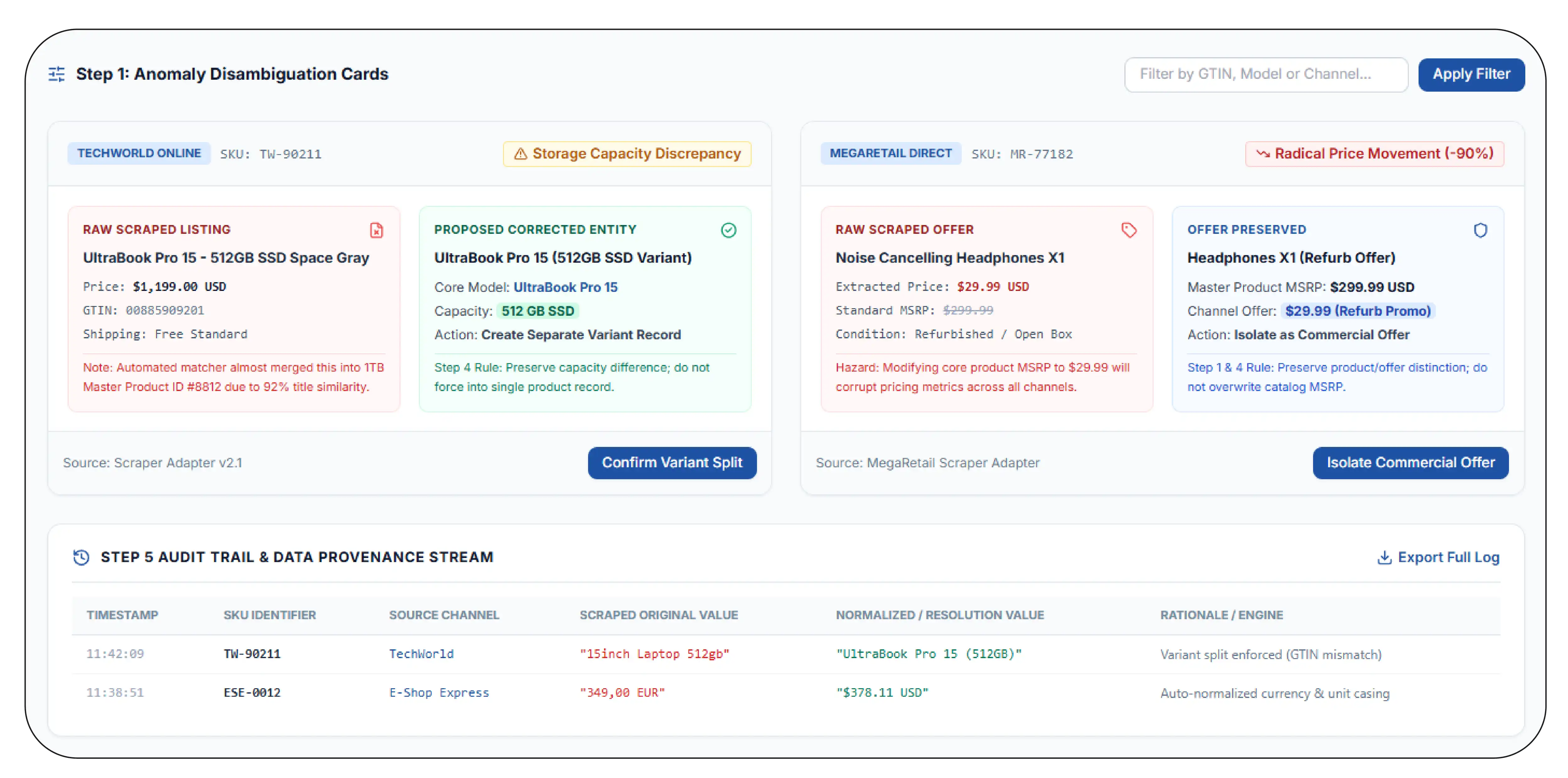
Product Listing Intelligence for Retail Websites helps businesses identify inconsistencies in titles, attributes, pricing, product variants, and availability across online retail channels. Rather than treating every extracted record as immediately trustworthy, a strong workflow checks whether the information is complete, internally consistent, and comparable with other listings.
A common source of inconsistency is the difference between a product and an offer. A product represents the underlying item, while an offer describes a retailer's commercial presentation of that item. Two stores may sell the same model at different prices, but their offers can differ in shipping costs, availability, bundle contents, or promotions.
The system should preserve these distinctions instead of forcing all values into a single product record.
A robust correction process follows five steps:
- Detect anomalies. Flag missing prices, unexpected currency changes, unusually large price movements, and absent product identifiers.
- Verify the source. Determine whether the value is genuinely missing or whether the extraction process failed.
- Normalize attributes. Standardize units, casing, spacing, currency codes, and category labels.
- Resolve product identity. Compare GTINs, manufacturer part numbers, model identifiers, and distinguishing variant attributes.
- Retain an audit trail. Record the original value, normalized value, source, timestamp, and reason for any correction.
For example, if two listings share a model name but have different capacities, they should not be merged solely because their titles are similar. Likewise, a discounted price should not be interpreted as the standard price unless the source explicitly supports that interpretation.
A Modular product-detail scraper for e-commerce sites can apply shared validation rules across retailers while retaining individual adapters for source-specific exceptions. This approach allows the business to fix a recurring data-quality issue centrally without assuming that every retailer expresses product information identically.
The monitoring process should also detect structural changes. A sudden increase in missing titles across one website may indicate a page-layout change rather than a real catalog event. Separating technical alerts from commercial alerts helps analysts prioritize the correct response.
How Can Extraction Scale Without Sacrificing Data Quality?
Modular E-commerce Product Data Extraction combines reusable collection logic, source-specific configurations, and repeatable quality checks to support product monitoring across multiple online stores.
Scaling a collection process does not simply mean requesting more pages. More sources can introduce additional currencies, product taxonomies, languages, variant structures, access restrictions, and update schedules. If these differences are not handled systematically, a larger dataset can create more inconsistencies rather than better insight.
A Modular product-detail scraper for e-commerce sites should therefore scale through controlled configuration and observability.
First, prioritize fields according to the intended use case. A pricing team may require current prices, currencies, product identifiers, and availability. A category manager may also need specifications, product images, brand relationships, and assortment attributes. Collecting only relevant information reduces unnecessary processing and makes quality requirements easier to define.
Second, use incremental collection where appropriate. If the business needs to detect changes rather than reconstruct every historical page, it can compare the latest validated record with the previous successful version. The collection schedule should reflect the rate at which the relevant information changes, not an arbitrary frequency applied to every source.
Third, design explicit recovery procedures. A failed request should not automatically replace a valid stored value with a blank field. The system should record the failure, preserve the last verified observation, and identify the age of that observation.
Fourth, monitor access and compliance. Collection methods should respect applicable laws, website terms, access controls, and rate limits. Where an API, licensed feed, or permitted structured data source is available, it may be preferable to repeated page-level extraction.
The following operational checks help maintain reliability:
| Operational area | Recommended control | Expected benefit |
|---|
| Collection scheduling | Set source-specific refresh intervals | Better alignment with data requirements |
| Error handling | Retry transient failures and log persistent errors | More reliable collection |
| Change management | Test adapters against representative pages | Earlier detection of breakage |
| Historical records | Store timestamped observations | Traceable trend analysis |
| Access management | Respect permissions and rate limits | More responsible collection practices |
The goal is not to promise perfect coverage or uninterrupted collection. It is to make limitations visible, isolate failures, and ensure that business users can distinguish current verified observations from stale or incomplete information.
What Do Verified Market Trends Tell Us About Retail Data Needs?
The growth of online commerce increases the practical value of accurate, comparable product information. However, market growth statistics should be used as context, not as proof that a particular scraping method delivers a specific return on investment.
The US Census Bureau's quarterly e-commerce reports provide a consistent source for tracking online retail's share of total retail sales. Eurostat offers complementary evidence about online purchasing behavior in the European Union.
The table below presents selected, source-verified observations from 2020 through 2026. The figures refer to different measures, so they should not be read as a single continuous time series.
| Year | Verified observation | Relevance to retail data operations |
|---|
| 2020 | US e-commerce reached 16.1% of total retail sales in Q2 on a seasonally adjusted basis. | Demonstrates the importance of monitoring online retail during a major disruption. |
| 2021 | US retail sales increased 17.1% year over year, according to the Census Bureau's Annual Retail Trade Survey. | Shows the importance of interpreting online data alongside broader retail activity. |
| 2022 | US retail sales reached approximately $6.52 trillion in 2021, according to the Census Bureau's 2021 annual survey released in 2022. | Illustrates the scale of the retail market covered by commercial intelligence. |
| 2023 | No separate, directly comparable annual statistic is asserted here. | Maintain consistent definitions when comparing historical datasets. |
| 2024 | 77% of EU internet users purchased goods or services online during the previous 12 months. | Supports the relevance of accurate digital product and offer information. |
| 2025 | US e-commerce represented 16.6% of total retail sales in Q4 on a seasonally adjusted basis. | Provides a recent benchmark for the online share of US retail. |
| 2026 | US e-commerce accounted for 17.1% of total retail sales in Q2 on a seasonally adjusted basis, according to the Census Bureau's August 2026 release. | Provides a current benchmark for evaluating online retail monitoring needs. |
Sources: US Census Bureau, Q2 2020 online retail share; 2021 Annual Retail Trade Survey; 2021 retail sales estimates; Eurostat online shopping statistics; US Census Bureau quarterly e-commerce reports.
These observations support a practical conclusion: businesses need clear definitions, reliable timestamps, and consistent product matching to interpret information across retailers and over time.
For pricing teams, the immediate priority is to distinguish genuine price changes from differences in product configuration or promotional terms. For category managers, the priority is to identify missing attributes, assortment changes, and variant mismatches. For data engineering leaders, it is to make source failures visible and ensure that downstream systems receive validated information.
A useful implementation plan starts with a limited set of priority retailers and product categories. Teams can establish a baseline for completeness, matching accuracy, freshness, and extraction failures before expanding to additional sources. This approach provides measurable evidence of data quality and helps avoid scaling a flawed process.
How Can Product Data Scrape Help?
Product Data Scrape can support businesses seeking a structured approach to product data collection, normalization, validation, and competitive intelligence across online retail sources.
The value of an effective service is not merely the volume of records collected. It is the usefulness of the resulting data for business decisions and the ability to investigate how each value was obtained.
Through tailored data collection workflows, E-Commerce Datasets can be organized around the fields and business rules relevant to pricing intelligence, catalog analysis, assortment monitoring, and product comparison. A Modular product-detail scraper for e-commerce sites can be designed around the different page structures and product attributes encountered across selected retailers.
A practical engagement can focus on the following capabilities:
- Multi-retailer data collection: Gather agreed product information from selected online stores using suitable, permitted collection methods.
- Schema standardization: Map source-specific fields into a common structure for easier comparison.
- Product matching: Use available identifiers and product attributes to distinguish equivalent products from similar but different variants.
- Data validation: Identify missing fields, inconsistent units, duplicate records, and potentially incorrect values.
- Historical monitoring: Preserve timestamped observations so teams can review changes over time.
- Business-ready delivery: Prepare structured outputs suitable for downstream analytics, reporting, or data integration.
The exact scope should be defined around the customer's target websites, product categories, required fields, refresh frequency, delivery format, and access permissions. Data completeness and refresh performance should be measured during implementation rather than assumed.
For businesses managing complex catalogs, the recommended starting point is a focused pilot. Select representative retailers, define product-matching rules, agree on data-quality thresholds, and validate the output against known source records. Once the results meet the agreed requirements, the workflow can be extended to additional sources.
Conclusion
Inconsistent product data is best addressed through a combination of modular extraction, standardized schemas, reliable product matching, validation rules, and transparent source tracking. Effective E-commerce data scraping helps businesses separate retailer-specific collection logic from shared data-quality processes, making workflows easier to maintain as online stores update their product pages and catalog structures.
The key is to treat product data as an ongoing, quality-controlled information asset rather than a collection of disconnected records. Consistent identifiers, explicit variant handling, timestamped observations, and measurable validation rules help pricing analysts, retail managers, and data teams make better-informed comparisons.
Product Data Scrape can help businesses define and implement a product data collection approach aligned with their retail intelligence requirements. If your organization needs an E-Commerce Scraper tailored to its target sources, product attributes, and reporting objectives, explore how a Modular product-detail scraper for e-commerce sites can support more consistent and actionable product intelligence.
Ready to improve product data consistency across multiple stores? Contact Product Data Scrape to discuss your requirements and plan a tailored product data collection solution!


 Singapore
 EMAIL
 PHONE












.webp)