Quick Overview
A leading grocery retail brand partnered with us to improve real-time inventory
visibility and supply chain responsiveness across multiple store locations. Using the Kroger
ClickList Grocery Inventory Scraping API, we built a scalable data pipeline capable of tracking
product availability and demand fluctuations across Kroger’s online grocery platform. Our system
helped the client efficiently Extract Grocery & Gourmet Food Data from hundreds of product
listings, enabling accurate monitoring of inventory levels and product availability. Over a
six-month deployment, the brand achieved three key impacts: a 30% reduction in out-of-stock
incidents, 40% faster inventory monitoring, and real-time product availability insights across
multiple regions. These improvements empowered the client to optimize restocking strategies and
strengthen their digital grocery operations.
The Client
The client is a fast-growing grocery retail analytics company that provides
market intelligence and supply chain insights to major food brands and retailers. As online
grocery shopping surged between 2020 and 2024, brands began facing increasing pressure to
maintain consistent product availability across digital storefronts. The rapid growth of online
grocery platforms created a need for advanced data monitoring solutions. Retailers needed
accurate insights into product availability, inventory turnover, and consumer demand patterns.
To meet this challenge, the client required reliable Kroger ClickList Online
Grocery Data Extraction capabilities that could collect structured inventory data directly from
Kroger’s online grocery platform. Before our collaboration, the client relied heavily on manual
data collection and fragmented data sources. These outdated methods caused delays in tracking
product availability and prevented the team from identifying inventory shortages quickly.
Additionally, inconsistent datasets limited their ability to generate actionable insights for
grocery brands. To solve these issues, the client decided to implement a fully automated Kroger
Grocery Data Scraping API solution capable of collecting real-time product data, ensuring
accurate inventory monitoring and enabling deeper retail analytics across multiple store
locations.
Goals & Objectives
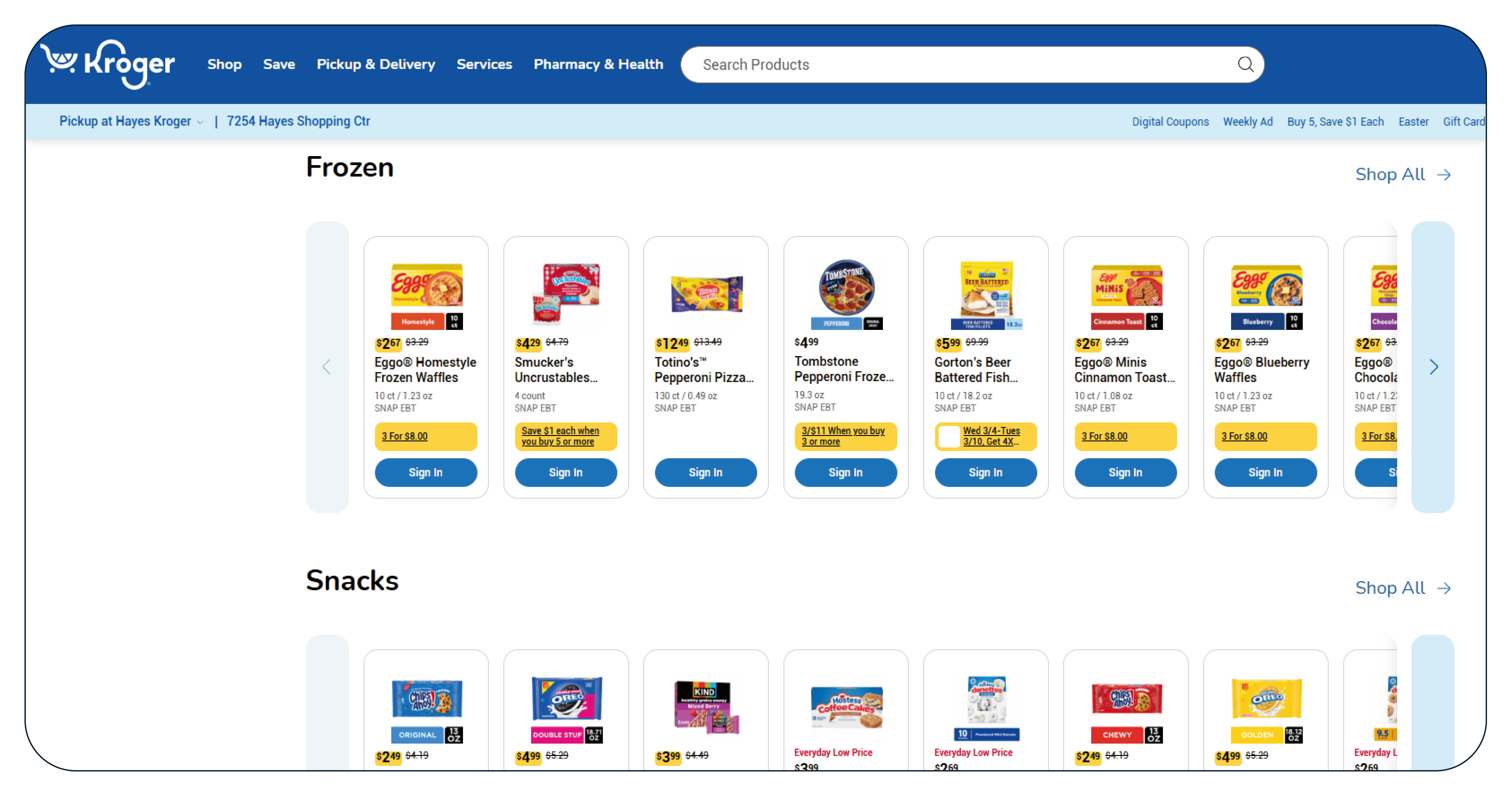
The primary business goal was to build a scalable infrastructure capable of
monitoring grocery product inventory across multiple Kroger ClickList store locations.
By implementing the Kroger ClickList Grocery Product Scraper API, the client
aimed to create a centralized data system that could collect and analyze product availability
data at scale.
From a technical perspective, the objective was to automate product inventory
tracking and integrate the collected information into the client’s analytics platform.
By building a structured Kroger Grocery Store Dataset, the client could enable
real-time reporting, automate demand analysis, and generate location-specific inventory insights
for retailers.
Achieve real-time monitoring of grocery product availability across Kroger
stores.
Improve inventory data accuracy by more than 35%.
Reduce manual data collection processes by over 60%.
Enable automated data pipelines for grocery inventory analytics.
Increase speed of product availability tracking by 40%.
The Core Challenge
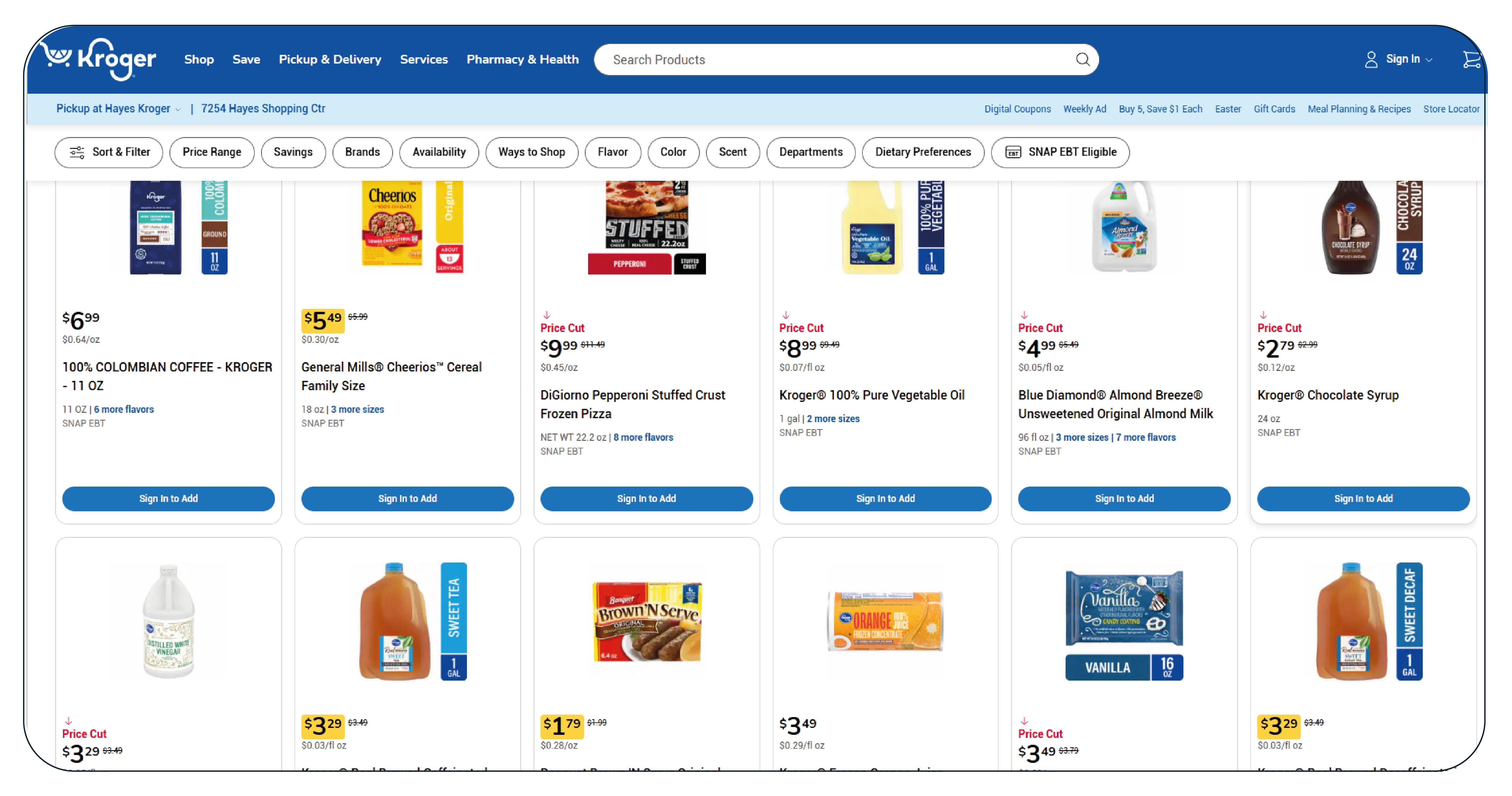
Before implementing our data extraction solution, the client faced several
operational challenges that limited their ability to track grocery inventory effectively. One of
the biggest obstacles was inconsistent access to structured product availability data across
Kroger ClickList stores. Manual monitoring processes were slow and inefficient, making it
difficult to capture real-time changes in product inventory. Additionally, the absence of
automated Kroger ClickList Supermarket Data Scraping systems meant that inventory information
was often outdated by the time it reached analysts.
Another major challenge involved data standardization. The client needed to
collect thousands of product listings and transform them into a structured Grocery store dataset
that could support advanced analytics. However, inconsistent data formats and incomplete product
information made this process extremely difficult. These limitations created gaps in inventory
monitoring, preventing the client from identifying stock shortages early. As a result, grocery
brands struggled to maintain consistent product availability, leading to lost sales
opportunities and reduced customer satisfaction.
Our Solution
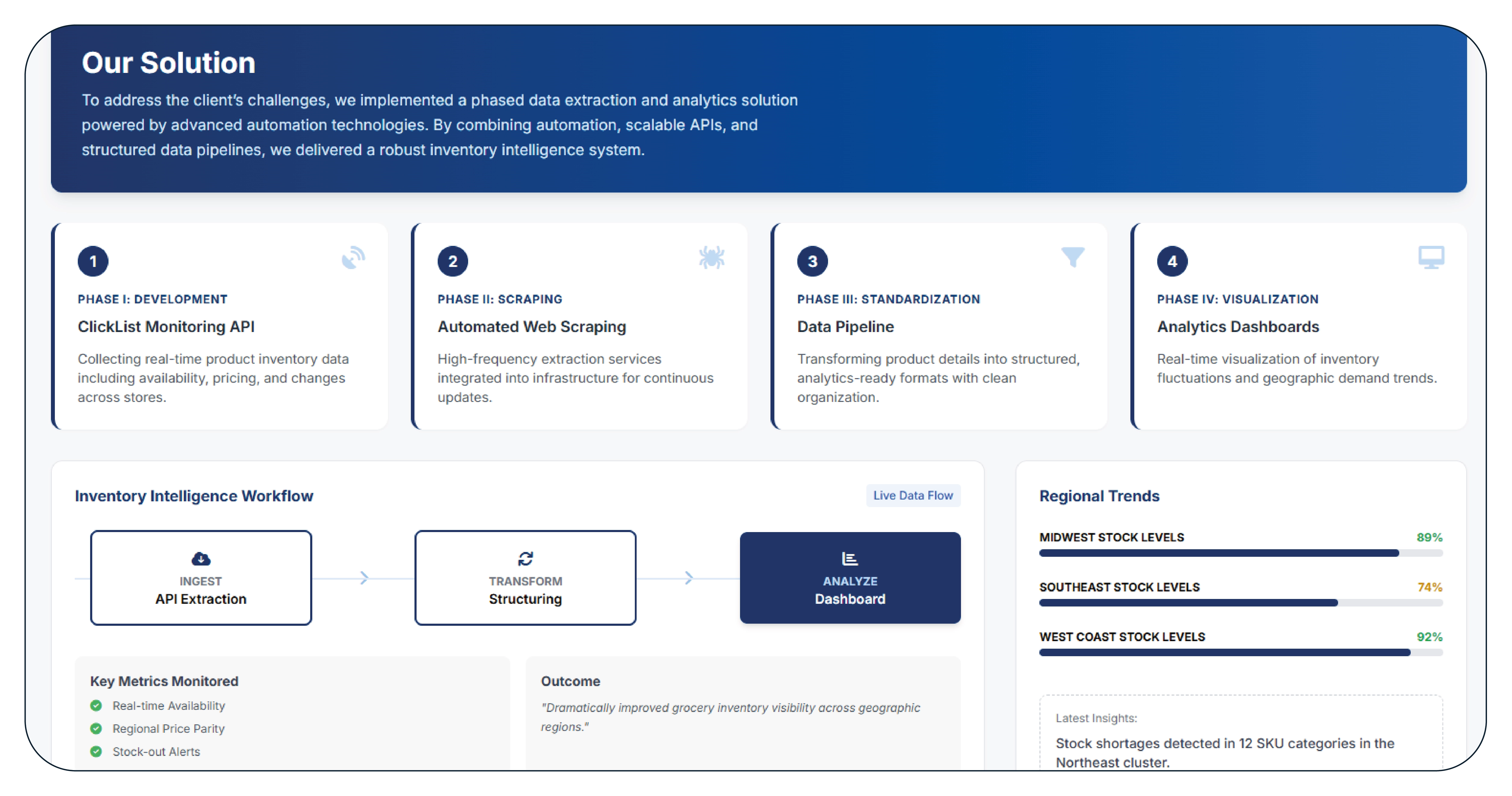
To address the client’s challenges, we implemented a phased data extraction and
analytics solution powered by advanced automation technologies. The first phase focused on
developing the Kroger ClickList Grocery Inventory Monitoring API, which allowed us to collect
real-time product inventory data from Kroger’s online grocery platform. This system tracked
product availability, pricing updates, and inventory changes across multiple store locations.
In the second phase, we integrated automated Web Scraping API Services into the
client’s data infrastructure. These services enabled high-frequency data extraction from Kroger
ClickList listings, ensuring that product availability information remained continuously
updated.
Next, we implemented a data transformation pipeline that standardized product
information into structured datasets. This process organized product details, inventory status,
store location data, and pricing information into clean and analytics-ready formats.
The final phase involved integrating the datasets with real-time analytics
dashboards. This allowed the client’s team to visualize inventory fluctuations, detect potential
stock shortages, and analyze product demand trends across different geographic regions.
By combining automation, scalable APIs, and structured data pipelines, we
delivered a robust inventory intelligence system that dramatically improved grocery inventory
visibility.
Results & Key Metrics
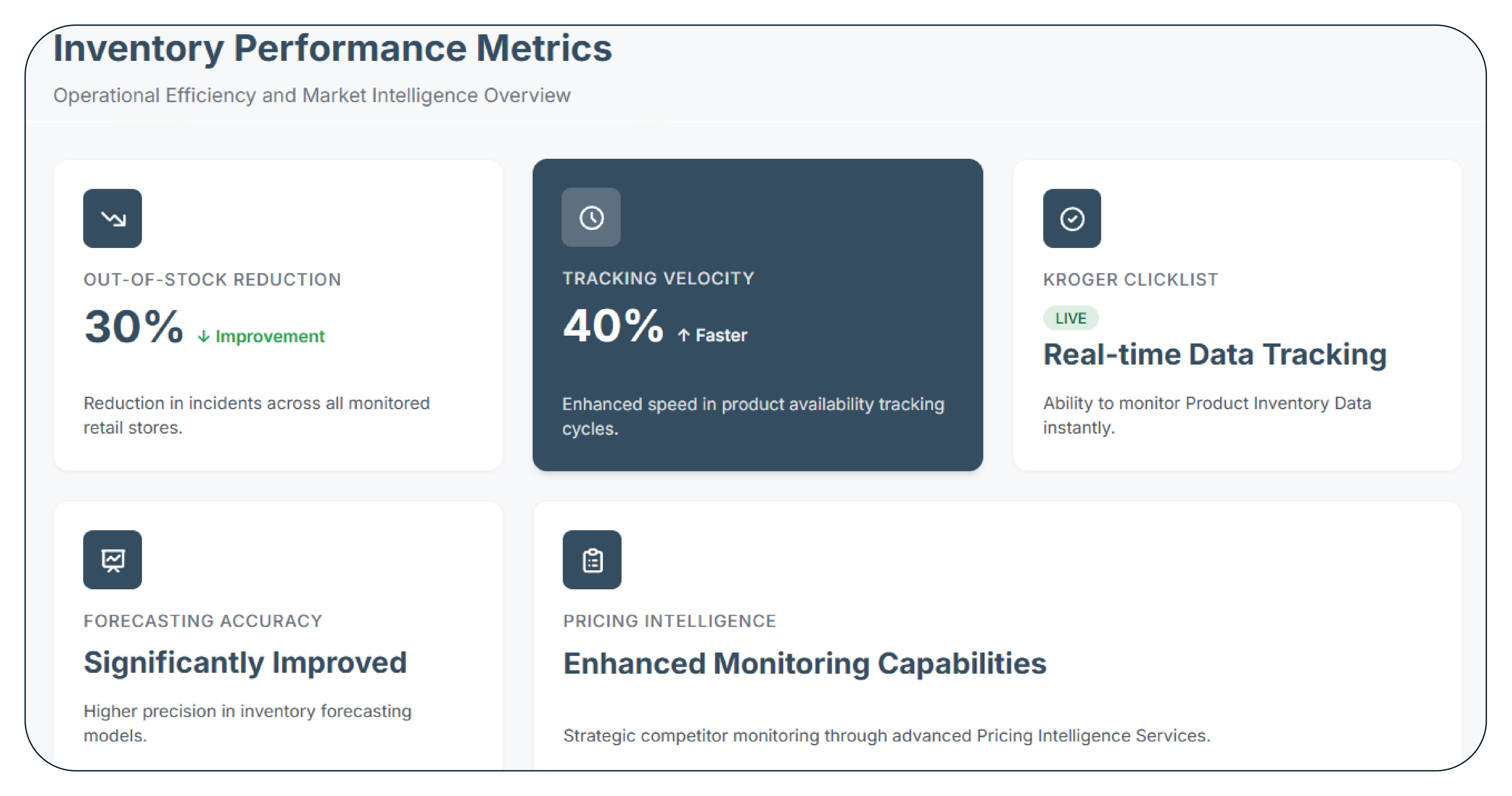
30% reduction in out-of-stock incidents across monitored stores.
40% faster product availability tracking.
Real-time ability to Track Kroger ClickList Product Inventory Data.
Improved inventory forecasting accuracy.
Enhanced competitor and pricing monitoring through Pricing Intelligence
Services.
Results Narrative
The implementation of automated inventory monitoring delivered measurable
improvements across the client’s operations. By enabling the ability to Track Kroger ClickList
Product Inventory Data in real time, the client gained immediate visibility into product
availability trends. This allowed grocery brands to identify potential supply issues earlier and
adjust restocking strategies accordingly. Additionally, integrating data insights with Pricing
Intelligence Services enabled the client to analyze how pricing strategies affected product
demand and inventory turnover. As a result, the brand achieved stronger supply chain
coordination, improved product availability, and better customer satisfaction.
What Made Product Data Scrape Different?
Our approach stood out because of our ability to combine advanced automation
with deep retail analytics expertise. Through our proprietary technologies, we enabled
businesses to Scrape Kroger Grocery Inventory and Stock Trends at scale while maintaining high
data accuracy. By integrating these insights into Digital Shelf Analytics, we allowed the client
to monitor product availability alongside pricing trends and competitor performance. This
combination of inventory intelligence and digital shelf insights helped the client gain a
comprehensive view of online grocery operations.
Client’s Testimonial
“Working with this team transformed our grocery inventory intelligence capabilities. Their
automated systems allowed us to Extract Kroger API Product Inventory Data in real time and
monitor product availability across multiple stores effortlessly. The insights we gained
helped us improve stock planning and deliver better results for our retail partners.”
— Director of Retail Data Analytics
Conclusion
Modern grocery retailers require accurate and scalable inventory intelligence
to remain competitive in the digital marketplace. By implementing automated solutions that
Extract Kroger Grocery & Gourmet Food Data, businesses can gain deeper insights into product
availability, demand patterns, and supply chain performance. The deployment of the Kroger
ClickList Grocery Inventory Scraping API enabled our client to monitor thousands of grocery
products across multiple store locations and reduce out-of-stock incidents by 30%. With
real-time inventory insights, the brand now has the tools needed to optimize grocery supply
chains and deliver better shopping experiences.
FAQs
What is Kroger ClickList inventory scraping?
Kroger ClickList inventory scraping is the automated process of collecting product availability,
pricing, and inventory information from Kroger’s online grocery platform to support retail
analytics and supply chain optimization.
What data can be extracted from Kroger ClickList?
Businesses can extract product names, pricing, inventory availability, product categories,
promotional offers, store locations, and stock status across multiple Kroger stores.
How does inventory scraping help reduce out-of-stock situations?
By monitoring real-time product availability data, retailers can identify potential shortages
early and adjust restocking strategies to maintain consistent product supply.
Can this data support grocery pricing analytics?
Yes. Inventory data combined with pricing information enables retailers to analyze demand
patterns, evaluate promotional strategies, and optimize pricing decisions.
How does automated scraping improve grocery analytics?
Automated data extraction eliminates manual monitoring, improves data accuracy, enables
real-time insights, and supports advanced analytics across large grocery product datasets.


 Singapore
 EMAIL
EMAIL
 PHONE
PHONE










.webp)