Quick Overview
A leading sportswear brand partnered with Product Data Scrape to gain deeper visibility into Adidas retail operations and optimize its market expansion strategy. The project focused on Mapping Adidas Store Footprint and Assortment across key markets to understand store presence, product distribution, and regional merchandising patterns. By leveraging advanced Geo and store-level pricing intelligence, the client gained actionable insights into location-specific product availability and competitive positioning. Over a six-month engagement, the solution delivered a 70% improvement in market visibility, a 60% increase in assortment analysis efficiency, and a 55% reduction in manual research efforts. These insights enabled faster expansion planning, improved assortment decisions, and enhanced competitive intelligence.
The Client
The client is a rapidly growing sportswear and lifestyle brand operating across multiple international markets. Competing in a highly dynamic retail environment, the company needed greater visibility into competitor store networks, product assortments, and merchandising strategies. Rising consumer expectations, changing buying patterns, and increasing competition from global sportswear brands created significant pressure to improve market intelligence capabilities.
To support expansion initiatives, the company required accurate information about competitor store footprints and product availability. Through advanced Adidas Store Locations Scraping, Product Data Scrape collected structured data covering store locations, categories, inventory distribution, and regional assortment trends. This information enabled the client to evaluate market saturation levels, identify underserved regions, and benchmark merchandising strategies.
The company also sought to Spot trending products across different geographies to better understand local demand patterns. Prior to the partnership, market research depended heavily on manual processes that limited visibility and delayed strategic decision-making. The lack of real-time intelligence reduced responsiveness to market opportunities and constrained growth planning efforts. Product Data Scrape transformed this process by delivering scalable, automated retail intelligence that improved speed, accuracy, and strategic planning.
Goals & Objectives
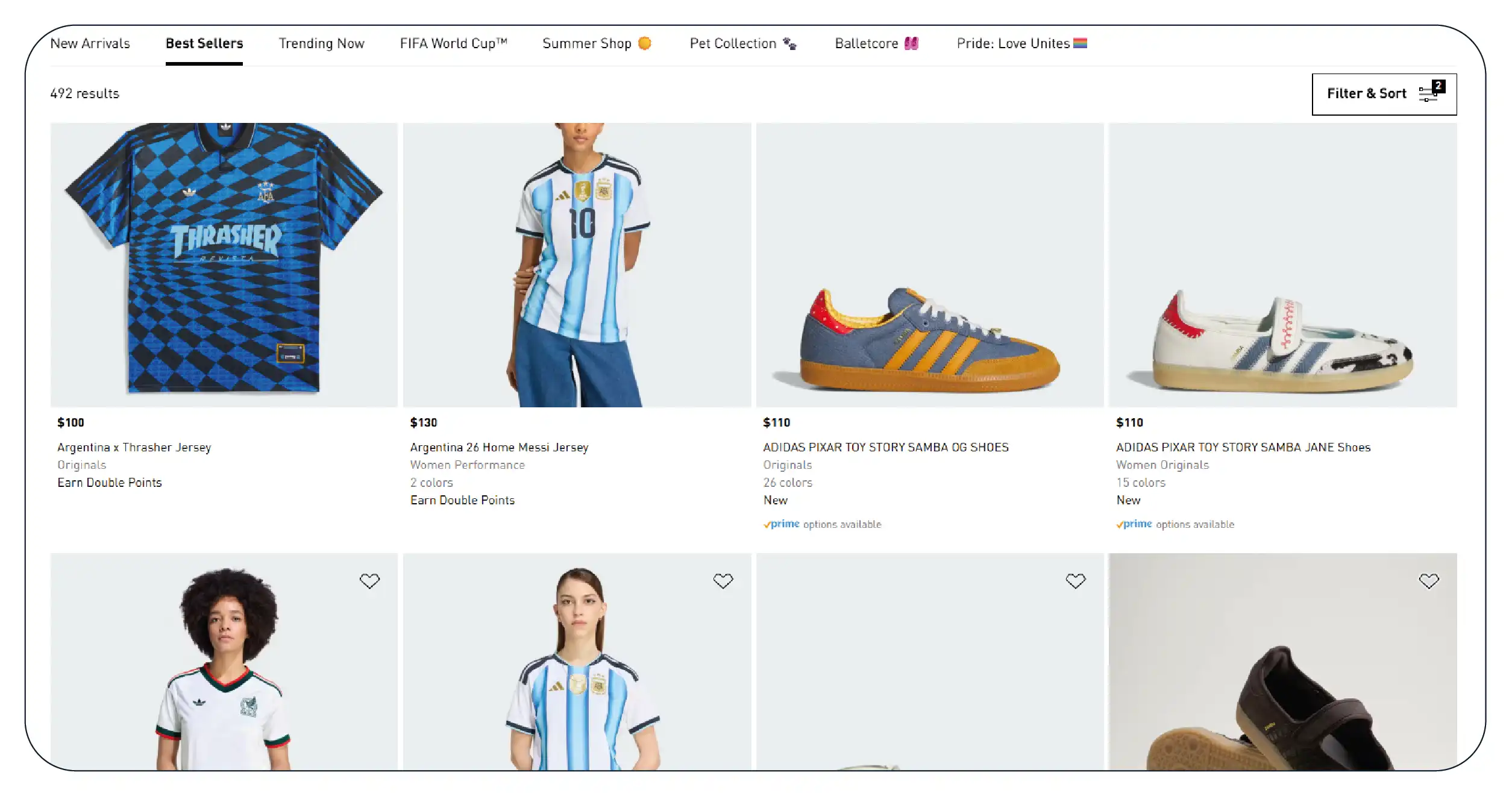
The primary business goal was to enhance visibility into competitor retail operations and support data-driven expansion planning. The client aimed to leverage Adidas Product Assortment Mapping and Analytics to evaluate assortment performance and identify opportunities for market growth.
The project focused on automation, scalability, and analytics integration. Using advanced Digital Shelf Analytics, the client sought to improve assortment monitoring, reduce manual research, and gain real-time insights into store-level merchandising activities.
Increase store coverage visibility by 70%
Improve assortment analysis speed by 60%
Reduce manual monitoring efforts by 55%
Enhance product trend identification accuracy by 50%
Improve regional market assessment capabilities by 65%
Increase data refresh frequency from weekly to daily
These KPIs provided measurable benchmarks for evaluating project success and operational improvements.
The Core Challenge
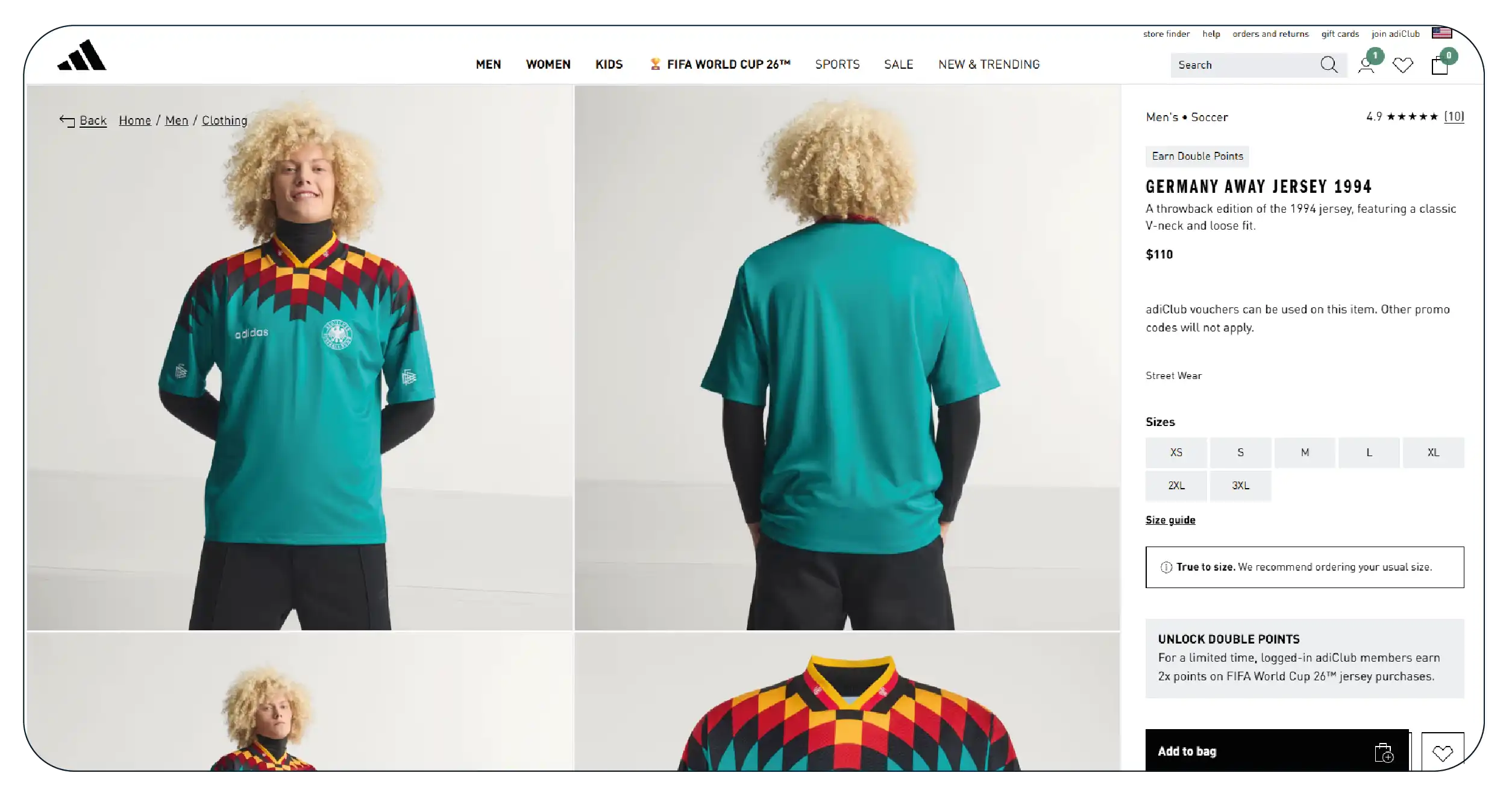
The client faced several operational challenges that limited its ability to understand competitor strategies and market dynamics. Manual collection of store information was time-consuming and often resulted in outdated insights. Product assortment tracking across multiple regions lacked consistency, making it difficult to identify trends and benchmark performance effectively.
The absence of comprehensive Store-Level Adidas Assortment Intelligence prevented stakeholders from understanding how product availability differed across markets. As a result, expansion planning often relied on incomplete information.
Additionally, traditional Fashion data scraping methods lacked the scalability required to monitor large store networks and thousands of products simultaneously. Frequent assortment updates, inventory changes, and regional merchandising differences further complicated the process. These limitations affected data quality, reduced visibility into market opportunities, and delayed strategic decisions. The client required an automated solution capable of delivering accurate, real-time intelligence to support expansion planning and competitive benchmarking.
Our Solution
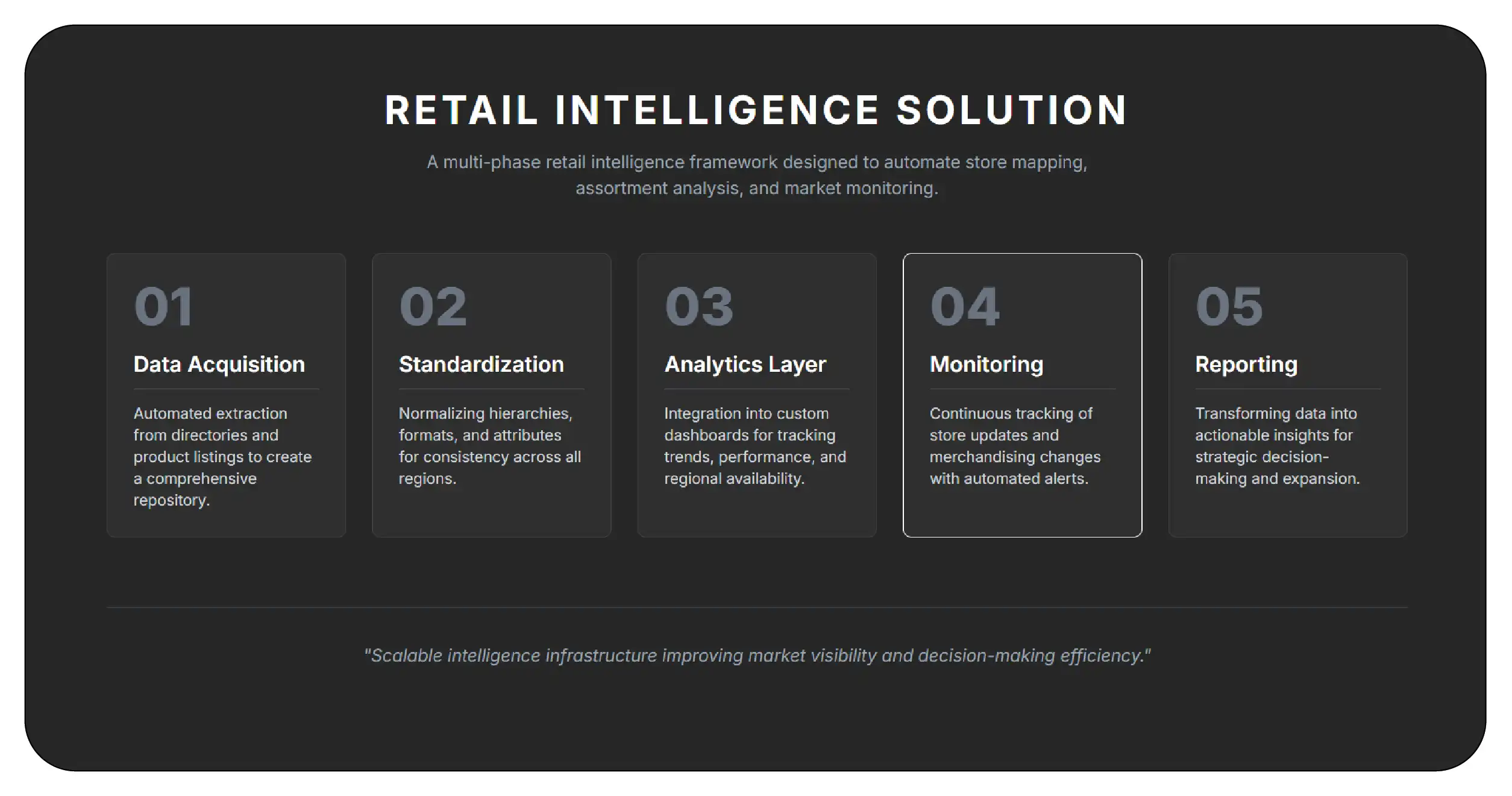
Product Data Scrape implemented a multi-phase retail intelligence solution designed to automate store mapping, assortment analysis, and market monitoring.
Phase 1: Data Acquisition Framework
The first phase focused on Mapping Adidas Store Locations with Product Insights through automated extraction systems. Data was collected from store directories, product listings, category pages, and location-specific inventory sources. This created a comprehensive repository of store and assortment information.
Phase 2: Data Processing & Standardization
Collected data was normalized and categorized to ensure consistency across regions and product categories. Product hierarchies, store formats, and location attributes were standardized to support advanced analytics and reporting.
Phase 3: Analytics & Intelligence Layer
Using a robust Web Scraping API, Product Data Scrape integrated extracted data into customized dashboards. These dashboards enabled users to analyze store footprints, evaluate assortment trends, monitor category performance, and benchmark regional product availability.
Phase 4: Automated Monitoring
Continuous monitoring systems tracked store openings, assortment updates, inventory shifts, and merchandising changes. Automated alerts ensured stakeholders received timely notifications regarding significant market developments.
Phase 5: Strategic Reporting
Advanced reporting capabilities transformed raw data into actionable insights. Stakeholders could evaluate expansion opportunities, identify high-growth regions, monitor competitor strategies, and optimize product distribution decisions. This phased approach provided scalable intelligence infrastructure that significantly improved decision-making efficiency and market visibility.
Results & Key Metrics
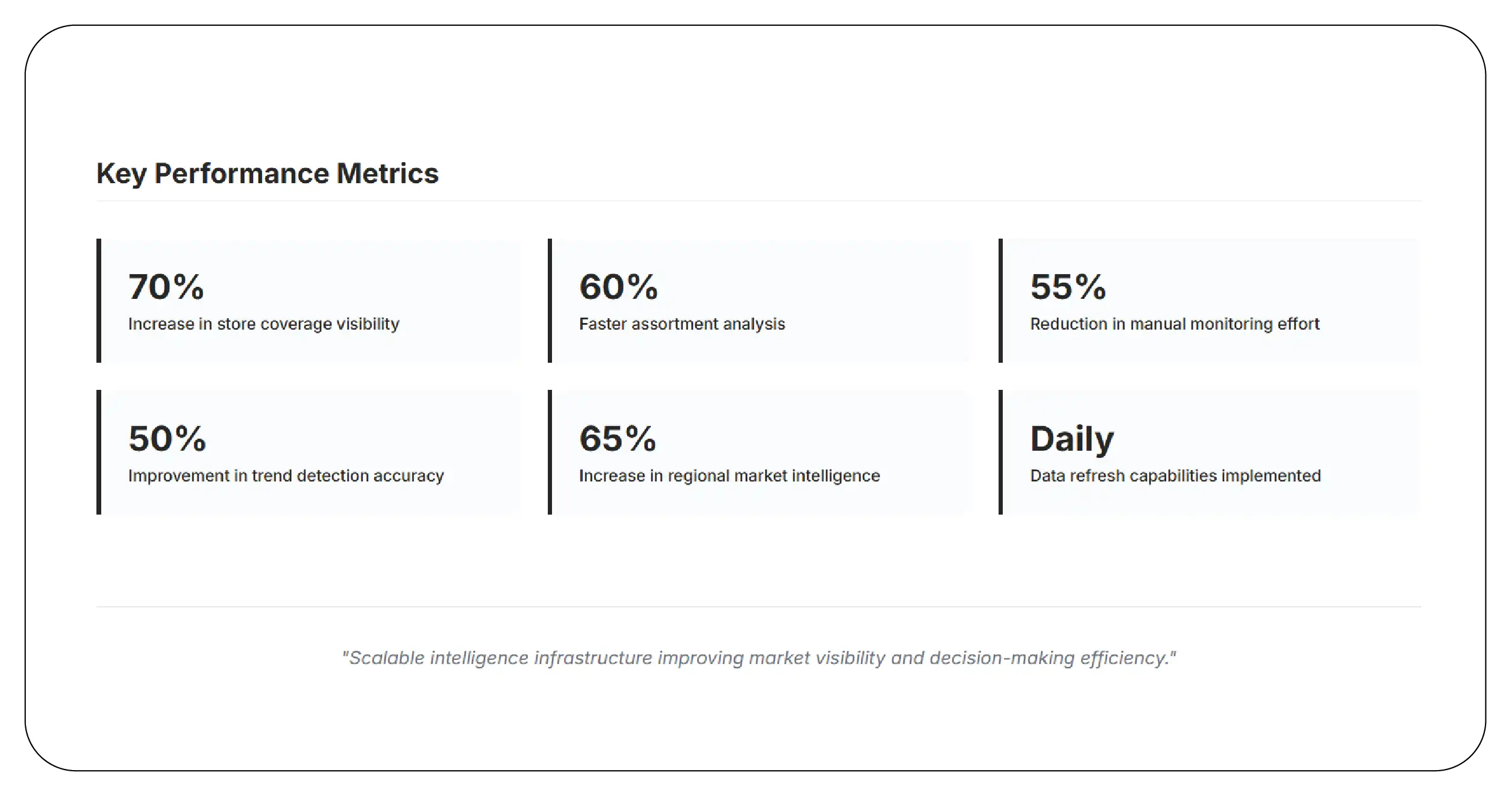
70% increase in store coverage visibility
60% faster assortment analysis
55% reduction in manual monitoring effort
50% improvement in trend detection accuracy
65% increase in regional market intelligence
Daily data refresh capabilities implemented
Results Narrative
Through Mapping Adidas Store Footprint and Assortment, the client gained a comprehensive understanding of competitor store networks and product strategies. Automated intelligence enabled faster expansion planning, more accurate market assessments, and improved product assortment decisions. Enhanced visibility into regional merchandising trends allowed leadership teams to identify growth opportunities and respond proactively to evolving market conditions. The solution strengthened strategic planning capabilities while improving operational efficiency across market research functions.
What Made Product Data Scrape Different
Product Data Scrape combined advanced automation, scalable infrastructure, and intelligent analytics to deliver superior retail intelligence. Our proprietary frameworks transformed complex retail data into actionable insights with minimal manual intervention.
By leveraging sophisticated Assortment analytics, we enabled granular visibility into product distribution, category performance, and regional assortment variations. Our expertise in Mapping Adidas Store Footprint and Assortment ensured accurate store-level intelligence and continuous monitoring capabilities. The combination of automation, data quality controls, and customized reporting differentiated our solution and delivered measurable value to the client.
Client's Testimonial
"The insights delivered by Product Data Scrape transformed our approach to market expansion. Their expertise in Mapping Adidas Store Footprint and Assortment provided us with detailed visibility into store networks, product availability, and regional merchandising strategies. The automated intelligence platform significantly improved our decision-making speed and enabled more informed expansion planning. We now have access to reliable market intelligence that supports both strategic growth and competitive benchmarking initiatives."
— Director of Market Intelligence, Global Sportswear Brand
Conclusion
This case study demonstrates the value of data-driven retail intelligence in supporting market expansion and competitive analysis. By leveraging advanced monitoring and analytics capabilities, Product Data Scrape enabled the client to gain deeper visibility into competitor store networks and product strategies. Through comprehensive Assortment and availability monitoring, stakeholders gained actionable insights that improved planning accuracy and operational efficiency. The success of Mapping Adidas Store Footprint and Assortment highlights how automated retail intelligence solutions can help brands identify opportunities, optimize expansion strategies, and maintain a competitive edge in rapidly evolving retail markets.
FAQs
1. What is Adidas store footprint mapping?
Adidas store footprint mapping involves tracking store locations, formats, regional presence, and distribution patterns to understand market coverage and competitive positioning.
2. Why is assortment analysis important?
Assortment analysis helps businesses evaluate product availability, category performance, regional demand, and merchandising effectiveness across retail locations.
3. How does store-level intelligence support expansion planning?
Store-level intelligence provides insights into market saturation, competitor presence, and product distribution, helping brands identify optimal expansion opportunities.
4. What data can be collected from retail store mapping?
Businesses can collect store locations, product assortments, category information, inventory trends, pricing details, and regional merchandising insights.
5. How does Product Data Scrape help retailers?
Product Data Scrape delivers automated retail intelligence solutions that provide accurate store mapping, assortment analytics, competitive benchmarking, and market expansion insights.



 Singapore
 EMAIL
EMAIL
 PHONE
PHONE











.webp)