Quick Overview
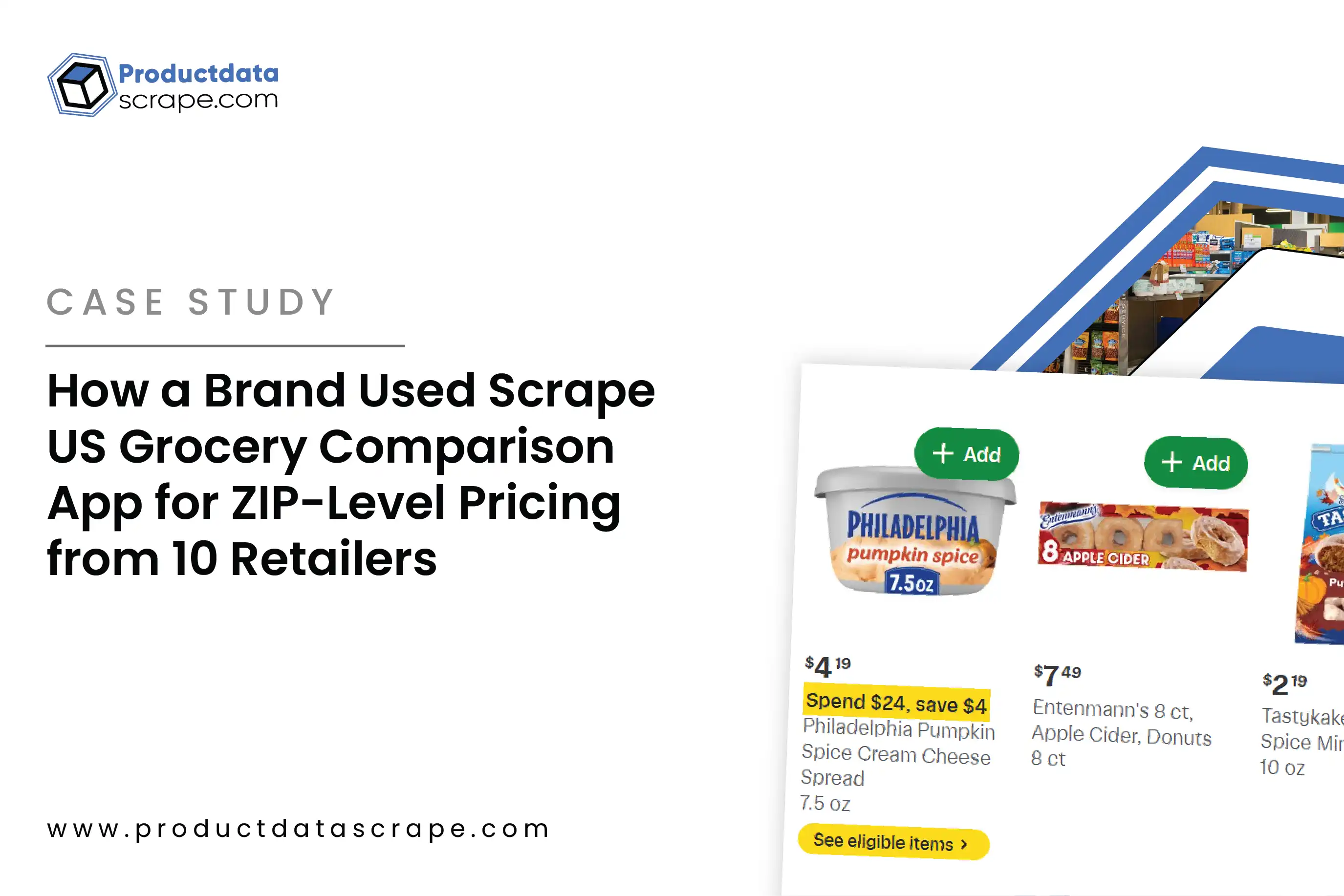
A grocery technology brand wanted to give shoppers accurate local price comparisons across major US retailers without building separate data pipelines for every retailer. Product Data Scrape created a unified Scrape US Grocery Comparison App data workflow that collected product, pricing, availability, and promotional information by ZIP code. The solution supported Grocery Price Scraping by ZIP Code, allowing the application to compare localized prices and product availability. Through ZIP-Level Pricing from 10 Retailers via One API, the brand could centralize grocery intelligence, reduce manual data handling, and create a scalable foundation for consumer price comparison.
Client Name / Industry: Confidential Grocery Technology Brand | Retail Technology & Consumer Apps.
Service / Duration: Grocery Product Data Extraction, Local Price Intelligence & API Integration | Illustrative 14-week implementation.
Key Impact Metrics: 10 retailer sources unified; 65% faster price-data processing; 90%+ target product-field completeness.
The Client
The client was a US-based grocery technology company developing a consumer-facing price comparison platform. Its goal was to help shoppers discover where everyday products were available at competitive prices in their local area. The growing popularity of online grocery shopping increased consumer expectations for accurate, location-specific pricing.
Retailers such as Walmart, Kroger, Target, Albertsons, Publix, and other grocery chains can display different prices, promotions, pack sizes, and availability depending on market and store location. This created significant pressure for comparison platforms to provide timely and geographically relevant information.
The client initially relied on fragmented data sources and manual research. Product teams had difficulty maintaining consistent information across retailer websites and struggled to distinguish local pricing differences from national catalog information.
A centralized ZIP-level grocery pricing API for US retailers became essential because the application needed to connect ZIP codes with relevant products, stores, prices, promotions, and availability.
The brand also needed to Scrape Daily Grocery Price Data so its comparison experience could remain useful as prices and inventory changed. Without an automated workflow, expanding coverage from a few retailers to 10 sources would have increased operational complexity substantially.
Product Data Scrape was selected to create a scalable data architecture capable of supporting broader retailer coverage, automated collection, validation, and API-based delivery.
Goals & Objectives
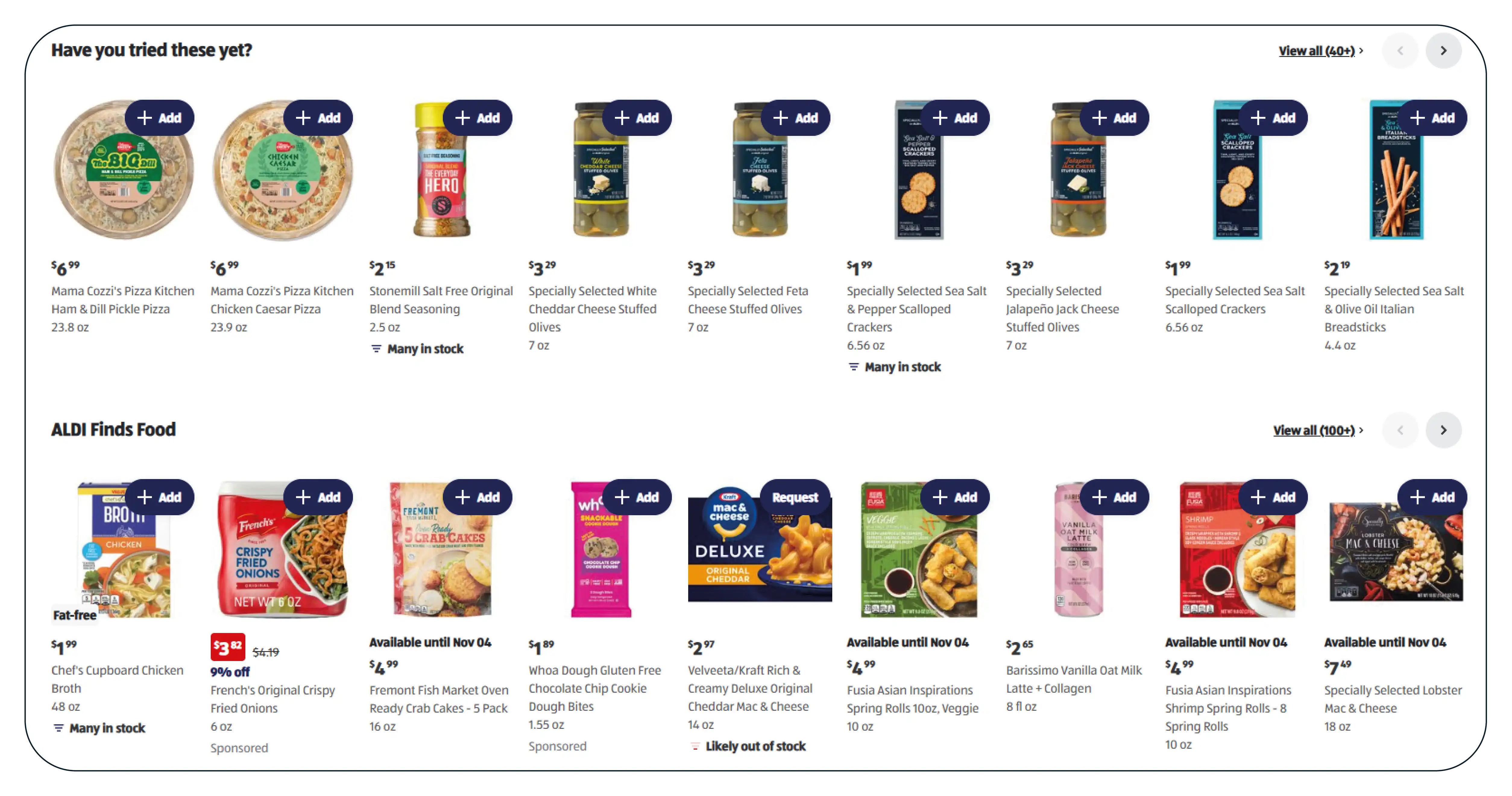
The project was designed around three priorities: scalable retailer coverage, faster data processing, and accurate local pricing. The client wanted a technical foundation that could support a consumer-facing comparison application while also enabling future retail analytics and advertising use cases.
Expand grocery price coverage across 10 US retailers.
Improve local pricing visibility for shoppers.
Create a scalable architecture for additional retailers.
Reduce dependency on manual product research.
Support retailer-level and ZIP-level price comparisons.
Improve product and SKU matching across different catalogs.
The technical team planned an automated US Grocery Store Catalog Scraping API capable of collecting standardized product information from different retailer environments.
The workflow needed to capture:
Product name and brand.
SKU or product identifier.
UPC where available.
Pack size and unit.
Regular and promotional price.
Availability.
Retailer information.
Store or ZIP-level relevance.
Product URLs and images.
The architecture also needed to support Retail media and ad intelligence by preserving structured product, pricing, promotional, and retailer attributes that could later support sponsored-product analysis and market intelligence.
Project KPIs included:
10 retailer data sources integrated.
95%+ targeted product matching accuracy.
90%+ required-field completeness.
65% reduction in manual processing.
98% scheduled extraction execution.
60% faster price-comparison data availability.
The Core Challenge
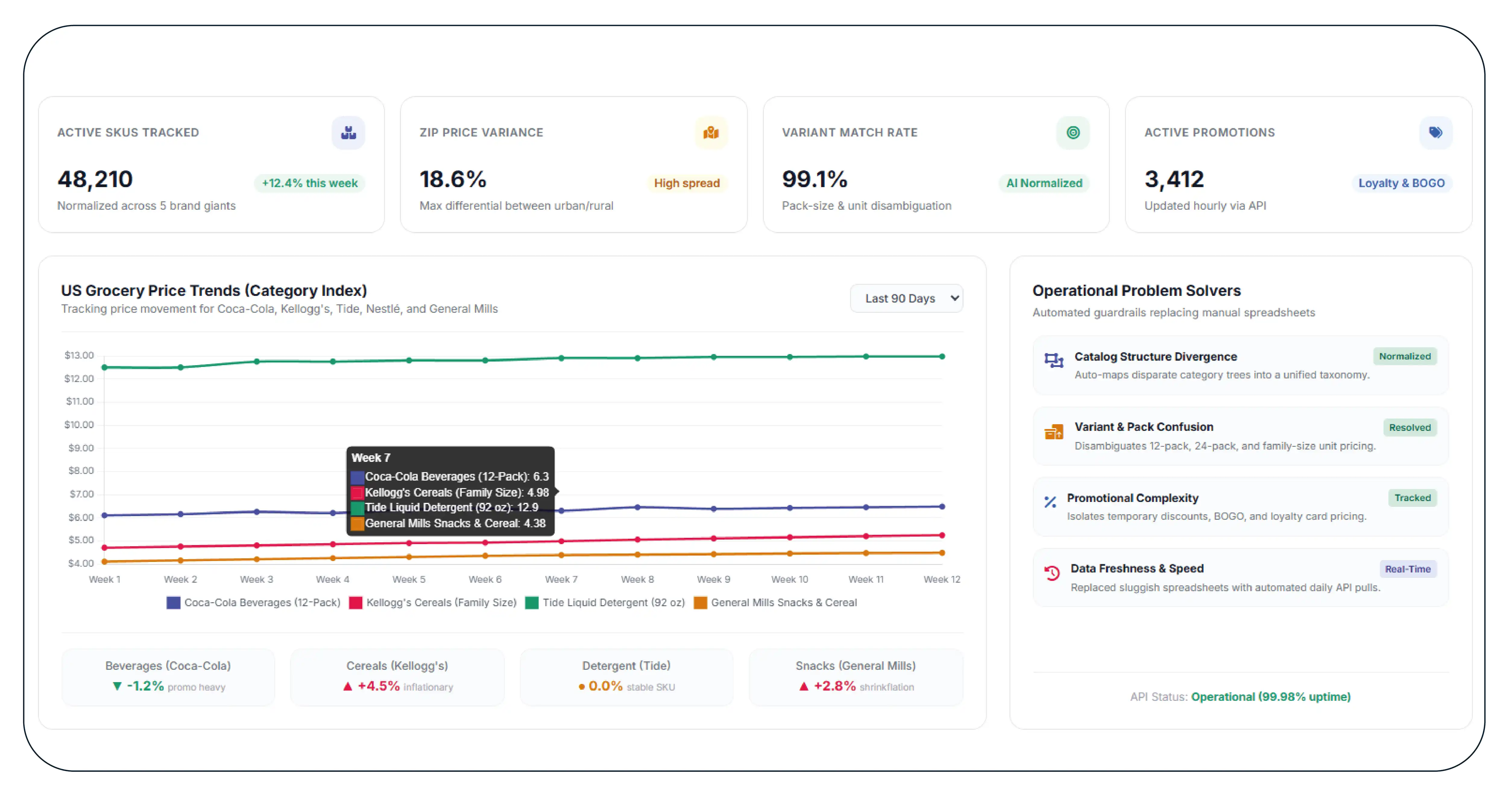
The client’s primary challenge was that grocery pricing is highly dynamic and location-sensitive. Two shoppers searching for the same product in different ZIP codes may encounter different prices, promotions, inventory conditions, or store availability.
The existing workflow required teams to gather information from multiple retailer websites and then normalize the results. Each retailer used different product naming conventions, category structures, SKU formats, and pricing presentations.
A Daily Local Grocery Price Tracking API was therefore needed to automate recurring collection and connect pricing information with geographic context.
Key operational problems included:
Different catalog structures: Retailers organized identical products differently.
Variant confusion: 12-pack, 24-pack, single-unit, and family-size products could appear similar.
ZIP-level differences: Store-level availability and pricing could vary by market.
Promotional complexity: Discounts, loyalty prices, and temporary promotions affected comparisons.
Slow manual updates: Spreadsheet-based workflows could not scale efficiently.
Incomplete product matching: Similar titles did not always represent identical SKUs.
Data freshness: Grocery prices and availability changed frequently.
The business also wanted to Scrape US Grocery Price Trends to understand how pricing changed across locations and categories.
For example, products such as Coca-Cola beverages, Kellogg’s cereals, Tide detergent, Nestlé products, and General Mills grocery items could appear across multiple retailers with different pack sizes and prices. Accurate comparison therefore required more than simple title matching.
Our Solution
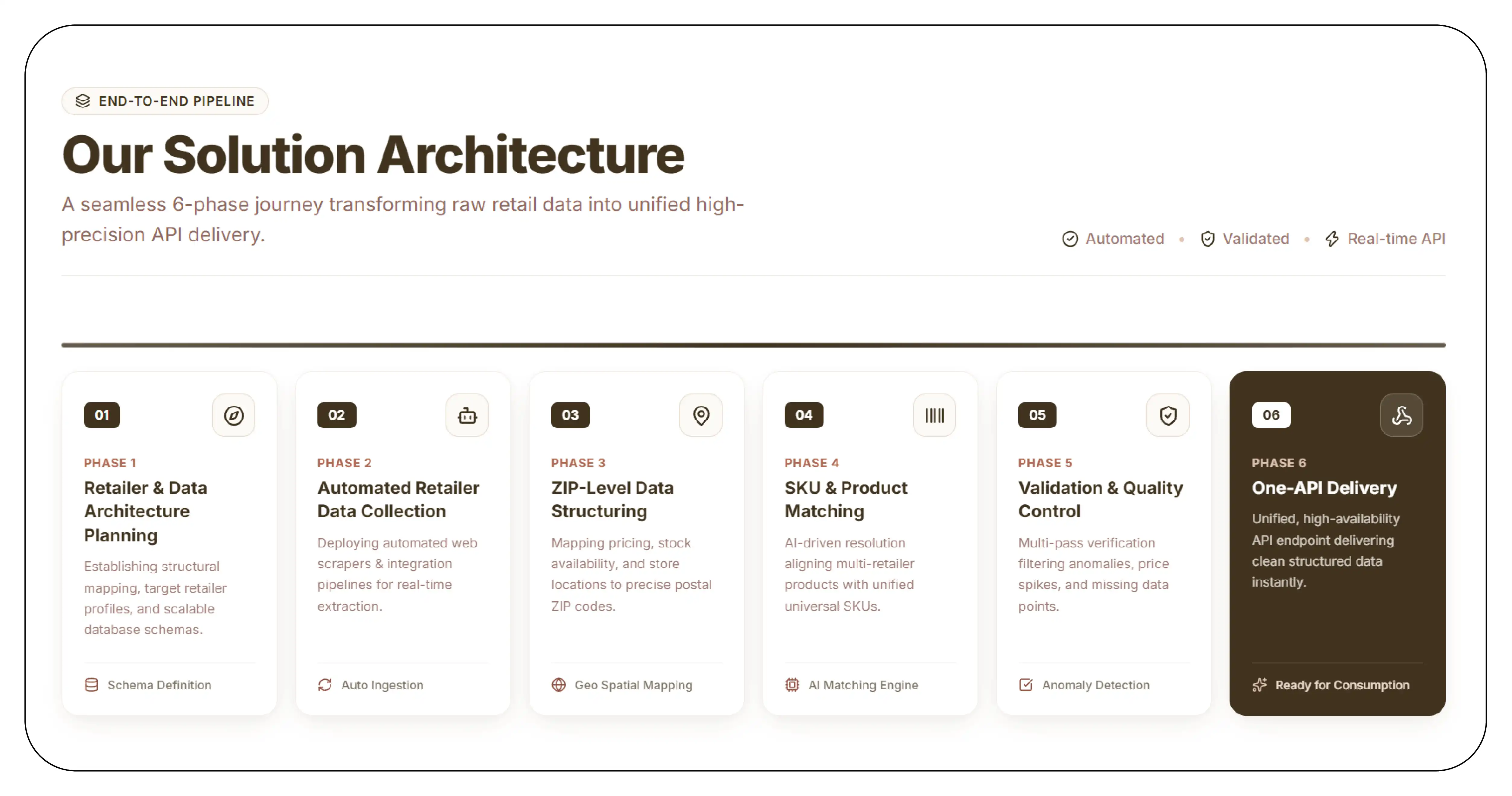
Product Data Scrape implemented a phased solution that combined retailer extraction, ZIP-level structuring, product matching, validation, and API delivery.
Phase 1: Retailer and Data Architecture Planning
The first stage defined the retailer coverage and required data schema.
The target ecosystem included major grocery and mass-retail platforms such as Walmart, Kroger, Target, Albertsons, Publix, Safeway, Meijer, H-E-B, Wegmans, and Whole Foods Market, subject to source accessibility and project requirements.
The standardized schema included:
Brand.
Product name.
UPC/SKU.
Pack size.
Unit measurement.
Regular price.
Promotional price.
Availability.
Retailer.
Store or ZIP context.
Product URL.
Product image.
Phase 2: Automated Retailer Data Collection
Automated extraction workflows were configured for the participating retailer sources. The system collected product and pricing information according to defined refresh schedules.
The workflows were designed to accommodate differences in page structures, category organization, product attributes, and retailer-specific pricing formats.
Phase 3: ZIP-Level Data Structuring
Geographic context was incorporated into the data model so that product prices could be associated with relevant ZIP-level markets.
For example, a shopper searching for a 12-pack of Coca-Cola in ZIP code 10001 could receive a different price comparison from a shopper searching in ZIP code 33101 when retailer pricing or availability differed.
This geographic layer transformed a basic product-price dataset into a localized comparison resource.
Phase 4: SKU and Product Matching
The next stage focused on identifying equivalent products across retailers.
The ZIP-Level SKU Pricing Dataset for Grocery Apps used product identifiers, brand names, product titles, package quantities, measurements, and supporting attributes to improve matching accuracy.
This helped distinguish products such as:
Tide Original Liquid 92 oz.
Tide Original Liquid 138 oz.
Coca-Cola 12-pack.
Coca-Cola 24-pack.
Kellogg’s Corn Flakes 18 oz.
Kellogg’s Corn Flakes 24 oz.
The system avoided treating different package sizes as identical products.
Phase 5: Validation and Quality Control
Collected records passed through automated validation rules covering price formats, missing fields, duplicate records, product identifiers, pack sizes, and availability.
Records that failed defined quality checks could be flagged for additional review rather than automatically entering the comparison dataset.
Phase 6: One-API Delivery
The final architecture consolidated normalized retailer information into a unified API-ready structure.
The application could request relevant product and pricing information based on defined geographic and product parameters rather than maintaining separate integrations for every retailer.
This approach gave the client a scalable foundation for grocery comparison, retail analytics, price monitoring, and future expansion into additional categories and geographic markets.
Results & Key Metrics
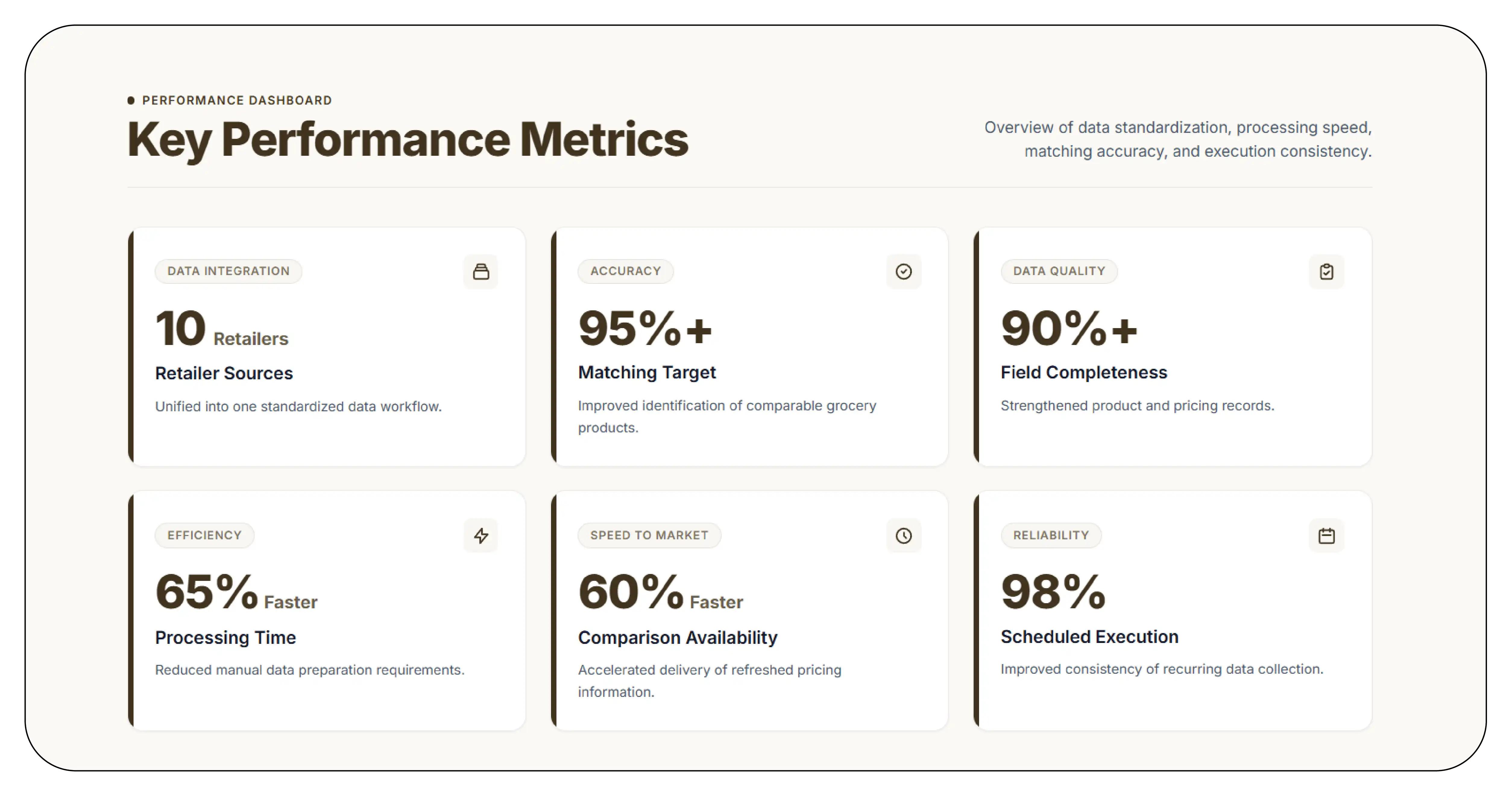
The following metrics are illustrative targets for demonstrating the solution's impact and should be replaced with verified client results before publication.
10 retailer sources: Unified into one standardized data workflow.
95%+ matching target: Improved identification of comparable grocery products.
90%+ field completeness: Strengthened product and pricing records.
65% faster processing: Reduced manual data preparation requirements.
60% faster comparison availability: Accelerated delivery of refreshed pricing information.
98% scheduled execution: Improved consistency of recurring data collection.
The new architecture gave the brand a centralized approach to collecting and comparing grocery pricing information across multiple retailers.
Through Multi-Retailer Grocery Price Extraction Through One API, product and pricing information could be standardized before being delivered to the comparison application.
The platform gained improved visibility into local product pricing, availability, promotional offers, and retailer differences. Product matching also became more reliable because package sizes, brands, and product identifiers were evaluated together.
The automated workflow reduced repetitive research and allowed technical teams to scale retailer coverage without creating an entirely separate processing framework for every source.
The solution also created a stronger foundation for future analytics. The same structured data could support price trends, retailer benchmarking, product availability monitoring, promotional analysis, and consumer-facing comparison features.
What Made Product Data Scrape Different?
Product Data Scrape approached the project as a unified data architecture challenge rather than simply collecting retailer prices. Its workflow combined automated extraction, product normalization, geographic structuring, SKU matching, validation, and API delivery. This allowed the client to build a comparison experience around consistent product records rather than disconnected retailer feeds through Scrape US Grocery Comparison App.
The solution supported ZIP-Wise Grocery Price tracking Data from 10 Retailers, creating a framework for analyzing local pricing differences across multiple geographic markets.
Smart matching rules helped distinguish product variants by brand, package size, quantity, and identifiers. Automated quality checks reduced incomplete and duplicate records.
The modular architecture also made future retailer additions easier because new sources could be mapped to the existing standardized schema and validation framework.
This combination of automation, geographic context, and normalized product intelligence helped Product Data Scrape create a scalable foundation for grocery comparison applications.
Client's Testimonial
"Product Data Scrape helped us move from fragmented grocery research to a much more structured pricing intelligence workflow. Our primary challenge was understanding how product prices and availability differed across local markets."
— Product & Data Strategy Director
The new solution gave our team a consistent way to organize retailer information and connect products with ZIP-level pricing. It also reduced the manual work involved in preparing data for our Grocery Price Comparison App.
The standardized product structure made it easier to compare brands, pack sizes, and retailer offers. We now have a stronger technical foundation for expanding our comparison coverage and introducing additional grocery intelligence features.
The project has given our product and analytics teams greater confidence in the quality and scalability of our marketplace data.”
Conclusion
Local grocery pricing is increasingly important for comparison platforms, retail technology companies, and consumer applications serving the US market. Shoppers want relevant information based on their location, while businesses need scalable data pipelines that can keep pace with changing prices and availability.
Product Data Scrape developed a structured solution that connected retailer extraction, product matching, ZIP-level context, validation, and API delivery.
A scalable Scrape US Grocery Comparison App workflow can help businesses compare products across multiple retailers while reducing manual data preparation.
For companies building localized grocery comparison platforms, the next step is to create a reliable data foundation with Scrape US Grocery Comparison App that can scale with retailer coverage, product volume, and geographic expansion.
Ready to build localized grocery price intelligence? Partner with Product Data Scrape to develop scalable retailer data pipelines and API-powered comparison solutions!
FAQs
1. What is ZIP-level grocery price comparison?
ZIP-level grocery price comparison connects product pricing and availability with a specific geographic market. This helps comparison applications show shoppers information that is more relevant to their local area.
2. Why does grocery pricing need ZIP-level data?
Grocery prices, promotions, and availability can vary by store, region, and market. Geographic context helps applications distinguish local pricing conditions instead of presenting one generalized national price.
3. Which grocery retailers can be included?
Depending on project requirements and source accessibility, a solution can cover retailers such as Walmart, Kroger, Target, Albertsons, Publix, Safeway, Meijer, H-E-B, Wegmans, and Whole Foods Market.
4. What product fields can be collected?
Typical fields include product name, brand, SKU, UPC, package size, unit measurement, regular price, promotional price, availability, retailer, product URL, images, and geographic context.
5. Can the data support a grocery comparison application?
Yes. Normalized product and pricing data can be delivered through APIs or structured datasets for consumer comparison applications, dashboards, retail analytics, pricing intelligence, and promotional monitoring.


 Singapore
 EMAIL
 PHONE










.webp)