Introduction
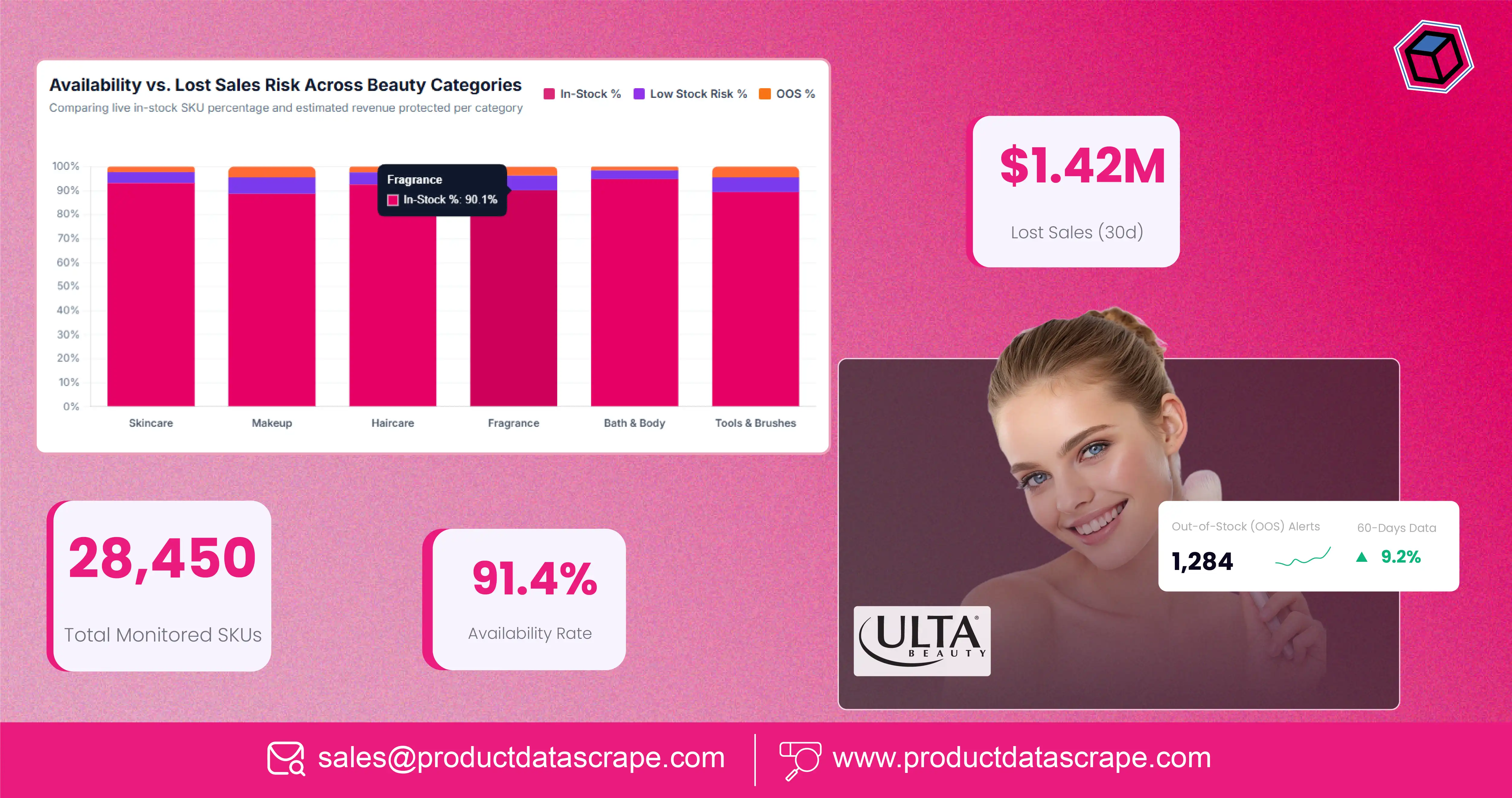
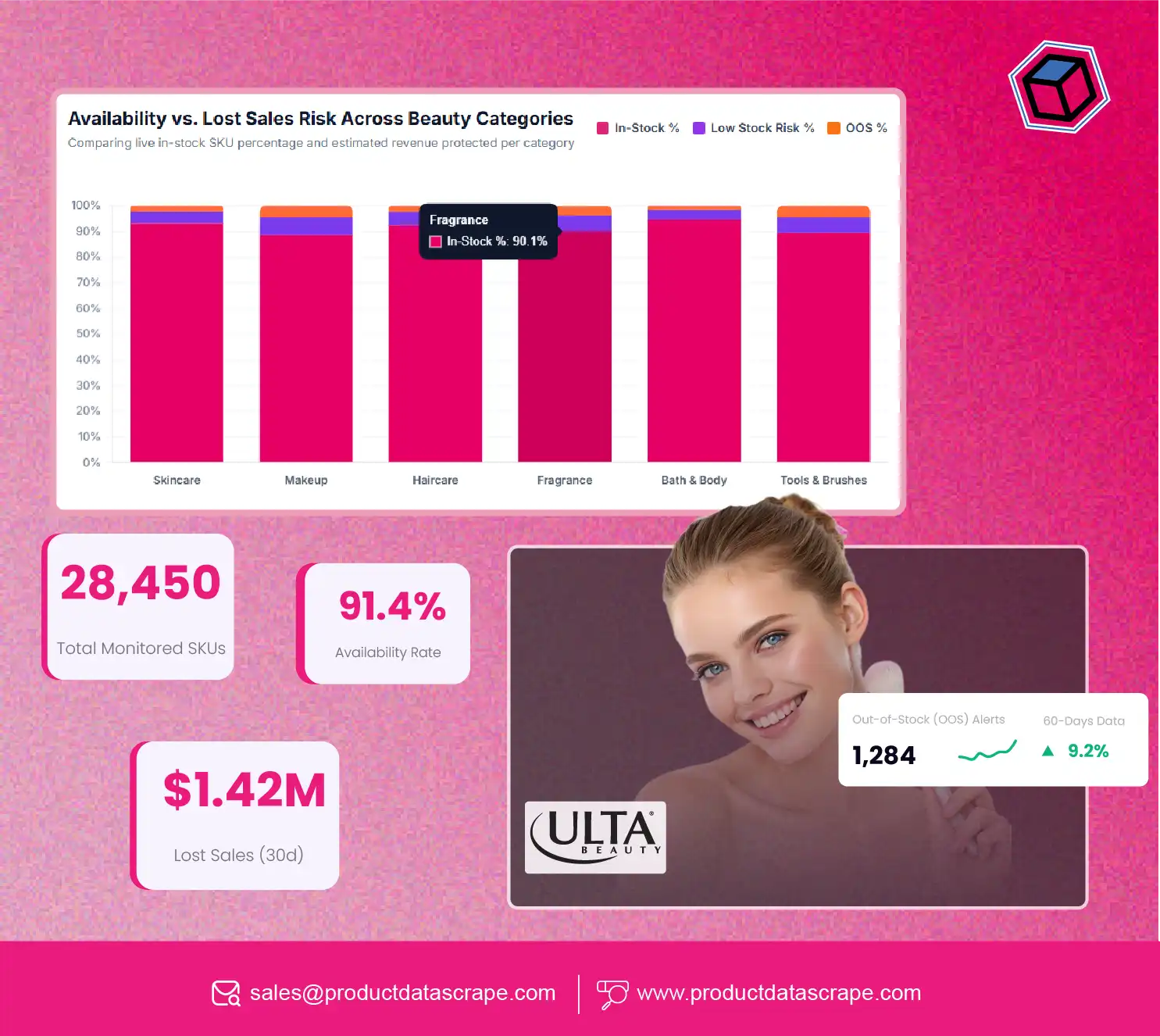
Product availability directly affects customer purchasing decisions, revenue opportunities, and inventory planning in the beauty retail industry. When popular cosmetics, skincare products, fragrances, or haircare items become unavailable, retailers risk losing customers to competing stores. Ulta Beauty Product Data Scraping helps businesses collect structured information about product availability, pricing, discounts, ratings, and category-level assortment. This information enables retailers, distributors, and market research teams to identify stock changes, monitor competing products, and make informed inventory decisions.
Ulta Beauty operates more than 1,500 locations across the United States and offers over 30,000 products from more than 600 beauty and wellness brands, according to its investor information. This extensive assortment makes product-level monitoring valuable for understanding beauty retail competition.
A structured Ulta Beauty Product Data Scraper can help businesses organize publicly available product information into consistent datasets. By monitoring product pages and recording changes over time, businesses can identify availability patterns, compare category performance, and respond to potential lost-sales situations more effectively.
How Has Beauty Retail Performance Changed Between 2020 and 2026?
Beauty retail has experienced significant changes in sales, product assortment, and consumer purchasing behavior. Ulta Beauty's reported financial performance provides useful context for understanding the scale of this market.
The following table presents reported company net sales. Fiscal-year figures are not calendar-year figures, and 2026 represents the reported second quarter rather than a completed annual result.
| Reporting period | Reported net sales |
|---|
| FY2020 | $6.15 billion |
| FY2021 | $8.63 billion |
| FY2022 | $10.21 billion |
| FY2023 | $11.21 billion |
| FY2024 | $11.3 billion |
| FY2025 | $12.4 billion |
| FY2026 Q2 | $3.04 billion |
Sources: Ulta Beauty annual reports and FY2026 second-quarter results. FY2026 Q2 covers the 13 weeks ended August 1, 2026, and should not be interpreted as full-year sales.
These figures demonstrate the expansion of Ulta Beauty's reported business over the period, although company-wide sales do not independently establish demand for any particular product. For retailers, this distinction matters: category-level and SKU-level information is necessary to understand which items are gaining attention and which products experience availability changes.
The company's FY2025 annual report also shows that cosmetics represented 39% of net sales, skincare and wellness 23%, haircare 19%, and fragrance 13%. These category shares demonstrate why monitoring product availability across different beauty segments can support more informed commercial decisions.
Why Is Brand-Level Product Monitoring Important for Beauty Retailers?
Beauty retailers manage extensive product assortments across cosmetics, skincare, haircare, fragrance, and personal care. Monitoring individual brands helps businesses understand assortment changes, identify products gaining visibility, and recognize potential availability gaps. Ulta Beauty Brand-Wise Catalog Extraction allows businesses to organize product information according to brand names, product categories, descriptions, variants, and listed availability.
Brand-level monitoring is particularly useful for competitive research. Retailers can identify newly introduced products, discontinued listings, changing product sizes, and differences in promotional activity. For example, comparing the listed assortment of established beauty brands across multiple observation dates can reveal changes in their online presence. These observations can support assortment planning and competitor analysis.
Another important consideration is product shelf life. Cosmetics and skincare products have different formulation characteristics and expiration requirements. Shelf Life Intelligence can help businesses organize manufacturer-provided expiration information, batch details, or best-before dates when these details are legitimately available in authorized product records. However, retailers should never estimate an expiration date from a product's launch date or listing age.
Useful monitoring fields include:
- Brand and manufacturer names for consistent catalog identification.
- Product titles, sizes, shades, and formulation details.
- First-seen and last-seen dates for identifying listing changes.
- Listed availability and promotional information.
- Expiration or batch information only when explicitly disclosed.
This structured approach helps retailers maintain more accurate catalogs and prioritize products requiring further inventory verification.
How Can Product-Level Collection Reveal Availability Gaps?
Beauty products frequently have multiple variants, including shades, sizes, finishes, and formulations. A foundation may have dozens of shades, while skincare products may offer different quantities or ingredient combinations. Monitoring only the parent product can therefore hide availability problems affecting individual variants.
Businesses can Scrape Ulta Beauty Makeup and Skincare Data to organize product titles, brands, category classifications, prices, descriptions, ratings, and visible availability information. The resulting dataset can help retailers compare product assortment across categories and identify products whose listings change over time.
For example, a product page may remain active even when a particular shade is unavailable. Tracking variant-level information helps distinguish a completely unavailable product from an item with only selected variants missing. Retailers can then investigate whether the issue concerns inventory, product discontinuation, or a temporary listing change.
Beauty Marketplace Pricing Data adds another layer of commercial intelligence. When businesses compare listed prices, promotional prices, and availability across authorized retail sources, they can identify pricing differences and evaluate whether competing products remain accessible to customers.
| Data field | Business application |
|---|
| Product name | Catalog identification |
| Brand | Brand-level assortment analysis |
| Shade or size | Variant-level availability tracking |
| Listed price | Price comparison |
| Promotional price | Discount monitoring |
| Availability status | Potential stockout identification |
| Product URL | Source verification |
| Observation timestamp | Change tracking |
A reliable process should retain historical observations instead of overwriting previous records. This makes it easier to distinguish temporary availability changes from longer-term assortment adjustments.
What Can Pricing and Consumer Trends Reveal About Inventory Decisions?
Product availability becomes more useful when businesses analyze it alongside pricing and consumer interest. A product that receives frequent promotional attention may require different inventory planning from a product with limited customer engagement. Similarly, a popular skincare item experiencing repeated availability changes deserves closer investigation.
Ulta Beauty Product Pricing Intelligence helps businesses organize regular-price information, discounts, product variants, and promotional changes. Retailers can compare these records over time to understand how pricing strategies differ across brands and product categories.
Analyzing product assortment alongside pricing also helps identify potential market opportunities. Businesses can examine whether certain brands maintain consistent pricing, introduce frequent discounts, or expand their product ranges. These observations can support competitive positioning without assuming that a lower price automatically indicates higher demand.
Analyzing Skincare Trends requires additional attention to product characteristics. Ingredients, skin concerns, formulation types, product sizes, and customer feedback can provide useful context for category research. Businesses can compare the visibility of different product types and observe how their listed availability changes.
For reliable analysis, historical records should include:
- Original listed price and promotional price.
- Product category, brand, and variant.
- Availability status at the observation time.
- Review count and rating when publicly displayed.
- Changes in product descriptions or ingredient information.
These fields help businesses connect assortment changes with commercial observations. However, online ratings and review counts are indicators of displayed customer feedback, not verified sales volumes. Combining several data points creates a more dependable foundation for inventory planning and beauty market research.
How Can Continuous Monitoring Help Prevent Missed Sales Opportunities?
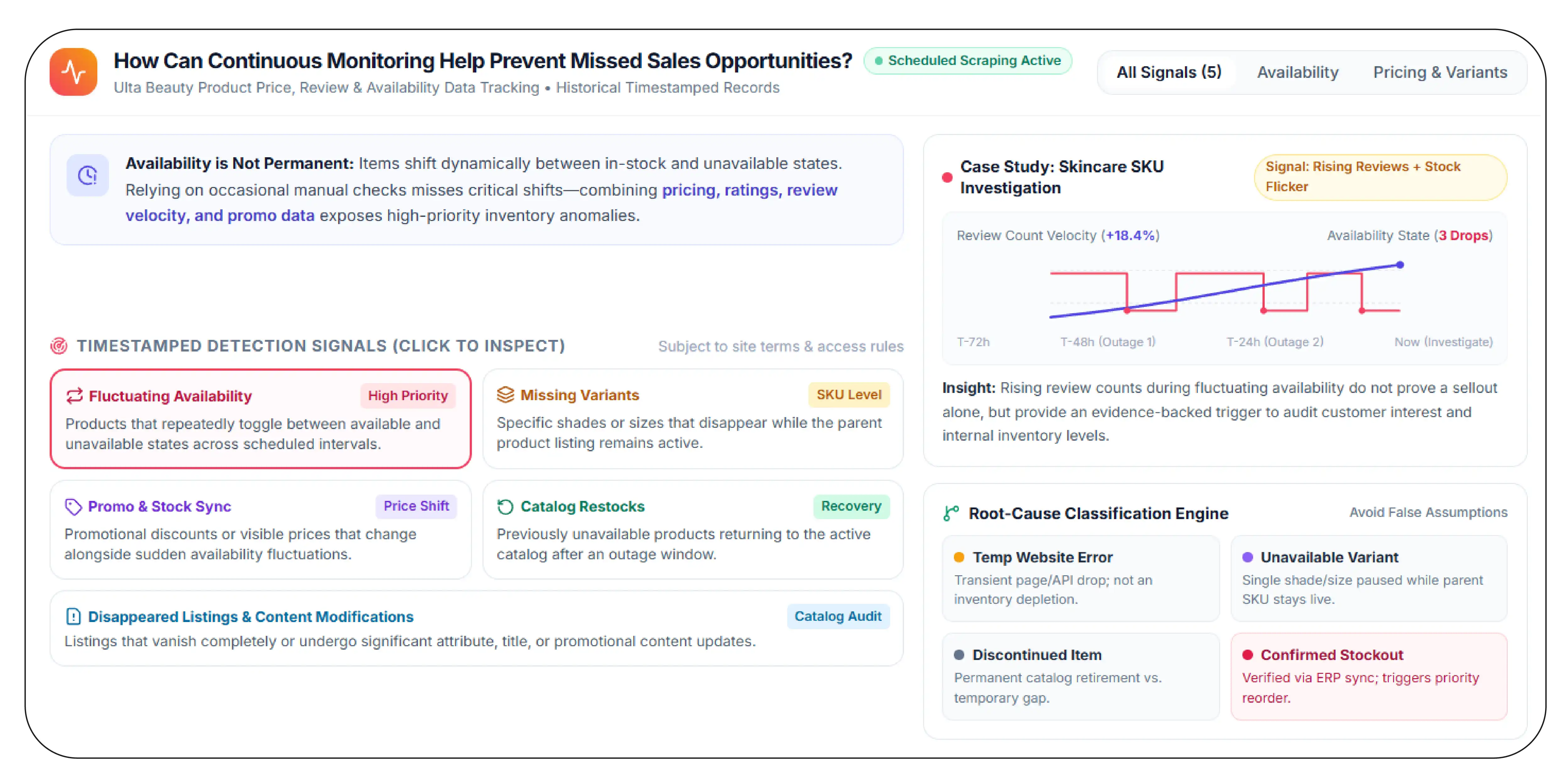
Product availability is not a permanent condition. An item listed as available during one observation may become unavailable later, while a previously unavailable product may return to the catalog. Businesses that depend on occasional manual checks can overlook these changes.
Ulta Beauty Product Price & Review Data Tracking helps retailers maintain historical records of visible pricing, customer ratings, review counts, promotional activity, and product availability. Combining these fields makes it easier to identify changes that deserve investigation.
For example, a retailer may notice that a particular skincare product has a changing availability status while its displayed review count continues to increase. This does not prove that the product is selling out, but it provides a reason to investigate customer interest and inventory conditions further.
Ulta Beauty Product Data Scraping can support this process by collecting product-level information at scheduled intervals, subject to applicable website terms and access restrictions. Businesses can use timestamped records to identify:
- Products that repeatedly change between available and unavailable states.
- Variants that disappear while the parent listing remains active.
- Promotional prices that change alongside availability.
- Products that return after a period of unavailability.
- Listings that disappear or undergo significant content changes.
A useful monitoring system should also distinguish between temporary website errors, unavailable variants, discontinued products, and confirmed stockouts. A missing listing alone is not sufficient evidence that inventory has been exhausted.
Businesses can connect these observations to internal inventory systems and review alerts before taking action. This reduces reliance on assumptions and helps purchasing teams prioritize the products that need attention.
What Should a Reliable Beauty Retail Dataset Include?
A structured product dataset allows businesses to compare large assortments without repeatedly reviewing individual product pages. It also creates a consistent foundation for reporting, competitor analysis, and category-level inventory research.
A Ulta Beauty Beauty Retail Dataset can contain product identifiers, brand information, category names, product descriptions, prices, promotional details, variants, and visible availability statuses. Historical observations make the information more useful because businesses can compare records across different dates.
Ulta Beauty reported more than 30,000 products from over 600 beauty and wellness brands as of January 31, 2026. Its FY2026 reporting also identifies cosmetics, skincare and wellness, haircare, and fragrance as major merchandise categories.
For retailers analyzing such a broad assortment, standardized product fields are essential. Ulta Beauty Product Data Scraping can help organize collected information into a consistent structure that supports product matching and historical comparisons.
| Dataset component | Recommended fields | Business value |
|---|
| Product identity | Product ID, title, URL | Record matching |
| Brand information | Brand, manufacturer | Brand analysis |
| Categorization | Makeup, skincare, haircare, fragrance | Category research |
| Product variants | Shade, size, formulation | Variant monitoring |
| Pricing | Regular price, sale price | Competitive analysis |
| Availability | Displayed status, timestamp | Change detection |
| Customer feedback | Rating, review count | Feedback analysis |
| Product details | Ingredients, description | Catalog enrichment |
Data validation should remove duplicate records, standardize category labels, preserve source URLs, and identify missing values. Product matching should consider brand, product name, size, shade, and other relevant attributes rather than relying on titles alone.
These practices help businesses build datasets that are easier to analyze, update, and integrate with their existing reporting systems.
How Can Product Performance Analysis Improve Beauty Inventory Planning?
Product performance analysis helps businesses move beyond basic product collection and identify which assortment changes require commercial attention. Retailers can evaluate availability alongside pricing, customer feedback, brand information, and category-level trends.
Extract Ulta Beauty Product Performance Data to develop reports that organize product observations into meaningful business indicators. These indicators may include the frequency of observed availability changes, price movements, review-count changes, and the number of listed variants associated with a product.
Businesses should interpret these indicators carefully. A higher review count does not establish the number of units sold, and an unavailable product listing does not reveal the exact quantity of remaining inventory. These distinctions are important when converting collected information into purchasing decisions.
Ulta Beauty Product Data Scraping can provide historical observations for identifying recurring patterns. For example, businesses can compare a product's listed price and availability across several collection dates. They can also identify whether specific categories contain a growing number of unavailable listings.
Useful performance indicators include:
- Availability change frequency: How often a product's displayed status changes.
- Price movement: Differences between observed regular and promotional prices.
- Variant coverage: The number of listed variants available for comparison.
- Review growth: Changes in publicly displayed review counts.
- Assortment changes: Newly listed, modified, or removed product records.
Retailers can combine these indicators with their own sales history, warehouse inventory, and replenishment records. This creates a more complete view of product performance than external listing data alone.
The ultimate objective is to identify potential inventory risks early, improve assortment decisions, and prioritize products requiring further investigation. Structured historical data makes these decisions more transparent and measurable.
Why Choose Product Data Scrape?
Product Data Scrape helps businesses transform publicly accessible retail information into structured, actionable datasets. Our data collection solutions support product catalog monitoring, pricing research, category analysis, and availability tracking across beauty retail platforms. With Ulta Beauty Product Data Scraping API, businesses can organize product information into formats suitable for analytics, dashboards, and internal systems. Our approach emphasizes data consistency, source traceability, duplicate identification, and scheduled collection based on project requirements and permitted access. Ulta Beauty Product Data Scraping can help retailers monitor assortment changes, understand competitive activity, and strengthen inventory research with regularly updated product intelligence.
Conclusion
Beauty retailers need reliable product information to identify availability gaps, understand competitor activity, and improve inventory planning. Structured Health & Beauty Data Scraping helps businesses analyze product catalogs, pricing changes, customer feedback, and category-level assortment trends. By combining historical observations with internal inventory and sales records, retailers can make better-informed commercial decisions.
Ulta Beauty Product Data Scraping provides a valuable approach to organizing beauty product information and monitoring changes across retail categories.
Ready to improve your beauty retail intelligence? Contact Product Data Scrape today to discuss customized data collection solutions that support smarter inventory decisions and competitive market research!
FAQs
1. What is Ulta Beauty product data collection?
It involves collecting publicly accessible product information, including brand names, descriptions, prices, variants, ratings, reviews, and displayed availability for structured retail market analysis.
2. How does product availability monitoring help retailers?
It helps retailers identify changing listing statuses, investigate potential stockouts, monitor product variants, and make informed replenishment decisions using historical observations.
3. Which product categories can businesses monitor?
Businesses can monitor makeup, skincare, haircare, fragrance, wellness, and other beauty categories to understand assortment changes, pricing differences, and product availability patterns.
4. Can collected product data support competitor analysis?
Yes. Structured product records help businesses compare listed prices, promotional activity, product assortments, customer feedback, and availability across authorized retail sources.
5. How does Product Data Scrape deliver collected information?
Product Data Scrape can provide structured datasets in formats such as CSV, JSON, or Excel, depending on project requirements, integration needs, and collection scope.



 Singapore
 EMAIL
 PHONE











.webp)