Introduction
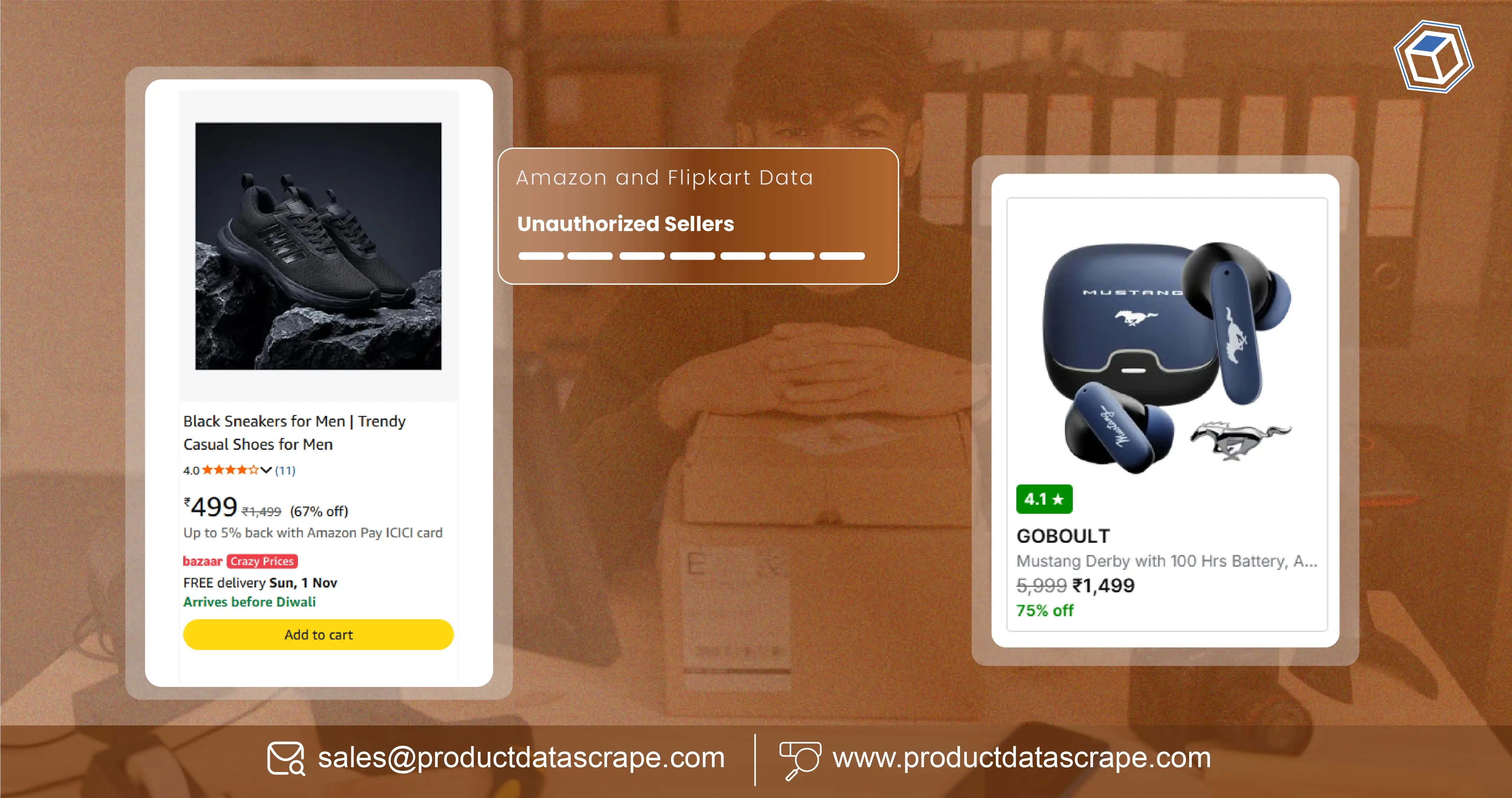
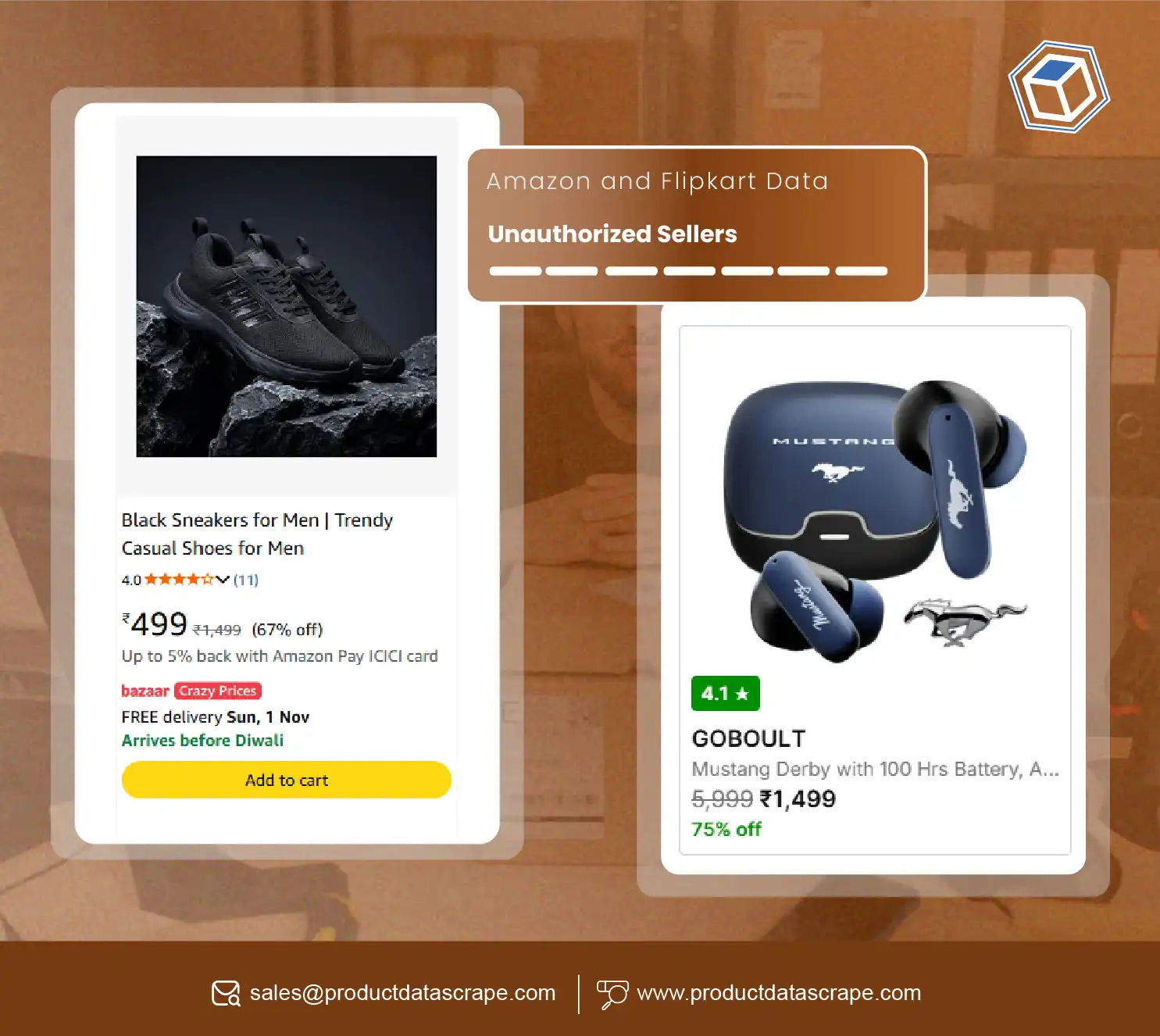
A Scraper for Amazon and Flipkart marketplace data helps brand-protection, e-commerce, and pricing teams organize publicly available product-listing information to identify suspicious seller activity, inconsistent prices, duplicate listings, and product-detail changes. Flipkart product data scraping can support structured monitoring, but unusual pricing alone does not prove that a seller is unauthorized or that a product is counterfeit.
The business challenge is visibility. Brands may sell through authorized distributors while other sellers list apparently identical products at different prices. Without historical records, teams can struggle to distinguish legitimate promotions, reseller competition, listing errors, and possible intellectual-property violations.
A structured monitoring workflow compares product identifiers, seller information, price history, availability, listing attributes, and review signals. It then prioritizes anomalies for human investigation. This allows brand owners to protect pricing consistency, investigate potential misuse of trademarks, and preserve a reliable customer experience without automatically penalizing legitimate resellers.
How Can Brands Identify Suspicious Product Listings?
Amazon & Flipkart Catalog Scraping, Amazon Price Monitoring helps brands build a consistent record of products and sellers across marketplace listings. The process starts by establishing an approved product catalogue containing SKUs, GTINs or barcodes, model numbers, brand names, product titles, authorized seller records, and recommended or listed prices where applicable.
Each new observation can be compared against the reference catalogue. Differences in product identifiers, images, descriptions, package quantities, or brand names may indicate a listing that deserves review. A seller appearing for the first time is another useful signal, but it is not proof of unauthorized activity.
Price monitoring adds another layer. A sudden price reduction can result from a legitimate promotion, clearance sale, or seller-specific strategy. Therefore, teams should investigate price anomalies alongside seller changes and product inconsistencies instead of treating every low price as a violation.
Amazon's 2024 Brand Protection Report, published in March 2025, stated that its proactive controls blocked more than 99% of suspected infringing listings before brands needed to report them. Amazon also reported a roughly 35% reduction in valid infringement notices submitted by brands since 2020. These are Amazon-reported results, not a guarantee of equivalent outcomes for third-party monitoring programs. (Amazon Brand Protection Report)
What should teams monitor from 2020 to 2026?
| Year | Verified public milestone | Relevance to brand protection |
|---|
| 2020 | Amazon's Counterfeit Crimes Unit launched | Establishes a public milestone in Amazon's anti-counterfeiting work |
| 2021 | No comparable annual figure used here | Avoid assuming a year-on-year detection trend |
| 2022 | No comparable annual figure used here | Preserve historical listing snapshots where available |
| 2023 | No comparable annual figure used here | Use product-level evidence rather than unsupported market estimates |
| 2024 | Amazon reported blocking over 99% of suspected infringing listings proactively | Demonstrates the importance of layered detection |
| 2025 | Amazon published its 2024 Brand Protection Report | Provides documented protection metrics for the prior year |
| 2026 | Flipkart reported over 11,000 brands onboarded to Brand Assure as of December 2025; Amazon India reported 20 lakh sellers in September 2026 | Shows the scale of marketplace monitoring and brand-protection needs |
Sources: Amazon Brand Protection Report, Flipkart marketplace governance announcement, and Amazon India seller-base announcement.
For brand teams, the actionable output is a prioritized investigation queue. Each alert should include the listing URL or identifier, the observed change, the first and most recent observation dates, the reason for flagging, and supporting evidence. This makes the next step clearer for marketplace operations and legal teams.
How Can Stock and Catalogue Changes Reveal Potential Misuse?
Amazon Stock Availability Tracking, Catalog Enrichment Services can help brands identify listing changes that deserve attention. A product that repeatedly disappears, reappears under a different title, or changes its package details may require a closer look, particularly when other risk indicators appear at the same time.
Stock availability is not a direct measure of seller authorization. Genuine sellers can experience inventory shortages, and different sellers may hold legitimate stock at the same time. The value of availability monitoring lies in connecting changes to other signals, such as seller identity, product identifiers, price movements, and listing edits.
Catalogue enrichment makes these comparisons more reliable. Product titles can be standardized, model numbers extracted, package sizes normalized, and brand names matched against approved reference data. Images and descriptions may also be compared where their use is permitted. Any image similarity or text mismatch should be treated as a clue, not a legal conclusion.
Amazon's Brand Protection Report stated that its Transparency program had verified more than 2.5 billion product units and enrolled 88,000 brands worldwide. Transparency uses unique codes to verify participating products, offering an additional authentication mechanism beyond monitoring listing information. (Amazon Brand Protection Report)
Which catalogue signals are most useful?
| Signal | Possible explanation | Recommended next step |
|---|
| Product identifier mismatch | Incorrect listing or possible product substitution | Verify the identifier against the approved catalogue |
| Unexpected brand-name variation | Typographical error, catalogue issue, or potential misuse | Review the title and product details |
| New seller on a protected SKU | New legitimate reseller or potential risk | Check authorization and sourcing records |
| Product quantity differs | Bundle, variant, or inaccurate listing | Compare packaging and item identifiers |
| Sudden stock disappearance | Stockout, delisting, or listing change | Recheck over multiple observations |
| Description or image changes | Routine content update or potential misrepresentation | Preserve evidence and request human review |
A strong process combines these fields into a product-level history. For example, a stock change accompanied by a seller change and a product-identifier mismatch may deserve higher priority than a stock change alone. This is a risk-scoring approach, not proof that a violation occurred.
For brand owners, the main benefit is reduced manual checking. Teams can focus on listings that have multiple independent warning signs instead of reviewing every catalogue change with equal urgency.
How Can Brands Track Changes Across a Large Marketplace?
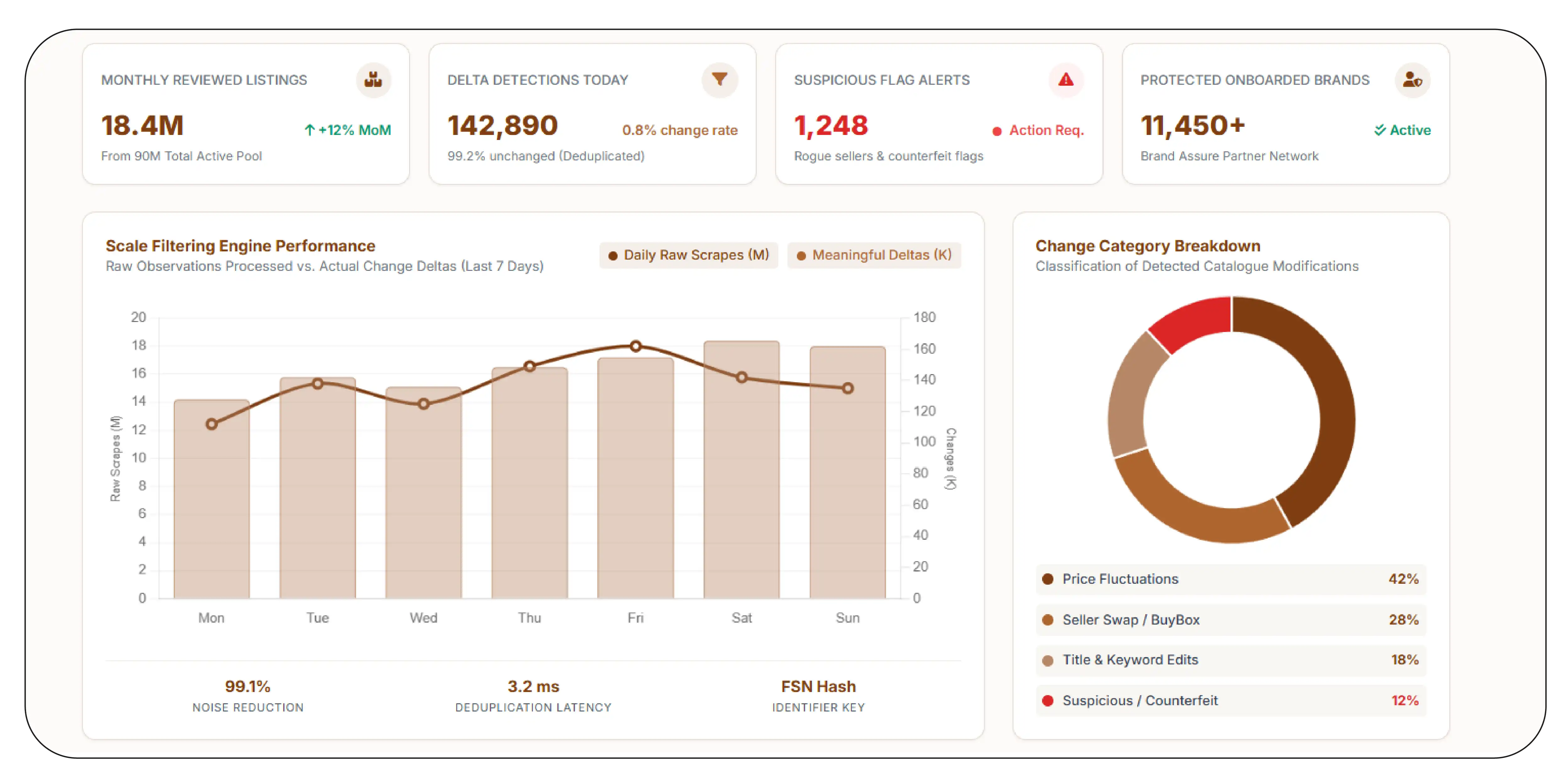
Flipkart Marketplace Product Trend Monitoring, Flipkart Scraping at Scale supports the analysis of large product catalogues where manual tracking becomes difficult. The objective is to detect changes across listings over time while retaining enough context to distinguish ordinary market activity from suspicious patterns.
Flipkart reported that its marketplace had more than 90 million seller product listings in September 2025. In January 2026, the company said its marketplace governance systems reviewed millions of listings monthly and that Brand Assure had onboarded over 11,000 brands as of December 2025. These are company-reported figures and illustrate the scale of the platform's catalogue and protection workflows. (Flipkart seller marketplace update, Flipkart marketplace governance announcement)
At scale, monitoring should use scheduled observations, stable product identifiers, deduplication, and change detection. Rather than repeatedly processing every unchanged field, the workflow can focus on meaningful differences in price, seller, product title, availability, and other relevant attributes.
What does a scalable monitoring workflow need?
| Component | Business purpose |
|---|
| Product reference catalogue | Defines the products the brand needs to protect |
| Listing identification | Connects observations to a product or SKU |
| Seller history | Records seller names or identifiers where available |
| Change detection | Highlights differences between successive observations |
| Risk scoring | Prioritizes listings with multiple warning signs |
| Evidence archive | Preserves timestamps and source references |
| Review queue | Routes potential issues to the correct team |
| Reporting dashboard | Summarizes patterns and investigation status |
A useful dashboard should separate confirmed cases from unverified alerts. It should also show how long a listing has been monitored, whether the signal has recurred, and whether a reviewer has already examined the evidence.
For instance, a product-title change may be routine, while the same change combined with a mismatched product identifier and a seller outside the brand's known distribution network may justify investigation. The system should explain why the alert was generated so that analysts can validate it efficiently.
Brands should also establish clear access permissions and retention rules for the collected information. Collection methods must comply with applicable laws, platform terms, and authorized access conditions. The goal is a repeatable monitoring process, not indiscriminate collection of marketplace content.
How Can Bestseller and Ranking Changes Support Investigations?
Amazon & Flipkart Marketplace Bestseller Rank Monitoring, Scraper for Amazon and Flipkart marketplace data can provide useful context for understanding product performance and unusual listing changes. Where rank information is publicly displayed and may lawfully be collected, teams can record the rank, category, product identifier, seller information, and observation timestamp.
Ranking movements should not be treated as evidence of counterfeiting or unauthorized selling. Rankings can change because of demand, advertising, seasonality, promotions, availability, and marketplace algorithms. Their value is in identifying patterns that can be compared with other observations.
For example, a brand may want to examine whether a sharp price change coincides with a change in seller, a revised product description, or a sudden shift in stock availability. These combined signals can help the team decide which listing deserves closer review. They cannot establish intent or authenticity without further evidence.
Amazon's 2024 Brand Protection Report also stated that its automated systems scan billions of attempted product-detail-page changes daily for potential abuse. This is a platform-reported operational metric and should not be interpreted as a publicly available count of suspicious seller listings or a target for external monitoring tools. (Amazon Brand Protection Report)
How should rank information be used?
| Observation | Useful interpretation | What not to conclude |
|---|
| Rank changes while price stays stable | Demand or visibility may have changed | Do not assume a seller violation |
| Rank and price change together | Promotion or market activity may be involved | Do not assume deliberate price manipulation |
| Rank changes with a seller change | Additional context for an investigation | Do not assume the new seller is unauthorized |
| Listing vanishes from a category | Category change, delisting, or availability issue | Do not assume counterfeit activity |
| Repeated changes across several fields | Potentially higher investigation priority | Do not treat an automated alert as a legal finding |
The most useful design is a timeline that places rank, price, seller, and availability changes side by side. That helps analysts review the sequence of events instead of relying on a single screenshot or isolated measurement.
Brand-protection teams should set category-specific thresholds and document the reasoning behind each alert. They should also allow analysts to mark known seasonal events, official promotions, and authorized distributor changes so that recurring legitimate activity does not generate unnecessary alerts.
How Can Buy Box and Featured Offer Changes Be Interpreted?
Amazon Flipkart Buy Box Price Monitoring helps sellers and brand teams track price and offer changes where the marketplace provides relevant information. On Amazon, the Featured Offer—often referred to as the Buy Box—can change based on multiple factors. It should not be treated as a simple indicator of which seller is authorized or which price is lowest.
A brand may observe that the same product is offered at different prices by several sellers. This can reflect legitimate competition, shipping differences, promotions, seller-specific costs, or variations in fulfilment. The right response is to compare the offer with the brand's approved distribution records and applicable pricing policies before taking action.
The workflow should retain the displayed price, seller identity or identifier where available, fulfilment details, product identifier, offer status, and timestamp. If a listing shows a seller that is not in the brand's internal authorization records, the record can be flagged for verification. An incomplete authorization list, however, can lead to false positives.
What should teams compare?
| Field | Why it matters |
|---|
| Product identifier | Ensures the offers refer to the same item |
| Seller identity | Supports comparison with internal reseller records |
| Displayed price | Shows the observed offer at a specific time |
| Shipping or fulfilment details | Adds context to price comparisons |
| Offer status | Indicates whether the offer was visible |
| Timestamp | Supports historical analysis |
| Authorization status | Records the result of internal verification |
| Investigation outcome | Prevents repeated review of resolved cases |
Pricing compliance also requires care. A lower price does not by itself prove a policy violation, and brands should not assume that they can legally prohibit resale of genuine products in every situation. Applicable competition law, distribution agreements, trademark rights, and local rules all matter.
A monitoring system should therefore produce evidence for review rather than automatically demand that a seller raise a price or be removed. Its purpose is to improve visibility, support legitimate brand-protection workflows, and help teams identify potential issues with greater consistency.
How Can Review and Rating Changes Help Prioritize Risk?
Amazon & Flipkart Review Count Tracking, Scraper for Amazon and Flipkart marketplace data can help teams monitor changes in public review counts, rating averages, and visible feedback where the source permits collection. These signals can highlight changes in customer experience, but they cannot independently verify product authenticity or seller authorization.
A sudden increase in negative feedback may indicate product quality problems, delivery issues, mismatched expectations, or a listing that combines reviews for different variants. A change in review count may also result from platform moderation, aggregation rules, or catalogue restructuring. The monitoring workflow should therefore preserve context and avoid attributing every change to a particular seller.
For brand protection, review data becomes more useful when combined with listing history. If customers repeatedly report that the received product differs from its description, the brand can compare those reports with packaging details, product identifiers, and seller information. Any escalation should follow the platform's reporting process and applicable privacy requirements.
Amazon's published brand-protection data offers broader context: its 2024 report said that the company identified, seized, and disposed of more than 15 million counterfeit products worldwide during that year. This is a global Amazon-reported total, not an estimate of counterfeit products on Amazon India or Flipkart specifically. (Amazon Brand Protection Report)
How should feedback signals be handled?
- Track rating and review-count changes: Record dated observations rather than relying on a single snapshot.
- Separate product and seller feedback: Different feedback types may describe different problems.
- Preserve relevant text carefully: Follow source terms, privacy requirements, and permitted collection limits.
- Compare with listing changes: Check whether product descriptions, variants, or seller details changed around the same time.
- Escalate recurring product-mismatch reports: Validate the claims with product and fulfilment records.
- Document review outcomes: Record whether the issue was confirmed, unresolved, or explained by a legitimate change.
The aim is to prioritize customer-experience risks and potential listing inaccuracies. Review signals should never be used to label a seller as fraudulent without independent supporting evidence.
Why Choose Product Data Scrape?
An effective Amazon Product Data Scraper, Scraper for Amazon and Flipkart marketplace data workflow should give brands more than a list of product URLs. It should provide structured, timestamped observations that help teams investigate pricing inconsistencies, seller changes, listing edits, and customer-experience signals.
Product Data Scrape can support a tailored approach that includes:
- Product catalogue normalization and SKU matching.
- Historical price and availability tracking.
- Seller and listing-change monitoring where data is available.
- Configurable alerts based on multiple risk indicators.
- Data validation, deduplication, and timestamp management.
- Reporting that distinguishes suspected issues from confirmed cases.
The workflow should use authorized collection methods, respect platform requirements, and route enforcement decisions to qualified reviewers. This reduces the risk of treating legitimate sellers as offenders because of a price difference or incomplete catalogue information.
Conclusion
Marketplace & Seller Intelligence, Scraper for Amazon and Flipkart marketplace data can help brand teams identify suspicious listing changes, monitor competitive pricing, and prioritize potential seller-related risks. The most reliable approach combines product identifiers, seller history, price observations, availability, listing changes, and customer feedback instead of relying on one signal.
Automated monitoring should create clear, evidence-backed alerts—not make unsupported claims about counterfeit products or unauthorized sellers. Brands should validate findings against authorization records and use Amazon's and Flipkart's official reporting mechanisms when appropriate.
Contact Product Data Scrape to discuss a tailored marketplace monitoring solution for product catalogue tracking, price intelligence, seller-change detection, and brand-protection workflows across Amazon and Flipkart.
FAQs
1. Can marketplace data identify unauthorized sellers?
Marketplace data can flag sellers for review using listing and price signals. Authorization must be verified through brand records and appropriate platform procedures.
2. Does a low product price prove counterfeiting?
No. A low price may reflect a promotion, clearance, or legitimate resale. Investigate additional evidence before concluding that a product is counterfeit.
3. What product information should brands monitor?
Track identifiers, titles, prices, seller details, availability, product attributes, and dated listing changes where collection is permitted and available.
4. How often should marketplace listings be checked?
Monitoring frequency depends on category volatility, business risk, and permitted access. High-priority products may need more frequent checks than stable, low-risk listings.
5. Can Product Data Scrape build a tailored monitoring workflow?
Yes. Product Data Scrape can discuss a workflow aligned with authorized data sources, catalogue structure, monitoring priorities, validation rules, and reporting requirements.


 Singapore
 EMAIL
 PHONE












.webp)