Quick Overview
The client, a large e-commerce and retail business, needed a faster way to understand customer feedback across thousands of product listings. The project focused on Consumer Insights Dashboard Using Review Data, combining Ratings, reviews and sentiment analysis into a centralized intelligence workflow. Before the engagement, teams relied heavily on manual review collection, spreadsheets, and fragmented marketplace reports, making it difficult to detect emerging complaints or compare sentiment at scale. The solution automated review collection, classification, sentiment processing, and dashboard reporting. Project benchmarks showed up to 80% faster review processing, 90% reduction in manual data preparation, and significantly faster identification of recurring customer issues.
The Client
The client was an established e-commerce and retail organization operating across a broad product catalogue and multiple digital sales channels. Its customer base generated a continuous stream of reviews, ratings, questions, and product feedback. However, the volume of information had become difficult to manage through conventional manual processes.
The wider market was also becoming more review-driven. Customers increasingly compare ratings and written feedback before purchasing, while brands and retailers use review signals to evaluate product quality, customer experience, and competitor positioning. This created pressure for the client to transform customer feedback into a structured business intelligence resource.
Before the partnership, review information was collected from multiple sources and stored in separate files. Analysts had to manually consolidate product reviews, normalize ratings, remove duplicate records, and identify recurring themes. This process consumed considerable time and introduced inconsistencies.
The client's primary requirement was therefore not simply collecting more reviews. It was creating a reliable system capable of converting unstructured feedback into usable intelligence.
The project combined Product Review Data Scraping for Consumer Insights with automated workflows designed to Extract Product Review Data consistently. This allowed the organization to move from periodic manual analysis toward a repeatable process that could support product, merchandising, customer experience, and competitive intelligence teams.
The transformation was essential because delayed feedback can result in delayed action. A recurring product-quality complaint, for example, could remain hidden inside thousands of reviews until an analyst manually identified the pattern. The new approach was designed to surface those signals much earlier.
Goals & Objectives
Build a scalable framework for collecting product reviews from targeted digital channels.
Reduce dependence on manual review collection and spreadsheet-based processing.
Improve the speed at which product teams could access customer feedback.
Create a consistent structure for ratings, review text, products, categories, and dates.
Enable management teams to identify recurring customer concerns quickly.
Establish a foundation for ongoing consumer intelligence and competitive benchmarking.
Automate the collection and processing of incoming review records.
Normalize different rating formats into a consistent analytical structure.
Classify review sentiment into positive, neutral, and negative categories.
Identify recurring topics such as quality, packaging, delivery, durability, pricing, and usability.
Connect individual reviews with relevant product and category information.
Build dashboards that could be integrated into existing reporting workflows.
Enable near-real-time visibility into emerging customer sentiment.
Create historical datasets for month-over-month and product-level trend analysis.
The technical architecture was designed around the principle that customer feedback should become a continuously updated business asset rather than a static research file.
Up to 80% faster review-processing workflow compared with manual handling.
Up to 90% reduction in manual data-preparation activities.
More than 95% structured-record completeness across targeted review fields.
Faster detection of recurring negative themes.
Improved consistency across product-level sentiment classifications.
Reduced reporting turnaround from days to substantially shorter operational cycles.
The resulting Consumer Sentiment Dashboard Using Review Data provided a measurable framework for tracking these improvements while giving business users a centralized view of customer perception.
The Core Challenge
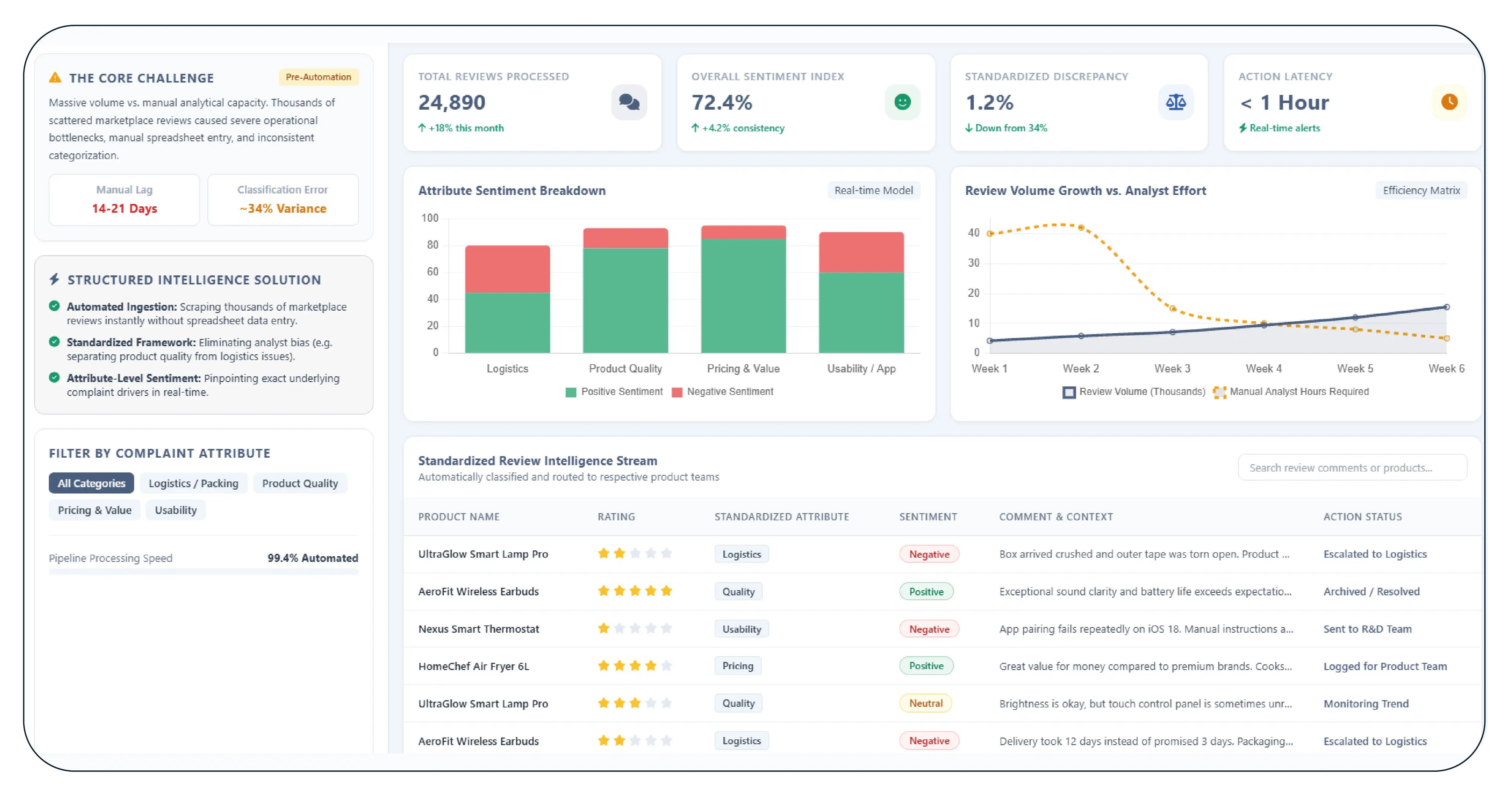
The client's biggest challenge was the gap between the volume of customer feedback and the organization's ability to analyze it efficiently. Thousands of reviews could be generated across products and marketplaces, but the existing workflow depended heavily on manual collection and interpretation.
Analysts had to locate reviews, copy information into spreadsheets, standardize product names, review ratings, check duplicates, and manually identify recurring complaints. This created operational bottlenecks and made the process difficult to scale as the catalogue expanded.
Another issue was inconsistency. Different analysts could classify similar comments differently. One reviewer might categorize "poor packing" as a product-quality issue, while another might classify it as a logistics problem. Without a standardized framework, historical comparisons became difficult.
The lack of timely analysis also created a business risk. When negative feedback increased around a product, the issue might not be visible until a periodic report was prepared. By that stage, product teams could already have missed an opportunity to investigate the underlying problem.
The project therefore required more than automated collection. It required a structured intelligence pipeline capable of preserving product context, standardizing review information, identifying sentiment, and making patterns searchable.
Review Data Scraping and Sentiment Analysis became the central solution area. The workflow needed to distinguish overall sentiment from specific product attributes so that teams could understand not only whether customers were unhappy, but why.
The challenge was ultimately one of scale, consistency, speed, and actionability. The client needed a system that could process growing review volumes without proportionally increasing manual analytical effort.
Our Solution
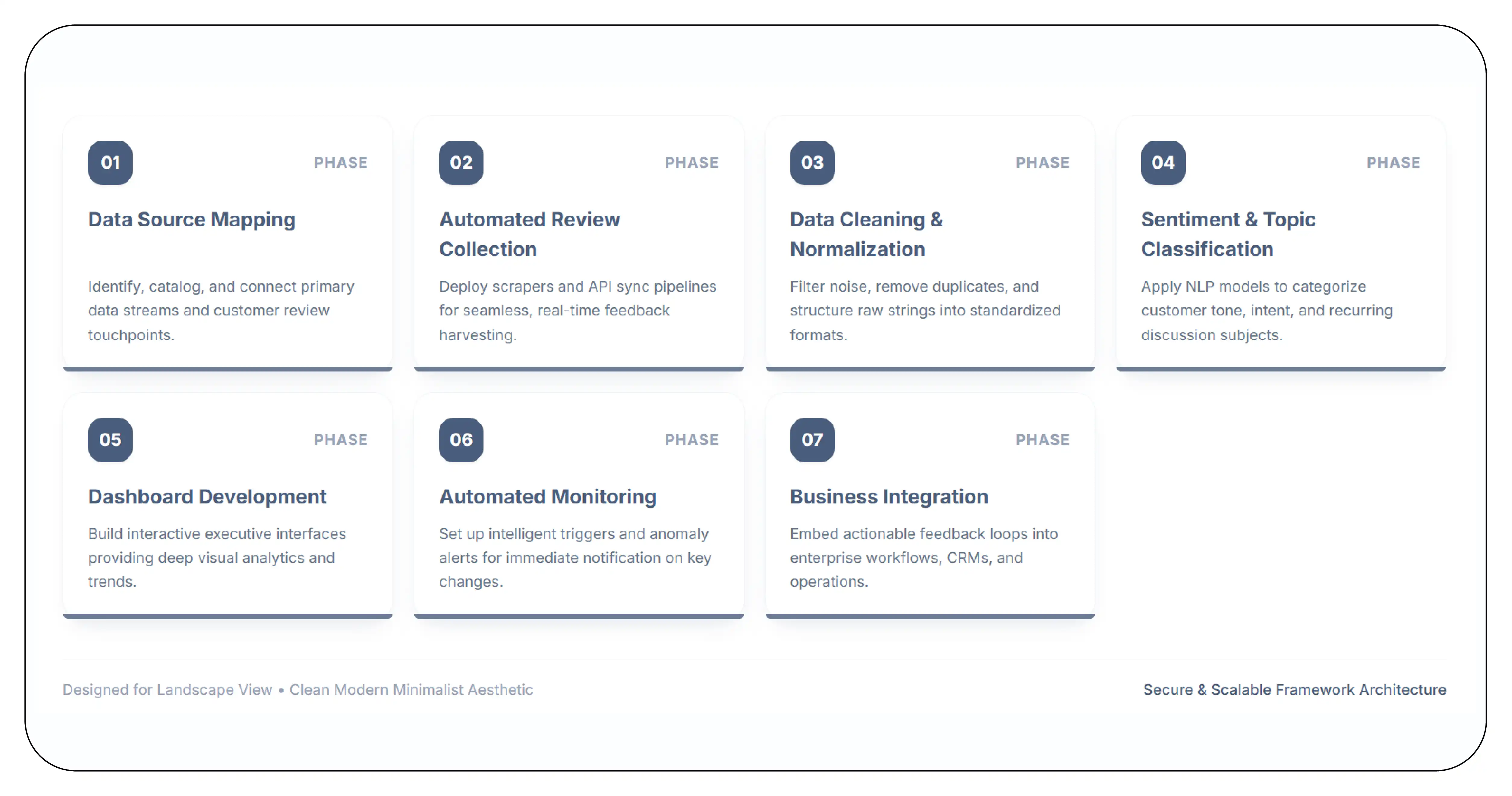
The solution was implemented through a phased data and analytics workflow designed to address collection, processing, classification, visualization, and monitoring separately.
Phase 1: Data Source Mapping
The first phase identified relevant review sources, product categories, marketplace structures, and required fields. Product identifiers, review IDs, ratings, review text, dates, product variants, and platform information were mapped into a standardized schema. This created a common data model that could accommodate differences between sources.
Phase 2: Automated Review Collection
Automated collection workflows were established to capture new and historical review records at defined intervals. The system was designed to preserve timestamps and product relationships so that each observation could be used for trend analysis. This reduced repetitive manual collection and established a more consistent refresh cycle.
Phase 3: Data Cleaning and Normalization
Raw review records were processed through validation and normalization rules. Duplicate records were identified, incomplete fields were flagged, product names were standardized, and rating formats were converted into a common structure. The objective was to ensure that downstream analytics worked from consistent records rather than fragmented source formats.
Phase 4: Sentiment and Topic Classification
Review text was processed to identify sentiment and recurring themes. Positive, neutral, and negative classifications were combined with topic-level categories such as product quality, packaging, delivery experience, value for money, durability, product features, size and fit, usability, and customer service. Aspect-level analysis was particularly important. A single review could contain both positive and negative observations. The workflow therefore allowed individual product attributes to carry separate sentiment signals.
Phase 5: Dashboard Development
The processed dataset was connected to an interactive reporting layer. Users could filter information by product, category, rating, sentiment, review period, and issue type. The Review Data Dashboard for Retail Intelligence provided management with a consolidated view instead of requiring analysts to inspect multiple spreadsheets.
Phase 6: Automated Monitoring
Monitoring rules were introduced to identify unusual movements, including sudden increases in negative reviews, rating deterioration, emerging complaint categories, and significant changes in sentiment. For example, if negative comments relating to packaging increased substantially over a defined period, the dashboard could flag the category for investigation.
Phase 7: Business Integration
The final workflow was designed to support product, merchandising, customer experience, and competitive intelligence teams. Historical records were retained so teams could compare current sentiment with previous periods.
The resulting architecture transformed review information from a manually maintained research activity into a repeatable intelligence workflow. Instead of asking analysts to find problems manually, the system prioritized the signals most likely to require attention.
Results & Key Metrics
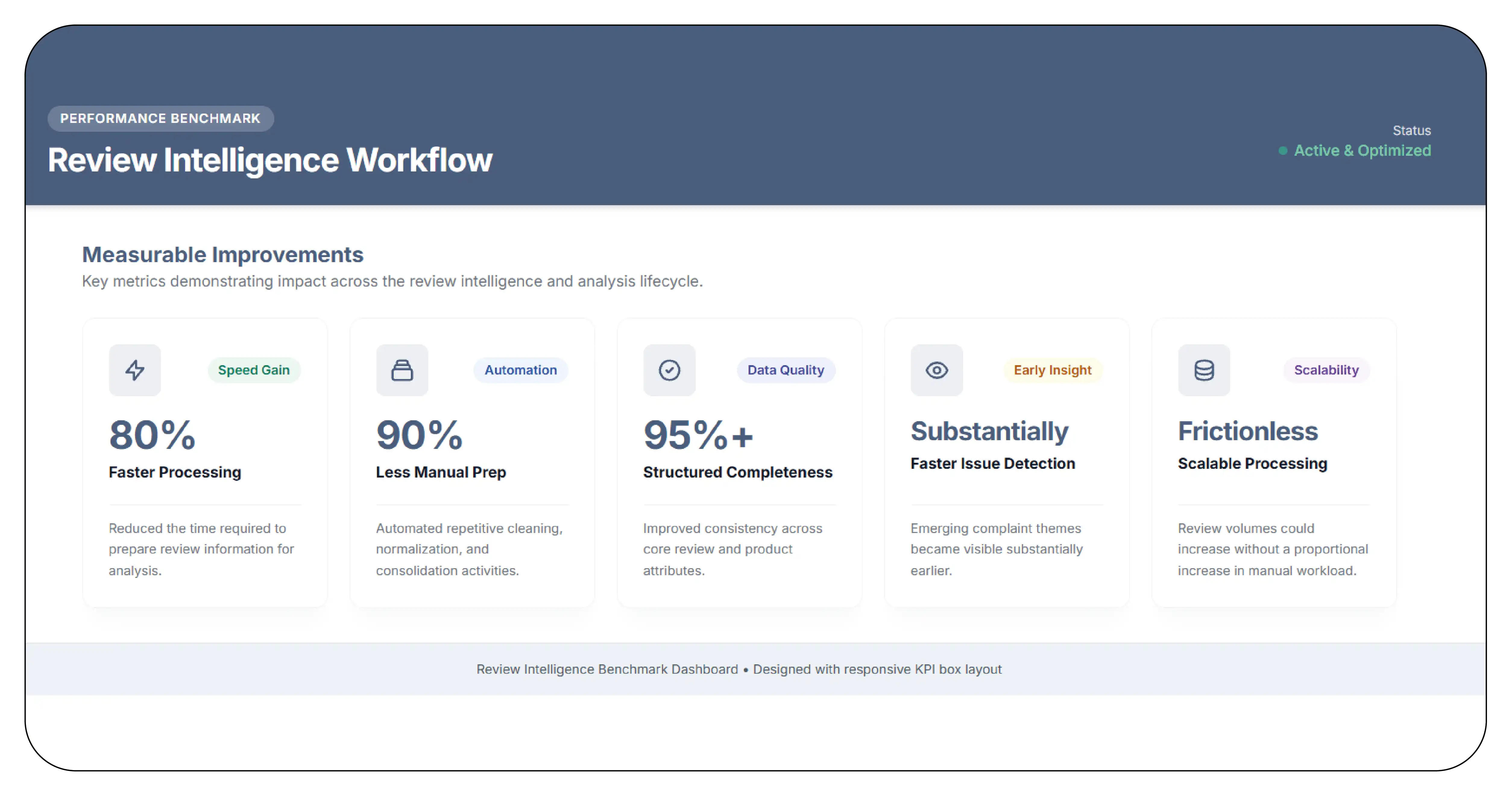
The project benchmarks demonstrated measurable improvements across the review intelligence workflow:
80% faster processing: Reduced the time required to prepare review information for analysis.
90% less manual preparation: Automated repetitive cleaning, normalization, and consolidation activities.
95%+ structured-field completeness: Improved consistency across core review and product attributes.
Faster issue detection: Emerging complaint themes became visible substantially earlier.
Scalable processing: Review volumes could increase without a proportional increase in manual analytical workload.
These improvements strengthened the client's ability to use Consumer Sentiment Data Scraping Services as an ongoing intelligence capability rather than a periodic research exercise.
Results Narrative
The biggest improvement was the shift from reactive review analysis to continuous customer intelligence. Teams no longer needed to wait for manually prepared reports before identifying recurring product concerns.
The dashboard allowed users to move from high-level ratings to specific sentiment drivers. A declining rating could be investigated by examining the topics generating negative feedback, while strong positive themes could be identified for merchandising or marketing consideration.
The workflow also improved cross-functional collaboration. Product teams could investigate quality issues, category teams could evaluate products, and customer-experience teams could prioritize recurring complaints using the same underlying dataset.
Most importantly, the system created a historical evidence base. Instead of treating every review as an isolated comment, the organization could analyze changes in sentiment over time and identify emerging customer trends earlier.
What Made Product Data Scrape Different
The key differentiator was the combination of automated collection, structured normalization, sentiment classification, and business-focused visualization within a single workflow.
Rather than treating review scraping as a standalone extraction task, Product Data Scrape designed the process around the questions business users needed to answer. Product-level relationships were preserved throughout the pipeline, allowing review signals to remain connected to brands, categories, variants, and time periods.
Smart automation reduced repetitive analyst work while validation rules helped maintain data consistency. Topic-based sentiment analysis added another layer of intelligence by explaining the reasons behind positive or negative feedback.
The framework also supported historical monitoring, allowing organizations to identify changes instead of viewing reviews as isolated snapshots.
Client's Testimonial
"Before the project, our teams had access to a large amount of customer feedback, but turning that information into timely business insight was difficult. The new workflow gave us a much clearer view of what customers were saying about individual products and categories.
The dashboard made it easier to identify recurring complaints, understand sentiment drivers, and prioritize issues without manually reviewing large volumes of comments. We particularly valued the ability to compare sentiment over time and move from overall ratings to specific customer concerns.
The automated workflow also reduced repetitive data preparation and gave our teams more time to focus on interpretation and action. The solution has become a useful component of our broader customer and product intelligence process."
— Head of Consumer Insights, E-commerce & Retail
Conclusion
Customer reviews become significantly more valuable when businesses can collect, structure, classify, and monitor them continuously. Review Data Scraping provides the foundation for transforming unstructured customer feedback into measurable signals, while Consumer Insights Dashboard Using Review Data makes those signals accessible to business teams.
The project demonstrated how automation can reduce manual effort while improving visibility into customer sentiment, recurring product issues, and emerging trends. Historical review intelligence also creates opportunities for better product decisions, merchandising, customer experience, and competitive benchmarking.
For organizations managing large product catalogues, the objective should be to identify customer signals before they become widespread problems.
Partner with Product Data Scrape to build a scalable review intelligence workflow and turn customer feedback into faster, data-driven business decisions!
FAQs
1. What does a consumer insights dashboard using review data provide?
It consolidates ratings, review text, sentiment, product information, and recurring themes into one analytical interface, helping teams identify customer preferences, complaints, trends, and product opportunities.
2. How can review scraping improve customer intelligence?
Automated review collection enables businesses to process larger volumes of feedback consistently, preserve historical observations, identify recurring themes, and monitor changes in customer sentiment over time.
3. Can sentiment analysis identify specific product problems?
Yes. Aspect-level analysis can connect sentiment with topics such as packaging, quality, delivery, durability, pricing, usability, or product features, making customer feedback more actionable.
4. How does the dashboard help retail and e-commerce teams?
Teams can filter feedback by product, category, rating, sentiment, date, and issue type. This helps prioritize complaints, benchmark products, identify trends, and support merchandising decisions.
5. Can Product Data Scrape support large-scale review intelligence?
Yes. Product Data Scrape can support automated review collection, structured data processing, sentiment workflows, historical storage, and dashboard-ready datasets for organizations managing large product catalogues.


 Singapore
 EMAIL
 PHONE











.webp)