Introduction
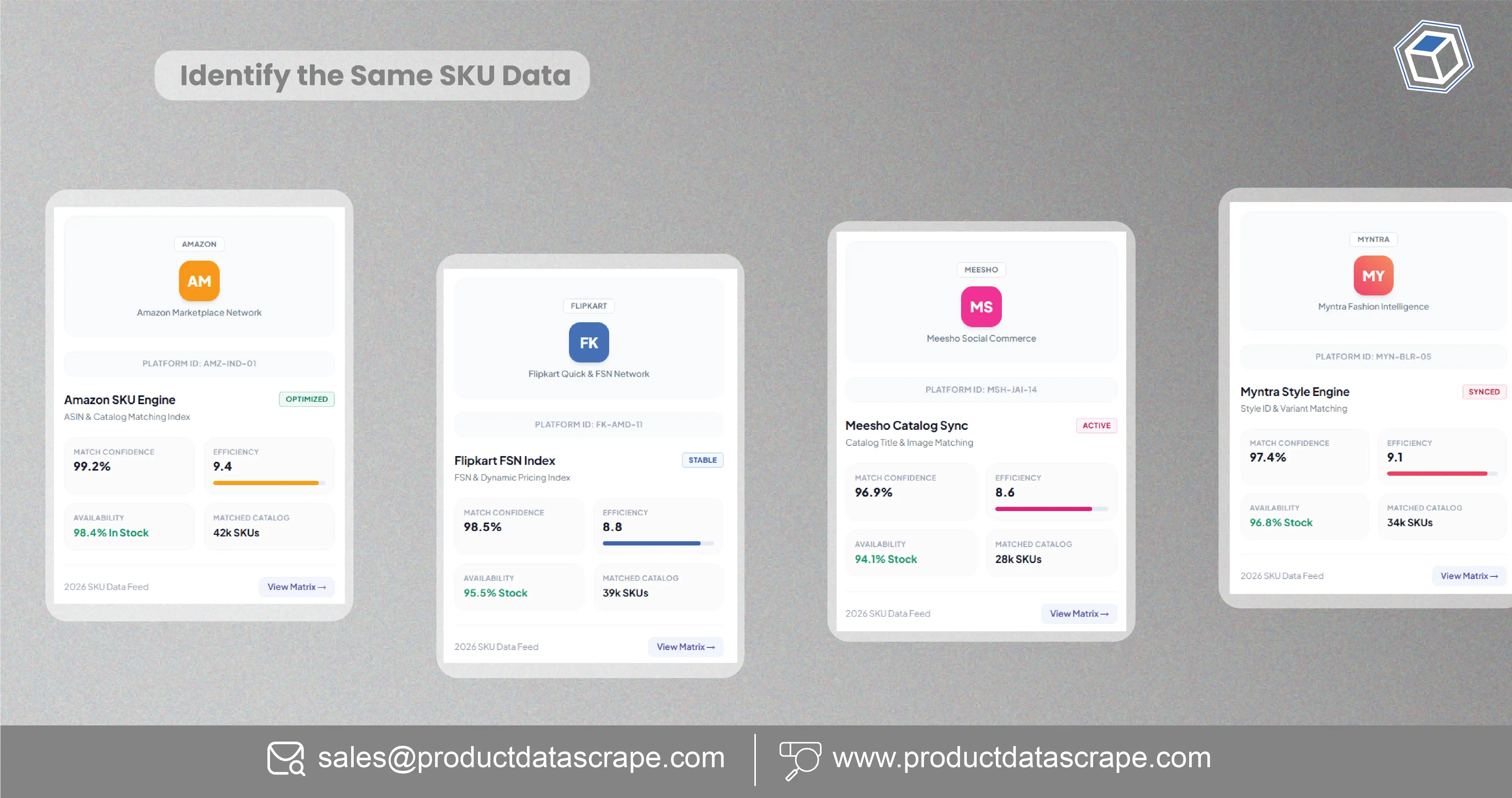
Identifying the same product across Amazon, Flipkart, Meesho, and Myntra requires more than comparing product titles. An ecommerce product matching API combines identifiers such as GTIN, barcode, brand, model number, product attributes, and listing information to connect equivalent products across marketplaces. This helps retailers, manufacturers, brands, and e-commerce analytics companies reduce duplicate records and improve cross-platform price comparisons.
The challenge is that marketplaces use different catalog structures, product identifiers, seller references, and listing formats. The same physical product may have different titles, descriptions, images, or seller-specific SKUs across platforms. Matching these records manually becomes difficult when businesses manage large catalogs.
Barcode and GTIN Matching provides a strong starting point because standardized product identifiers help establish product identity. However, identifiers are not always available or correctly populated. Businesses therefore need additional matching signals, including brand, model, size, color, pack quantity, and product specifications.
A reliable matching workflow combines identifier-based verification with attribute comparison, duplicate detection, and confidence scoring. The objective is to create a standardized product view that allows businesses to compare equivalent items rather than unrelated listings.
For multi-marketplace retailers, this approach supports better catalog management, competitive price intelligence, product research, and inventory analysis.
Why Is Identifying Equivalent Products Across Marketplaces Difficult?
Cross-marketplace product identification is challenging because individual marketplaces maintain their own product catalogs and listing structures. A brand may publish the same product on multiple platforms, but the information presented to shoppers can differ.
For example, a product title may contain a brand name and model number on one marketplace, while another listing may emphasize color, material, or product benefits. Seller-specific SKU codes may also differ even when the physical product is identical.
Cross-Platform Product Matching Scraping helps collect permitted product information from multiple marketplace sources and organize it into a common structure. Instead of comparing disconnected listings, businesses can evaluate products using standardized fields such as brand, model, GTIN, category, size, color, and pack quantity.
A Modular Product-Detail Scraper for E-commerce Sites can support this process by extracting relevant product attributes through configurable collection modules. Separate modules can handle titles, prices, specifications, product identifiers, and listing URLs. This makes it easier to maintain different extraction requirements for different sources.
Important matching challenges include:
- Different product naming conventions across marketplaces.
- Missing or inconsistent GTIN and barcode information.
- Different seller SKUs for the same product.
- Variations in product sizes, colors, and pack quantities.
- Similar product images belonging to different models.
- Inconsistent category and attribute structures.
The matching process should distinguish an identical product from a similar product. For instance, two products may share the same brand and product family but have different capacities or pack sizes. Treating them as identical can distort price comparisons and inventory analysis.
Businesses should therefore use a hierarchy of matching signals. Verified identifiers should receive priority, followed by model numbers and structured attributes. Product titles and images can provide additional evidence, but should not independently establish an exact match when important specifications differ.
How Do Marketplace Identifiers Help Connect Product Listings?
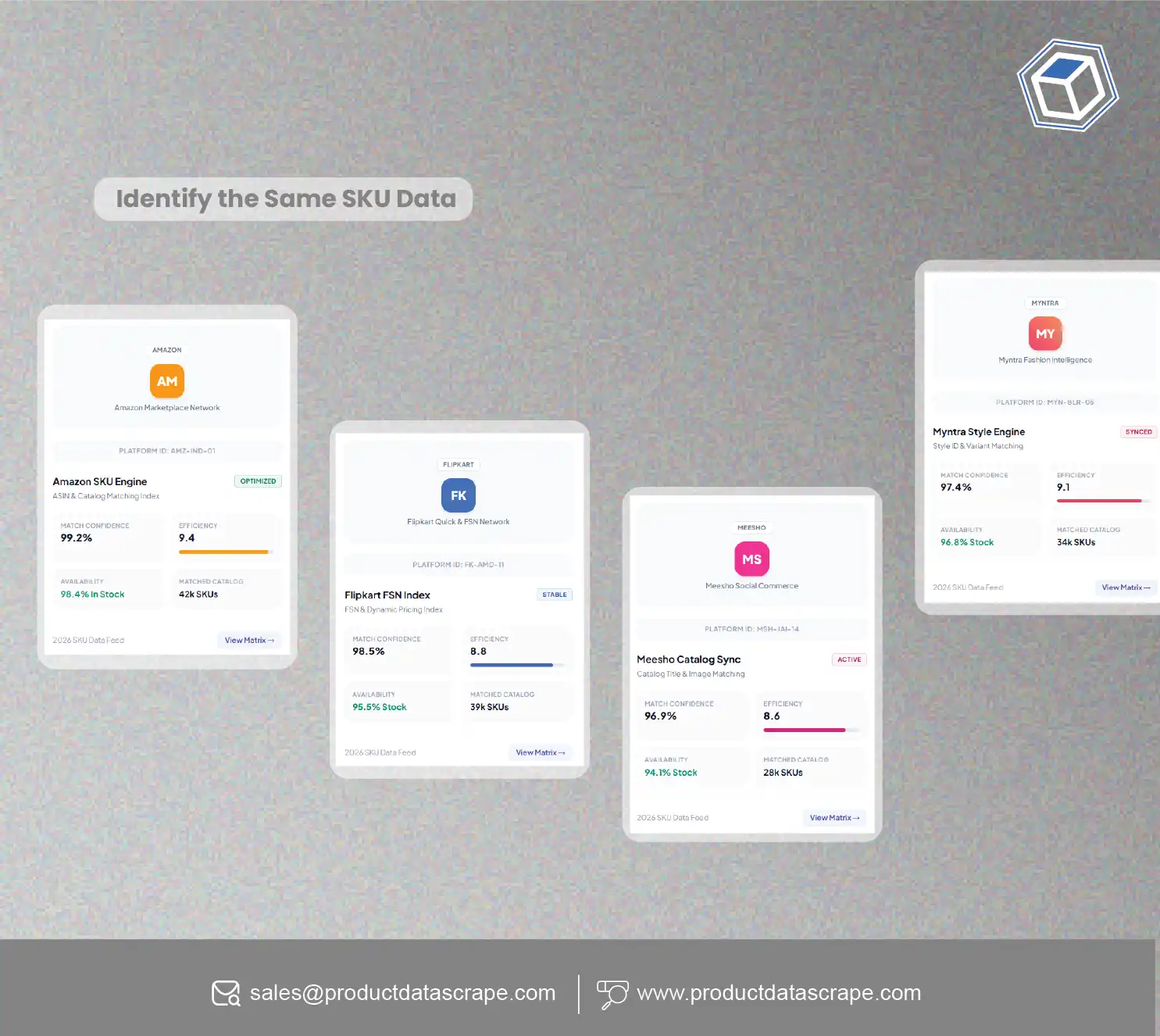
Amazon, Flipkart, Meesho, and Myntra may represent products through different catalog identifiers. Businesses must understand the difference between a product identity, a marketplace catalog identifier, and a seller-specific SKU.
Amazon Flipkart Meesho Myntra Product Matching should not assume that one platform's SKU can directly identify the same product on another platform. A seller SKU is often an internal reference, whereas a marketplace product identifier can refer to a catalog record.
Amazon uses ASINs to identify catalog products. It also supports industry-standard identifiers such as UPC, EAN, and GTIN for product identification. Amazon India explains that sellers can search and match existing products using identifiers, product names, model numbers, and brand information.
Flipkart's developer documentation distinguishes between a product identified by an FSN and a listing identified by a listing ID mapped to a seller SKU. This distinction is important when building cross-platform catalog relationships.
A Flipkart scraper can collect permitted listing information, such as product names, identifiers, prices, and attributes, for structured comparison. The resulting records should be mapped to a common internal product identity instead of treating every marketplace listing as a separate physical product.
| Identifier | Purpose | Matching application |
|---|
| GTIN | Global Trade Item Number | Strong product identity signal |
| EAN | European Article Number format | Barcode-based identification |
| UPC | Universal Product Code | Product identification |
| ASIN | Amazon catalog identifier | Amazon catalog reference |
| FSN | Flipkart Serial Number | Flipkart product reference |
| Seller SKU | Seller-defined inventory reference | Seller-level catalog mapping |
| Model number | Manufacturer or brand reference | Product variant comparison |
| Product URL | Marketplace listing reference | Source tracking and verification |
The GS1 system explains that a GTIN uniquely identifies a trade item. However, a GTIN should be checked against the actual product and its packaging. A multipack, individual unit, or different product variation may require a different identifier.
A robust matching database should preserve the original marketplace identifiers alongside a standardized internal product ID. This allows analysts to trace every match back to its original listing.
What Role Does a Standardized Dataset Play in Matching?
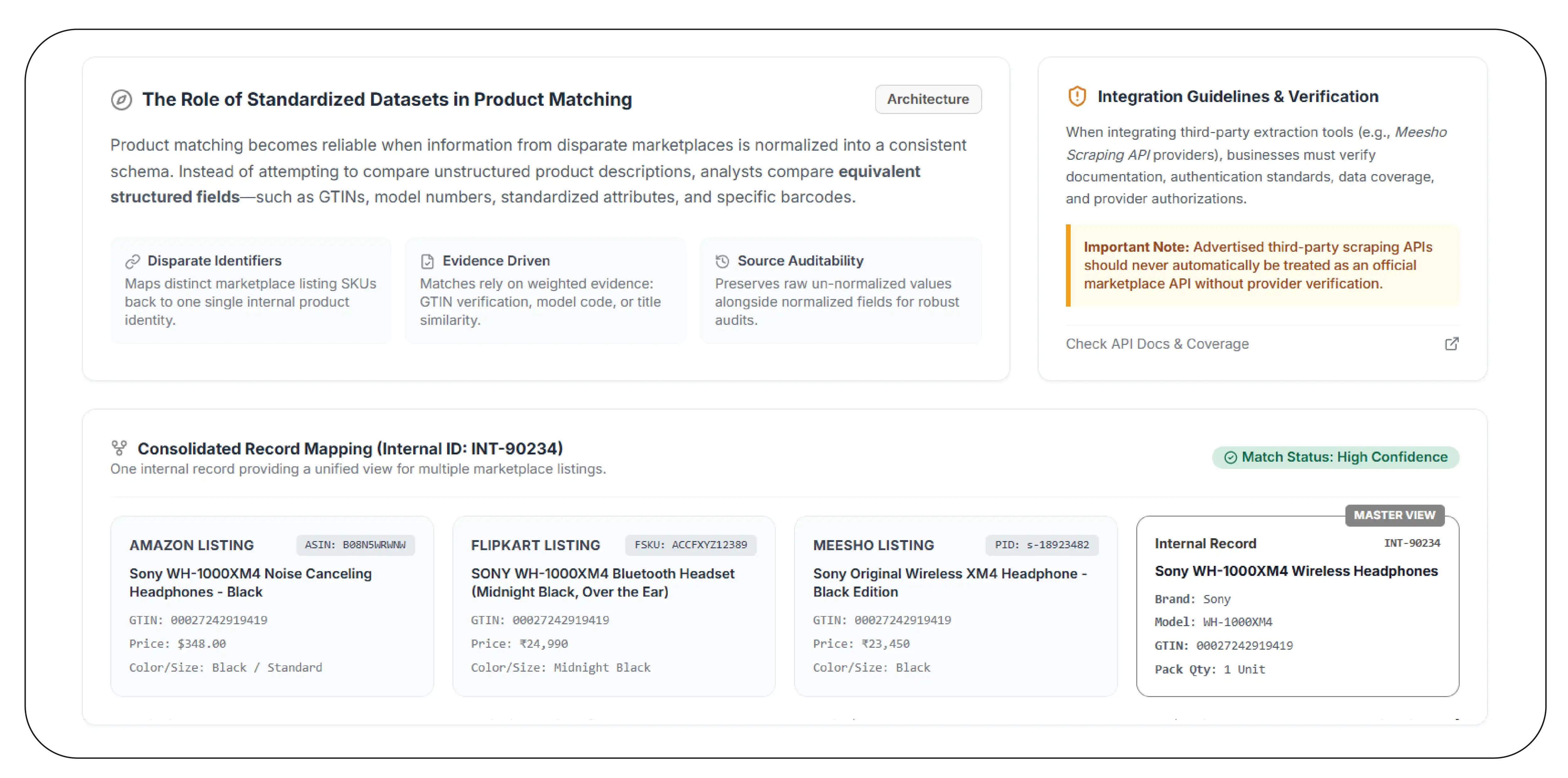
Product matching becomes more reliable when information from different marketplaces is stored in a consistent structure. A standardized dataset allows analysts to compare equivalent fields instead of attempting to match unorganized product descriptions.
A Cross-Platform Product Matching Dataset can contain an internal product ID, marketplace name, marketplace product identifier, seller SKU, GTIN, brand, model, category, product title, attributes, price, and source URL.
For example, one internal product record may be associated with separate marketplace listing references. Each reference retains its original identifier, while the common product record provides a consolidated view of the physical product.
A Meesho Scraping API may be considered when a business has verified access to a suitable API provider and the required fields are supported. Businesses should check documentation, authentication, data coverage, usage restrictions, and provider authorization before relying on such an integration. An advertised third-party API should not automatically be treated as an official Meesho API.
The dataset should also include matching evidence. This can identify whether two listings were connected through a verified GTIN, a matching model number, or a combination of product attributes.
Useful dataset fields include:
- Internal product ID for cross-marketplace grouping.
- Original product title and standardized product title.
- Brand and manufacturer information.
- GTIN, EAN, UPC, and available barcode values.
- Marketplace-specific product and listing identifiers.
- Size, color, material, dimensions, and pack quantity.
- Displayed price and collection timestamp.
- Source URL and data validation status.
- Matching method and confidence score.
A confidence score is useful for separating strong matches from uncertain relationships. An exact verified identifier can provide strong evidence, while a title-only similarity score should generally trigger further verification.
The most important principle is to preserve source information. Analysts should never overwrite original product attributes with normalized values without retaining the original records. Maintaining both versions makes audits, corrections, and future matching improvements easier.
How Can Amazon Product Information Improve Matching Accuracy?
Amazon provides several product identification methods that can help businesses connect catalog entries with existing products. Its seller guidance explains that product IDs such as UPC, EAN, ISBN, and GTIN can be used to find matching catalog products. Sellers can also search using product names, model numbers, and brand information.
Extract Amazon SKU Data workflows should distinguish between the ASIN, seller SKU, and standardized product identifiers. An ASIN represents an Amazon catalog product, whereas a seller SKU identifies an individual seller's inventory reference. These values should not be treated as interchangeable.
An Amazon Product Data Scraper can collect permitted listing attributes for comparison, including product titles, brand names, model numbers, specifications, displayed prices, and product URLs. These attributes can then be mapped to a common product schema.
A practical Amazon matching workflow includes:
- Collect product identifiers and available catalog attributes.
- Normalize brand names, model numbers, and product titles.
- Compare GTIN and barcode values where available.
- Check product specifications and variant attributes.
- Associate verified listings with an internal product ID.
- Flag incomplete or conflicting matches for manual review.
Amazon's Indian seller guidance also explains that a product ID may not be mandatory when an item already exists in its catalog, while a new product generally requires an applicable product identifier unless an exemption applies.
This matters because not every Amazon listing will contain a publicly visible GTIN. A matching system should therefore support multiple identification methods without assuming that missing identifiers indicate different products.
The final dataset should preserve ASINs, seller SKUs, product attributes, and source references separately. This gives businesses a traceable foundation for matching Amazon listings with equivalent products on other marketplaces.
How Can Flipkart Listings Be Compared With Other Marketplace Records?
Flipkart's product catalog and listing structure provides important distinctions for cross-marketplace data analysis. Its developer documentation explains that a product is identified by an FSN, while a listing contains seller-specific information such as stock, price, and delivery details. The listing is identified by a listing ID mapped to the seller's SKU.
Businesses that Scrape Flipkart Product Data should maintain these identifiers separately. An FSN can help identify a catalog product, while the seller SKU and listing ID provide information about a specific seller's offer.
An ecommerce product matching API can bring Flipkart records together with product information collected from other authorized marketplace sources. The matching process should compare product attributes instead of assuming that different seller SKUs represent different products.
Useful comparison attributes include brand, model, color, size, material, product dimensions, pack quantity, and manufacturer identifiers. Price should be used for commercial comparison only after product identity has been established.
The following table illustrates how a matching workflow should organize source-specific records.
| Marketplace | Source identifier | Supporting matching attributes |
|---|
| Amazon | ASIN and seller SKU | GTIN, brand, model |
| Flipkart | FSN, listing ID, seller SKU | Brand, model, specifications |
| Meesho | Available listing and seller references | Brand, title, attributes, barcode where available |
| Myntra | Available product and listing references | Brand, style code, size, color, product details |
A matching pipeline should first identify potential product relationships, then verify them using available attributes. Listings with conflicting model numbers, sizes, or pack quantities should be separated even when their titles appear similar.
Businesses should also retain the collection date and original source URL. This is especially important when product information changes or a listing becomes unavailable.
The resulting cross-marketplace view can support catalog reconciliation, price benchmarking, and product assortment analysis while preserving the differences between catalog products and seller offers.
How Can Myntra Product Records Be Included in a Unified Catalog?
Fashion catalogs require additional attention because products often have multiple sizes, colors, styles, and seasonal variations. A product family may contain several variants that share a brand and design but differ in commercially important attributes.
Scrape Myntra Cross-Platform Product Data workflows should therefore preserve product-level and variant-level information separately. Brand, style or model references, color, size, material, and product descriptions can help identify equivalent products across marketplaces.
For example, matching two apparel listings using only their brand and title may produce an incorrect result if the garment has a different size, fit, material, or design. A reliable matching workflow must compare variant attributes before treating listings as identical.
An ecommerce product matching API can help standardize available product information and connect records using a common internal identifier. The system should retain original Myntra references and map them to corresponding records from Amazon, Flipkart, and Meesho only when sufficient evidence supports the relationship.
Important fashion matching checks include:
- Brand and product or style reference.
- Garment type and product category.
- Size and fit information.
- Color and pattern.
- Fabric or material composition.
- Pack quantity and product configuration.
- Product images and descriptive attributes.
Image similarity can help identify candidate matches, but it should not replace structured attribute verification. Visually similar garments may have different materials, designs, or model references.
A unified fashion catalog should also distinguish between a parent product and its individual variants. This allows businesses to compare equivalent sizes and colors without combining different variants into one inaccurate record.
For retailers and fashion brands, this structured approach can improve product catalog reconciliation, cross-platform price comparisons, and assortment analysis. It also creates a consistent foundation for tracking changes in marketplace product information over time.
What Do Market Growth Figures Tell Businesses About Product Matching?
The expansion of online commerce increases the importance of accurate catalog organization. The following figures from the India Brand Equity Foundation (IBEF) provide a market-level perspective. They are market estimates and forecasts, not measurements of product-matching API adoption.
| Year | Indian e-commerce market (US$ billion) | Data status |
|---|
| 2020 | Not included in this comparable series | Not reported |
| 2021 | 67 | Reported estimate |
| 2022 | 84 | Reported estimate |
| 2023 | 102 | Reported estimate |
| 2024 | 125 | Reported estimate |
| 2025 | 145 | Forecast |
| 2026 | 163 | Forecast |
Source: IBEF, Indian E-commerce Industry Infographics, August 2025. Forecasts are not actual realized market results. View the IBEF report.
The figures indicate the growing scale of India's e-commerce market. For businesses operating across multiple marketplaces, this makes consistent product identification an important data-management consideration.
The figures should not be interpreted as evidence that every marketplace has experienced identical growth or that product matching demand has increased at the same rate.
What should businesses take away?
- Maintain a common product identity across sales channels.
- Preserve marketplace-specific identifiers.
- Separate product variants from parent products.
- Validate product attributes before comparing prices.
- Retain historical observations for trend analysis.
- Review uncertain matches before using them in reports.
The objective is to make product information consistent and traceable as businesses expand their marketplace coverage.
Why Choose Product Data Scrape?
Product Data Scrape helps businesses organize marketplace information into structured, comparable datasets. Its services support Meesho Marketplace Product Matching Data Extraction, product attribute collection, catalog normalization, duplicate identification, and cross-platform data analysis. With an ecommerce product matching API, businesses can establish common product references and connect relevant marketplace records. The approach focuses on data quality, source traceability, and customized field requirements. Whether a business needs product catalog reconciliation or competitive price intelligence, Product Data Scrape can help plan a suitable data collection and matching workflow based on available sources and authorized access.
Conclusion
Identifying the same product across Amazon, Flipkart, Meesho, and Myntra requires standardized identifiers, structured attributes, and reliable validation. GTINs and barcodes provide strong identification signals, while brand, model, size, color, and product specifications help resolve incomplete records. A Myntra Product Data Scraping API or another authorized marketplace data integration can contribute source information to a unified catalog. An ecommerce product matching API can then connect verified records and support more accurate product comparisons.
Ready to improve your cross-marketplace product intelligence? Contact Product Data Scrape to discuss a customized product matching solution and build a more consistent, reliable e-commerce catalog!
FAQs
1. What is cross-marketplace product matching?
It is the process of identifying identical products listed across different marketplaces using product identifiers, brand names, model numbers, specifications, and other matching attributes.
2. Why are GTINs important for product matching?
GTINs provide standardized product identification. They help businesses connect equivalent products across marketplaces while reducing dependence on inconsistent product titles and seller-specific SKU references.
3. Can different marketplace SKUs represent the same product?
Yes. Seller-specific SKUs can differ across marketplaces even when listings represent the same physical product. Additional identifiers and product attributes help establish equivalence.
4. How does an API improve product matching?
An API can automate data exchange, standardize product records, connect matching identifiers, and integrate verified marketplace information into business databases and analytics systems.
5. How can Product Data Scrape support catalog matching?
Product Data Scrape can help businesses collect, normalize, validate, and organize authorized marketplace product information for cross-platform catalog matching and competitive analysis.


 Singapore
 EMAIL
 PHONE












.webp)