Introduction
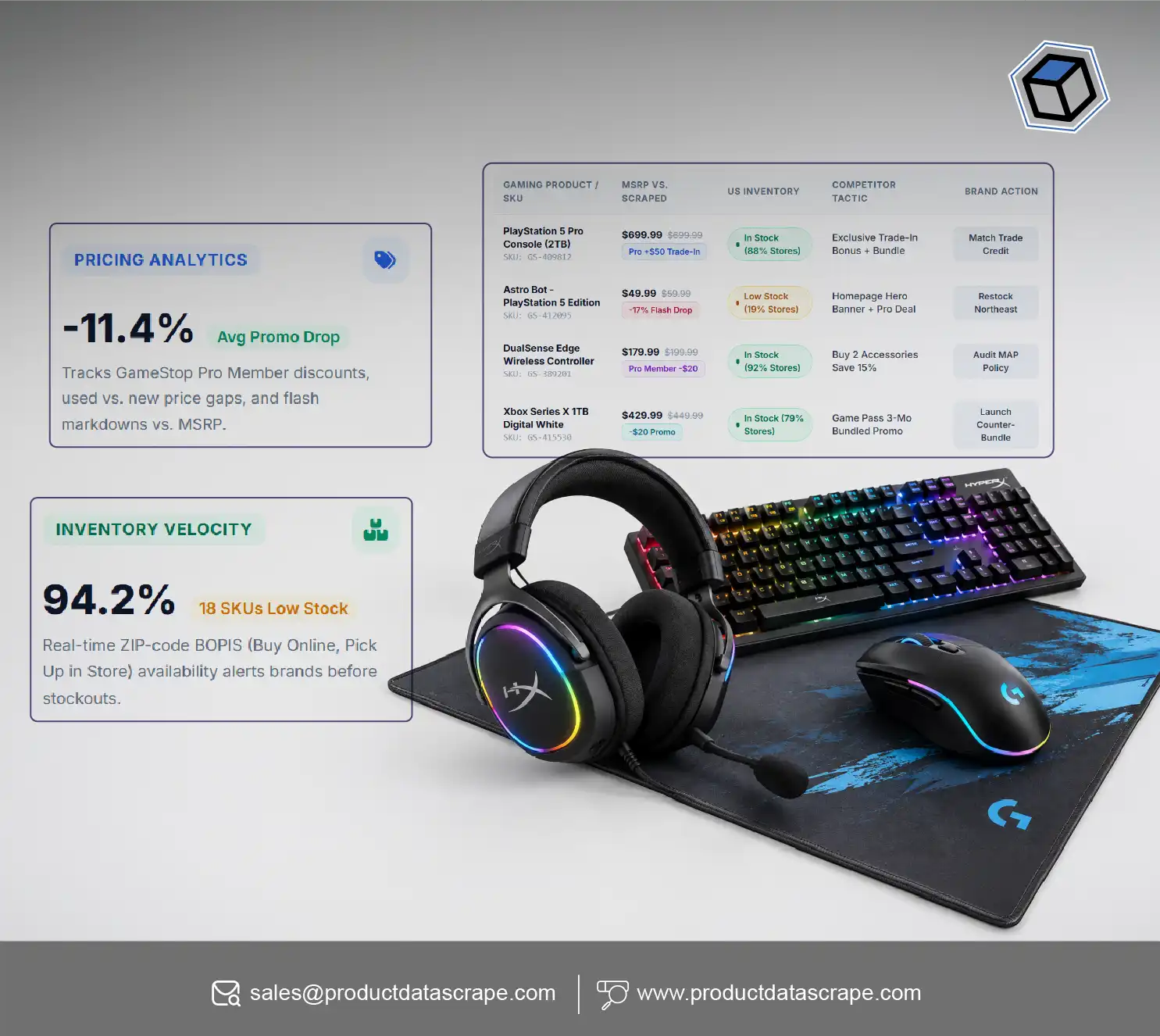
Gaming brands operate in a competitive retail environment where product prices, inventory levels, promotional campaigns, and customer demand change frequently. Monitoring these changes helps retailers make informed decisions, improve product positioning, and identify new revenue opportunities. US GameStop Gaming Product Scraping helps businesses collect structured information about gaming consoles, video games, controllers, headsets, accessories, collectibles, and pre-owned products listed on GameStop's US website.
By analyzing product names, SKUs, prices, discounts, availability, product categories, and listing changes, businesses can understand competitor strategies and identify market opportunities. This information is especially valuable for gaming manufacturers, e-commerce retailers, distributors, and market research companies.
The gaming market also offers substantial opportunities. According to the Entertainment Software Association (ESA), US consumer spending on video games reached $59.3 billion in 2024, including content, hardware, and accessories. Such market activity makes consistent product intelligence important for businesses competing across online and offline retail channels.
Toys & Games Data Scraping further supports market research by organizing product information into comparable datasets. Businesses can use these insights to evaluate pricing differences, monitor product availability, identify popular categories, and improve retail strategies.
How Can Gaming Accessories Be Compared Across Different Product Listings?
Gaming accessories are an important part of the gaming retail ecosystem. Controllers, gaming headsets, charging stations, keyboards, mice, cables, and storage devices serve different customer requirements and price segments. Brands need reliable product information to understand how competing retailers position these products.
GameStop Gaming Accessories Scraping helps collect relevant listing attributes, including product names, brands, model numbers, platform compatibility, specifications, prices, promotional offers, and availability. This information allows retailers to compare similar products across categories and identify differences in product positioning.
An important step is Product matching. Different retailers may describe the same accessory using slightly different product names, abbreviations, or manufacturer references. Matching products through UPCs, GTINs, model numbers, brand names, and specifications helps reduce duplicate records and incorrect comparisons.
For example, a gaming headset listed with a manufacturer model number can be matched against the same model on another retail website, even when its product title differs. Businesses can then compare its selling price, discount, features, and stock status.
The following market figures demonstrate why accessory intelligence deserves attention.
| Year | US gaming accessories spending |
|---|
| 2023 | $3.0 billion |
| 2024 | $3.2 billion |
| 2025 | $2.9 billion |
Source: ESA and Circana. Figures are rounded; 2025 reflects the revised reported figure.
For gaming brands, these insights support assortment planning, accessory bundling, competitive benchmarking, and identifying products that need better pricing or positioning.
Why Should Retailers Monitor Product Prices Frequently?
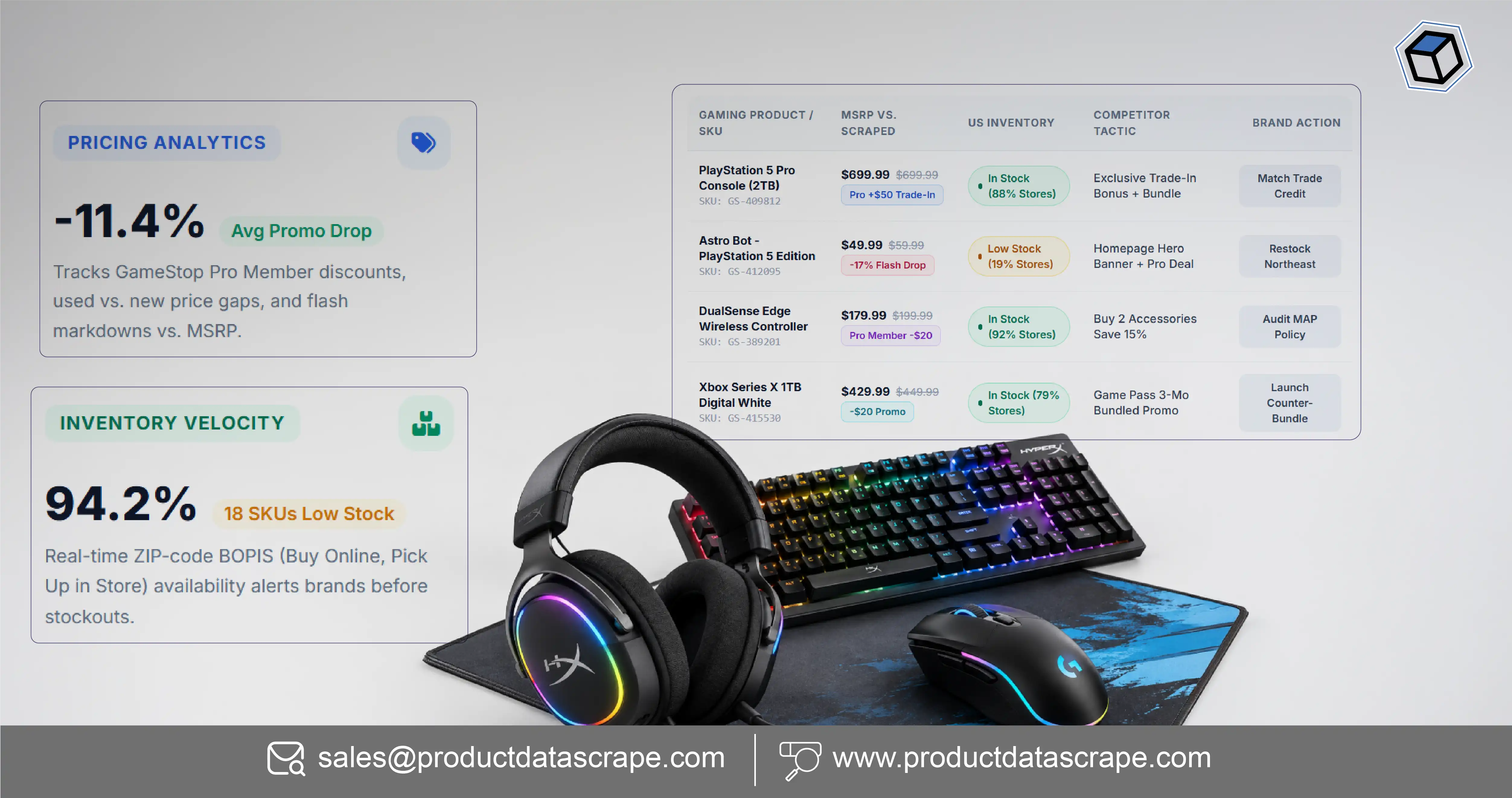
Gaming product prices can change because of new console releases, seasonal promotions, product launches, clearance campaigns, and competitive pricing decisions. A product that sells at its regular price today may receive a promotional discount tomorrow.
GameStop Product-Wise Price Monitoring helps businesses track these changes at the individual product level. Instead of reviewing broad category averages, retailers can examine the price history of specific consoles, games, controllers, headsets, and accessories.
The collected information can include:
- Original listed price and current selling price.
- Discount amount and percentage, where displayed.
- Product identifiers and manufacturer details.
- Promotional labels and bundle information.
- Availability and listing status.
- Price changes across different observation dates.
This information supports Competitive pricing data analysis by allowing businesses to compare equivalent products across retailers. Product matching should happen before calculating price differences because comparing different models or product conditions can produce misleading results.
Historical market figures also provide useful context for pricing decisions.
| Year | US total video game consumer spending |
|---|
| 2020 | $55.9 billion |
| 2021 | $59.3 billion |
| 2022 | $56.5 billion |
| 2023 | $57.2 billion |
| 2024 | $59.3 billion |
| 2025 | $60.8 billion |
| 2026 | $62.8 billion forecast |
Sources: ESA historical industry figures and revised 2024–2025 spending; Circana's February 2026 market forecast. The 2026 figure is a forecast, not a completed-year result.
Retailers can use these observations to evaluate discount strategies, identify unusual price movements, and determine whether their products remain competitively positioned. Regular monitoring also helps identify pricing opportunities before major promotional periods.
What Can Historical Product Records Reveal About Gaming Retail Trends?
Historical product information helps businesses understand how gaming retail categories change over time. Tracking product listings across multiple observation periods can reveal changes in assortment, pricing, promotional activity, and product availability.
A structured GameStop Gaming Retail Price Dataset can contain product identifiers, category names, listed prices, discounts, brands, condition information, and availability records. These fields help analysts compare product performance across different time periods.
For example, gaming retailers can examine whether a particular console category experiences more frequent promotional activity during holiday shopping periods. They can also investigate whether older gaming accessories remain listed after newer models enter the market.
US GameStop Gaming Product Scraping supports this process by collecting product-level information from publicly accessible listings and organizing it into a consistent format. Historical snapshots are especially useful because a single current listing cannot explain how a product's price or availability has changed.
Consider the following publicly reported market data:
| Year | Total US video game spending |
|---|
| 2020 | $55.9 billion |
| 2021 | $59.3 billion |
| 2022 | $56.5 billion |
| 2023 | $57.2 billion |
| 2024 | $59.3 billion |
| 2025 | $60.8 billion |
| 2026 | $62.8 billion forecast |
These figures represent the broader gaming industry, not GameStop-specific revenue.
GameStop's own financial reporting also provides useful category-level context. Its fiscal 2025 annual report recorded $1,840.4 million in hardware and accessories sales, $729.3 million in software sales, and $1,060.2 million in collectibles sales.
Combining historical market information with product-level observations helps brands understand category movements, improve assortment planning, and develop more informed retail strategies.
How Can Exclusive and Collectible Products Be Tracked?
Limited-edition gaming products and exclusive merchandise can attract collectors and customers looking for products that are not widely available. These products may include special-edition controllers, character merchandise, exclusive game editions, collectible figures, and branded accessories.
GameStop Limited Edition Product Scraping helps businesses identify and organize product listings that carry exclusive, special-edition, or collector-focused labels.
GameStop maintains an official Only at GameStop product section featuring exclusive merchandise and selected gaming products. Its listings demonstrate the importance of tracking product exclusivity as a separate attribute rather than treating every item as a standard retail product.
Brands and retailers can collect information such as:
- Product title and manufacturer.
- Exclusive or limited-edition designation.
- Product category and platform compatibility.
- Listed price and promotional details.
- Release date, when published.
- Product description and visible specifications.
- Availability and listing status.
This information can help market researchers compare exclusive merchandise with standard product alternatives. Retailers can also identify which categories receive exclusive product placements and evaluate how these listings change over time.
However, a product labeled exclusive should not automatically be classified as scarce or high-demand. Actual scarcity, customer demand, and resale value require separate evidence.
A useful dataset should preserve the original product description and capture the date when each listing was observed. This makes it easier to distinguish discontinued listings, temporarily unavailable products, and products that remain actively offered.
For gaming brands, these records can support collectible assortment planning, product launches, merchandising decisions, and competitor research without relying on assumptions about customer demand.
How Does Store-Level Availability Help Improve Inventory Decisions?
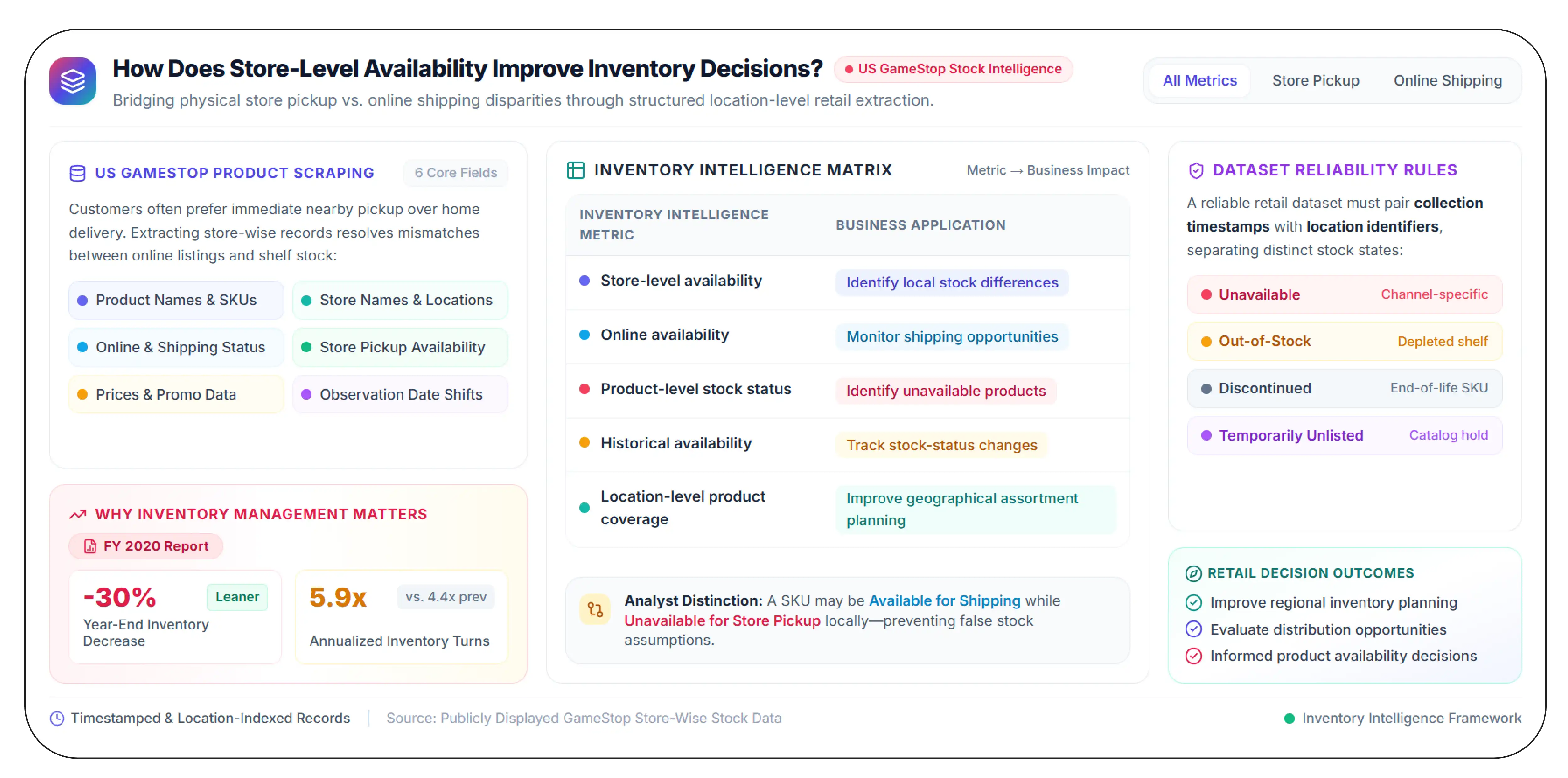
Product availability is an important factor in gaming retail because customers may prefer purchasing products from nearby stores rather than waiting for home delivery. However, online availability and physical store inventory are not always identical.
Extract GameStop Store-Wise Stock Data helps retailers collect publicly displayed location-level availability information, where GameStop makes it accessible. Businesses can organize these records to understand differences between online listings and individual store availability.
US GameStop Gaming Product Scraping can support this process by collecting:
- Product names, SKUs, and identifiers.
- Store names and publicly displayed locations.
- Online availability and shipping status.
- Store pickup availability, where displayed.
- Product prices and promotional information.
- Availability changes across observation dates.
For inventory analysts, these records provide a way to identify geographical differences in product availability. For example, a product may appear available for shipping but unavailable for pickup at a particular location. Recording these distinctions prevents businesses from treating every availability status as identical.
GameStop's financial reporting highlights why inventory management matters. Its fiscal 2020 results reported a 30% decrease in year-end inventory and annualized inventory turns of 5.9 times, compared with 4.4 times in the previous year.
| Inventory intelligence metric | Business application |
|---|
| Store-level availability | Identify local stock differences |
| Online availability | Monitor shipping opportunities |
| Product-level stock status | Identify unavailable products |
| Historical availability | Track stock-status changes |
| Location-level product coverage | Improve geographical assortment planning |
A reliable dataset should include collection timestamps and location identifiers. Businesses should also distinguish between unavailable, out-of-stock, discontinued, and temporarily unlisted products whenever the source provides enough information.
These insights help retailers improve inventory planning, evaluate distribution opportunities, and make more informed decisions about product availability.
What Can Trade-In Listings Reveal About the Pre-Owned Gaming Market?
The pre-owned gaming market creates opportunities for retailers to serve customers looking for more affordable gaming products. Trade-in programs also allow customers to exchange eligible products for cash or store credit, depending on the retailer's terms.
GameStop Trade-In Product Data Scraping helps businesses study publicly available information about eligible trade-in categories, estimated values, product conditions, and related offers.
GameStop's official trade-in page lists eligible categories such as video games, consoles, controllers, smartphones, tablets, and other technology products. It also explains that customers can receive cash or trade credit for eligible items.
Relevant data fields can include:
- Product names and model identifiers.
- Eligible trade-in categories.
- Published estimated trade-in values.
- Cash and store-credit options, where displayed.
- Product condition requirements.
- Promotional trade-in offers.
- Date and time of value collection.
One important consideration is the difference between estimated online values and final in-store trade-in offers. GameStop explains that online values are estimates and that the final value is determined after the product is inspected in-store.
How It Works :
Retailers can use this information to understand the relationship between new-product pricing and pre-owned market positioning. They can also compare trade-in estimates with publicly listed prices for pre-owned products, provided the products have comparable specifications and conditions.
| Data category | Analytical purpose |
|---|
| New-product price | Establish retail price reference |
| Pre-owned listing price | Compare used-product positioning |
| Trade-in estimate | Understand published exchange values |
| Product condition | Separate comparable product grades |
| Promotional trade-in offer | Track additional incentives |
Historical trade-in records can help analysts identify changes in estimated values over time. However, an estimated trade-in price should never be treated as a guaranteed resale value or final transaction amount.
For gaming retailers, these insights can support used-product assortment decisions, refurbishment planning, pricing research, and competitive benchmarking.
Why Choose Product Data Scrape?
Gaming retailers need structured, accurate, and regularly updated product information to make better commercial decisions. Product Data Scrape helps businesses collect, organize, and analyze gaming product information across relevant retail sources. Its GameStop Product Data Scraping API approach can support structured data delivery, product identification, pricing comparisons, inventory monitoring, and historical tracking. Businesses can define required fields, update frequencies, and delivery formats according to their research requirements. With US GameStop Gaming Product Scraping, brands can build consistent datasets to support competitor analysis, assortment planning, and retail intelligence. Data validation and duplicate management further improve dataset usability.
Conclusion
Gaming brands need reliable market intelligence to understand changing prices, product availability, competitor promotions, and pre-owned product trends. Digital Shelf Analytics helps businesses evaluate product positioning and identify opportunities to improve their retail strategies. By combining historical pricing, store-level availability, accessory information, exclusive merchandise, and trade-in records, retailers can develop a clearer understanding of the competitive landscape. US GameStop Gaming Product Scraping provides a structured approach to collecting these insights and supporting data-driven decisions.
Partner with Product Data Scrape today to build customized gaming product datasets, monitor competitor activities, and strengthen your retail intelligence strategy!
FAQs
1. What is gaming product scraping?
Gaming product scraping collects publicly accessible information about gaming consoles, accessories, video games, prices, discounts, specifications, and availability to support market research and competitor analysis.
2. Why do gaming brands monitor GameStop prices?
Monitoring GameStop prices helps gaming brands understand competitor positioning, identify promotional changes, compare similar products, and make informed pricing decisions across different retail categories.
3. Can store-level inventory information be collected?
Yes, publicly displayed store-level availability can be collected where accessible. Location identifiers and timestamps help businesses compare inventory visibility across different GameStop retail locations.
4. How does trade-in data support retailers?
Trade-in data helps retailers evaluate estimated exchange values, pre-owned product positioning, promotional incentives, and opportunities to improve refurbished gaming product strategies.
5. Can Product Data Scrape provide customized gaming datasets?
Yes, Product Data Scrape can support customized datasets with selected product fields, pricing information, availability records, historical snapshots, and structured delivery formats. Sources and references The following primary and industry sources support the factual information used in this article:
6. ESA – US Consumer Spending on Video Games in 2024
7. ESA – 2024 Essential Facts About the US Video Game Industry
8. ESA – 2025 US Consumer Spending Report
9. Circana – 2026 Video Game Market Forecast
10. GameStop – Fiscal 2025 Annual Report
11. GameStop – Official Trade-In Program
12. GameStop – Only at GameStop Products
13. GameStop – Fiscal 2020 Results



 Singapore
 EMAIL
 PHONE










.webp)