Introduction
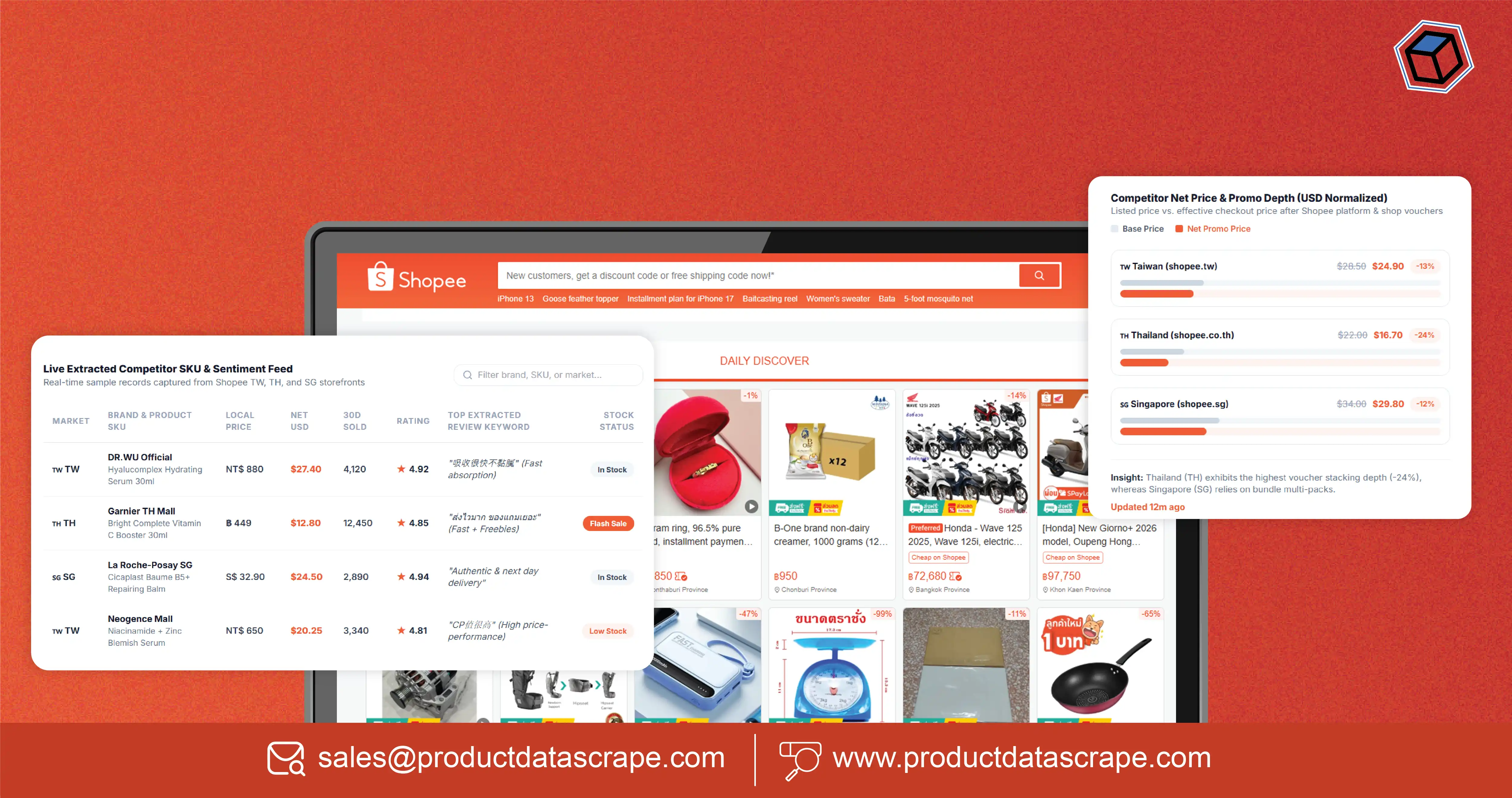
Brands can use Shopee product and review intelligence to compare competitor prices, identify popular products, analyze customer feedback, and understand changing shopping preferences across Thailand, Singapore, and Taiwan. By collecting structured marketplace information, businesses can turn product listings and customer reviews into actionable insights for pricing, merchandising, and market research.
Extract Shopee Product & Review Data to understand how products perform across different marketplace environments. Brands can collect product titles, categories, seller information, listed prices, discounts, ratings, review counts, customer comments, and product availability indicators. Comparing these attributes helps e-commerce businesses understand competitor positioning and identify opportunities to improve their own product offerings.
A Shopee Product Data Scraper can automate the collection and organization of publicly accessible marketplace information. Instead of manually checking thousands of listings, businesses can build structured datasets for recurring competitor monitoring and customer sentiment research.
The geographical distinction is important: Thailand and Singapore are Southeast Asian markets, while Taiwan is an East Asian market. Including all three provides a broader regional comparison rather than treating them as one geographical market.
For e-commerce managers, brand owners, marketplace sellers, and pricing analysts, this intelligence can support five important decisions:
- Which products are competitors promoting?
- How do prices and discounts vary across markets?
- Which product attributes receive positive or negative feedback?
- How do customer ratings differ between sellers?
- What product categories show changing marketplace activity?
The objective is not simply to collect more marketplace information. It is to build reliable, comparable datasets that help brands make better commercial decisions.
How Can Product Reviews Reveal Customer Preferences and Competitor Performance?
Customer reviews provide valuable information about product experiences, perceived quality, packaging, delivery, sizing, and customer satisfaction. Brands monitoring Shopee can use review information to understand how shoppers respond to competing products and identify recurring issues that influence purchasing decisions.
A structured Shopee Product Review Dataset can include product identifiers, review text, star ratings, review dates, verified-purchase indicators where displayed, product variants, and seller information. Organizing these attributes makes it easier to compare customer feedback across categories and marketplaces.
Through E-commerce data scraping, businesses can collect publicly accessible review information and organize it for further analysis. For example, a brand can categorize comments around product quality, price satisfaction, packaging, durability, and delivery experience. These categories can help identify recurring customer concerns.
Review volume and average ratings should be evaluated together. A product with a high average rating but very few reviews should not automatically be considered more popular than a product with a larger and more established review history.
Southeast Asia's expanding online marketplace environment makes this analysis commercially relevant. Google, Temasek, and Bain & Company reported that regional e-commerce GMV reached an estimated $156 billion in 2024 in their 2025 report.
| Year | Southeast Asian e-commerce GMV |
|---|
| 2020 | $74 billion |
| 2021 | $120 billion |
| 2022 | $131 billion |
| 2023 | $138 billion |
| 2024 | $156 billion |
| 2025 | $185 billion |
| 2026 | $226 billion |
Sources: Google, Temasek and Bain & Company e-Conomy SEA reports for 2021, 2022, 2025 and 2026. Figures are regional market estimates, not Shopee-specific GMV. Report editions use evolving market coverage and methodologies; the 2025 figure covers ASEAN-10, while earlier estimates use earlier report coverage. 2026 is the latest published estimate.
For brand managers, review analysis becomes more actionable when comments are grouped by product category, country, and collection period. A recurring complaint about material quality, for example, can highlight an opportunity for product improvement.
Actionable insight: Maintain a review dashboard that compares average ratings, review counts, recurring complaint themes, and positive feedback. Separate verified-purchase reviews from other review types whenever the marketplace provides that distinction.
How Can Brands Compare Customer Feedback Across Thailand and Singapore?
Thailand and Singapore offer different marketplace environments, consumer preferences, and competitive conditions. Brands operating in both markets need more than a general overview of product ratings. They need country-specific information to understand how customers evaluate similar products and what influences their purchasing decisions.
Shopee Thailand Review Data Scraping helps businesses organize customer reviews, product ratings, seller information, product attributes, and feedback dates from relevant Thai marketplace listings. These records can be analyzed to identify frequently mentioned product benefits, common complaints, and differences in customer expectations.
Similarly, E-commerce data scraping in Singapore helps brands examine product prices, discounts, ratings, review volumes, and seller performance across Singapore-based listings. Businesses can compare equivalent products and identify differences in promotional positioning.
The analysis should preserve local currencies and original review language. Thai-language and English-language reviews may require separate language-processing workflows. Brands should avoid directly comparing translated sentiment scores without checking translation accuracy and cultural context.
The broader digital economy provides useful market context. The 2026 e-Conomy SEA report estimates Singapore's digital economy and Thailand's digital economy separately, reinforcing the importance of country-level market analysis rather than relying exclusively on regional averages.
| Comparison area | Thailand | Singapore |
|---|
| Product pricing | Preserve THB | Preserve SGD |
| Customer feedback | Analyze Thai-language reviews | Analyze English and other displayed languages |
| Ratings | Capture product-level ratings | Capture product-level ratings |
| Seller comparison | Compare local marketplace sellers | Compare local marketplace sellers |
| Review themes | Categorize product and service feedback | Categorize product and service feedback |
| Promotional activity | Track displayed discounts | Track displayed discounts |
A practical comparison should examine the same product category, similar product specifications, and comparable observation periods. Otherwise, differences in ratings or prices may reflect different product assortments rather than genuine competitive advantages.
For example, a brand comparing personal-care products should distinguish between different package sizes, formulations, and product variants before evaluating prices. Similarly, customer comments about shipping should be separated from comments about product quality.
Actionable insight: Create individual Thailand and Singapore dashboards, then use standardized product categories and common performance indicators to compare market-level trends. This gives regional managers a clearer understanding of where product positioning and customer experiences differ.
How Does Cross-Market Price Intelligence Improve Competitive Positioning?
Pricing is one of the most important factors influencing marketplace competition. Brands need to understand how competing sellers position similar products, how frequently prices change, and whether discounts are associated with particular products or promotional periods.
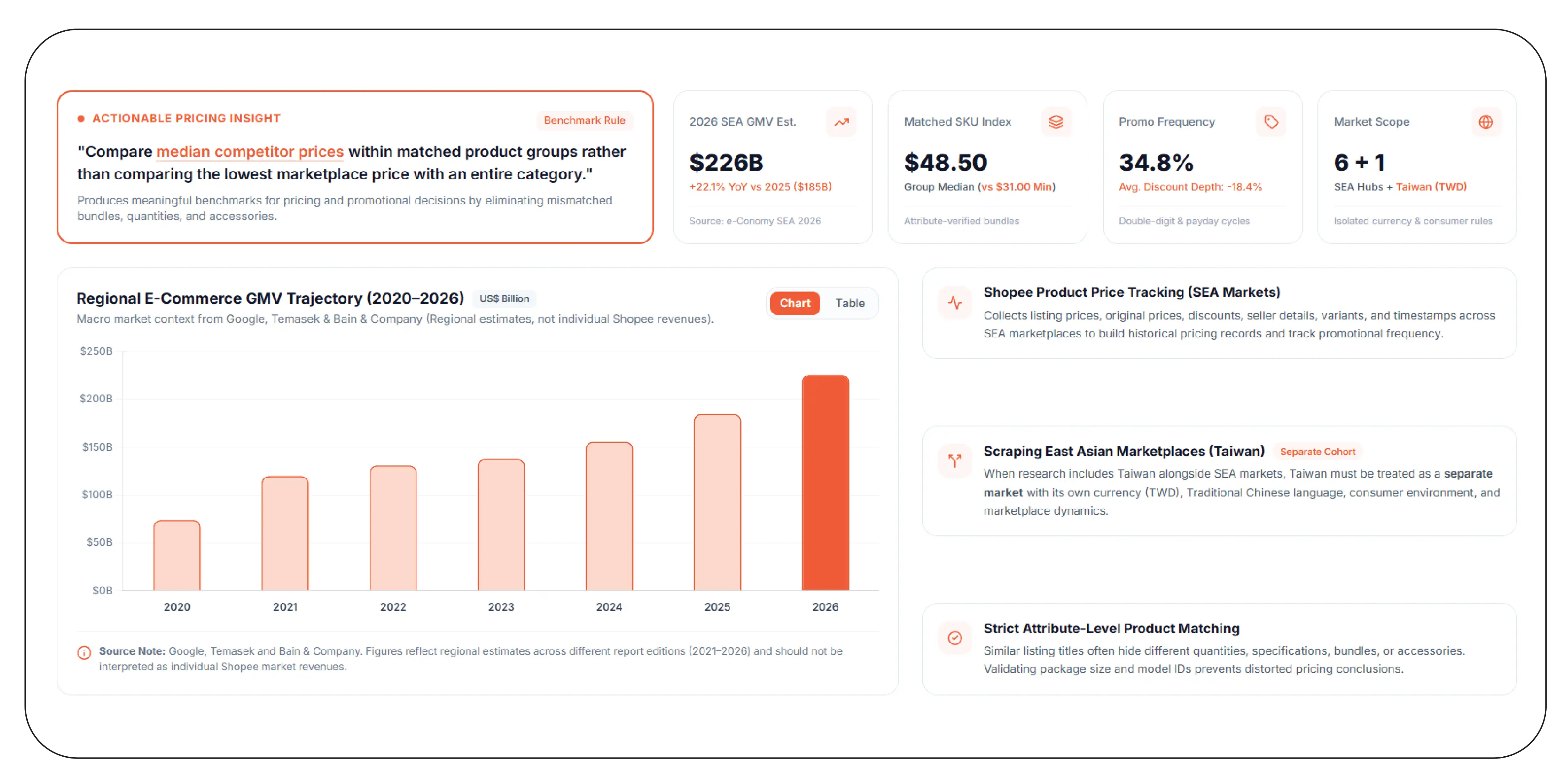
Shopee Product Price Tracking in SEA Markets helps businesses collect listing prices, original prices, discounts, seller details, product variants, and timestamps across selected marketplaces. This information can be used to create historical pricing records and compare competitors selling equivalent products.
Brands can also benefit from Scraping East Asian Marketplaces when their research includes Taiwan alongside Southeast Asian markets. Taiwan should be treated as a separate market with its own currency, language, consumer environment, and marketplace conditions.
Price comparisons require careful product matching. Two listings with similar titles may contain different quantities, specifications, bundles, or accessories. Comparing them without checking these attributes can produce misleading pricing conclusions.
The following table illustrates the market-level context using published e-commerce GMV estimates. These are regional figures and should not be interpreted as individual Shopee market revenues.
| Year | Regional e-commerce GMV (US$ billion) | Published source |
|---|
| 2020 | 74 | e-Conomy SEA 2021 |
| 2021 | 120 | e-Conomy SEA 2021 |
| 2022 | 131 | e-Conomy SEA 2022 |
| 2023 | 138 | e-Conomy SEA 2025 |
| 2024 | 156 | e-Conomy SEA 2025 |
| 2025 | 185 | e-Conomy SEA 2025 |
| 2026 | 226 | e-Conomy SEA 2026 |
Source: Google, Temasek and Bain & Company. These figures reflect regional estimates from different report editions, not Shopee transaction data.
A useful competitive pricing dataset should contain:
- Product title and model identifier.
- Current and original listed prices.
- Discount percentage, where displayed.
- Currency and marketplace country.
- Seller name and product URL.
- Product variant and package quantity.
- Collection date and time.
Brands can use this information to identify pricing gaps, monitor promotional frequency, and evaluate whether their products are positioned competitively.
Actionable insight: Compare median competitor prices within matched product groups rather than comparing the lowest marketplace price with an entire category. This produces more meaningful benchmarks for pricing and promotional decisions.
How Can Singapore Price Monitoring Identify Changes in Competitor Strategies?
Singapore is an important digital commerce market for brands seeking to understand online retail competition in Southeast Asia. Marketplace price monitoring can help businesses identify changes in seller pricing, discount strategies, product assortment, and promotional positioning.
Shopee Singapore Product Price Monitoring involves collecting publicly displayed information from selected product listings at regular intervals. The resulting dataset can include product names, SKU identifiers, seller names, listed prices, discounts, ratings, review counts, and availability indicators.
When brands Extract Shopee Product & Review Data, they can connect pricing information with customer feedback to understand the broader competitive position of individual products.
For example, a product experiencing a price reduction alongside an increase in review activity deserves further investigation. The change could be associated with a campaign, increased seller activity, or other marketplace factors. However, review counts alone cannot establish actual sales volume.
Sea Limited's 2025 financial results provide additional context about Shopee's scale. Shopee's gross merchandise value increased from US$100.5 billion in 2024 to US$127.4 billion in 2025, representing 26.8% growth. Orders increased from 10.9 billion to 13.9 billion during the same period. These are global Shopee figures, not Singapore-specific measurements.
| Metric | 2024 | 2025 |
|---|
| Shopee GMV | US$100.5 billion | US$127.4 billion |
| Gross orders | 10.9 billion | 13.9 billion |
| Average order value | Approximately US$9 | Approximately US$9 |
| Shopee service revenue | US$10.9 billion | US$14.5 billion |
Source: Sea Limited Fourth Quarter and Full Year 2025 Results. Global corporate figures, not Singapore marketplace results.
Retailers can use the difference between product-level observations and company-level reporting to create more accurate market intelligence. Corporate GMV explains platform scale, while listing-level information helps brands investigate specific competitors and product categories.
Actionable insight: Maintain a Singapore competitor price history with daily or campaign-based observations. Flag significant price movements, compare matched products, and investigate whether changes coincide with rating or review-volume movements.
How Can Regional Collection Services Support Multi-Market Research?
Brands operating across Thailand, Singapore, and Taiwan often struggle to combine marketplace information because each market uses different currencies, languages, product descriptions, and listing structures. A regional collection strategy can make this information easier to analyze.
Southeast Asia Shopee Product Scraping Services can help businesses organize marketplace information into standardized datasets for competitor research, pricing intelligence, and product performance analysis.
Although Taiwan is geographically part of East Asia, including it in a regional Shopee project can provide useful comparisons between the selected markets. The collection workflow should preserve the original marketplace country rather than grouping every record under Southeast Asia.
When businesses Extract Shopee Product & Review Data, they should establish a consistent data structure while maintaining market-specific attributes.
A regional dataset can include:
| Dataset category | Information to collect | Business application |
|---|
| Product details | Titles, categories, descriptions, SKUs | Product assortment research |
| Pricing | Original and current prices | Competitive benchmarking |
| Promotions | Discounts and promotional labels | Campaign analysis |
| Reviews | Customer comments and dates | Customer feedback research |
| Ratings | Star ratings and review counts | Product evaluation |
| Sellers | Seller names and listing details | Competitor monitoring |
| Variants | Color, size, quantity, specifications | Product matching |
| Availability | Publicly displayed stock indicators | Assortment monitoring |
Data standardization is especially important when combining records from multiple countries. For example, prices should retain their original currencies, while a separate normalized currency field can be used for cross-market financial comparisons. The exchange rate and conversion date should also be recorded.
Review data requires similar care. Original-language comments should be retained alongside translated text, where translation is used. This prevents the loss of context during sentiment analysis.
A reliable regional workflow should include product deduplication, URL validation, timestamp tracking, missing-field checks, and consistent category mapping.
Brands should also define the collection scope carefully. Publicly accessible listings and reviews should be collected in accordance with applicable laws, marketplace terms, privacy requirements, and technical restrictions. Personal information should not be unnecessarily collected or retained.
Actionable insight: Build one regional dataset with separate country identifiers and market-specific currency and language fields. This enables centralized reporting without losing the differences that matter to local business teams.
How Can Taiwan Review Analysis Help Brands Understand Customer Expectations?
Taiwan provides an additional marketplace perspective for brands researching consumer preferences and competitor performance across Shopee markets. Its language, currency, product descriptions, and retail environment require dedicated analysis rather than direct reuse of Thailand or Singapore reporting assumptions.
Shopee Review Data Extraction for Taiwan helps businesses organize product listings, customer ratings, review counts, review text, seller information, and product variants from relevant public marketplace pages.
Review analysis can reveal recurring customer concerns about product quality, packaging, product descriptions, compatibility, and perceived value. These insights can help brands understand how shoppers evaluate competing products.
The quality of review analysis depends on language handling. Traditional Chinese text should be retained in its original form, with language-aware processing used for categorization and sentiment analysis. Machine translation may help regional teams understand comments, but translated sentiment should be validated against original-language examples.
Brands should also distinguish between product satisfaction and seller or delivery satisfaction. A low rating may concern shipping delays rather than the product itself. Combining all negative feedback into one category can therefore lead to incorrect product decisions.
For a Taiwan-focused dataset, useful fields include:
- Product title in the original language.
- Product category and model identifier.
- Listed price in New Taiwan dollars (TWD).
- Product rating and review count.
- Original customer review text.
- Review date and displayed variant.
- Seller information and product URL.
- Publicly displayed promotional details.
Regional marketplace growth provides context for why such research matters. The e-Conomy SEA 2026 report estimates Southeast Asian e-commerce GMV at US$226 billion, up 18% year over year. This regional figure excludes Taiwan from its Southeast Asian market coverage and should not be presented as a Taiwan market estimate.
For brands comparing Taiwan with Thailand and Singapore, the strongest approach is to analyze each market separately first and then compare common indicators. This makes it easier to identify differences in review themes, price positioning, and product assortment without confusing market-specific behavior.
Actionable insight: Develop a Taiwan-specific review classification system using Traditional Chinese language processing. Compare recurring product complaints, positive attributes, and rating distributions across collection periods to support localized product and marketing decisions.
Why Choose Product Data Scrape?
Brands need reliable marketplace intelligence to understand customer preferences and respond to changing competitor strategies. Ratings, reviews and sentiment analysis can reveal recurring product complaints, positive customer experiences, and differences in perceived product value across markets.
Product Data Scrape provides structured data collection, product matching, data cleaning, and customized reporting workflows. Businesses can use these datasets to monitor competitor pricing, evaluate product ratings, and analyze customer feedback across Thailand, Singapore, and Taiwan.
With Extract Shopee Product & Review Data, brands can turn fragmented marketplace information into actionable insights for smarter pricing, merchandising, and market expansion decisions.
Conclusion
Marketplace intelligence helps brands understand competitor strategies, customer expectations, and changing product performance across regional markets. Real-Time Shopee Product Data Scraping enables businesses to monitor publicly available product listings, pricing changes, ratings, reviews, and seller information through structured collection workflows.
By combining these insights with Extract Shopee Product & Review Data, businesses can strengthen competitor benchmarking and customer sentiment research.
Partner with Product Data Scrape to build customized marketplace intelligence datasets for Thailand, Singapore, and Taiwan. Contact our team today to discuss your Shopee data requirements and develop a scalable solution for your business!
FAQs
1. What information can brands collect from Shopee?
Brands can collect product titles, prices, discounts, seller details, ratings, review counts, customer comments, product variants, categories, and publicly displayed availability information.
2. Can Shopee data be collected across three markets?
Yes. Marketplace research can cover Thailand, Singapore, and Taiwan using country-specific collection workflows, currencies, languages, and standardized product attributes.
3. How does review analysis help brands?
Review analysis identifies recurring customer complaints, positive product attributes, satisfaction patterns, and potential product improvement opportunities across different marketplace categories.
4. Why is historical pricing information important?
Historical pricing records help brands identify competitor price movements, promotional patterns, discount frequency, and changes in product positioning across different collection periods.
5. Can Product Data Scrape provide customized datasets?
Yes. Product Data Scrape can organize collected marketplace information into customized datasets with relevant product fields, review attributes, country identifiers, and reporting formats.
6. Sources and References
The following credible sources support the market statistics and platform-level information used in this article. Google, Temasek and Bain – e-Conomy SEA 2021 Report — Historical e-commerce GMV for 2020 and 2021. Google, Temasek and Bain – e-Conomy SEA 2022 Report — Regional e-commerce GMV for 2022. Google, Temasek and Bain – e-Conomy SEA 2025 Report — Regional e-commerce estimates for 2023–2025. Temasek – e-Conomy SEA 2026 Report — Latest regional digital economy and e-commerce findings. Sea Limited – Fourth Quarter and Full Year 2025 Results — Shopee global GMV, order volume, and revenue. Google – Southeast Asia Digital Economy 2026 — Regional e-commerce growth and AI-driven shopping developments.


 Singapore
 EMAIL
 PHONE











.webp)