Executive Summary

The Gulf's e-commerce and quick-commerce market has consolidated fast, and the data opportunity has consolidated with it. A handful of large platforms now carry most of the region's online grocery and product demand, they price and stock differently zone by zone, and very few data providers cover them with the granularity the market actually needs.

For an FMCG brand entering the Gulf, a retailer benchmarking competitors, or an operator planning expansion, the binding question is not "what is the price in the UAE" — it is "what is the price in this zone, on this platform, right now, and is it in stock." That is a zone-level, platform-specific, availability-aware data problem, and it is the shape of GCC e-commerce data scraping that is worth building.

This report covers what a usable Gulf commerce dataset captures, the traps specific to the region, and what the data looks like across the current major platforms.

This report is published by Product Data Scrape. Sample figures are illustrative of structure, not a live census.

The Current GCC Platform Landscape

The Gulf quick-commerce and e-commerce field has consolidated around several large players, and getting the roster right matters because a dataset built on a defunct or minor platform generates nothing.

The major platforms as of 2026 include Talabat, Noon, HungerStation, Careem, and Jahez among the regional leaders, with grocery and quick-commerce increasingly delivered through talabat mart dark stores, Noon Minutes, Careem Quik, and supermarket-backed channels. The structure has shifted toward dark-store-led fulfilment: Talabat completed the acquisition of InstaShop in March 2025, and ADNOC Distribution and Noon formalised a partnership in April 2025 to place Noon Minutes fulfilment hubs inside ADNOC's service-station and convenience-store network across the UAE. Amazon entered the format in October 2025 with Amazon Now, a 15-minute service in Dubai and Abu Dhabi.

The practical implication: a current GCC dataset has to track the dark-store-led platforms (talabat mart, Noon Minutes, Careem Quik), the supermarket-backed channels (Carrefour, LuLu), and the newer entrants — because share is moving between them, and a snapshot of only the incumbents misses the shift.

Why the Gulf Is Its Own Data Problem

Zone-level pricing is the norm, not the exception. Gulf q-commerce platforms price and stock by delivery zone and dark store. A single city carries many independent price and availability states for the same product. A national or city-level capture averages them into a number that describes no zone.

Bilingual listings. Product data appears in Arabic and English, and the two are not always identical. A dataset has to handle both, and match products across language variants.

Multi-emirate, multi-country structure. The GCC is several countries with different platform availability, pricing, and regulation. "Gulf data" that does not segment by country and city is too coarse to act on.

Rapid structural change. Acquisitions, partnerships, and new entrants are reshaping the field continuously. A dataset built on last year's platform list decays fast.

The Traps
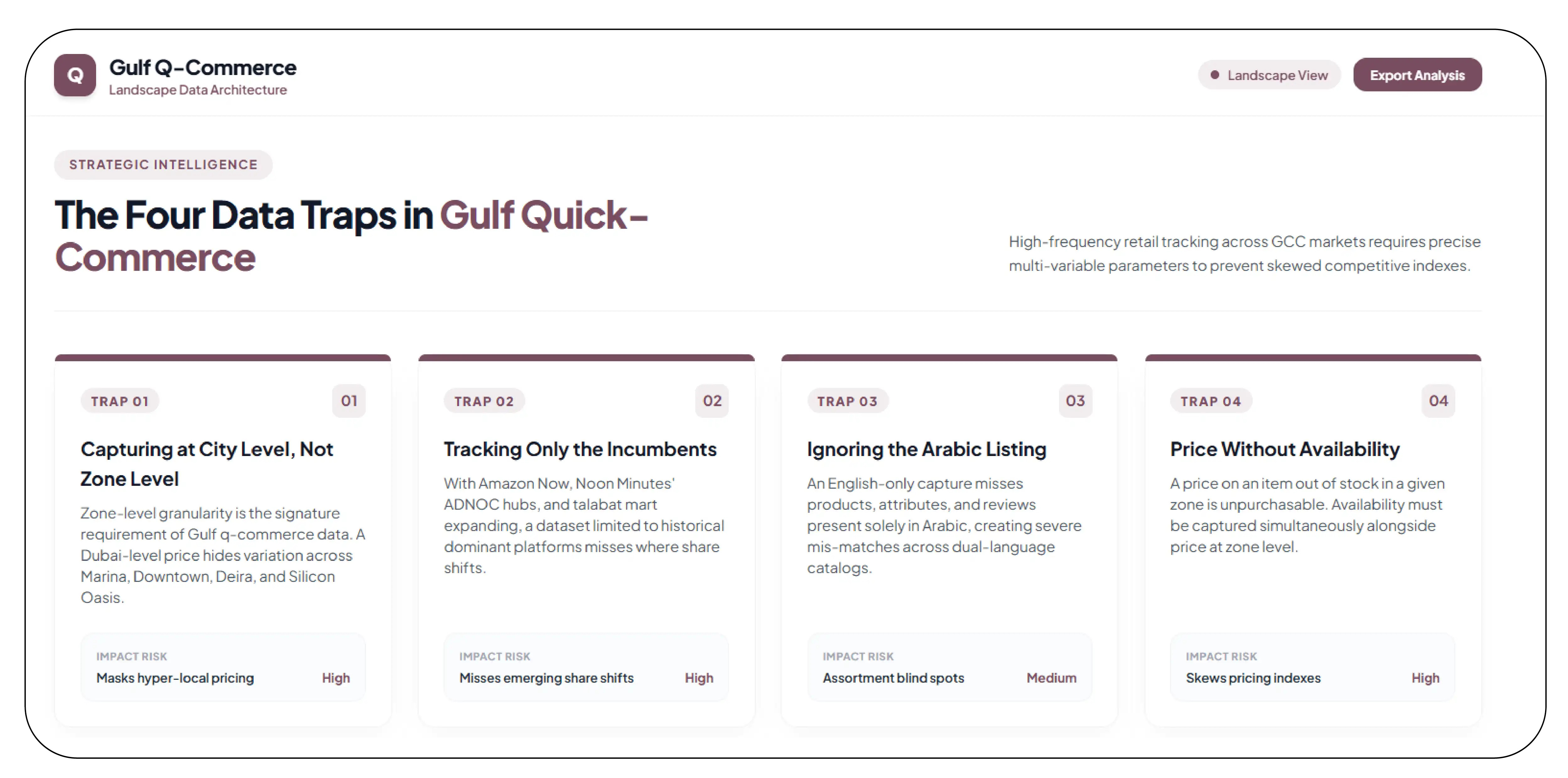
Trap one: capturing at city level, not zone level

Zone-level granularity is the signature requirement of Gulf q-commerce data. A Dubai-level price hides the variation across Marina, Downtown, Deira, and Silicon Oasis that is the actual object of interest.

Trap two: tracking only the incumbents

With Amazon Now, Noon Minutes' ADNOC hubs, and talabat mart's dark-store push all expanding, a dataset limited to the historically dominant platform misses where share is moving.

Trap three: ignoring the Arabic listing

An English-only capture misses products, attributes, and reviews present only in Arabic, and mis-matches products across the two languages.

Trap four: price without availability, per zone

A price on an item out of stock in that zone is not purchasable. Availability has to be captured per zone, alongside price, at the same moment.

What a Usable GCC Dataset Captures

Field group Fields
Identity product_id, brand, platform, country, city, zone_id, dark_store_id
Language title_en, title_ar, attributes_en, attributes_ar
Pricing price, base_price, promo_price, promo_type, currency, price_per_unit
Availability in_stock, stock_signal, delivery_eta, delivery_fee
Capture captured_at, capture_window

zone_id / dark_store_id and the bilingual title fields are what make a GCC dataset usable rather than a coarse national average.

Sample Data: One Product, Multiple Zones

An illustrative same-day capture of one product across zones and platforms in one city.

Platform Zone Price (AED) Promo In stock Delivery ETA
Platform A (dark store) Marina 12.50 No Yes 18 min
Platform A (dark store) Deira 12.50 No No
Platform B (q-comm) Marina 11.95 Yes Yes 25 min
Platform C (supermarket) Marina 13.00 No Yes 45 min

Illustrative figures.

The zone rows carry the finding: the same product on the same platform is in stock in Marina and out in Deira — a zone-level availability gap a city-level capture would erase. And across platforms in the same zone, price, promotion, and delivery ETA all differ, which is exactly the comparison an entering brand or a benchmarking retailer needs.

The structured record:


{
  "product_id": "GCC-FMCG-SNACK-0231",
  "brand": "brand_a",
  "platform": "platform_a",
  "country": "AE",
  "city": "dubai",
  "zone_id": "dubai_marina",
  "dark_store_id": "DS-MAR-04",
  "captured_at": "2026-07-15T16:00:00+04:00",

  "title_en": "Snack Product 150g",
  "title_ar": "منتج وجبة خفيفة ١٥٠ غرام",

  "pricing": {
    "price": 12.50,
    "base_price": 12.50,
    "promo_price": null,
    "currency": "AED",
    "price_per_unit": 8.33,
    "unit_basis": "per_100g"
  },
  "availability": {
    "in_stock": true,
    "stock_signal": "normal",
    "delivery_eta_min": 18,
    "delivery_fee": 0
  }
}

What the Aggregate Data Reveals

Zone-level variation is substantial. Price, promotion, availability, and delivery ETA differ meaningfully across zones of the same city — the core reason zone-level capture is non-negotiable in the Gulf.

Platform share is shifting. With new entrants and partnerships expanding fast, cross-platform capture shows where availability and competitive pricing are moving, not just a static incumbent snapshot.

Availability is the binding constraint per zone. Dark-store models mean a product's availability is a zone fact that changes through the day, and a price without it overstates what is purchasable.

Bilingual capture widens coverage. Arabic-only listings and attributes are missed entirely by English-only capture.

Limitations

The GCC platform landscape is changing rapidly through acquisitions and new entrants; any platform roster should be verified at capture time. Zone definitions vary by platform. Bilingual matching is imperfect where listings diverge. We collect publicly available pricing and product information only; sample figures illustrate structure rather than audited statistics, and current market figures should be confirmed against primary sources.

About the Data

This report was produced using GCC e-commerce data scraping methods from Product Data Scrape. We build zone-level Gulf commerce datasets across Noon, Talabat, Careem, Deliveroo, HungerStation, and supermarket-backed channels — bilingual titles and attributes, zone and dark-store granularity, base and promotional pricing with per-unit normalisation, and per-zone availability with delivery ETA and fee.

Delivered as JSON, CSV, via REST API, or pushed to your warehouse, segmented by country, city, and zone.

Want a zone-level Gulf sample for your category? Product Data Scrape will build it across the platforms and cities you are entering, so your price and availability picture reflects the zone a customer actually orders from.

Product Data Scrape — turning marketplace complexity into decision-ready data.

LATEST BLOG

Festive Grocery Price Scraping: Reading Seasonal Patterns Without Getting Them Wrong

Festive Grocery Price Scraping is easy to misread — mix shift looks like inflation. How to measure real festive price movement with a pre-season baseline.

Flipkart Quick Data Scraping: Dark Store Availability and Q-Commerce Insights

Flipkart Quick data scraping reveals dark store coverage, 10-minute delivery ETAs and city-level availability. Fields, sample data and q-commerce use cases inside.

Store Location Data for Healthy Food Access Analysis Using Healthy Food Data for Kroger Store Locations & Competitors

Leverage Store Location Data for Healthy Food Access Analysis to optimize retail planning, accessibility insights, and healthier community outcomes.

Case Studies

Discover our scraping success through detailed case studies across various industries and applications.

WHY CHOOSE US?

Product Data Scrape for Retail Web Scraping

Choose Product Data Scrape to access accurate data, enhance decision-making, and boost your online sales strategy effectively.

Reliable Insights

Reliable Insights

With our Retail Data scraping services, you gain reliable insights that empower you to make informed decisions based on accurate product data and market trends.

Data Efficiency

Data Efficiency

We help you extract Retail Data product data efficiently, streamlining your processes to ensure timely access to crucial market information and operational speed.

Market Adaptation

Market Adaptation

By leveraging our Retail Data scraping, you can quickly adapt to market changes, giving you a competitive edge with real-time analysis and responsive strategies.

Price Optimization

Price Optimization

Our Retail Data price monitoring tools enable you to stay competitive by adjusting prices dynamically, attracting customers while maximizing your profits effectively.

Competitive Edge

Competitive Edge

THIS IS YOUR KEY BENEFIT.
With our competitive price tracking, you can analyze market positioning and adjust your strategies, responding effectively to competitor actions and pricing in real-time.

Feedback Analysis

Feedback Analysis

Utilizing our Retail Data review scraping, you gain valuable customer insights that help you improve product offerings and enhance overall customer satisfaction.

5-Step Proven Methodology

How We Scrape E-Commerce Data?

01
Identify Target Websites

Identify Target Websites

Begin by selecting the e-commerce websites you want to scrape, focusing on those that provide the most valuable data for your needs.

02
Select Data Points

Select Data Points

Determine the specific data points to extract, such as product names, prices, descriptions, and reviews, to ensure comprehensive insights.

03
Use Scraping Tools

Use Scraping Tools

Utilize web scraping tools or libraries to automate the data extraction process, ensuring efficiency and accuracy in gathering the desired information.

04
Data Cleaning

Data Cleaning

After extraction, clean the data to remove duplicates and irrelevant information, ensuring that the dataset is organized and useful for analysis.

05
Analyze Extracted Data

Analyze Extracted Data

Once cleaned, analyze the extracted e-commerce data to gain insights, identify trends, and make informed decisions that enhance your strategy.

Start Your Data Journey
99.9% Uptime
GDPR Compliant
Real-time API

See the results that matter

Read inspiring client journeys

Discover how our clients achieved success with us.

6X

Conversion Rate Growth

“I used Product Data Scrape to extract Walmart fashion product data, and the results were outstanding. Real-time insights into pricing, trends, and inventory helped me refine my strategy and achieve a 6X increase in conversions. It gave me the competitive edge I needed in the fashion category.”

7X

Sales Velocity Boost

“Through Kroger sales data extraction with Product Data Scrape, we unlocked actionable pricing and promotion insights, achieving a 7X Sales Velocity Boost while maximizing conversions and driving sustainable growth.”

"By using Product Data Scrape to scrape GoPuff prices data, we accelerated our pricing decisions by 4X, improving margins and customer satisfaction."

"Implementing liquor data scraping allowed us to track competitor offerings and optimize assortments. Within three quarters, we achieved a 3X improvement in sales!"

Resource Hub: Explore the Latest Insights and Trends

The Resource Center offers up-to-date case studies, insightful blogs, detailed research reports, and engaging infographics to help you explore valuable insights and data-driven trends effectively.

Get In Touch

Festive Grocery Price Scraping: Reading Seasonal Patterns Without Getting Them Wrong

Festive Grocery Price Scraping is easy to misread — mix shift looks like inflation. How to measure real festive price movement with a pre-season baseline.

Flipkart Quick Data Scraping: Dark Store Availability and Q-Commerce Insights

Flipkart Quick data scraping reveals dark store coverage, 10-minute delivery ETAs and city-level availability. Fields, sample data and q-commerce use cases inside.

Store Location Data for Healthy Food Access Analysis Using Healthy Food Data for Kroger Store Locations & Competitors

Leverage Store Location Data for Healthy Food Access Analysis to optimize retail planning, accessibility insights, and healthier community outcomes.

Real-Time Grocery Pricing from Checkers, Pick n Pay, Woolworths and SPAR for Competitive Retail Intelligence

Unlock Real-Time Grocery Pricing from Checkers, Pick n Pay, Woolworths and SPAR to monitor prices, optimize strategies, and stay ahead.

How We Helped a Leading Grocery Brand Tracked Daily Prices Across Tesco, Asda, Sainsbury's & Ocado for UK Supermarket Pricing Intelligence

Tracked Daily Prices Across Tesco, Asda, Sainsbury’s & Ocado for real-time UK supermarket pricing, promotions, and retail analytics.

Scrape Daily Prices for 500 SKUs Across 6 Retailers - Walmart, Target, Wegmans, ShopRite, ACME, and Aldi for Real-Time Pricing Intelligence

Scrape Daily Prices for 500 SKUs Across 6 Retailers to monitor pricing, promotions, stock, and competitor trends with real-time insights.

Albertsons Grocery Delivery Scraper API - Market Intelligence, Inventory Monitoring, and Grocery Retail Benchmarking

ASDA Grocery Data Scraping helps track grocery prices, promotions, inventory, and competitor trends across the UK retail market.

Costco Alcohol & Liquor Price Data scraping to Track Consumer Buying Trends and Inventory Intelligence

Costco Alcohol & Liquor Price Data scraping helps brands track pricing, promotions, inventory trends, and competitor insights.

B&M Stores Pet Supplies Data Scraping for Market Research and Pet Product Trend Analysis in Retail Chains

B&M Stores Pet Supplies Data Scraping helps businesses collect pricing, stock, and product insights to optimize pet retail strategies.

Reducing Returns with Myntra AND AJIO Customer Review Datasets

Analyzed Myntra and AJIO customer review datasets to identify sizing issues, helping brands reduce garment return rates by 8% through data-driven insights.

Before vs After Web Scraping - How E-Commerce Brands Unlock Real Growth

Before vs After Web Scraping: See how e-commerce brands boost growth with real-time data, pricing insights, product tracking, and smarter digital decisions.

Scrape Data From Any Ecommerce Websites

Easily scrape data from any eCommerce website to track prices, monitor competitors, and analyze product trends in real time with Real Data API.

Fresh Citrus Price Wars - Coles vs Aldi — What Does the Data Say?

Fresh Citrus Price Wars — Coles vs Aldi: data-driven comparison of prices, trends, and savings to see which retailer wins on value for shoppers.

Retail Inflation 2025 – Comparing Grocery Baskets in Dubai vs. Abu Dhabi (Noon)

Retail Inflation 2025 – Comparing Grocery Baskets in Dubai vs. Abu Dhabi (Noon) highlights price differences and real-world grocery costs across UAE cities.

Unlock Winning Products on Pinduoduo - How Scraping Bestseller Data Reveals Top Titles, Prices & Sales Trends

Scrape Pinduoduo bestseller data to analyze top-selling products, pricing trends, sales performance, for smarter eCommerce and intelligence decisions.

FAQs

E-Commerce Data Scraping FAQs

Our E-commerce data scraping FAQs provide clear answers to common questions, helping you understand the process and its benefits effectively.

E-commerce scraping services are automated solutions that gather product data from online retailers, providing businesses with valuable insights for decision-making and competitive analysis.

We use advanced web scraping tools to extract e-commerce product data, capturing essential information like prices, descriptions, and availability from multiple sources.

E-commerce data scraping involves collecting data from online platforms to analyze trends and gain insights, helping businesses improve strategies and optimize operations effectively.

E-commerce price monitoring tracks product prices across various platforms in real time, enabling businesses to adjust pricing strategies based on market conditions and competitor actions.

Get a free sample dataset

See the exact fields, accuracy and format — for your products, on your target sites — before you spend a rupee or a dollar.

  • Sample delivered within 24 hours
  • Scoped to your real use case, not a generic demo
  • No obligation, no long contract

Tell us what you need

A specialist replies within one business day.