Introduction
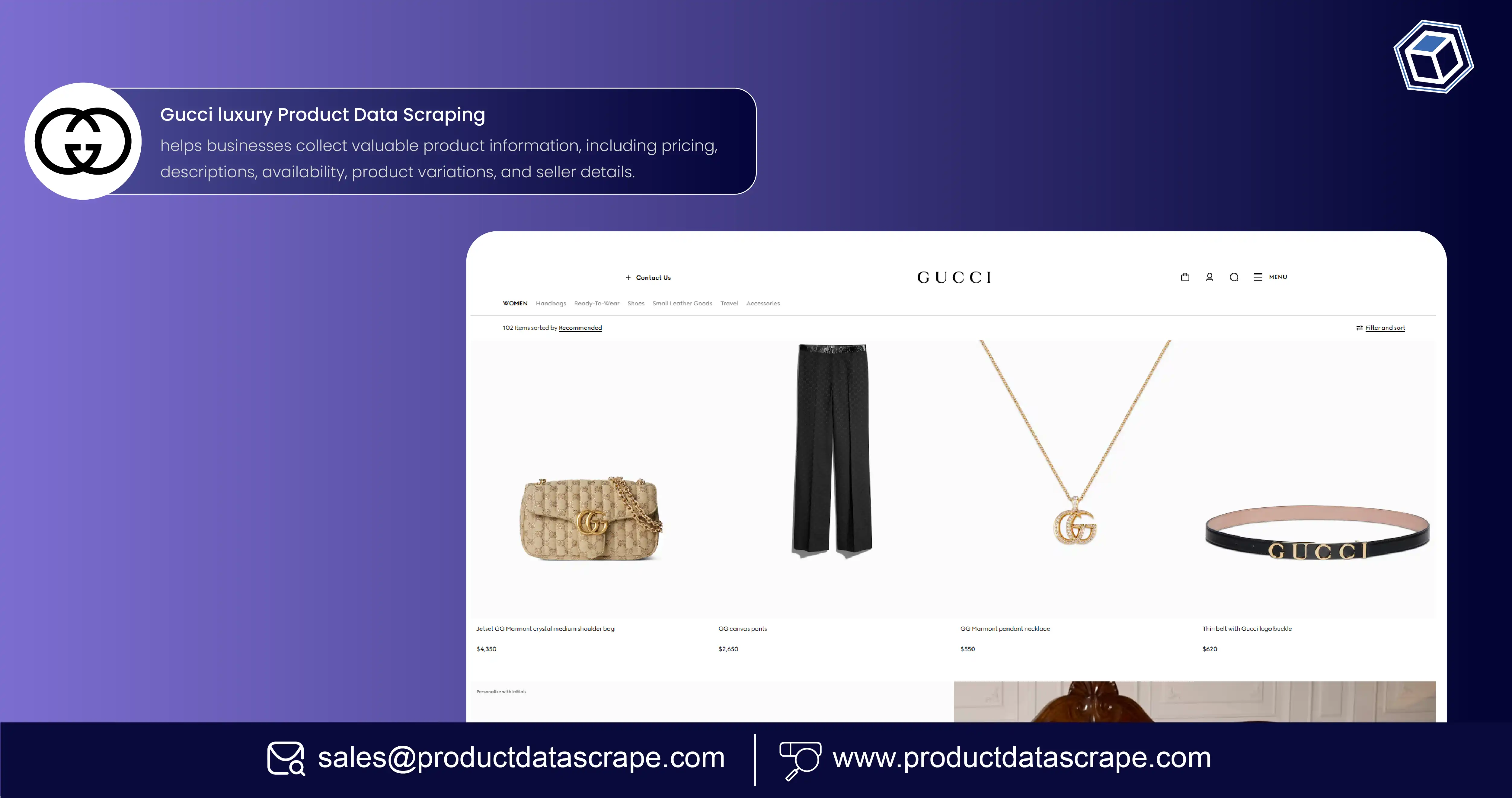
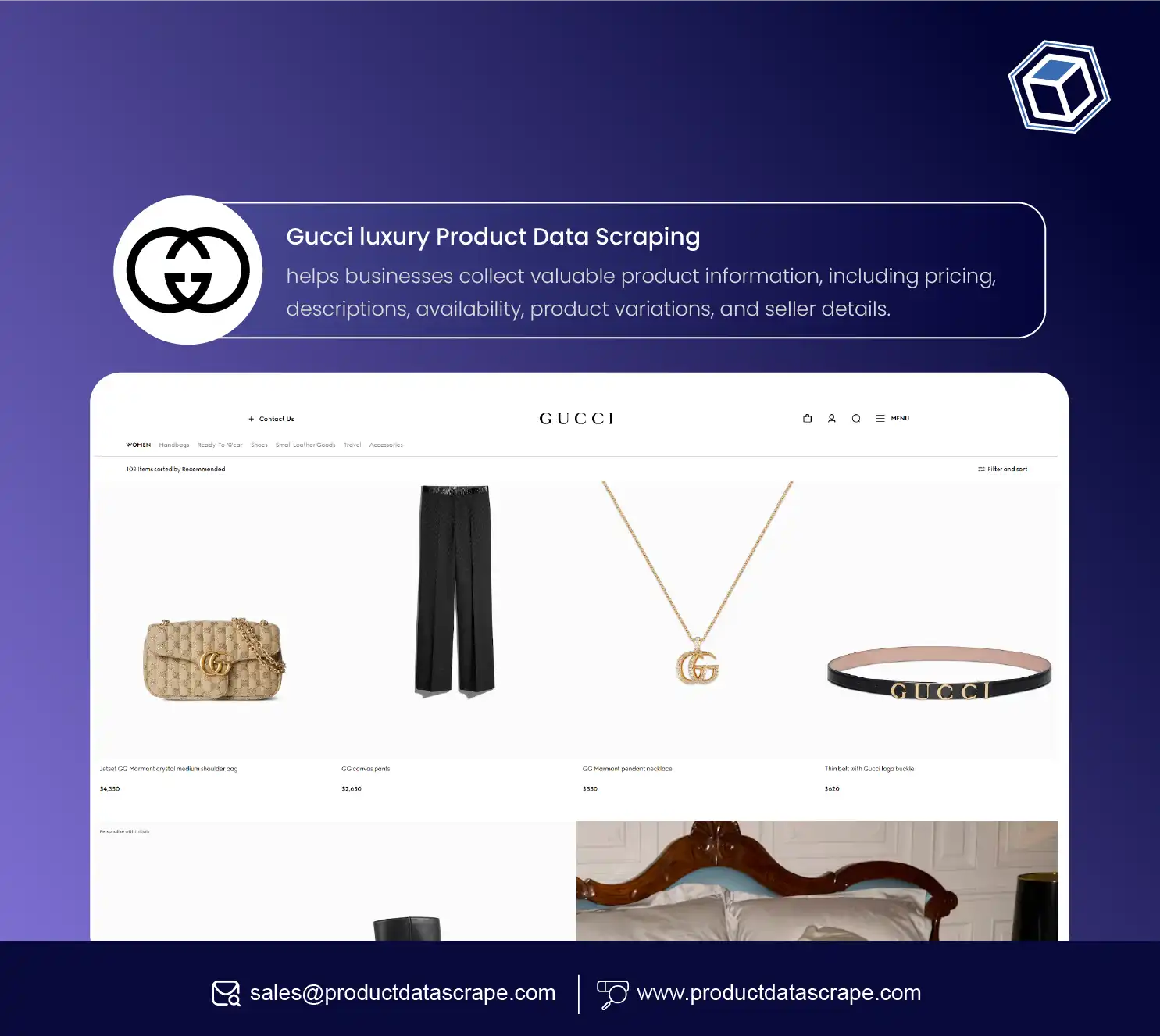
Counterfeit luxury products can damage brand reputation, mislead customers, and weaken consumer trust. Gucci luxury Product Data Scraping helps retailers and brand-protection teams monitor online marketplaces, collect product listing information, compare prices, identify suspicious sellers, and flag potentially unauthorized merchandise for further investigation. By analyzing product descriptions, images, seller profiles, pricing patterns, and availability, businesses can identify warning signs before questionable listings spread across digital channels.
Luxury fashion brands face growing challenges as counterfeit sellers use e-commerce platforms, social media, and international shipping networks to reach consumers. According to the OECD and European Union Intellectual Property Office (EUIPO), global trade in counterfeit goods was estimated at $467 billion in 2021, representing 2.3% of global imports. Clothing, footwear, and leather goods accounted jointly for 62% of seized counterfeit goods.
For businesses studying a Luxury Retailer Leveraged Gucci Fashion strategy, product intelligence can support better marketplace visibility, competitive research, and counterfeit-risk identification. Structured data helps teams move beyond manual listing checks and establish a consistent process for investigating suspicious products.
The objective is not to declare a product fake based on one unusual listing. It is to collect reliable evidence, identify multiple risk indicators, and support appropriate brand-protection decisions.
How Can Online Listing Data Reveal Suspicious Product Offers?
Gucci Luxury Product Price and Availability Scraping helps businesses compare product offers across authorized retail channels and third-party marketplaces. Price differences, unusual discounts, inconsistent product descriptions, and questionable seller information can provide useful signals for further investigation.
Gucci's official FAQ states that the brand does not offer marked-down merchandise online and that discounted Gucci products sold outside official retailers may be counterfeit. Gucci also confirms that products purchased through Gucci.com and its stores are guaranteed authentic.
This creates a useful reference point for monitoring suspicious offers. A data collection system can capture product names, listed prices, discount claims, seller names, product URLs, images, and availability information. Businesses can then compare these records against official product information and known authorized retail sources.
For example, an unusually low price should trigger a review rather than an automatic counterfeit classification. Other warning signs may include inconsistent model names, copied descriptions, missing product details, and sellers with limited business information.
Commerce Intelligence makes these observations more actionable by organizing listing information into searchable datasets. Retailers can compare recurring patterns, identify sellers publishing similar offers, and prioritize listings that show several risk indicators.
The following table presents verified EU-wide enforcement figures that demonstrate the wider counterfeit challenge. These are not Gucci-specific detections.
| Year | Counterfeit items detained in the EU | Estimated value |
|---|
| 2020 | Approximately 66 million | €2.1 billion |
| 2021 | Approximately 87 million | €2.0 billion |
| 2022 | Approximately 86 million | €2.0 billion |
| 2023 | Approximately 152 million | €3.4 billion |
| 2024 | Approximately 112 million | €3.8 billion |
| 2025 | Approximately 196 million | €6.3 billion |
| 2026 | Full-year figure not yet available | Not yet available |
Sources: EUIPO, European Commission, and Europol enforcement publications.
These figures cover different product categories and enforcement activities across the EU. They should not be interpreted as the number of counterfeit Gucci products or as a direct measure of online listings.
How Does Product Catalog Comparison Help Identify Unauthorized Merchandise?
Gucci Product Assortment Tracking allows retailers to examine how products are presented across different online sales channels. Counterfeit listings may imitate genuine product names, colors, collections, and descriptions. Comparing these attributes with verified product references helps identify inconsistencies that deserve investigation.
A structured product catalog can include product titles, model identifiers, category names, colors, materials, sizes, image references, and product descriptions. When these fields are collected consistently, businesses can compare similar listings without manually opening every product page.
For example, a listing may use a genuine Gucci product name but display images that do not correspond to the referenced design. Another seller may reuse official product photographs while providing incomplete or contradictory product specifications. These differences do not independently establish counterfeiting, but they can help investigators prioritize cases.
Catalog Enrichment Services can improve this process by standardizing product attributes and matching marketplace records against reference catalogs. Duplicate listings can be grouped, inconsistent descriptions can be highlighted, and missing product information can be identified.
A practical comparison framework includes:
- Product identity: Compare model names, product codes, and collection references wherever available.
- Visual information: Identify image reuse, mismatched colors, and differences between listing photographs and reference imagery.
- Product specifications: Review materials, dimensions, sizes, and other published attributes.
- Seller information: Record seller names, marketplace profiles, contact details, and business descriptions.
- Listing history: Track changes in prices, product descriptions, images, and availability.
Catalog enrichment is particularly useful when retailers monitor several marketplaces with different product naming conventions. Standardized records make suspicious similarities and inconsistencies easier to review.
However, product catalogs should be maintained using verified reference information. An outdated catalog could incorrectly flag legitimate new-season products, regional variations, or discontinued designs.
Can Automated Collection Improve Marketplace Investigation?
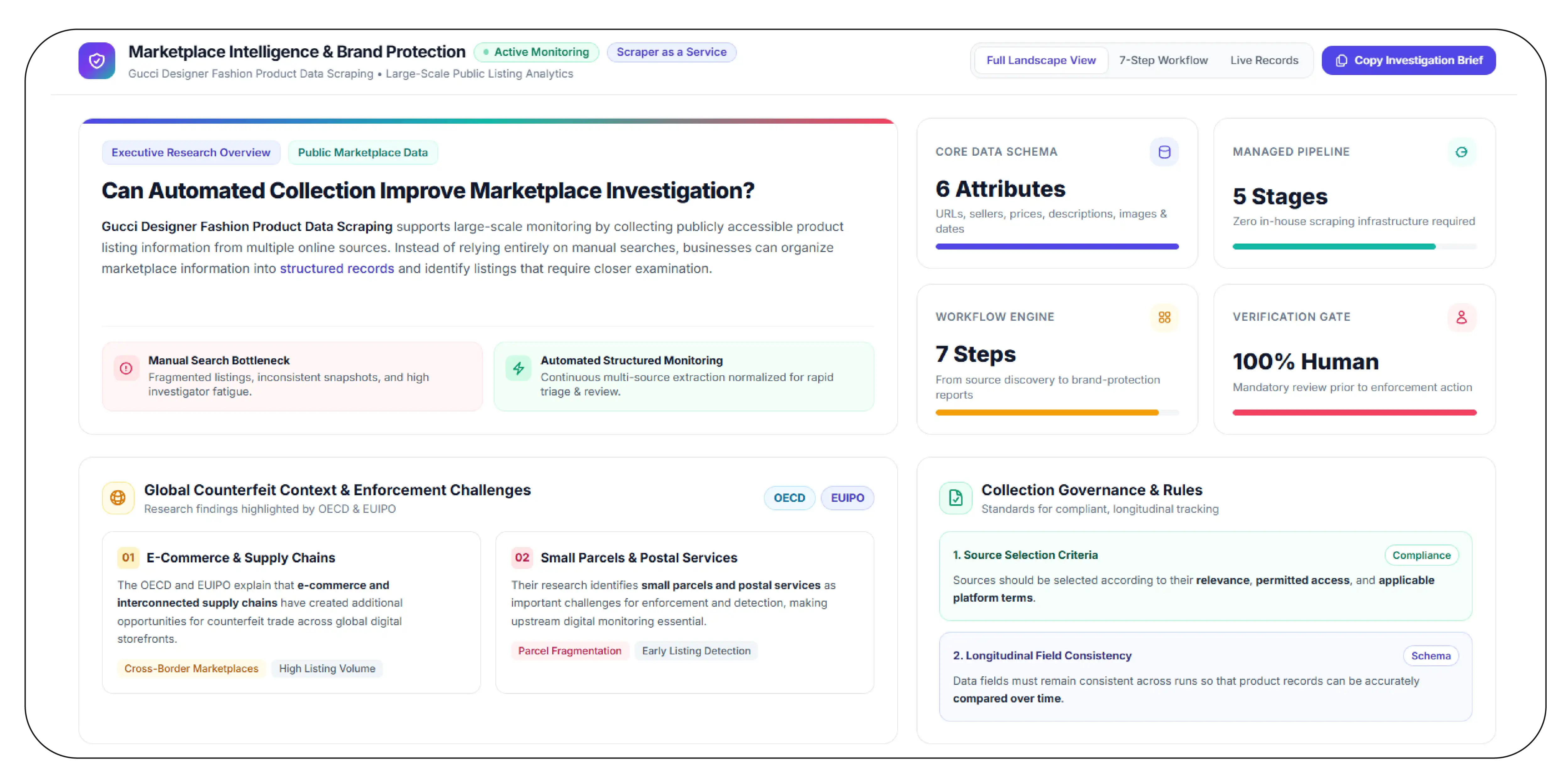
Gucci Designer Fashion Product Data Scraping supports large-scale monitoring by collecting publicly accessible product listing information from multiple online sources. Instead of relying entirely on manual searches, businesses can organize marketplace information into structured records and identify listings that require closer examination.
The OECD and EUIPO explain that e-commerce and interconnected supply chains have created additional opportunities for counterfeit trade. Their research also identifies small parcels and postal services as important challenges for enforcement and detection.
Automated collection can help address the volume challenge by gathering information such as product URLs, seller details, displayed prices, listing descriptions, images, and publication dates. These records can be consolidated into a central monitoring system.
Scraper as a Service can support businesses that need recurring data collection without developing and maintaining their own scraping infrastructure. A managed workflow can include source configuration, data extraction, validation, formatting, and scheduled delivery.
For effective monitoring, businesses should establish clear collection rules. Sources should be selected according to their relevance, permitted access, and applicable platform terms. Data fields should remain consistent so that product records can be compared over time.
A useful automated workflow includes:
- Identify relevant marketplaces and public product pages.
- Collect product and seller information.
- Standardize product titles, attributes, and prices.
- Match listings against verified reference catalogs.
- Flag unusual patterns for human review.
- Preserve listing URLs and timestamps as supporting evidence.
- Prepare investigation reports for authorized brand-protection teams.
Automation improves coverage and consistency, but it cannot independently authenticate physical merchandise. Human investigators and appropriate brand representatives must evaluate suspicious findings before enforcement action is taken.
How Can Continuous Price Monitoring Expose Potential Counterfeit Sellers?
Gucci Luxury Retail Price Monitoring helps businesses identify unusual pricing behavior across online marketplaces. Luxury products often have established retail positioning, making substantial unexplained price differences worth investigating.
Gucci luxury Product Data Scraping can capture listing prices, promotional claims, seller details, product availability, and historical changes. By comparing these attributes over time, businesses can identify sellers repeatedly advertising products at unusually low prices or using misleading discount language.
Kering, Gucci's parent group, documents the importance of this activity in its 2025 Universal Registration Document. The group describes ongoing online surveillance, technological detection of unlawful activity, and actions to request the removal of infringing advertisements from e-commerce websites and social media.
Universal Registration Document 2025_EN
A monitoring framework can focus on several indicators:
- Unusual discounts: Compare advertised prices with official retail references.
- Repeated seller behavior: Identify accounts publishing similar suspicious offers across multiple channels.
- Product duplication: Detect repeated photographs, descriptions, and product information across different seller accounts.
- Misleading promotions: Identify questionable sale, clearance, or limited-stock claims.
- Availability patterns: Monitor listings that repeatedly disappear and reappear under different URLs.
The following table explains how monitoring information can support investigation.
| Monitoring attribute | Potential warning sign | Recommended action |
|---|
| Listed price | Unusually deep discount | Verify seller and offer |
| Product images | Repeated identical images | Compare with reference catalog |
| Seller profile | Incomplete business details | Investigate seller identity |
| Product description | Inconsistent specifications | Request further verification |
| Listing history | Repeated suspicious relisting | Preserve historical records |
Price monitoring should never be treated as standalone authentication. Genuine resale products, regional pricing differences, and pre-owned merchandise can also produce lower prices. Combining multiple indicators produces a more reliable investigation process.
How Can Product-Level Information Strengthen Brand Protection?
Gucci Luxury Apparel Data Extraction helps retailers examine product information across fashion categories, including handbags, clothing, footwear, accessories, and other luxury merchandise.
Gucci luxury Product Data Scraping provides structured information that can help investigators compare product listings with verified references. This is important because counterfeit sellers may copy authentic product titles, reuse photographs, and reproduce descriptions to make questionable offers appear legitimate.
The OECD and EUIPO's 2025 research identifies clothing, footwear, and leather goods as major categories affected by counterfeit trade. Together, these categories represented 62% of seized counterfeit goods in the study's underlying customs data.
A detailed product dataset can help businesses investigate the following information:
Product photographs and visual consistency: Images can be compared with verified product references to identify mismatched designs, inconsistent colors, repeated photographs, and suspicious visual similarities. Image matching is a screening technique, not proof of authenticity.
Material and specification information: Published descriptions can be checked for inconsistencies involving materials, dimensions, construction details, and product features. Missing or contradictory information can be prioritized for manual review.
Product identification: Model names, collection references, product codes, and category information can help distinguish genuine product variations from listings that misuse authentic product descriptions.
Seller and listing connections: Multiple listings can be grouped using seller identifiers, URLs, images, and repeated descriptive patterns. This helps investigation teams identify potentially connected accounts.
Evidence preservation: Product URLs, collection timestamps, screenshots where permitted, and historical listing information can support investigations and marketplace complaints.
The main advantage is improved visibility. Rather than investigating isolated product pages, brand-protection teams can examine patterns across multiple listings and prioritize cases using consistent evidence.
How Does Historical Marketplace Monitoring Protect Brand Reputation?
Gucci Premium Product Catalog Monitoring helps businesses maintain a record of online product listings and identify suspicious changes over time. Counterfeit sellers may change product titles, prices, images, or seller accounts to avoid detection. Historical monitoring makes these changes easier to investigate.
Gucci luxury Product Data Scraping can support continuous observation by storing listing information with timestamps and source references. When a suspicious product disappears and later returns under a different URL, historical records may help investigators recognize similarities.
Kering's 2025 reporting describes coordinated physical and online anti-counterfeiting measures. It reports that, during 2025, almost 24,000 anti-counterfeiting initiatives led to the seizure of more than 4.5 million counterfeit products worldwide. It also reports that more than 6 million items of unlawful online content were identified and subjected to pre-screening or takedown requests. These are Kering Group figures, not Gucci-only results.
Historical monitoring can strengthen brand-protection operations in several ways:
- Trend identification: Compare suspicious listing volumes across marketplaces and reporting periods.
- Seller tracking: Identify recurring accounts and repeated seller behavior.
- Evidence management: Preserve historical product details and source URLs.
- Marketplace coordination: Prepare structured information for platform reporting teams.
- Risk prioritization: Rank cases according to the number and severity of identified warning signs.
- Performance measurement: Track reviewed listings, confirmed infringements, and successful platform actions separately.
A useful monitoring dashboard should distinguish suspected listings from confirmed infringements. It should also record investigation outcomes, removal requests, platform responses, and repeat appearances.
This distinction protects legitimate sellers from incorrect accusations while helping authorized teams concentrate on stronger cases. Consistent monitoring, documented evidence, and timely reporting together support long-term luxury brand reputation management.
How Can Product Data Scraping Support Luxury Retail Businesses?
A reliable product intelligence solution should combine accurate data collection, catalog standardization, and actionable reporting. For luxury retailers, the priority is not simply gathering more listings. It is identifying meaningful differences, maintaining dependable reference information, and making suspicious activity easier to investigate.
Why Choose Product Data Scrape?
Businesses need structured information to monitor competitive activity and identify potentially unauthorized product listings. Our solutions support product information collection, price tracking, seller monitoring, catalog enrichment, and marketplace intelligence.
With a properly configured Fashion & Apparel Dataset, retailers can compare product attributes, monitor availability, identify unusual pricing patterns, and organize listing information across multiple sources. Data validation and historical records further improve the consistency of monitoring workflows.
The focus is on delivering organized, usable datasets that support informed decisions, efficient research, and stronger online marketplace visibility.
Why Is Structured Data Important for Luxury Brand Protection?
Structured data makes it easier to compare product information, identify suspicious patterns, and prepare consistent investigation reports. Without standardization, teams may struggle to connect duplicate listings, recognize recurring sellers, or distinguish genuine product variations from questionable offers.
A well-organized monitoring system should maintain:
| Data component | Business benefit |
|---|
| Product reference catalog | Consistent product comparisons |
| Seller information | Better seller investigations |
| Price history | Identification of unusual pricing |
| Image records | Visual similarity checks |
| Listing URLs | Traceable evidence |
| Timestamps | Historical activity tracking |
| Investigation status | Better reporting and follow-up |
The most effective approach combines automated collection with human verification. This reduces unnecessary investigations and helps brand-protection teams focus on credible evidence.
Conclusion
Counterfeit listings threaten luxury brand reputation by misleading customers and weakening confidence in genuine merchandise. Fashion data scraping helps businesses monitor product listings, compare prices, examine seller behavior, and identify suspicious marketplace activity. Combining structured datasets, catalog matching, image comparisons, and historical monitoring creates a stronger foundation for investigation. Gucci luxury Product Data Scraping supports these activities by transforming scattered marketplace information into actionable intelligence. Businesses looking to strengthen their luxury retail monitoring can partner with Product Data Scrape for tailored product data extraction, competitive intelligence, and marketplace monitoring solutions. Contact our team today to build a smarter luxury product intelligence strategy!
FAQs
1. How does product data scraping help identify counterfeit Gucci products?
It collects product prices, descriptions, images, and seller information, allowing investigators to compare suspicious listings against verified product references and identify inconsistencies.
2. Can scraping identify suspicious Gucci discounts?
Yes. Price monitoring highlights unusual discounts and promotional claims. These findings should be checked against official pricing policies and seller authorization before conclusions are drawn.
3. Which marketplaces should luxury brands monitor?
Businesses should prioritize relevant e-commerce marketplaces, resale platforms, and publicly accessible social commerce listings where unauthorized luxury product offers may appear.
4. Is automated product data extraction sufficient to confirm authenticity?
No. Automated extraction identifies warning signs and supports investigations. Physical inspection, expert authentication, and verification through authorized channels remain important.
5. How can Product Data Scrape support luxury retailers?
Product Data Scrape provides structured product datasets, price monitoring, catalog enrichment, and marketplace intelligence to support competitive research and brand-protection workflows.


 Singapore
 EMAIL
 PHONE










.webp)