Introduction
Online flower retailers operate in a competitive market where product prices, seasonal promotions, delivery charges, and bouquet availability can influence purchasing decisions. Tracking these changes manually across competing websites is time-consuming and makes it difficult to identify pricing opportunities. 1-800-Flowers USA Data Scraping helps retailers collect structured information about flower arrangements, product prices, discounts, delivery options, and inventory availability from publicly accessible online listings. This information supports competitor benchmarking, pricing decisions, and seasonal inventory planning.
The growing importance of digital commerce makes reliable market intelligence particularly valuable. According to the U.S. Census Bureau's Annual Integrated Economic Survey, U.S. retail e-commerce sales increased from approximately $784.6 billion in 2020 to $1.18 trillion in 2024. Retailers can use this broader digital-commerce trend to understand why consistent online market monitoring matters.
Additionally, Garden & Outdoor Data Scraping can help businesses examine related product categories, including gardening accessories, decorative planters, and seasonal gifting products. Combining relevant product intelligence with floral pricing information gives retailers a broader understanding of customer demand and competitive positioning.
How Can Retailers Understand Competitor Pricing Across Online Flower Stores?
Flower retailers frequently encounter pricing differences between similar arrangements listed across competing online stores. Two bouquets containing comparable flowers may have different displayed prices because of stem quantities, packaging, presentation, seasonal availability, and delivery conditions. Without consistent competitor information, retailers may struggle to determine whether their products are competitively positioned.
USA Floral Product Pricing Intelligence helps businesses organize competitor product information into comparable datasets. Retailers can examine product names, bouquet descriptions, flower varieties, displayed prices, promotional discounts, delivery fees, and product availability. Matching comparable products is particularly important because a premium rose arrangement should not be benchmarked against a smaller mixed-flower bouquet simply because both belong to the same category.
For online retailers, E-commerce data scraping provides a structured approach to collecting publicly available product information at regular intervals. Businesses can use this information to identify pricing differences, monitor promotional activity, and evaluate how competing retailers position their offerings.
The following table provides verified U.S. retail e-commerce sales figures that demonstrate the expansion of the online retail environment. These figures represent the overall retail sector, not flower-specific sales.
| Year | U.S. retail e-commerce sales |
|---|
| 2020 | $784.62 billion |
| 2021 | $916.44 billion |
| 2022 | $972.30 billion |
| 2023 | $1.083 trillion |
| 2024 | $1.183 trillion |
| 2025 | No comparable finalized annual AIES figure cited |
| 2026 | No comparable finalized annual AIES figure cited |
Source: U.S. Census Bureau data through FRED.
Retailers can turn these insights into actionable decisions by comparing equivalent bouquets, separating delivery costs from product prices, and identifying products that consistently appear above or below competitor price levels.
Why Should Businesses Monitor Seasonal Price Changes?
Flower prices and promotional strategies can change around major gifting occasions. Valentine's Day, Mother's Day, Christmas, anniversaries, and other celebrations create different purchasing patterns. Retailers need historical pricing information to understand how competitors adjust their product offerings before and during these occasions.
A 1-800-Flowers Seasonal Pricing Dataset can organize product-level information by collection date, occasion, bouquet type, listed price, discount, and availability. This allows businesses to compare seasonal changes rather than relying on isolated price observations.
For example, the National Retail Federation reported that planned Valentine's Day consumer spending reached $27.4 billion in 2020, $21.8 billion in 2021, and $23.9 billion in 2022. Spending was projected at $25.9 billion in 2023, $25.8 billion in 2024, and $27.5 billion in 2025. Its January 2026 survey projected another record of $29.1 billion.
| Year | Planned Valentine's Day spending |
|---|
| 2020 | $27.4 billion |
| 2021 | $21.8 billion |
| 2022 | $23.9 billion |
| 2023 | $25.9 billion |
| 2024 | $25.8 billion |
| 2025 | $27.5 billion |
| 2026 | $29.1 billion |
Source: National Retail Federation – Valentine's Day research and historical results.
These figures represent total planned holiday spending across gift categories, not flower sales alone. However, they demonstrate why occasion-based monitoring is relevant to retailers.
Through 1-800-Flowers USA Data Scraping, businesses can examine how product prices and promotional offers change around important gifting periods. They can compare pre-holiday and holiday listings, identify discounts, and assess whether premium arrangements maintain their positioning during periods of increased consumer spending.
This information helps merchandising teams prepare promotional calendars, evaluate competitor campaigns, and plan product availability more effectively. Historical observations also help retailers distinguish recurring seasonal patterns from temporary pricing changes.
How Does Bouquet-Level Monitoring Improve Price Comparisons?
Comparing entire product categories does not always provide accurate competitive intelligence. A bouquet's price depends on several attributes, including flower varieties, stem count, arrangement size, container type, presentation, and additional gifts. Retailers need product-level comparisons to understand whether competing arrangements offer similar value.
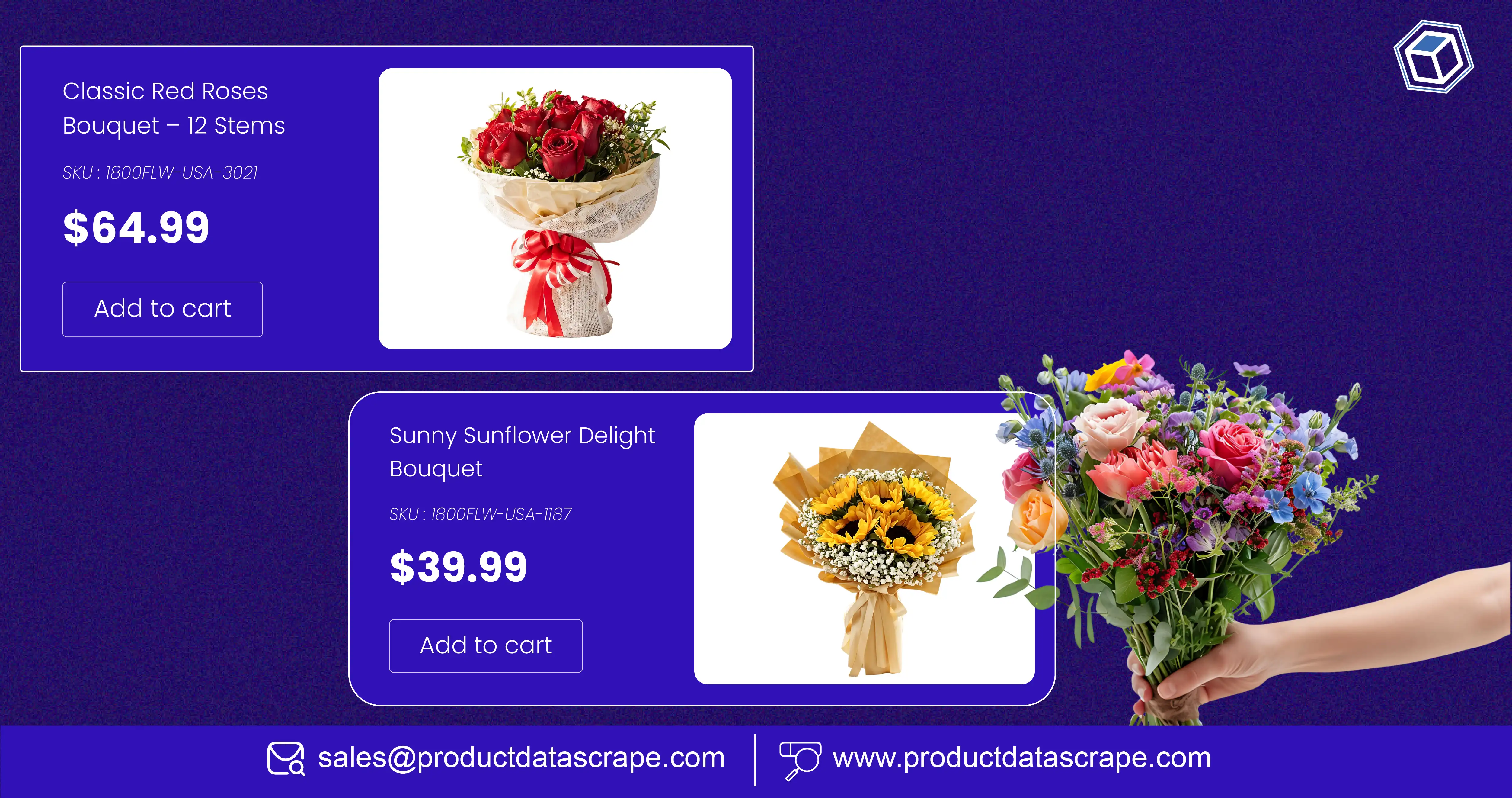
1-800-Flowers Bouquet-Level Price Monitoring focuses on collecting information about individual floral arrangements rather than relying only on category-level averages. Relevant fields include product titles, product identifiers, flower varieties, bouquet descriptions, listed prices, sale prices, image references, and availability status.
For example, retailers can organize competitor listings into categories such as red rose bouquets, mixed seasonal arrangements, lilies, tulips, premium floral collections, and sympathy flowers. Within each category, products can be matched using comparable attributes. This prevents misleading comparisons between products with substantially different compositions.
A structured bouquet dataset can support several business decisions. Retailers can identify products priced significantly above comparable listings, evaluate promotional discounts, and examine how premium arrangements are positioned against standard offerings. They can also identify products that disappear from competitor catalogs or return after temporary unavailability.
A useful comparison framework includes:
- Product identification: Match listings using product names, identifiers, images, and descriptions.
- Composition analysis: Compare flower varieties, stem quantities, and arrangement dimensions when disclosed.
- Price comparison: Separate original prices, discounted prices, and delivery charges.
- Availability tracking: Record whether products are available, unavailable, or listed with delivery restrictions.
- Historical monitoring: Preserve dated observations to identify price changes over time.
Retailers should also maintain consistent product-matching rules. A bouquet containing roses, lilies, and decorative greenery should not automatically be compared with a rose-only arrangement. Better matching improves the quality of competitor benchmarks and reduces incorrect pricing decisions.
How Can Occasion-Based Product Information Improve Retail Planning?
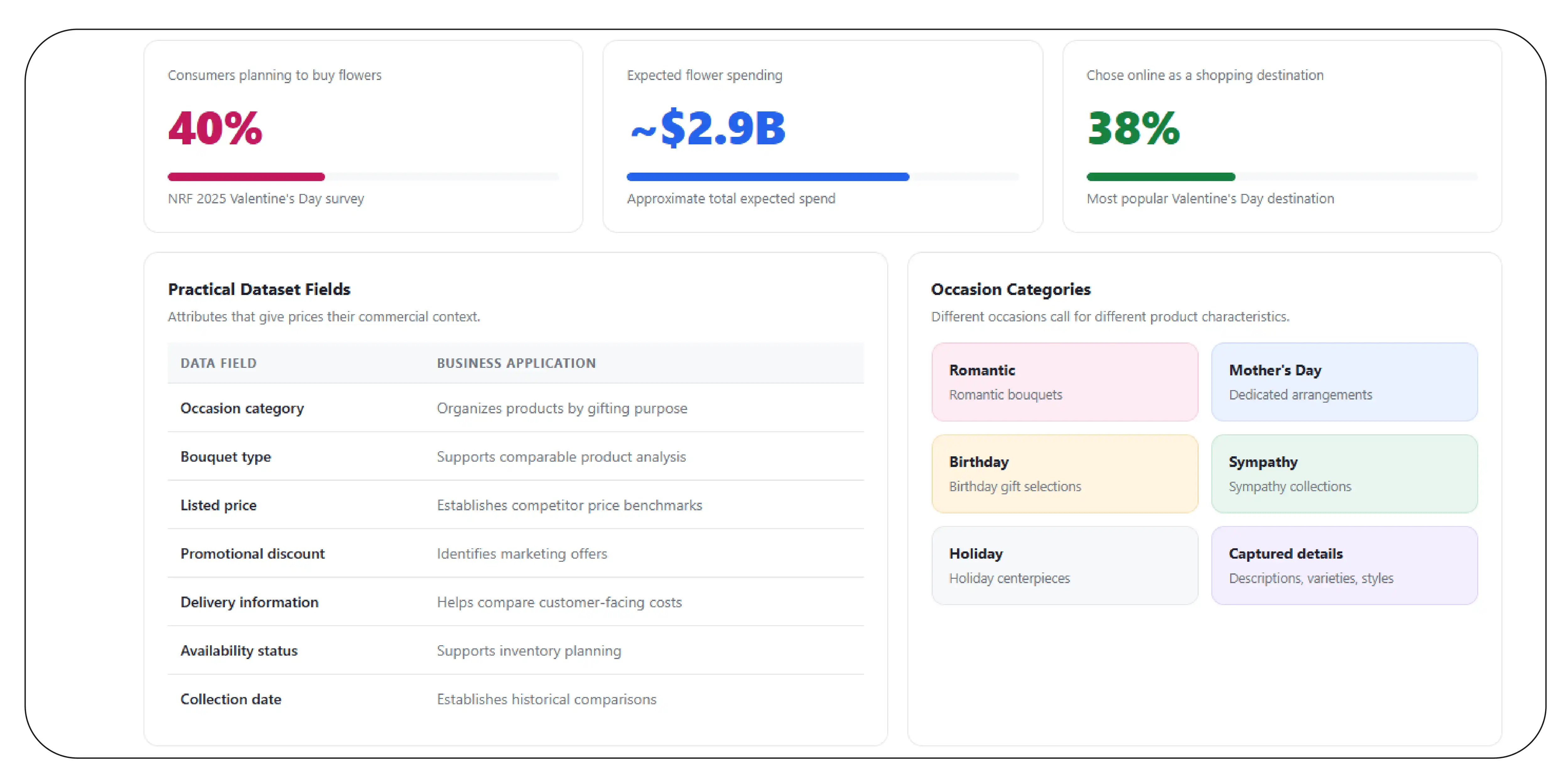
Customer purchasing preferences vary according to the occasion, recipient, and type of celebration. A romantic bouquet may have different product characteristics from a Mother's Day arrangement, birthday gift, sympathy collection, or holiday centerpiece. Retailers that organize competitor listings by occasion can better understand how products and promotional strategies differ across gifting categories.
A 1-800-Flowers Occasion-Based Product Dataset can capture occasion labels, product descriptions, flower varieties, arrangement styles, displayed prices, promotional information, and delivery options. Organizing these attributes creates a more useful dataset than collecting product prices without their commercial context.
The National Retail Federation's 2025 Valentine's Day survey found that 40% of consumers planned to purchase flowers. It also reported expected flower spending of approximately $2.9 billion. Online shopping was the most popular destination for Valentine's Day purchases, selected by 38% of surveyed consumers.
Source: NRF 2025 Valentine's Day survey.
These findings demonstrate the importance of understanding the relationship between gifting occasions and product selection. Retailers can use occasion-based product monitoring to examine whether competitors introduce specialized collections, modify prices, or promote specific arrangements during important shopping periods.
A practical dataset can include the following information:
| Data field | Business application |
|---|
| Occasion category | Organizes products by gifting purpose |
| Bouquet type | Supports comparable product analysis |
| Listed price | Establishes competitor price benchmarks |
| Promotional discount | Identifies marketing offers |
| Delivery information | Helps compare customer-facing costs |
| Availability status | Supports inventory planning |
| Collection date | Establishes historical comparisons |
By analyzing these attributes, retailers can identify which product categories receive greater promotional attention and how competitors organize their seasonal catalogs. The resulting insights support more informed assortment planning, campaign development, and price positioning.
What Can Historical Market Data Reveal About Floral Pricing?
Historical pricing information helps retailers understand how competitor positioning changes over time. A single product observation only provides a snapshot, while repeated observations make it possible to examine price movements, promotional frequency, and availability patterns.
USA Occasion-Based Floral Pricing Intelligence enables retailers to organize historical observations around specific gifting periods. Businesses can compare Valentine's Day collections across different years, examine Mother's Day promotions, and assess whether certain arrangements maintain consistent pricing outside peak shopping periods.
However, historical price comparisons require careful interpretation. Changes in bouquet composition, flower sourcing, product size, delivery fees, and promotional conditions can influence the displayed price. Therefore, retailers should preserve product attributes alongside price records.
The financial performance of 1-800-FLOWERS.COM, Inc. also illustrates why category-level business context matters. According to its fiscal 2026 year-end results, the company reported approximately $638.9 million in Consumer Floral & Gifts revenue for the fiscal year ended June 28, 2026, compared with approximately $776.8 million in fiscal 2025. This represented a reported decline of 17.7%.
| Fiscal year | Consumer Floral & Gifts revenue |
|---|
| FY2025 | $776.8 million |
| FY2026 | $638.9 million |
Source: 1-800-FLOWERS.COM, Inc. FY2026 results.
These are company-reported segment revenues, not individual bouquet sales or competitor prices. Nevertheless, they provide relevant business context for understanding the scale and changing performance of the company's floral category.
Retailers can combine historical product observations with broader financial and consumer-spending information to develop more informed strategies. For example, they can evaluate whether a promotional period coincides with changes in product availability or whether competitor pricing remains stable outside major gifting occasions.
The most useful approach is to maintain consistent collection intervals, record price changes with timestamps, and distinguish actual price movements from changes in product specifications. This creates a reliable foundation for longer-term competitive analysis.
How Can Product Assortment Analysis Support Better Decisions?
Pricing is only one part of online flower retail competition. Product assortment also influences customer choices, promotional opportunities, and inventory planning. Retailers need to understand which flower varieties, bouquet styles, gift combinations, and seasonal collections competitors make available.
Assortment analytics helps businesses examine the breadth and structure of competing product catalogs. By organizing product listings into meaningful categories, retailers can identify differences in assortment depth, premium product availability, seasonal collections, and complementary gifting options.
For example, a retailer can compare how competing websites organize rose arrangements, mixed bouquets, orchids, plants, gift baskets, chocolates, and personalized gifts. The analysis can reveal which categories have extensive product coverage and which contain fewer comparable listings.
1-800-Flowers USA Data Scraping supports this process by collecting structured information from publicly accessible product listings. Useful attributes include product names, category labels, descriptions, images, displayed prices, promotional offers, availability, and delivery information.
Retailers can use the resulting information to:
- Identify assortment gaps in their existing catalogs.
- Compare entry-level, mid-range, and premium product offerings.
- Monitor the introduction or removal of competitor products.
- Evaluate complementary gifting categories.
- Understand how seasonal collections change.
- Support product merchandising and category planning.
A useful assortment analysis should distinguish between the number of product listings and the number of genuinely different products. Similar listings may represent different sizes or delivery variations of the same arrangement. Deduplication and product matching help prevent inflated assortment counts.
Retailers should also connect product assortment observations with pricing and availability records. A competitor may have a broad catalog, but many listed products could be unavailable for particular delivery locations. Separating listed products from available products produces more meaningful comparisons.
Combining assortment, pricing, and availability information gives decision-makers a clearer view of competitor positioning. It supports catalog optimization, merchandising priorities, and evidence-based planning without relying on assumptions about market demand.
Why Choose Product Data Scrape?
Product Data Scrape helps retailers turn publicly accessible e-commerce information into structured business intelligence. Its data collection approach can support competitor price comparisons, seasonal product monitoring, bouquet-level analysis, and catalog research.
With Ratings, reviews and sentiment analysis, businesses can also organize customer feedback to understand recurring product concerns, satisfaction patterns, and customer perceptions of floral arrangements. Combining review insights with product and pricing information provides additional context for merchandising decisions.
1-800-Flowers USA Data Scraping can help businesses build datasets covering product descriptions, prices, discounts, availability, and seasonal collections. Structured delivery formats make it easier to integrate collected information into dashboards, reporting systems, and business intelligence workflows.
For retailers seeking more consistent competitor monitoring, Product Data Scrape offers a practical way to transform fragmented online listings into actionable market intelligence.
Conclusion
Online flower retailers need accurate competitor information to make informed pricing, merchandising, and inventory decisions. Tracking bouquet prices, seasonal promotions, product availability, and assortment changes helps businesses understand how competitors position their offerings.
Product Price scraping provides structured market information that supports continuous competitor benchmarking and historical analysis. By combining product-level observations with seasonal spending trends and catalog intelligence, retailers can make better-informed commercial decisions.
1-800-Flowers USA Data Scraping offers a valuable approach to understanding online floral competition through organized product information and pricing observations.
Want to improve your competitor monitoring strategy? Contact Product Data Scrape today to discuss a customized data extraction solution for your floral retail business!
FAQs
1. What is floral competitor price monitoring?
Floral competitor price monitoring involves collecting and comparing publicly listed bouquet prices, discounts, delivery charges, and product availability across online flower retailers to support informed pricing decisions.
2. Which information can businesses collect?
Businesses can collect product names, descriptions, flower varieties, displayed prices, discounts, availability, delivery information, product categories, and publicly accessible customer feedback.
3. How frequently should floral prices be monitored?
Monitoring frequency depends on business requirements. Daily or more frequent collection may suit active promotions, while weekly monitoring can support broader catalog and competitor analysis.
4. Can Product Data Scrape support seasonal research?
Yes. Product Data Scrape can help organize seasonal product listings, historical prices, promotional offers, and availability information to support occasion-based competitor research.
5. Why is bouquet-level price comparison important?
Bouquet-level comparisons help retailers evaluate similar arrangements using flower varieties, stem quantities, sizes, and other product attributes rather than relying on misleading category-wide averages.


 Singapore
 EMAIL
 PHONE










.webp)