Introduction
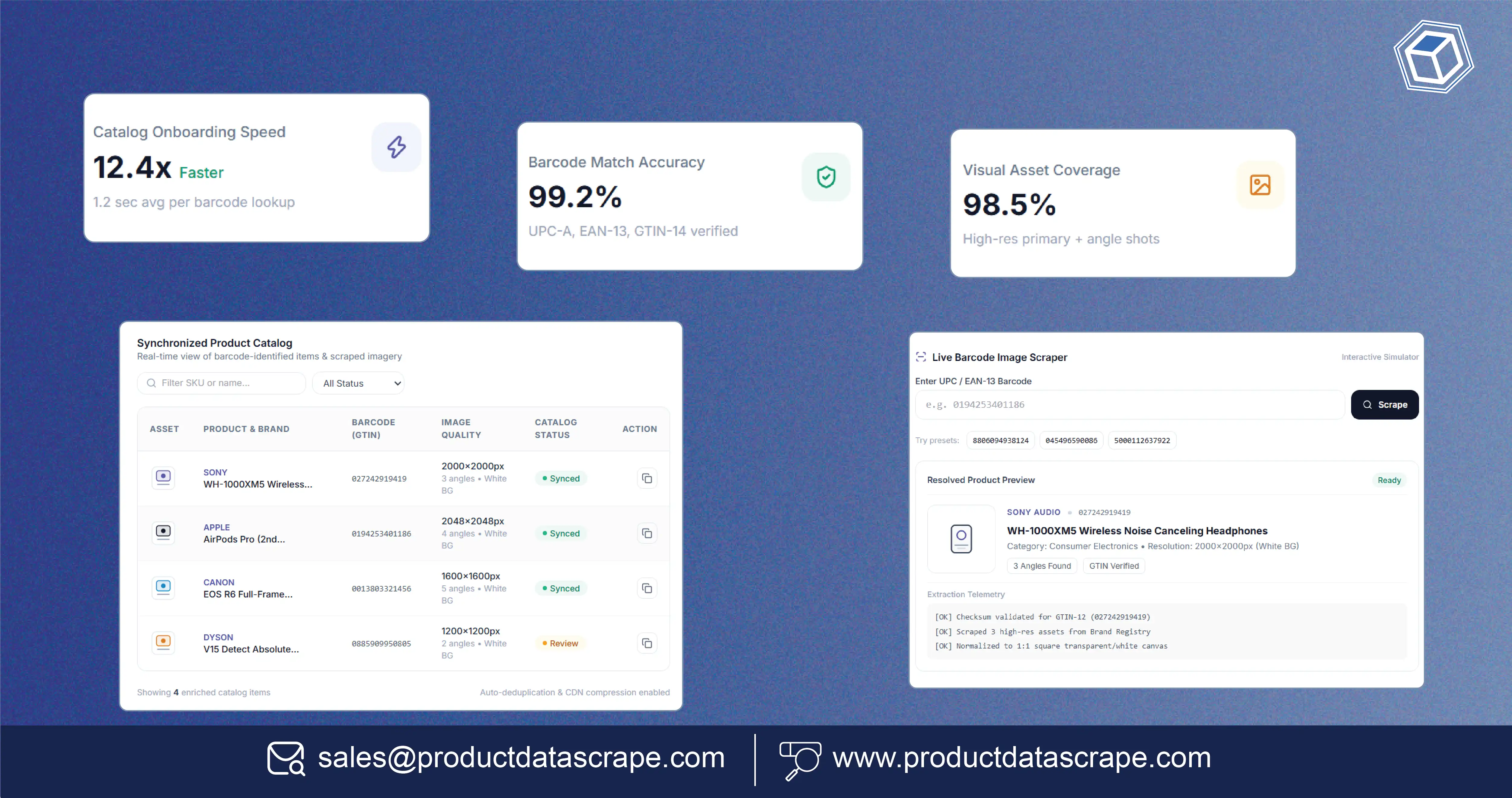
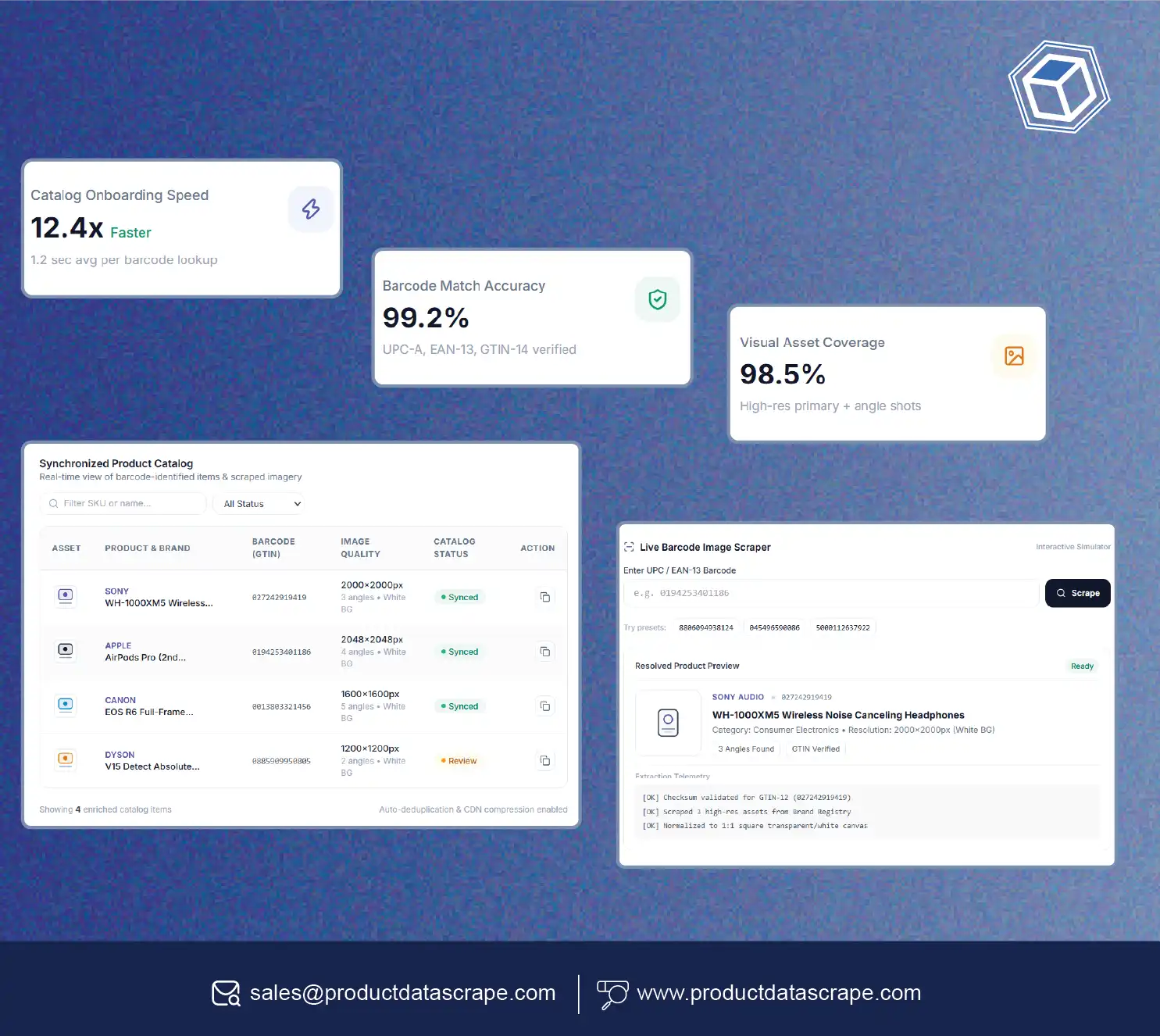
Accurate product identification and high-quality images are essential for managing large e-commerce catalogs. product image scraping by barcode helps businesses identify products through unique barcode numbers, collect matching images, and organize visual product information into structured datasets. By connecting product identifiers with reliable image sources, retailers can reduce manual catalog research, improve listing consistency, and simplify product data management.
As online marketplaces expand their product inventories, businesses must manage thousands of SKUs across multiple suppliers, categories, and sales channels. Inconsistent product images, duplicate listings, missing identifiers, and incorrect product details can make catalog maintenance difficult. These problems also affect Digital Shelf Analytics, where businesses evaluate how their products appear across digital retail platforms.
A barcode-based approach provides a structured starting point for solving these challenges. Instead of searching for products using incomplete names or descriptions, businesses can use identifiers such as Global Trade Item Numbers (GTINs), European Article Numbers (EANs), and Universal Product Codes (UPCs) to locate corresponding product records.
The process combines identifier validation, image discovery, product matching, and quality checks. However, a barcode identifies a product; it does not directly contain its product photograph. Businesses still need reliable product databases or authorized online sources to retrieve and verify the correct images.
How Can Businesses Improve Product Organization Across Multiple Retail Channels?
Managing product information across multiple online stores requires consistent identification methods. Different retailers may describe the same item using different product names, abbreviations, category labels, or packaging descriptions. These variations make manual product matching difficult, particularly when businesses manage extensive inventories.
Barcode-Based Catalog Enrichment provides a structured way to connect product identifiers with corresponding product attributes and images. A GTIN can help distinguish one trade item from another, including variations in size, colour, fragrance, and packaging. According to GS1's product identification guidance, different product variations receive different item references.
Businesses can use validated barcode records to organize product names, manufacturer information, categories, image URLs, and other available attributes. This also helps retailers compare equivalent products across marketplaces before evaluating Competitive pricing data.
For example, a retailer tracking packaged food products can use GTINs to distinguish different package sizes rather than grouping every variation under one generic listing. This improves catalog organization and reduces the risk of comparing different products.
A practical enrichment workflow should include:
- Barcode identification and format validation.
- Brand and manufacturer information collection.
- Product category standardization.
- Image URL collection and verification.
- Duplicate record identification.
- Cross-marketplace product matching.
The most important consideration is maintaining a connection between the original barcode and the enriched product record. This creates traceability and makes future catalog updates easier.
How Does Automated Image Collection Improve Product Discovery?
Product images influence how customers recognize and evaluate products online. When retailers use incorrect photographs, low-resolution thumbnails, or unrelated images, customers may struggle to identify the actual item being offered.
A structured Product Image Matching Dataset helps businesses associate product identifiers with relevant visual assets. The dataset can contain GTIN or EAN values, product titles, brand names, image URLs, image dimensions, source information, and verification status.
Through Web Image Scraping, businesses can collect publicly accessible product images from permitted websites and product information sources. The collected images can then be compared against product records using identifiers and additional attributes.
Image collection should not rely on barcode numbers alone. A matching system should also compare brand names, product descriptions, model numbers, packaging details, and product variants. This is particularly important when multiple products have similar packaging or when retailers publish different photographs of the same item.
Baymard Institute reported in its April 2020 research that 56% of users' first actions on product detail pages involved exploring product images. Its benchmark also found that 25% of evaluated e-commerce sites had insufficient image resolution or zoom capabilities. These findings demonstrate why image quality deserves attention during catalog enrichment. Source: Baymard Institute, 2020.
Businesses should organize collected images according to:
- Primary product image and alternative views.
- Product colour and packaging variations.
- Image resolution and file format.
- Original source and collection date.
- Product identifier and matching confidence.
- Duplicate and outdated image status.
A well-maintained image dataset supports product discovery, catalog updates, marketplace synchronization, and visual consistency across retail channels.
How Can Retailers Prevent Incorrect Product Image Associations?
Collecting images is only one part of catalog management. Businesses must also establish whether each photograph actually represents the product associated with its barcode. An incorrect image can create confusion between product variants and affect the reliability of marketplace listings.
Scrape Barcode-Based Product Image Validation focuses on checking whether collected visual assets correspond to the intended product record. The validation process should examine product identifiers, manufacturer details, packaging information, product titles, and image characteristics before accepting an image.
A reliable product image scraping by barcode workflow should use multiple validation stages rather than treating the first image search result as correct.
For instance, a product may have different barcode identifiers for its individual package sizes. Even when the packaging looks almost identical, the image dataset should preserve the distinction between those variations.
Google Merchant Center's product data guidelines require accurate product images and valid identifiers. Its documentation also explains that incorrect product information, missing GTINs, and low-quality images can cause product disapprovals or display problems. Source: Google Merchant Center.
Businesses can implement the following validation checks:
- Identifier verification: Check the barcode format and its check digit wherever applicable.
- Brand verification: Compare the manufacturer or brand information with the product record.
- Variant verification: Check packaging size, colour, model, and other distinguishing attributes.
- Image inspection: Identify broken links, irrelevant images, duplicates, and low-resolution files.
- Source verification: Record where the image originated and whether its use is permitted.
- Exception handling: Flag uncertain matches for additional review instead of automatically approving them.
| Validation parameter | What businesses should check | Expected outcome |
|---|
| Barcode | GTIN format and check digit | Valid identifier |
| Product name | Brand and item description | Relevant record |
| Packaging | Size and variant details | Correct variation |
| Image | Visual product correspondence | Relevant photograph |
| Image URL | Availability and file format | Accessible asset |
| Source | Collection permissions | Approved source |
These checks help businesses maintain accurate product-image relationships and reduce the chances of incorrect catalog entries.
How Do EAN and GTIN Records Support Large-Scale Image Management?
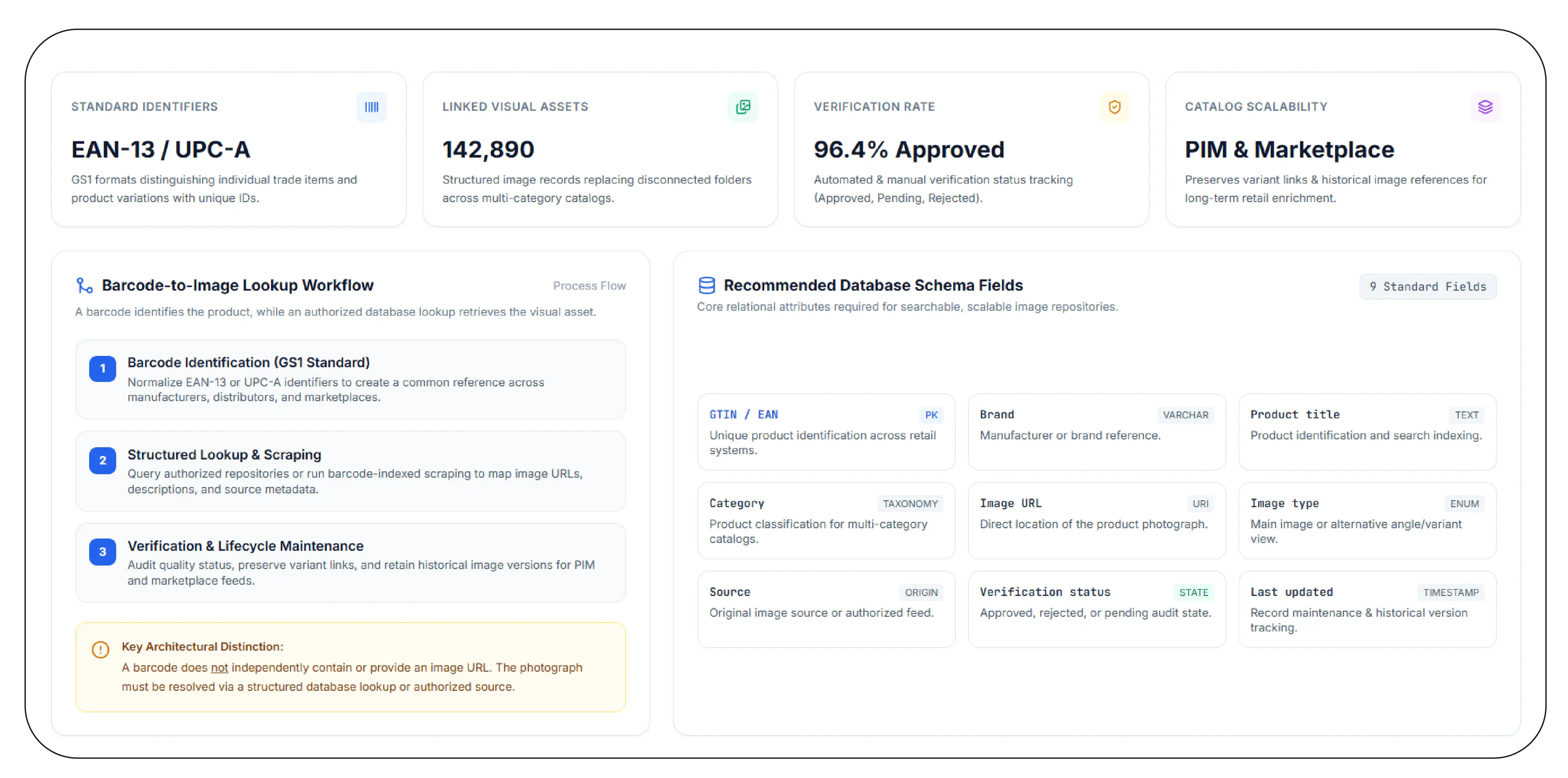
EAN and GTIN identifiers are useful for organizing product information across different retail systems. They provide a common identification reference that businesses can use when collecting product details from manufacturers, distributors, and online marketplaces.
An EAN-Linked Product Image Database connects product images with corresponding barcode identifiers, allowing businesses to retrieve and organize visual assets through structured records.
GS1 identifies EAN-13 and UPC-A as widely used barcode formats for trade item identification. Its documentation explains that GTINs distinguish individual trade items and that different product variations receive different identifiers. Source: GS1 barcode identification.
A structured product image scraping by barcode process can use these identifiers to create searchable image repositories. Each record can include the original barcode, normalized product identifier, brand, product description, image URL, source website, and verification status.
This approach is particularly useful for distributors and multi-category retailers managing products from different manufacturers. Rather than maintaining disconnected image folders, they can organize visual assets around consistent product identifiers.
Consider these recommended database fields:
| Database field | Purpose |
|---|
| GTIN/EAN | Unique product identification |
| Brand | Manufacturer or brand reference |
| Product title | Product identification and search |
| Category | Product classification |
| Image URL | Location of the product photograph |
| Image type | Main image or alternative view |
| Source | Original image source |
| Verification status | Approved, rejected, or pending |
| Last updated | Record maintenance |
Businesses should also distinguish between a barcode's identification function and the database lookup process. A barcode does not independently provide an image URL or product photograph. The image must be obtained from a relevant database or an authorized source.
For long-term scalability, retailers should maintain historical image references, update outdated records, and preserve links between product variants and their corresponding images. This makes the database useful for catalog enrichment, marketplace integrations, and product information management systems.
What Should Indian Retailers Consider When Matching Product Images?
Indian retailers frequently manage product catalogs containing domestic brands, international products, regional packaging variations, and multiple marketplace listings. These differences create challenges when matching images with product identifiers.
Businesses that Monitor Barcode-to-image matching for Indian products should consider the availability and reliability of product information across manufacturers, distributors, and online retail platforms.
A structured product image scraping by barcode process can help connect product images with corresponding GTINs and EANs. However, retailers should not assume that every Indian product has a registered barcode or that every barcode lookup will return a complete product record.
GS1 India provides GTIN validation services through DataKart, its national product data repository. The service allows retailers and data aggregators to validate GTINs against available product information. Source: GS1 India GTIN Validation.
This is a useful verification step before collecting images from other permitted sources. It can help businesses identify invalid identifiers and improve the reliability of their product records.
Indian retailers should pay attention to the following considerations:
- Regional product variations: Packaging, language, and product presentation may differ between markets.
- Brand identification: Verify the brand and manufacturer rather than relying entirely on similar product titles.
- Barcode availability: Some handmade, customized, or unregistered products may not have assigned GTINs.
- Marketplace differences: The same product can have different image formats and listing structures across platforms.
- Image permissions: Confirm whether images can legally be collected, stored, and reused.
- Product updates: Track packaging changes, discontinued products, and revised product photographs.
The following table summarizes relevant verified developments from 2020 to 2026. It distinguishes published research and industry milestones from annual market statistics.
| Year | Verified development | Relevance to retailers |
|---|
| 2020 | Baymard reported that 56% of users initially explored product images during product-page testing. | Highlights the importance of visual product information. |
| 2021 | No comparable annual image-matching benchmark is cited here. | Businesses should maintain their own image-quality records. |
| 2022 | No comparable annual barcode-to-image statistic is cited here. | Identifier and image validation remain important operational checks. |
| 2023 | No comparable annual product-image scraping statistic is cited here. | Avoid treating unverified market estimates as industry facts. |
| 2024 | GS1 published guidance explaining GTIN uniqueness and common EAN/UPC formats. | Supports standardized product identification. |
| 2025 | GS1 reported that next-generation barcode testing was underway in more than 45 countries. | Highlights the growing importance of barcode-readiness. |
| 2026 | GS1 released updated 2D barcode implementation guidance in July 2026. | Encourages businesses to prepare product data systems for evolving barcode standards. |
Sources: Baymard Institute, GS1 GTIN guidance, GS1 2025 adoption update, and GS1 July 2026 position paper.
An important upcoming development is GS1's Ambition 2027 initiative. The industry goal is for retail point-of-sale systems to support defined GS1-standardized 2D barcodes by the end of 2027, alongside existing linear barcodes. This makes it sensible for Indian retailers to design product databases that can accommodate evolving identification requirements. Source: GS1 Ambition 2027.
How Can Structured Product Records Improve Catalog Operations?
Large e-commerce catalogs require more than product photographs and barcode numbers. Businesses also need accurate product titles, descriptions, brands, categories, identifiers, and image references to maintain consistent product information.
Product Master Data Extraction helps collect and organize these attributes into standardized records. When combined with product image scraping by barcode, businesses can connect product photographs with relevant master data and create more complete catalog entries.
A structured workflow should begin with product identification. Businesses can collect GTINs, EANs, UPCs, manufacturer part numbers, and brand details from reliable sources. Next, they can retrieve corresponding images from permitted product databases and online sources.
The resulting records should pass through normalization and validation before being integrated into internal catalog systems.
Google Merchant Center provides useful guidance for this process. Its product data specification identifies GTIN, brand, MPN, product title, and image link as important product attributes. Google also recommends accurate identifiers and warns against submitting incorrect GTIN values. Source: Google Merchant Center product data specification.
Businesses can improve their operations through these practices:
- Centralized storage: Maintain one standardized product record for each identified trade item.
- Image version control: Record when images change and retain their source information.
- Automated validation: Check image accessibility, product identifiers, and required fields.
- Duplicate management: Identify repeated records and distinguish genuine product variations.
- Scheduled updates: Refresh product records when source information changes.
- System integration: Deliver structured datasets through CSV, Excel, JSON, or API-compatible formats.
A useful implementation also includes exception reporting. Records with missing images, conflicting brand information, invalid identifiers, or uncertain product matches should be separated for review.
This prevents incomplete records from entering the primary catalog without verification. It also gives catalog managers a clear view of data-quality issues that need attention.
Ultimately, standardized master data creates a dependable foundation for inventory management, marketplace synchronization, competitive research, and digital retail operations.
Why Choose Product Data Scrape?
Product Data Scrape helps businesses streamline product information collection through structured data extraction and image collection workflows. Its Scrape Product Images & Barcodes capabilities support businesses that need organized product photographs, barcode references, and reliable catalog information. By combining product image scraping by barcode with product identification and validation processes, businesses can improve catalog consistency and reduce repetitive manual research. Structured datasets can support marketplace management, product enrichment, retail intelligence, and competitive research. Businesses can also define their required product fields, source requirements, collection frequency, and delivery formats to meet specific operational needs.
Conclusion
Accurate product identification and image management are essential for maintaining scalable e-commerce catalogs. Catalog Enrichment helps businesses organize product attributes, validate identifiers, and connect relevant images with the correct product records.
A structured product image scraping by barcode workflow can simplify product discovery, reduce inconsistent listings, and support better product information management. Combining barcode validation, image matching, and master data extraction also creates a stronger foundation for digital retail operations.
Looking to improve product catalog accuracy? Contact Product Data Scrape to explore customized data extraction solutions, verified image collection, and scalable product enrichment services for your business!
FAQs
1. What is barcode-based product image collection?
It is a process of using product barcode identifiers, such as GTINs and EANs, to locate corresponding product records and retrieve relevant images from authorized sources.
2. Can every barcode provide a product image?
No. Barcodes identify products but do not contain photographs. Businesses need connected product databases or permitted online sources to retrieve corresponding images.
3. Which barcode formats are commonly used?
Common formats include GTIN-8, UPC/GTIN-12, EAN/GTIN-13, and GTIN-14. Their applications depend on product type and packaging requirements.
4. How does Product Data Scrape support catalog enrichment?
Product Data Scrape helps businesses collect structured product information, barcode references, and images to support catalog organization, product matching, and data-quality management.
5. How can businesses verify collected product images?
Businesses can compare product identifiers, brand names, packaging, and variants, while checking image quality, source permissions, URL availability, and duplicate records.


 Singapore
 EMAIL
 PHONE













.webp)