Introduction
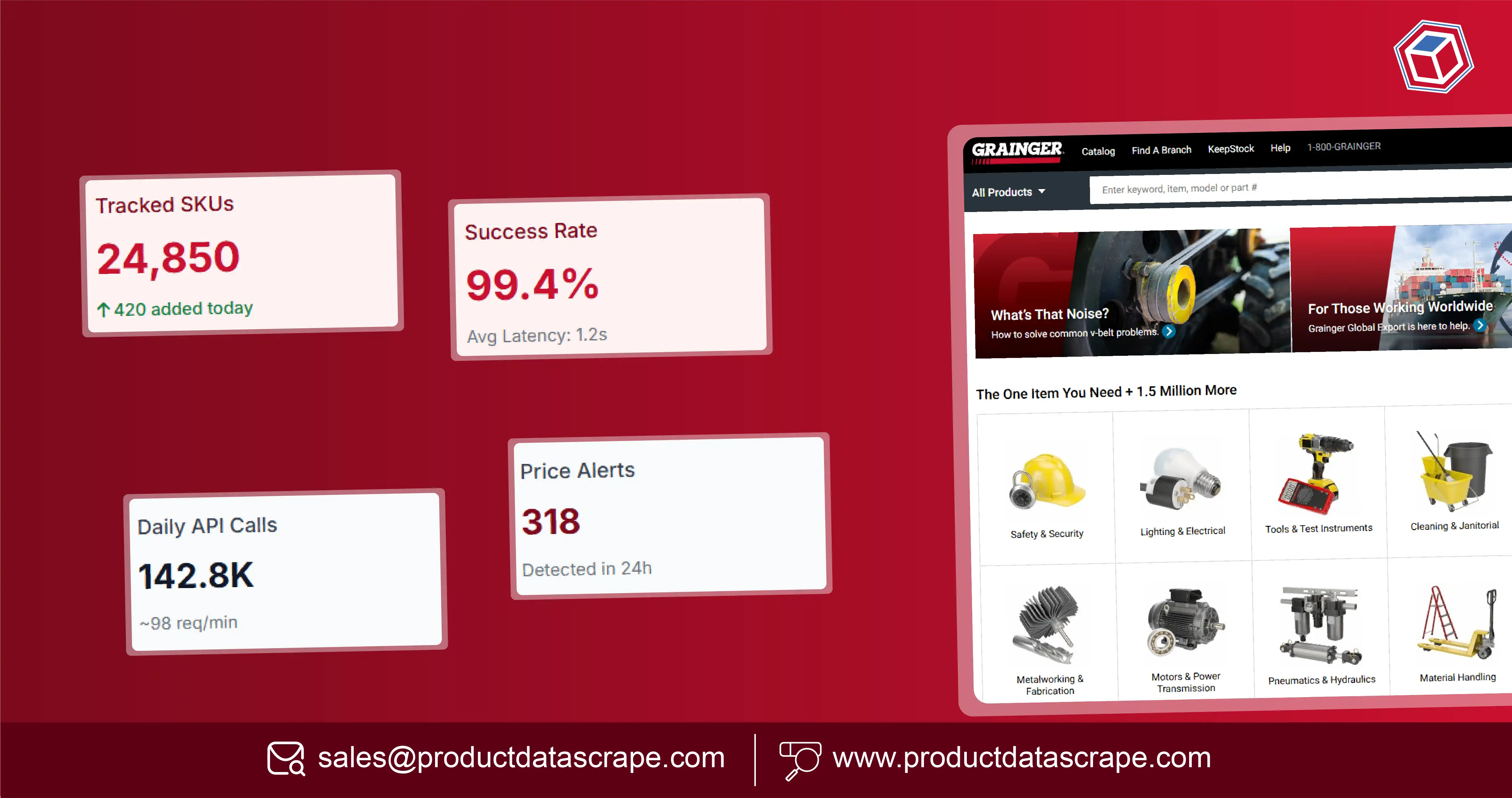
Industrial distributors, procurement teams, manufacturers, and B2B retailers need accurate product information to make informed purchasing and pricing decisions. Scraping Grainger Data helps businesses collect product names, prices, specifications, SKU numbers, categories, and availability information from online industrial catalogs. A structured Grainger Product Data Scraping API workflow can organize this information into usable datasets for product comparison, market research, and inventory intelligence.
Industrial supply catalogs contain thousands of products across maintenance, repair, and operations (MRO), electrical, safety, plumbing, material handling, and other categories. Tracking these products manually can become time-consuming, particularly when businesses monitor multiple suppliers or compare product variations.
Access to organized Fastenal Catalogs for Industrial Product Data can also help procurement and distribution teams understand product assortment, identify comparable items, and evaluate supplier positioning.
The objective is not simply to collect product listings. Businesses need standardized, validated, and regularly refreshed information that connects product identifiers with accurate descriptions, pricing, and availability. This makes industrial catalog data more useful for procurement planning, competitive analysis, and B2B pricing strategies.
Important compliance consideration: Grainger's current Terms of Access expressly prohibit automated scraping, data mining, and extraction of its website content without authorization. Fastenal's published EU website terms also restrict scraping without prior written permission. Therefore, any proposed data integration should use authorized feeds, licensed datasets, or written permission rather than assuming automated website access is permitted. Grainger Terms of Access · Fastenal Legal Terms.
How Can Businesses Compare Industrial Supplier Catalogs More Effectively?
Industrial distributors frequently need to compare product information across suppliers to understand assortment differences, identify equivalent products, and maintain competitive positioning. However, supplier catalogs often use different product descriptions, SKU formats, technical specifications, and category structures.
Grainger & Fastenal Catalog Data Scraping describes the collection and standardization of catalog information through authorized data access arrangements. Combining supplier datasets can help procurement teams compare products using consistent attributes rather than relying on product titles alone.
A structured catalog comparison process also supports Brand Protection by helping businesses identify inconsistent manufacturer references, unauthorized brand associations, and incorrect product descriptions in their own product records. These checks should be supported by verified manufacturer information and legitimate product identifiers.
Businesses should prioritize the following information:
- Manufacturer name and brand identification.
- Supplier SKU and manufacturer part number.
- Product title and technical description.
- Product dimensions, materials, and specifications.
- Product category and application.
- Published price and applicable pricing conditions.
- Stock status and delivery information, where authorized.
For example, an industrial distributor comparing safety equipment from two suppliers should first confirm that the products have equivalent certifications, dimensions, and intended applications. Comparing prices without checking these attributes can produce misleading results.
Catalog normalization makes these comparisons more reliable. It also helps businesses identify missing attributes, duplicate products, and inconsistent product naming across their procurement systems.
What Product Attributes Should Businesses Collect From Industrial Websites?
Industrial product catalogs contain technical information that purchasing teams need before selecting equipment, components, and maintenance supplies. Collecting only product names and prices is insufficient for meaningful industrial product comparison.
Industrial Product Data Scraping focuses on gathering structured product attributes from authorized industrial information sources. Businesses can use this information to build product intelligence datasets for procurement analysis, catalog enrichment, and supplier comparison.
For organizations that have appropriate access rights, the process to Extract Grainger.com product information should prioritize structured fields rather than unorganized page content.
Important product attributes include:
| Attribute | Business application |
|---|
| Product name | Product identification |
| Grainger SKU | Supplier-level identification |
| Manufacturer part number | Cross-supplier matching |
| Brand | Brand-level product comparison |
| Product description | Catalog enrichment |
| Technical specifications | Product compatibility |
| Product category | Catalog organization |
| Published price | Price comparison |
| Availability | Procurement planning |
| Product dimensions | Technical evaluation |
| Product documentation | Compliance and purchasing research |
Businesses should also preserve the original source and collection timestamp for each record. This helps purchasing teams understand when product information was obtained and whether it requires refreshing.
A standardized product schema can reduce inconsistencies between supplier catalogs. For example, dimensions should use consistent measurement units, while product descriptions should retain important technical details.
Another important consideration is product matching. Two products with similar names are not necessarily interchangeable. Manufacturer part numbers, specifications, and application requirements should be checked before grouping them into a comparable product set.
This process helps distributors create more dependable industrial product databases without confusing similar-looking products or different technical variants.
How Can Businesses Monitor Changes in Industrial Product Prices?
Industrial product prices can change because of supplier pricing decisions, manufacturer adjustments, market conditions, and product availability. Procurement teams that rely on outdated spreadsheets may miss important changes when evaluating supplier quotations.
Grainger industrial product data extraction can support price intelligence when businesses have permission to access the required product information through approved sources. The collected records can be organized to identify changes between successive observations.
Real-time price tracking should distinguish between a genuinely live price and a scheduled data refresh. A dataset collected once per day, for example, should not be described as real-time unless the underlying delivery system supports that frequency.
Businesses should capture the following pricing information:
- Product identifier and supplier SKU.
- Published unit price.
- Currency and applicable unit of measurement.
- Quantity-based pricing conditions.
- Contract or customer-specific pricing, where authorized.
- Applicable discounts and promotions.
- Collection timestamp.
- Product availability at the time of observation.
A historical pricing dataset can help businesses compare price movements and identify products that require purchasing attention.
What do the companies' financial results indicate about industrial supply markets?
The following table presents reported annual net sales for W.W. Grainger and Fastenal. These figures provide real-world business context for the scale of the industrial distribution industry. They are company-wide financial results, not product-level pricing or scraping statistics.
ANNUAL NET SALES — USD BILLIONS
| Year | Grainger | Fastenal |
|---|
| 2020 | $11.797B | $5.647B |
| 2021 | $13.022B | $6.011B |
| 2022 | $15.228B | $6.981B |
| 2023 | $16.478B | $7.347B |
| 2024 | $17.168B | $7.546B |
| 2025 | $17.942B | $8.201B |
| 2026* | $14.944B | $7.052B |
*2026 figures represent the nine months ended September 30, 2026, not full-year sales. Figures rounded to three decimal places.
Sources: Grainger SEC Annual Report, Fastenal SEC Annual Report, Grainger Q3 2026 results, and Fastenal Q3 2026 results.
These figures show the scale and continued business activity of both distributors. For procurement teams, the practical implication is that product assortment, pricing, and availability information need to be maintained systematically rather than through occasional manual checks.
How Can Businesses Build More Accurate Industrial Product Databases?
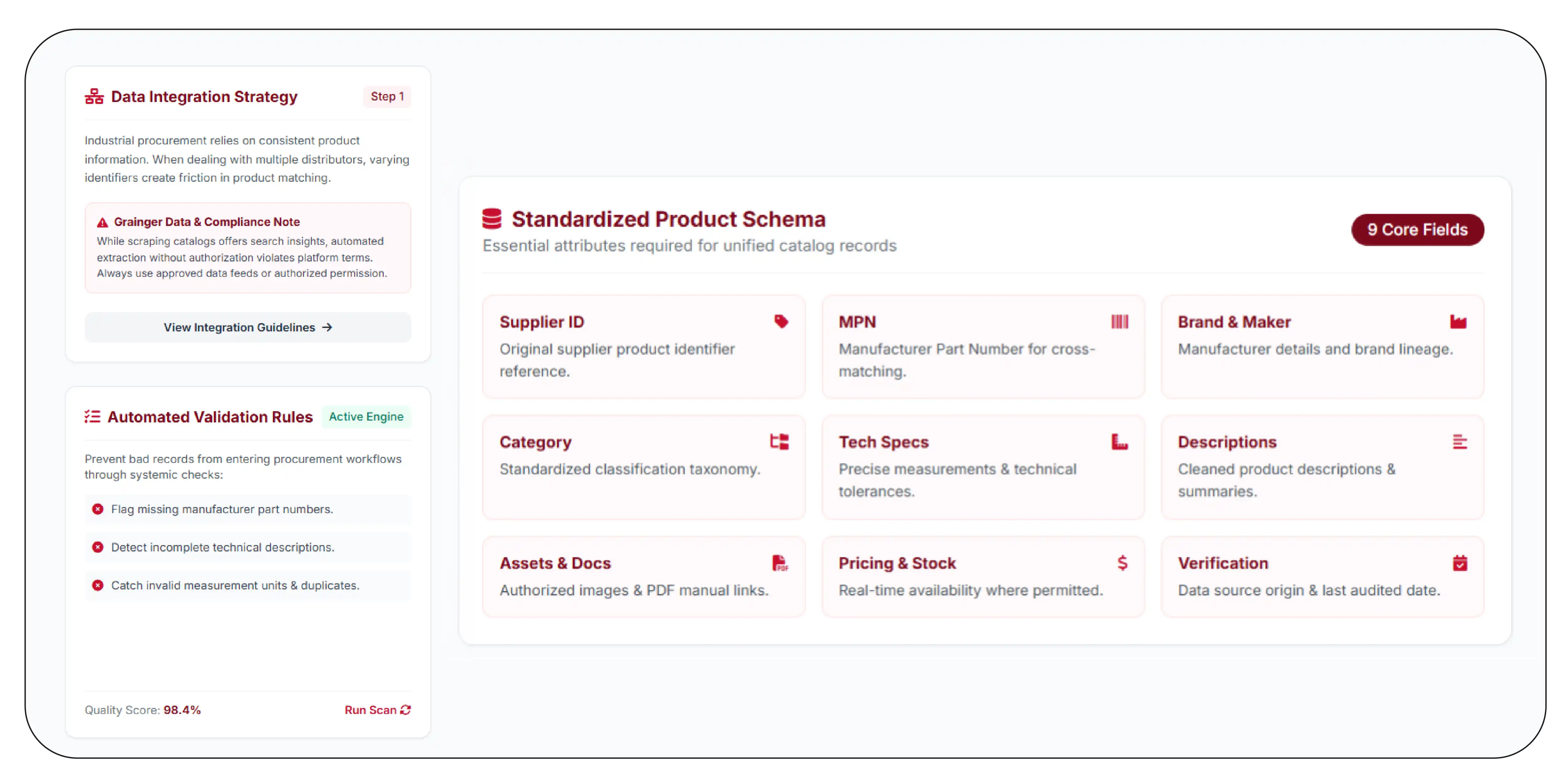
Industrial procurement platforms require consistent product information to support purchasing, inventory management, and supplier evaluation. When businesses work with multiple distributors, inconsistent product descriptions and identifiers can make product matching difficult.
The ability to Extract product details from industrial catalogs through authorized data sources helps organizations create standardized product records. These records can connect manufacturer details, technical specifications, supplier references, and pricing information.
Scraping Grainger Data can be used as a search topic for developing an authorized catalog data integration strategy. However, Grainger's published website terms prohibit scraping and automated data extraction without authorization. Businesses should obtain the required permission or use an approved data feed.
A structured product database should include:
- Original supplier product identifier.
- Manufacturer part number.
- Brand and manufacturer details.
- Standardized product category.
- Technical specifications and measurements.
- Product descriptions.
- Authorized image and documentation references.
- Pricing and availability records, where permitted.
- Data source and last verification date.
Product matching is especially important when multiple suppliers distribute the same manufacturer's product. A shared manufacturer part number can provide a useful matching reference, but businesses should also verify product configuration, packaging quantity, and specifications.
For example, an industrial fastener listed by two distributors may have a similar product title but a different thread size or material grade. A reliable database should preserve these differences rather than merging the records.
Businesses should also introduce validation rules to identify missing manufacturer numbers, incomplete descriptions, invalid units, and duplicate product entries.
This makes industrial product information more useful for procurement applications and reduces errors caused by inconsistent catalog structures.
How Can Procurement Teams Organize SKU and Pricing Information?
Managing industrial SKUs across multiple suppliers requires a consistent identification and pricing framework. A supplier's product number may differ from the manufacturer's part number, even when both records refer to the same physical product.
Industrial SKU and pricing data scraping refers to collecting product identifiers and pricing information through permitted data access arrangements. Businesses can use these records to establish relationships between supplier-specific SKUs and manufacturer-level product references.
Scraping Grainger Data can form part of an industrial data research strategy, provided the business has the necessary authorization for the information being collected.
A useful SKU management framework should include:
| Data field | Why it matters |
|---|
| Supplier SKU | Identifies the supplier listing |
| Manufacturer part number | Supports product matching |
| GTIN, if available | Supports standardized identification |
| Brand | Identifies the product brand |
| Product variant | Distinguishes configurations |
| Unit of measure | Prevents quantity confusion |
| Published price | Supports price analysis |
| Currency | Enables consistent comparisons |
| Availability status | Supports purchasing decisions |
| Updated timestamp | Establishes data freshness |
Businesses should avoid comparing prices without accounting for packaging and units of measure. A supplier may quote a product per individual piece, while another may list a package containing multiple pieces.
Similarly, published prices may not include freight, taxes, customer-specific discounts, or negotiated contract terms.
A reliable pricing comparison system should therefore normalize the pricing unit before calculating differences. It should also preserve the original quoted value so procurement professionals can verify the calculation.
Historical price records can help businesses identify products that need supplier quotation reviews or purchasing negotiations.
This approach supports more transparent procurement decisions and gives purchasing teams a structured way to evaluate industrial supplier information.
How Can Businesses Use Another Supplier's Catalog for Better Market Intelligence?
Comparing multiple industrial distributors gives businesses a broader understanding of product assortment, supplier positioning, and procurement options. Fastenal is particularly relevant because its product portfolio covers fasteners, safety supplies, and other industrial product categories.
Fastenal catalog data scraping should be approached through authorized access arrangements. Fastenal's published EU website legal terms explicitly state that scraping its website using software tools requires prior written permission. Businesses should confirm the applicable terms for their relevant Fastenal website and region before collecting information.
Scraping Grainger Data alongside authorized Fastenal catalog information can help businesses create a structured supplier comparison dataset.
Useful comparison fields include:
- Supplier product identifiers.
- Manufacturer and brand information.
- Product descriptions and technical specifications.
- Product categories.
- Unit prices and quantity conditions.
- Product availability.
- Delivery information, where provided.
- Product documentation references.
Fastenal's financial disclosures demonstrate the importance of digital procurement and product information management. Its 2025 annual reporting stated that its Digital Footprint reached 62.4% of sales in December 2025. The company defines this measure using sales through its Fastenal Managed Inventory technology and qualifying eBusiness activities. Source: Fastenal 2025 Annual Report.
This is a company-reported digital sales metric, not a measure of catalog scraping or API adoption.
For procurement teams, the broader takeaway is that digital product information and supply chain integration are important components of modern industrial distribution.
Businesses can use properly licensed catalog datasets to evaluate supplier coverage, identify equivalent products, organize purchasing information, and improve internal procurement intelligence.
Why Choose Product Data Scrape?
Product Data Scrape helps businesses develop structured industrial product datasets through customized data collection and enrichment workflows. Its Grainger Product Dataset requirements can be organized around product identifiers, manufacturer details, specifications, categories, pricing, and availability information from authorized sources. Scraping Grainger Data projects can be designed around approved access methods, validation rules, and structured delivery formats. Businesses can define their required fields, update schedules, and integration requirements to support procurement intelligence, product comparisons, and industrial catalog management. Data quality, traceability, and source permissions remain central to building dependable datasets.
Conclusion
Industrial distributors need accurate product information to compare suppliers, evaluate prices, and monitor product availability. Structured industrial B2B & MRO data can help procurement teams organize product specifications, supplier SKUs, and pricing information into usable datasets.
A properly authorized Scraping Grainger Data strategy can support product intelligence and catalog comparison without compromising supplier access requirements.
Combining standardized product records, validation processes, and scheduled updates creates a stronger foundation for procurement decisions.
Looking to streamline industrial catalog research? Contact Product Data Scrape to discuss customized data extraction, authorized supplier information, and scalable industrial product intelligence solutions for your business!
FAQs
1. What is industrial catalog data collection?
It is the process of gathering structured product information, including SKUs, specifications, prices, brands, and availability, from authorized industrial supplier databases and catalog sources.
2. Which product details are important for procurement analysis?
Important details include manufacturer part numbers, supplier SKUs, product descriptions, technical specifications, unit prices, packaging quantities, and availability information.
3. Can businesses compare Grainger and Fastenal products?
Yes. Businesses can compare equivalent products using authorized catalog datasets, matching manufacturer identifiers, specifications, packaging quantities, and pricing conditions.
4. Is automated collection from Grainger permitted?
Grainger's published Terms of Access prohibit scraping and automated data extraction. Businesses should obtain authorization or use approved data-sharing arrangements.
5. How can Product Data Scrape support industrial research?
Product Data Scrape can help businesses organize authorized industrial product datasets for SKU matching, pricing analysis, supplier comparisons, and catalog enrichment.


 Singapore
 EMAIL
 PHONE











.webp)