Quick Overview
A leading grocery and FMCG brand partnered with Product Data Scrape to
strengthen pricing intelligence, inventory monitoring, and competitor benchmarking across the
online grocery market. Through Morrisons Grocery Delivery Data Scraping, the client gained
access to real-time pricing, discount trends, product assortment updates, and delivery
availability insights from Morrisons’ digital grocery platform. Over a five-month engagement,
our automated retail intelligence framework significantly improved the client’s ability to react
to competitor pricing movements and optimize promotional planning. By leveraging scalable
systems to Extract Morrisons Grocery &
Gourmet Food Data, the brand achieved a 42% improvement
in pricing responsiveness, reduced manual monitoring efforts by 68%, and improved product
availability tracking accuracy by 37%.
The Client
The client was a rapidly expanding grocery retail and consumer packaged goods
brand operating across online marketplaces and regional supermarket chains in the UK. The
company specialized in packaged foods, gourmet grocery items, beverages, frozen products, and
household essentials. With increasing competition in the online grocery delivery sector, the
retailer faced mounting pressure to optimize pricing strategies and maintain competitive
visibility across digital shelves.
Consumer expectations for real-time delivery, dynamic discounts, and product
availability were rapidly reshaping the grocery landscape. The client needed stronger retail
intelligence capabilities to keep pace with fluctuating competitor pricing and fast-changing
consumer demand patterns. Through advanced Morrisons Retail Benchmark Analytics, the company
aimed to improve market visibility and strengthen category-level decision-making.
Before working with Product Data Scrape, the client relied heavily on manual
tracking processes and fragmented reporting systems. These outdated methods slowed down
competitive analysis and reduced operational efficiency. Access to automated Product Competitive
Pricing Services became essential for monitoring price fluctuations, promotions, and
inventory
changes across grocery categories. The client recognized that digital transformation was
necessary to improve agility, strengthen merchandising strategies, and support long-term growth
in the increasingly data-driven grocery retail ecosystem.
Goals & Objectives
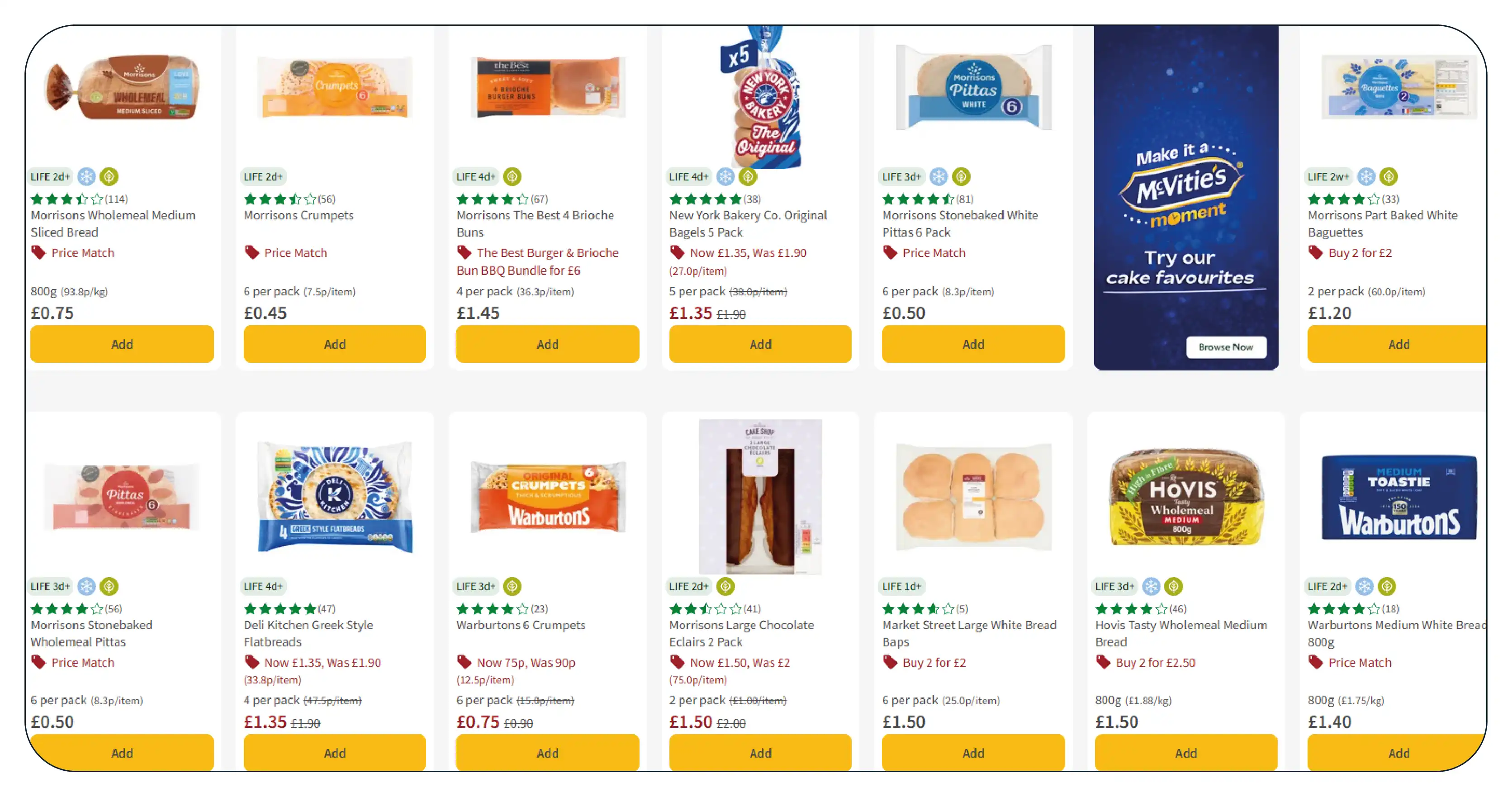
The client’s primary goal was to establish a scalable retail intelligence
system capable of monitoring online grocery pricing, promotions, inventory changes, and
category-level trends in real time. They wanted better visibility into competitor pricing
movements and improved responsiveness to changing market conditions. The business also aimed to
Track Real-Time Grocery Prices on Morrisons to strengthen pricing strategies across multiple
product categories.
From a technical standpoint, the client required a fully automated solution
that could collect, process, and structure large-scale grocery datasets with high accuracy and
speed. The platform needed seamless dashboard integration, automated reporting capabilities, and
real-time analytics functionality. Leveraging a structured Grocery store dataset was essential
for enabling advanced forecasting, inventory planning, and pricing optimization workflows.
Improve pricing responsiveness by over 40%
Reduce manual monitoring efforts by 65%
Increase real-time pricing update frequency
Improve inventory tracking efficiency by 35%
Enhance competitor benchmarking coverage
Accelerate promotional planning and reporting cycles
Improve grocery category forecasting accuracy
The Core Challenge
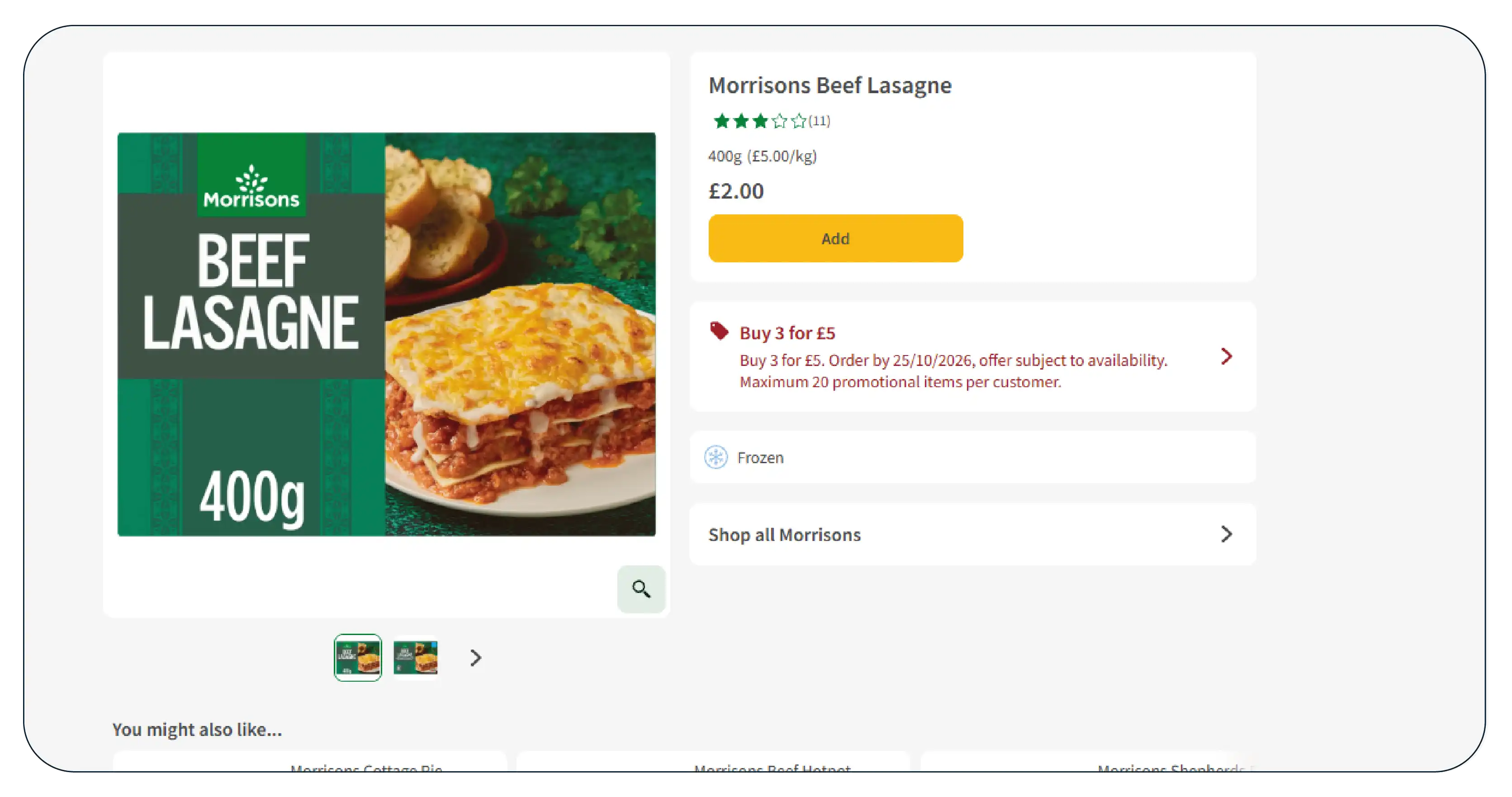
The client faced major operational inefficiencies due to fragmented retail
intelligence systems and inconsistent data visibility across online grocery platforms. Grocery
prices, stock availability, and promotional campaigns changed multiple times daily, making
manual tracking processes highly inefficient and unreliable.
The absence of automated systems to Extract Morrisons Grocery Product Catalog
Data limited the retailer’s ability to monitor product assortment changes and competitor pricing
movements accurately. Merchandising and pricing teams relied on delayed reports, reducing their
responsiveness to market fluctuations and seasonal demand changes.
The company also struggled with limited visibility into digital shelf
performance and online product positioning. Without effective Digital Shelf Analytics, the
client found it difficult to monitor product rankings, category visibility, customer engagement
trends, and stock availability across grocery segments.
Operational bottlenecks further impacted internal decision-making. Teams worked
with disconnected spreadsheets and inconsistent reporting formats, slowing collaboration between
pricing, inventory, and merchandising departments. These limitations reduced forecasting
accuracy and weakened the client’s ability to maintain competitive pricing strategies in the
highly dynamic grocery delivery market. The organization required a scalable and automated
retail intelligence infrastructure to overcome these challenges and improve market
responsiveness.
Our Solution
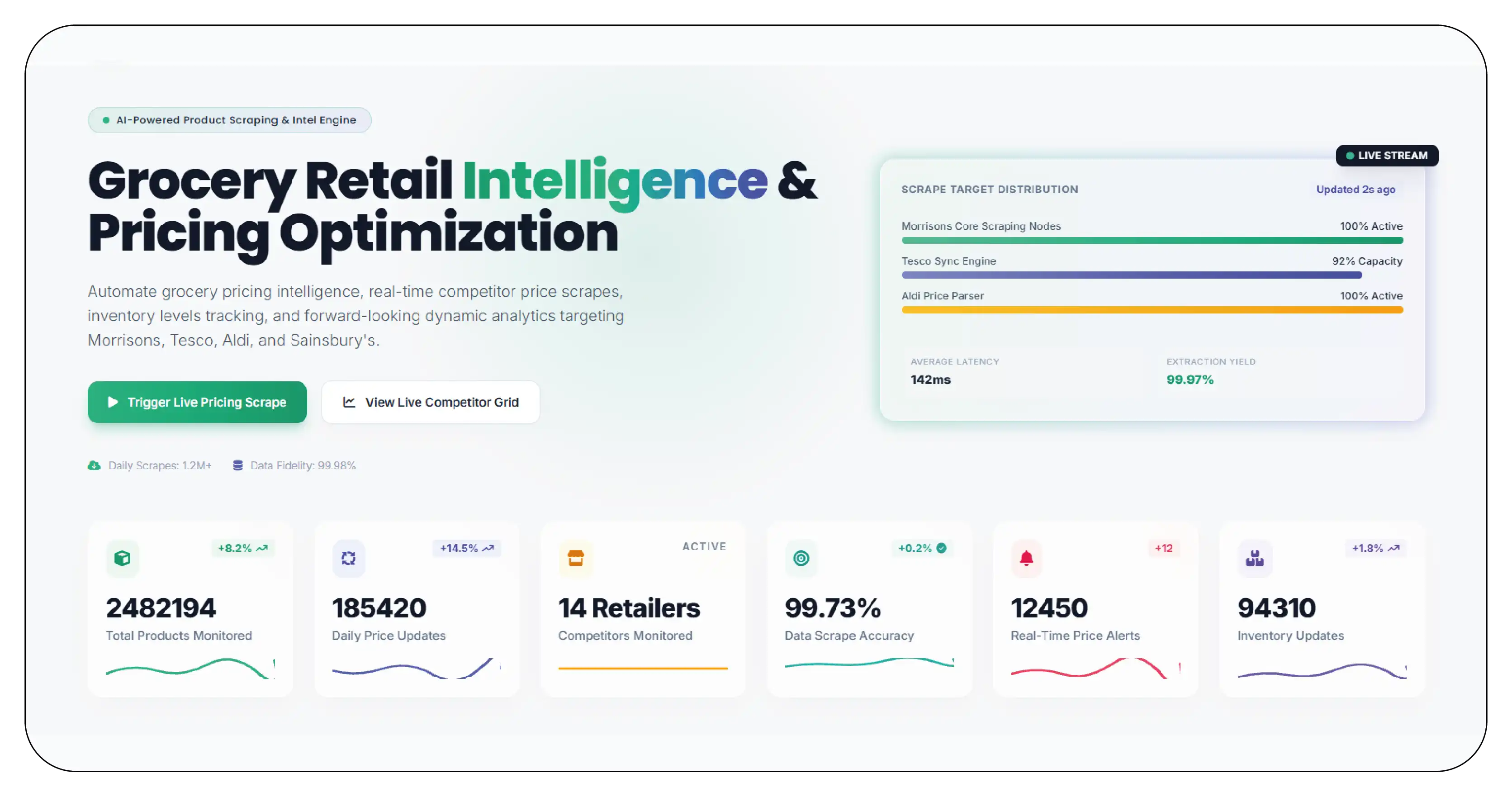
Product Data Scrape implemented a customized multi-phase grocery retail
intelligence solution designed specifically to address the client’s pricing optimization and
market monitoring requirements. Our approach combined automated extraction technologies,
centralized analytics frameworks, and real-time reporting systems to improve visibility across
grocery categories.
In the first phase, we deployed scalable scraping pipelines capable of
collecting large volumes of grocery product information from Morrisons delivery platforms. These
automated systems captured pricing updates, discounts, inventory availability, product rankings,
delivery schedules, ratings, and category-level assortment changes. By enabling the client to
Analyze Competitor Pricing on Morrisons, the solution provided continuous visibility into
competitor strategies and promotional campaigns.
The second phase focused on data standardization and dashboard integration. Our
engineering team consolidated raw retail data into centralized reporting systems that supported
real-time decision-making across pricing, merchandising, and analytics teams. This eliminated
the dependency on manual spreadsheets and fragmented reporting workflows.
We also integrated advanced Web
Scraping API Services to automate data delivery
and streamline reporting processes. These APIs enabled seamless access to structured datasets
for forecasting models, inventory planning tools, and internal analytics platforms.
Next, we implemented automated alert systems to notify the client about major
pricing fluctuations, stock shortages, and emerging grocery trends. Real-time monitoring
capabilities improved responsiveness to competitor promotions and enhanced pricing agility
across grocery categories.
Finally, predictive analytics models were incorporated to improve demand
forecasting and promotional planning accuracy. Historical data combined with live market
intelligence allowed the client to optimize category strategies and improve operational
efficiency throughout the grocery supply chain.
Results & Key Metrics
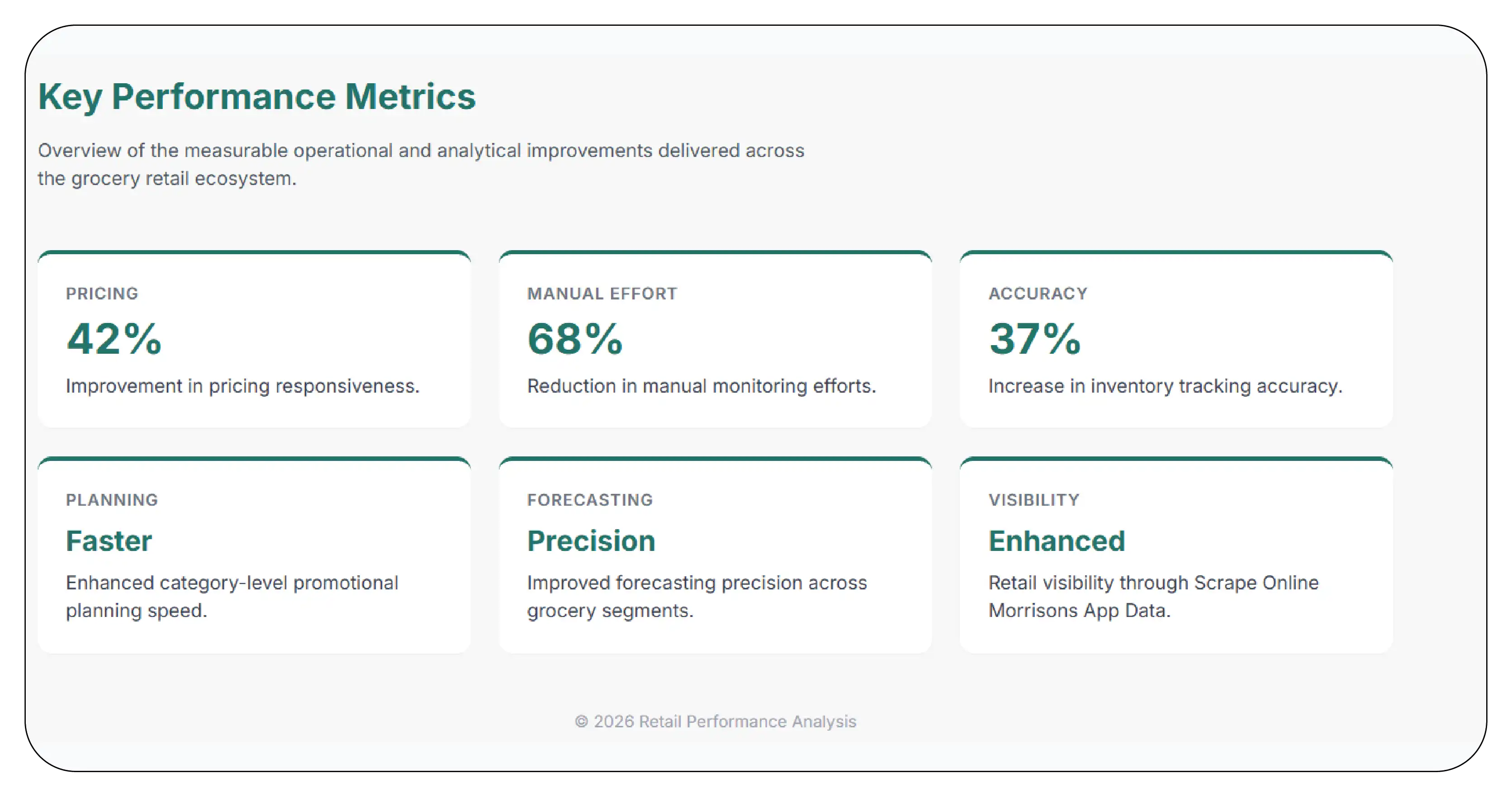
The implementation delivered measurable operational and analytical improvements
across the client’s grocery retail ecosystem.
42% improvement in pricing responsiveness
68% reduction in manual monitoring efforts
37% increase in inventory tracking accuracy
Faster category-level promotional planning
Improved forecasting precision across grocery segments
Enhanced retail visibility through Scrape Online Morrisons Grocery Delivery App
Data
Automated analytics supported by Pricing
Intelligence Services
Results Narrative
Following deployment, the client gained significantly stronger control over
pricing strategies, competitor monitoring, and inventory analytics. Real-time retail
intelligence enabled faster responses to market changes and improved coordination between
merchandising and pricing teams. Automated monitoring reduced reporting delays while increasing
analytical accuracy across grocery categories. The retailer also improved promotional planning
by identifying competitor discount patterns and customer demand shifts more efficiently.
Overall, the solution helped the brand strengthen digital competitiveness, improve forecasting
accuracy, and create a more agile decision-making environment within the evolving grocery
delivery ecosystem.
What Made Product Data Scrape Different
Product Data Scrape delivered a highly scalable grocery intelligence framework
tailored to the client’s operational and analytical requirements. Our proprietary extraction
systems provided high-frequency updates, structured datasets, and seamless dashboard integration
for faster business insights.
Unlike traditional monitoring approaches, our automation-first framework
combined predictive analytics, real-time alerts, and advanced extraction technologies to improve
decision-making accuracy. Through specialized expertise to Extract Morrisons Supermarket Data,
we enabled the client to monitor pricing, promotions, inventory, and product assortment changes
with exceptional efficiency and reliability across the online grocery retail landscape.
Client’s Testimonial
“Product Data Scrape helped us completely transform our grocery retail
intelligence operations. Their automated monitoring framework gave us real-time visibility
into competitor pricing, inventory trends, and promotional activity across digital grocery
platforms. The ability to Monitor Morrisons Inventory Availability in real time
significantly improved our pricing responsiveness and merchandising decisions. Their
expertise, accuracy, and scalable analytics infrastructure enabled our teams to make faster
and more informed decisions in a highly competitive grocery market.”
— Director of Retail Strategy & Analytics
Conclusion
The online grocery delivery market continues to evolve rapidly with increasing
competition, changing consumer behavior, and dynamic pricing strategies. Businesses that
leverage automated retail intelligence solutions can improve market responsiveness, optimize
pricing decisions, and strengthen inventory planning for long-term growth.
Using the advanced Morrisons
Grocery Data Scraping API, Product Data
Scrape
enabled the client to gain real-time visibility into grocery pricing, inventory movement,
promotions, and competitor activities. Our customized Morrisons Grocery Delivery Data Scraping
framework transformed fragmented retail data into actionable business intelligence, empowering
the client to improve operational efficiency and maintain a stronger competitive position in the
grocery retail ecosystem.
FAQs
1. What is Morrisons grocery delivery data scraping?
It is the automated process of extracting grocery pricing, inventory, promotions, and product
information from Morrisons delivery platforms for analytics and business intelligence purposes.
2. How can grocery data scraping help retailers?
It helps retailers monitor competitor pricing, optimize promotions, improve inventory planning,
and identify customer demand trends in real time.
3. What types of grocery data can be extracted?
Businesses can collect product names, prices, discounts, stock availability, delivery schedules,
ratings, reviews, and category-level information.
4. Why is real-time grocery pricing important?
Real-time pricing intelligence allows businesses to respond quickly to competitor promotions,
dynamic pricing changes, and seasonal market trends.
5. How does automated grocery scraping improve operations?
Automation reduces manual monitoring efforts, improves data accuracy, accelerates reporting, and
enables faster data-driven decision-making across retail teams.



 Singapore
 EMAIL
EMAIL
 PHONE
PHONE


.webp)
.webp)
.webp "thumb")
.webp "thumb")








.webp)