Executive Summary
A seller listing the same catalogue on Amazon, Flipkart, Meesho, and Myntra is not running one business. They are running four, and the four do not talk to each other.
Stock sold on one channel does not decrement on the others. A competitor's price cut on one platform is invisible on the rest. The Buy Box is won or lost per marketplace, on rules that differ per marketplace. And the seller, in the middle, is reconciling four dashboards by hand — over-selling stock they no longer have, holding stale prices while a rival undercuts, and finding out days late.
The operational fix is a single data layer that unifies price, stock, and position across every channel. This report covers what a multichannel seller data API has to provide to power that layer, the traps that make cross-channel seller data unreliable, and what the feed looks like in practice.
This report is published by Product Data Scrape. Sample figures are illustrative of structure, not a live census.
Why Multi-Channel Selling Breaks Without a Data Layer
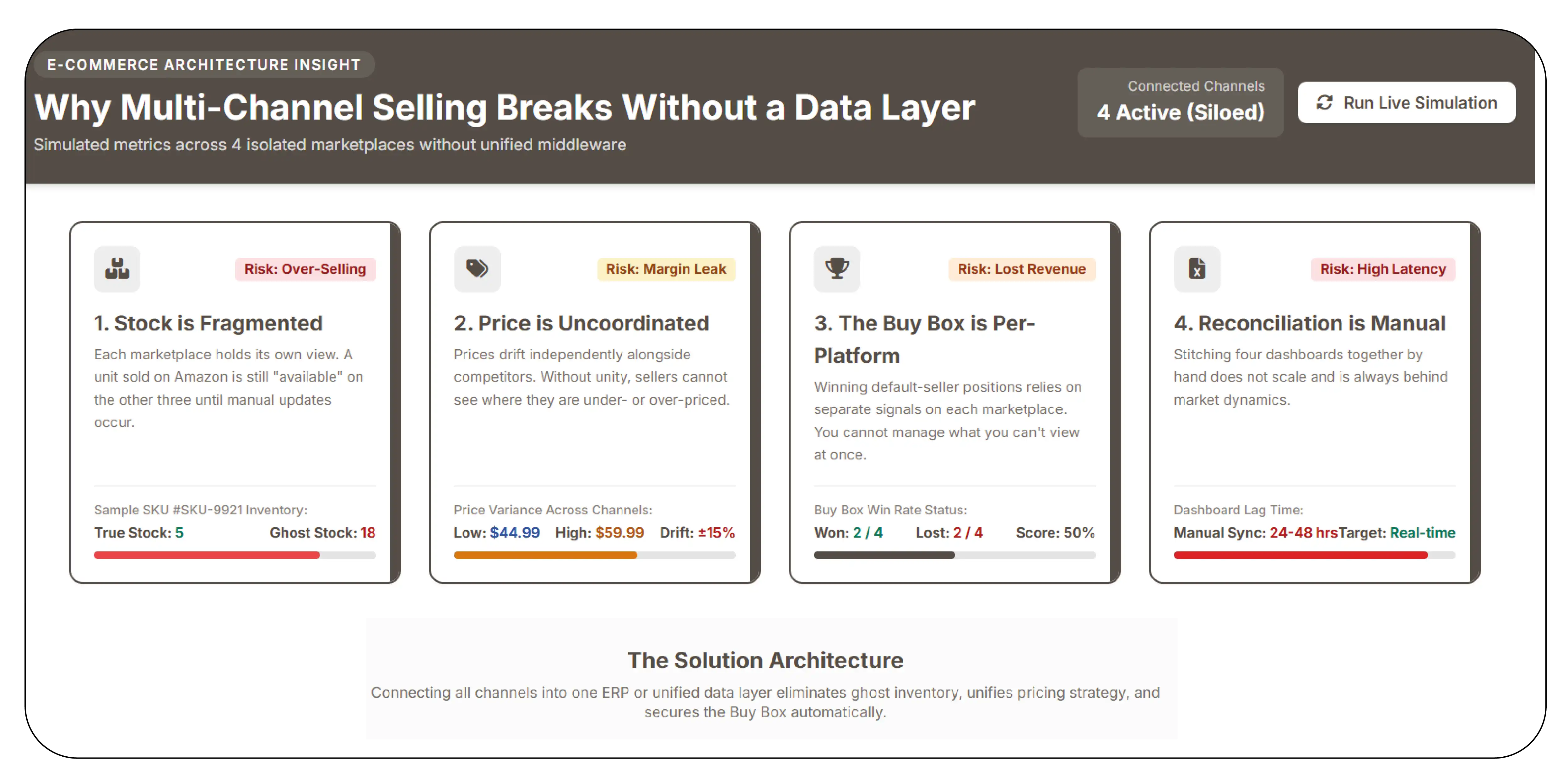
Stock is fragmented. Each marketplace holds its own view of the seller's inventory. A unit sold on one is still "available" on the other three until someone manually adjusts it. Over-selling — accepting an order for stock that is gone — is the direct, costly result.
Price is uncoordinated. A seller's price on each channel drifts independently, and competitor prices on each channel move independently. Without a unified view, the seller cannot see where they are under- or over-priced relative to each channel's competition.
The Buy Box is per-platform. Winning the default-seller position is decided separately on each marketplace, on different signals. A seller cannot manage what they cannot see across all four at once.
Reconciliation is manual and late. The seller stitches four dashboards together by hand, which does not scale and is always behind the market.
This is the exact pain behind requests to "connect all channels" into one ERP, and behind seller-analytics tools that need a unified feed to function.
The Traps
Trap one: treating channels as independent
A per-channel feed with no common product key cannot unify anything. The value is in the join — the same SKU mapped across all four marketplaces — not in four separate streams.
Trap two: price without competitive context
A seller's own price on a channel is half the picture. Without the competing sellers' prices and the Buy Box holder on that channel, the price is a number with nothing to compare it to.
Trap three: stock as a boolean
"In stock" is not enough for inventory sync. The feed needs the seller's own listing state per channel, low-stock signals, and — where surfaced — quantity indicators, so the sync logic can act before a stockout, not after.
Trap four: no common timestamp
Cross-channel decisions require the four channels captured close in time. A feed that captures Amazon this morning and Flipkart this evening cannot support a coherent repricing or sync decision.
What a Multichannel Seller Feed Provides
| Field group |
Fields |
| Identity |
master_sku, channel, channel_listing_id, product_url |
| Own listing |
own_price, own_stock_state, own_stock_signal, listing_status |
| Competition |
all_sellers[], lowest_price, buy_box_holder, our_buy_box_status |
| Signals |
price_gap_to_lowest, price_gap_to_buybox, reprice_recommendation |
| Sync |
stock_state_per_channel, last_sold_signal |
| Capture |
captured_at, capture_window |
The master_sku join and the per-channel buy_box_status are what make this a unifying layer rather than four disconnected feeds.
Sample Data: One SKU Across Four Channels
An illustrative unified view of one SKU across four marketplaces, captured together.
| Channel |
Our Price |
Lowest Competitor |
Buy Box |
Our Stock |
Signal |
| Marketplace A |
1,299 |
1,289 |
Competitor |
In stock |
Reprice down |
| Marketplace B |
1,299 |
1,349 |
Us |
In stock |
Hold |
| Marketplace C |
1,275 |
1,275 |
Us (tie) |
Low stock |
Watch stock |
| Marketplace D |
1,320 |
1,299 |
Competitor |
In stock |
Reprice down |
Illustrative figures.
The unified row reveals what four separate dashboards hide: the seller is priced identically (1,299) on two channels but losing the Buy Box on one and winning on the other, is cheapest on a third where stock is running low, and is over-priced on the fourth. Each channel needs a different action, and only a unified feed makes that visible in one view.
The structured record:
{
  "master_sku": "SKU-AUDIO-2211",
  "captured_at": "2026-07-15T12:00:00+05:30",
  "channels": [
    {
      "channel": "marketplace_a",
      "own_price": 1299,
      "listing_status": "active",
      "own_stock_state": "in_stock",
      "lowest_competitor_price": 1289,
      "buy_box_holder": "competitor",
      "our_buy_box_status": false,
      "reprice_recommendation": "reduce_to_regain"
    },
    {
      "channel": "marketplace_c",
      "own_price": 1275,
      "own_stock_state": "in_stock",
      "own_stock_signal": "low",
      "lowest_competitor_price": 1275,
      "buy_box_holder": "us",
      "our_buy_box_status": true,
      "reprice_recommendation": "hold_watch_stock"
    }
  ]
}
What the Feed Enables
Inventory sync that prevents over-selling. With stock state unified across channels, a sale on one can trigger adjustment on the others before an over-sell happens.
Rule-based repricing per channel. The feed carries each channel's competitive context and Buy Box status, so repricing rules can act correctly per marketplace instead of applying one price everywhere.
Buy Box management across platforms. Seeing win/loss status on all channels at once lets the seller prioritise where a small move regains the box.
One reconciliation instead of four. The manual stitching of four dashboards is replaced by one unified view, which is the entire point.
Who Uses a Multichannel Seller Feed
Multi-marketplace sellers managing the same catalogue across Amazon, Flipkart, Meesho, and Myntra unify inventory and pricing instead of reconciling by hand.
Seller-tool and ERP builders need this feed as the data layer beneath their product — the explicit ask behind "connect all my channels into one ERP" and "Seller Analytics Hub" requests.
Repricing-engine builders consume the competitive context and Buy Box status to drive per-channel repricing rules.
Operations teams use the unified stock view to stop over-selling across channels.
Limitations
Cross-channel SKU mapping depends on an accurate master-SKU join and is imperfect where listings diverge. Buy Box and competitive fields vary in availability by marketplace. Repricing recommendations are rule inputs, not decisions — the rules remain the seller's. We collect publicly available marketplace data only; sample figures illustrate structure rather than audited statistics.
About the Data
This report was produced using multichannel seller data methods from Product Data Scrape. Our multichannel seller data API unifies own-price, stock state, competitive prices, lowest-price, and Buy Box status across Amazon, Flipkart, Meesho, Myntra, and other marketplaces on a common master-SKU key, captured in one window.
Delivered as JSON, CSV, via REST API, or pushed to your warehouse — the data layer beneath cross-channel inventory sync and repricing.
Want a unified feed on your own catalogue? Product Data Scrape will map your SKUs across your channels and deliver one view of price, stock, and Buy Box, so each channel gets the action it actually needs.
Product Data Scrape — turning marketplace complexity into decision-ready data.



 Singapore
 EMAIL
EMAIL
 PHONE
PHONE


.webp "thumb")










.webp)