Quick Overview
Client Name / Industry: A global e-commerce and consumer products brand operating across multiple markets needed a scalable way to monitor customer reviews and understand product feedback.
Service / Duration: Product Data Scrape provided automated review data extraction, monitoring, structuring, and analytics support over a multi-phase implementation period.
Key Impact Metrics: The solution delivered up to 70% faster review processing, approximately 85% broader structured review coverage, and nearly 60% less manual monitoring effort. With Review Monitoring Automation for Global Brands, the client gained faster access to organized feedback, improved visibility across markets, and a stronger foundation for identifying customer concerns, tracking ratings, analyzing sentiment, and supporting product and marketplace decisions.
The Client
The client was a global consumer and e-commerce brand operating in a highly competitive digital marketplace where ratings, reviews, and customer sentiment increasingly influence purchasing decisions. As shoppers compare products across marketplaces and retail websites, brands face growing pressure to understand feedback quickly and respond before negative experiences affect product perception or sales performance. This market environment made transformation essential for the client.
Before partnering with Product Data Scrape, the brand depended on fragmented processes to monitor customer reviews across multiple digital sources. Teams had to manually locate, collect, organize, and review feedback from different marketplaces and websites. This approach became increasingly difficult as the product portfolio and geographical coverage expanded.
The brand also faced challenges with inconsistent review formats, scattered product information, varying update frequencies, and increasing data volumes. Manual collection created delays and made it difficult to maintain a continuously updated view of customer sentiment. Important patterns could remain hidden because teams were spending significant time gathering information rather than analyzing it.
Product Data Scrape introduced Automated Customer Review Tracking, Win the digital shelf as a scalable approach to address these challenges. The transformation enabled the client to move toward structured, automated review monitoring while improving visibility into customer experiences across products and markets.
Goals & Objectives
The primary business goal was to create a scalable review monitoring process capable of supporting growing product volumes, multiple markets, and numerous digital sources. The client wanted to improve the speed and accuracy of review collection while reducing repetitive manual activities. Another important goal was to make customer feedback easier for business teams to access and use when evaluating products, customer experience, and marketplace performance.
From a technical perspective, the project focused on building an automated extraction and processing workflow that could collect publicly available review information from defined sources. The solution needed standardized fields, automated refreshes, reliable data processing, and integration-ready outputs. The client also wanted analytics capabilities that could support faster identification of rating changes, recurring concerns, and emerging customer trends. Online Customer Feedback Monitoring became an important part of the framework, allowing the brand to establish a more consistent feedback intelligence process.
Achieve up to 70% faster review data processing.
Increase structured review coverage by approximately 85%.
Reduce manual monitoring effort by nearly 60%.
Improve consistency across collected review datasets.
Reduce delays between review publication and business visibility.
Support scalable monitoring across products and international markets.
The Core Challenge
The client's biggest challenge was the fragmented nature of review information. Customer feedback was distributed across multiple marketplaces, retailer websites, and digital channels, each using different layouts, structures, rating systems, and pagination methods. Collecting this information manually created operational bottlenecks and made continuous monitoring difficult.
As review volumes increased, the existing process became harder to scale. Teams could manually check selected products, but expanding monitoring across a larger catalog required substantially more time and resources. The process also introduced quality risks, including duplicate records, inconsistent product names, missing fields, formatting differences, and delayed updates.
Another issue was the gap between data collection and decision-making. When reviews were gathered manually at periodic intervals, new customer concerns could remain unnoticed until the next review cycle. This reduced the speed at which teams could respond to changing customer expectations.
Product Data Scrape addressed these problems through Scrape Review Data for Brand Monitoring, creating an automated workflow for collection, standardization, validation, and scheduled refreshes. The approach helped improve data consistency while reducing repetitive manual work. It also gave the client a more dependable stream of structured review information that could be analyzed for ratings, customer concerns, sentiment, and product performance.
Our Solution
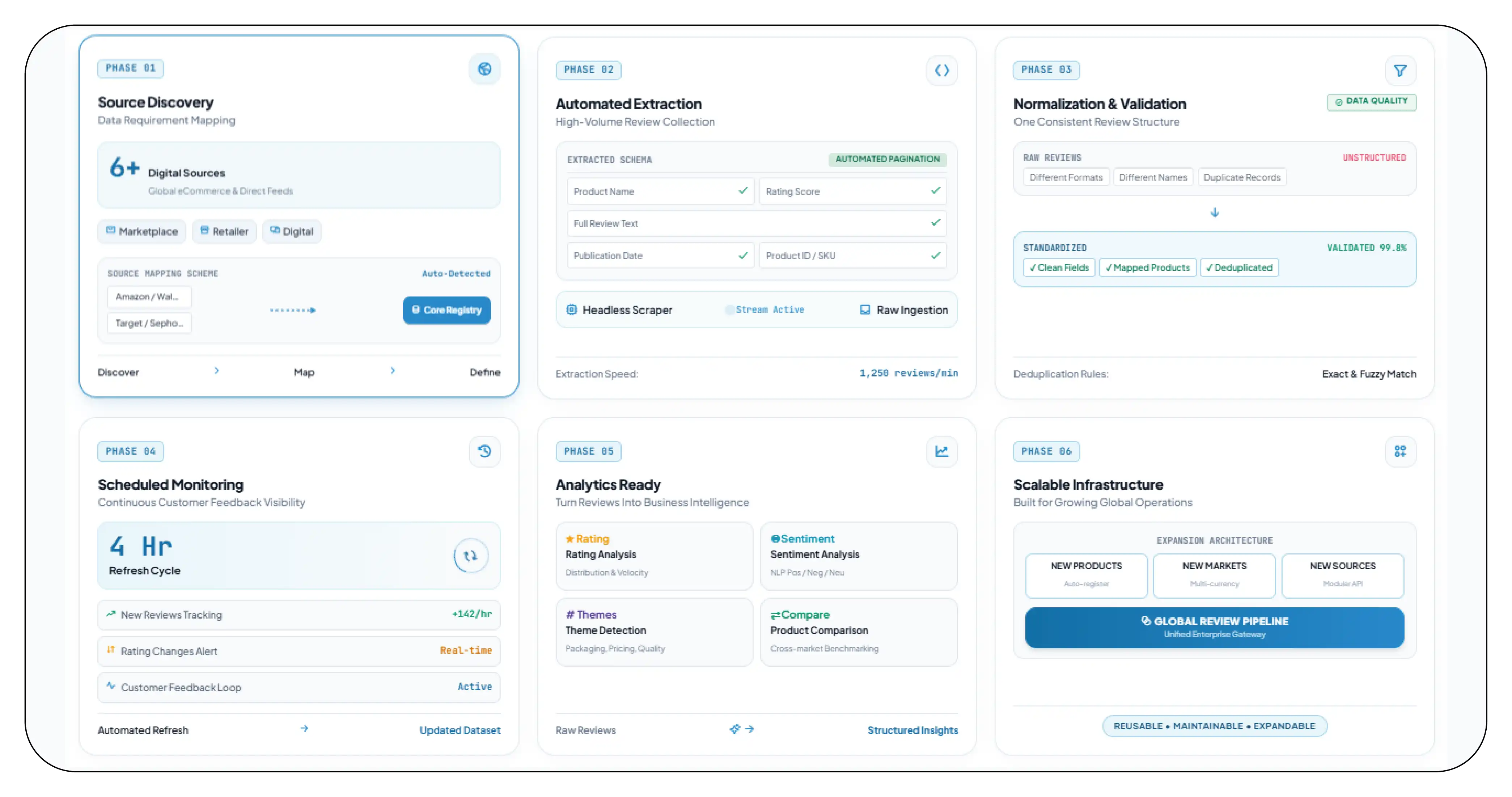
Product Data Scrape implemented the solution through several structured phases, with each phase designed to resolve a specific challenge.
Phase 1: Source Discovery and Data Requirement Mapping
The first phase involved source discovery and data requirement mapping. We identified relevant marketplaces and digital sources, reviewed their structures, determined the required review attributes, and established product and market mapping rules.
Phase 2: Automated Data Extraction
The second phase focused on automated data extraction. Our scraping framework collected available review attributes such as product names, ratings, review titles, review text, publication dates, product identifiers, and source information. Automated pagination and extraction workflows allowed the system to process larger volumes without relying on equivalent manual effort.
Phase 3: Data Normalization and Validation
The third phase introduced data normalization and validation. Review records from different sources were converted into standardized formats so that business teams could compare information consistently. Duplicate detection, field validation, formatting checks, and product mapping helped improve dataset quality.
Phase 4: Scheduled Monitoring
The fourth phase focused on scheduled monitoring. Instead of depending on occasional manual checks, automated workflows could refresh review information at predefined intervals. This improved visibility into newly published reviews, rating changes, and evolving customer feedback.
Phase 5: Analytics Integration
The fifth phase connected structured data with analytics workflows. The resulting datasets could support rating analysis, sentiment analysis, recurring-theme identification, product comparisons, and market-level reporting. This created the foundation for Global Customer Feedback Monitoring and helped transform raw reviews into usable business intelligence.
Phase 6: Scalability and Maintainability
The final phase emphasized scalability and maintainability. New products, markets, and sources could be incorporated into the workflow without rebuilding the complete infrastructure. Automated processes reduced repetitive work while maintaining consistent data collection standards.
By combining extraction, normalization, validation, scheduled monitoring, and analytics readiness, Product Data Scrape created a review intelligence pipeline that could support the client's growing global operations. The solution allowed teams to spend less time collecting information and more time interpreting customer feedback and acting on meaningful insights.
Results & Key Metrics
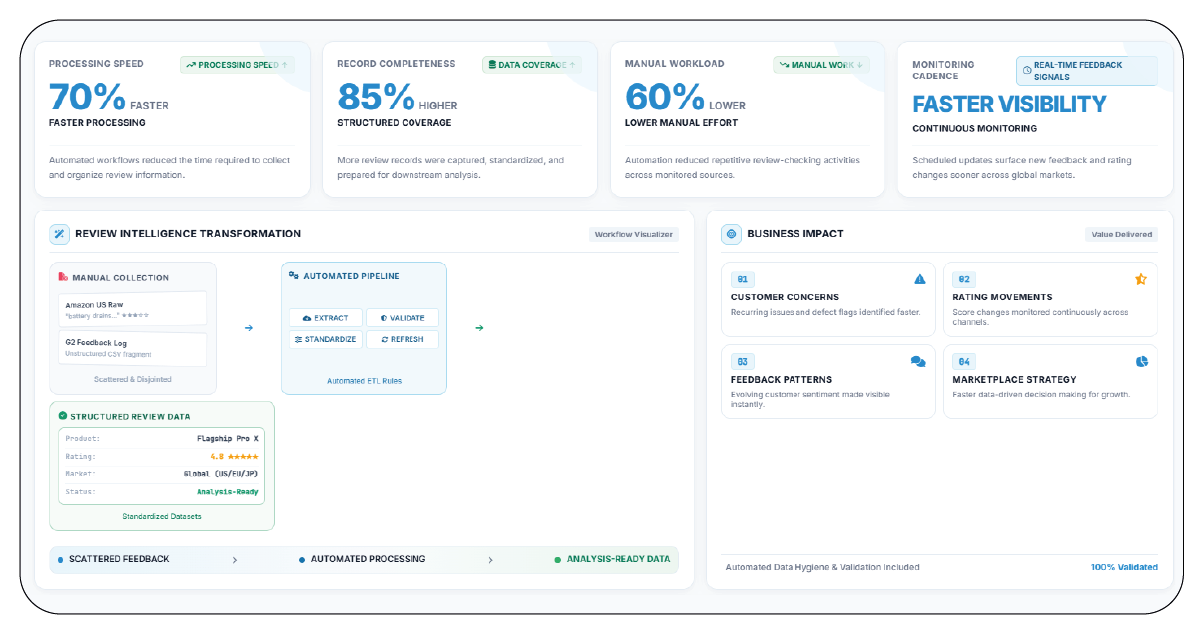
70% faster processing: Automated workflows reduced the time required to collect and organize review information.
85% higher structured coverage: More review records were captured, standardized, and prepared for analysis.
60% lower manual effort: Automation reduced repetitive review-checking activities across monitored sources.
Improved data consistency: Standardized fields made information easier to compare across products and markets.
Faster visibility: Scheduled updates helped teams identify new feedback and rating changes sooner.
Results Narrative
The implementation established a scalable foundation for Global Product Review Monitoring across multiple products and markets. Teams gained faster access to structured review information instead of depending primarily on manual collection. The improved workflow made it easier to identify recurring customer concerns, monitor rating movements, and understand changing feedback patterns. Standardized datasets also simplified downstream reporting and analytics. By combining automated extraction with validation and scheduled refreshes, Product Data Scrape improved operational efficiency while creating a more reliable customer feedback resource. The solution positioned the brand to make faster, data-driven decisions around product performance, customer experience, reputation, and marketplace strategy.
What Made Product Data Scrape Different
Product Data Scrape differentiated the project by treating review monitoring as a scalable data infrastructure rather than a simple scraping task. Our framework combined automated extraction, data normalization, validation, duplicate handling, scheduled refreshes, and analytics-ready outputs. The Shopper Ratings Data Extraction API approach made it easier to integrate structured review information into broader business workflows. Intelligent automation also helped accommodate changing page structures, increasing product volumes, and multiple markets. Most importantly, Review Monitoring Automation for Global Brands was designed around continuous data availability, allowing the client to transform fragmented customer feedback into structured intelligence that could support faster analysis, monitoring, and decision-making.
Client's Testimonial
"Before working with Product Data Scrape, monitoring reviews across markets required significant manual effort and made it difficult to maintain consistent visibility. Their solution helped us create a structured and scalable process for collecting customer feedback. We gained faster access to review data, improved our ability to identify recurring customer concerns, and reduced the amount of repetitive monitoring work required from our teams. The implementation was especially valuable for supporting our international operations because the workflow could accommodate multiple products and markets. Product Data Scrape understood our requirements and delivered a practical solution that strengthened our customer feedback intelligence."
— Head of E-commerce, Global Consumer Brand
Conclusion
For global brands, reviews provide valuable insights into customer expectations, product experiences, and marketplace perception. Product Data Scrape helped the client replace fragmented manual monitoring with an automated, scalable review intelligence workflow. The solution improved collection speed, data coverage, consistency, and operational efficiency while giving teams faster access to actionable feedback. By combining structured extraction with automated refreshes and analytics-ready data, the brand established a stronger foundation for Ratings, reviews and sentiment analysis. The project demonstrates how Review Monitoring Automation for Global Brands can turn large volumes of scattered feedback into organized intelligence, helping businesses identify opportunities, address concerns, improve customer experience, and make more informed decisions across global markets.
FAQs
1. What is Review Monitoring Automation for Global Brands?
Review Monitoring Automation for Global Brands is an automated approach to collecting, organizing, refreshing, and analyzing publicly available customer review data across multiple digital sources. It helps brands reduce manual monitoring and improve visibility into feedback.
2. What type of review data can Product Data Scrape collect?
Depending on the source and requirements, Product Data Scrape can collect available fields such as product names, ratings, review titles, review text, publication dates, product identifiers, and source information. The dataset can be structured for downstream analytics.
3. Can the solution monitor products across multiple countries?
Yes. The workflow can be designed to support multiple markets, products, marketplaces, and regional websites. Country-specific monitoring can help brands compare customer feedback and product performance across different geographical markets.
4. How does automation improve review monitoring?
Automation reduces repetitive manual collection, improves consistency, supports scheduled data refreshes, and allows teams to process larger review volumes. It also helps businesses identify new reviews, rating changes, and recurring customer concerns more quickly.
5. How can brands use the collected review data?
Brands can use structured review data for rating analysis, sentiment analysis, customer experience monitoring, product improvement, competitive intelligence, reputation management, and marketplace performance analysis. The resulting insights can support faster and more informed business decisions.


 Singapore
 EMAIL
 PHONE












.webp)