Quick Overview
The project helped an e-commerce intelligence team transform fragmented marketplace reviews into structured, EAN-linked customer sentiment insights. By implementing Scrape Bol.com EAN-based Reviews Data, the team could connect individual product identifiers with ratings, review text, timestamps, and customer feedback at scale. The workflow also incorporated Scraping Bol.com Product Data to create richer product-level context around reviews. The engagement focused on improving review collection speed, product matching accuracy, and automated analysis across large catalogs. Product examples such as Philips air fryers, Samsung televisions, LEGO sets, Apple accessories, and Bosch appliances demonstrated how EAN-level intelligence could support consistent product comparison and sentiment analysis.
Client Name / Industry: Confidential E-commerce Intelligence Company / E-commerce & Retail Analytics
Service / Duration: Product Review Data Extraction, EAN-Based Matching & Sentiment Analytics / Multi-Phase Engagement
Key Impact Metrics: Review processing became significantly faster, automated product-to-review matching improved data consistency, and structured review datasets enabled faster sentiment reporting across large product catalogs.
The Client
The client was an e-commerce intelligence company operating in a market where customer reviews had become an increasingly important source of competitive and consumer insight. Online marketplaces generate thousands of reviews across electronics, home appliances, toys, personal care, sports products, and other categories. However, turning this unstructured feedback into dependable intelligence requires more than simply collecting review text.
Before the partnership, the client's review-monitoring workflow involved multiple manual and semi-automated processes. Product identification could become difficult when the same product appeared under different titles, variations, or seller listings. Review information was also distributed across product pages, making consistent product-level analysis challenging.
The pressure to transform the process increased as brands such as Philips, Samsung, Bosch, Sony, LEGO, and Apple expanded their marketplace presence and accumulated large volumes of customer feedback. The client needed a scalable framework capable of associating reviews with precise product identifiers and maintaining historical information.
The project therefore focused on developing reliable Bol.com Product Review Analytics, Scrape Product Images & Barcodes capabilities. This transformation was essential for turning raw marketplace feedback into structured intelligence that could support product benchmarking, customer sentiment analysis, competitive research, and catalog-level decision-making.
Goals & Objectives
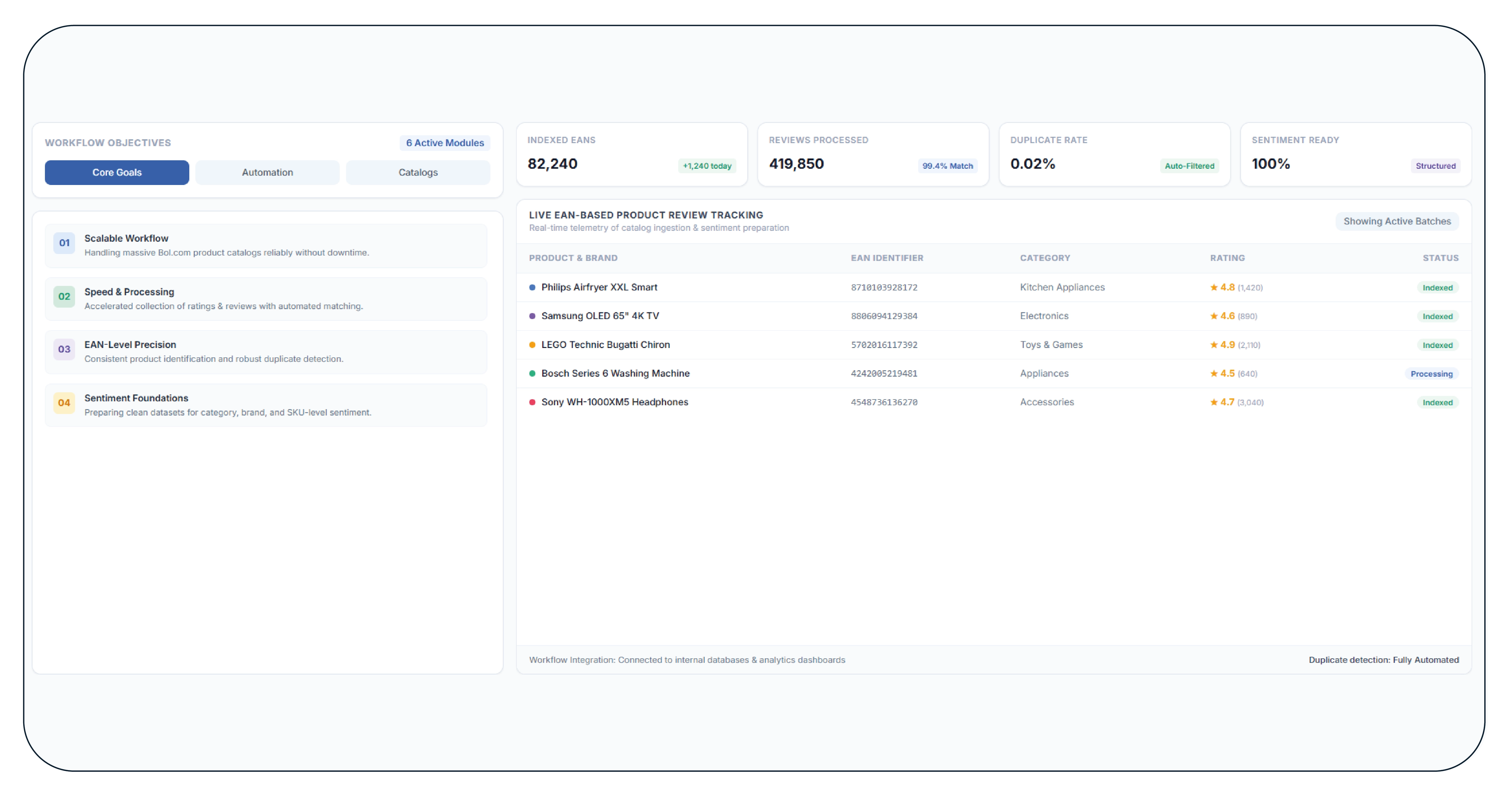
Build a scalable review-data collection workflow capable of handling large Bol.com product catalogs.
Improve the speed at which customer reviews and ratings could be collected and processed.
Establish consistent EAN-level product identification across review datasets.
Reduce dependency on repetitive manual review collection and product matching.
Create a foundation for category, brand, and SKU-level customer sentiment analysis.
Support products across categories including Philips kitchen appliances, Samsung electronics, LEGO toys, Bosch appliances, and Sony accessories.
Implement automated extraction of review ratings, review text, dates, product information, and identifiers.
Create a standardized data structure for connecting EANs with products and their customer feedback.
Automate duplicate detection and product matching.
Prepare review data for downstream sentiment classification and reporting.
Enable historical review monitoring and recurring data collection.
Develop workflows suitable for integration with analytics dashboards and internal databases.
Establish EAN-Based Product Review Tracking for reliable monitoring of customer feedback at the individual product level.
Collection speed: Reduce review-data processing time from lengthy manual cycles to automated recurring workflows.
Matching accuracy: Improve confidence in linking reviews to the correct EAN and product record.
Automation rate: Increase the percentage of review-processing tasks handled without manual intervention.
Data completeness: Capture essential review attributes consistently across monitored products.
Scalability: Expand the number of products and reviews processed without proportionally increasing operational workload.
Analytics readiness: Deliver structured datasets suitable for sentiment, rating, brand, and product-level analysis.
The Core Challenge
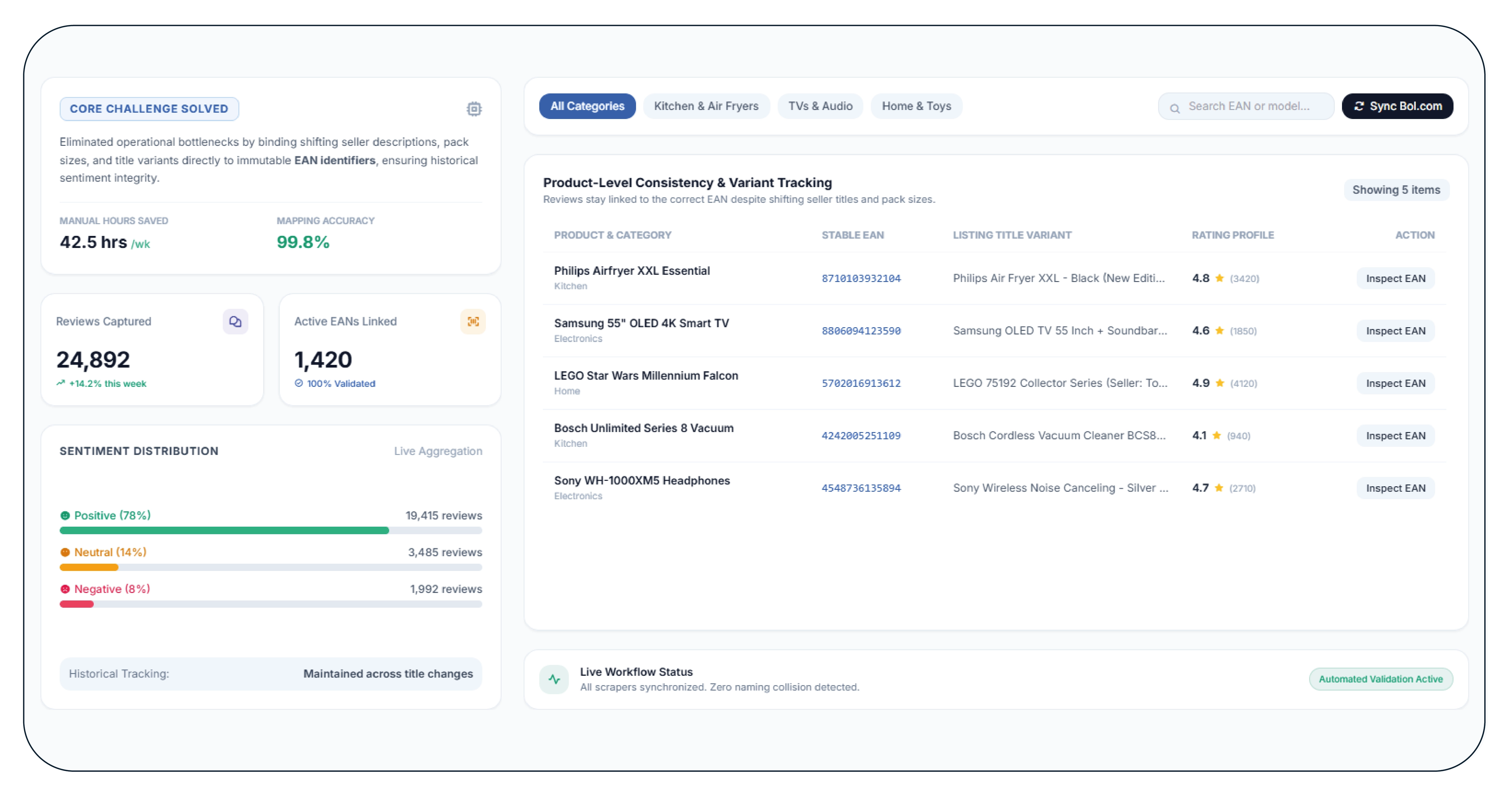
The client's biggest obstacle was not simply collecting reviews; it was creating a dependable relationship between customer feedback and the exact products being analyzed. Marketplace listings can contain variations in product names, pack sizes, model numbers, seller information, and product descriptions. Without accurate product identification, review analysis can produce misleading conclusions.
The client was also dealing with operational bottlenecks caused by repetitive extraction and validation activities. Manually checking product pages, copying ratings, validating product identifiers, and organizing review text became increasingly inefficient as the catalog expanded.
Another challenge involved maintaining consistent review records over time. New reviews could continuously change a product's rating profile, while older reviews remained valuable for historical sentiment analysis. A workflow that captured only current information could therefore miss important changes in customer perception.
The project addressed these problems through Bol.com Customer Feedback Monitoring, with a focus on product-level consistency and automated data handling. For example, reviews associated with a Philips air fryer needed to remain connected to the correct EAN even if listing titles or seller information changed. Similar challenges could occur with Samsung TVs, LEGO sets, Bosch vacuum cleaners, or Sony headphones.
The absence of a structured workflow affected both speed and analytical confidence. The client needed a solution that could automate collection while preserving the relationship between products, identifiers, ratings, and customer opinions.
Our Solution
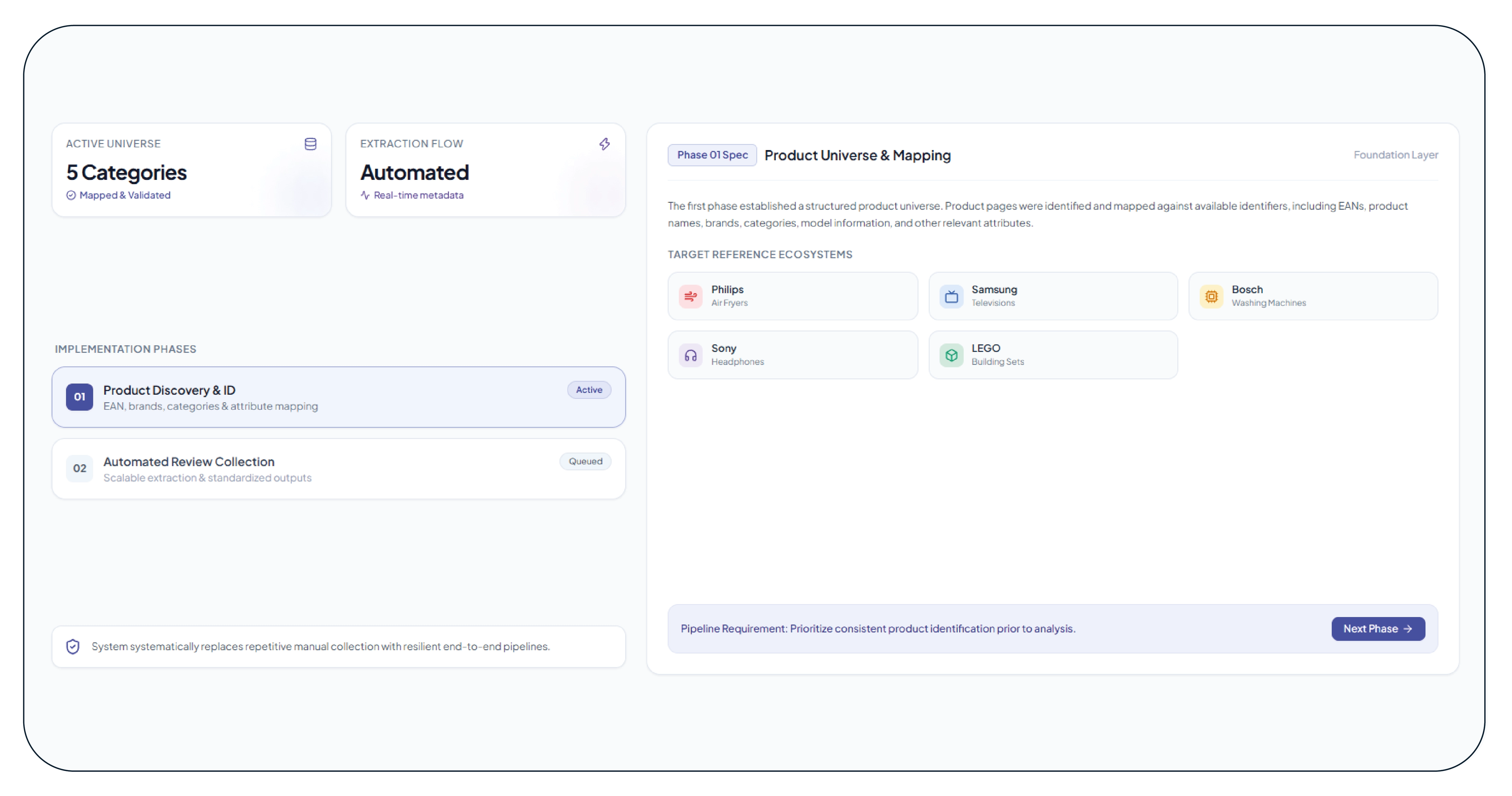
The solution was developed through a phased implementation designed to solve data collection, identification, validation, and analytics requirements systematically.
Phase 1: Product Discovery and Identification
The first phase established a structured product universe. Product pages were identified and mapped against available identifiers, including EANs, product names, brands, categories, model information, and other relevant attributes. This created a dependable foundation for connecting customer feedback with individual products. For products such as Philips air fryers, Samsung televisions, Bosch washing machines, Sony headphones, and LEGO building sets, the workflow prioritized consistent product identification before review information entered the analytical pipeline.
Phase 2: Automated Review Collection
The second phase focused on automated extraction of review information. The system collected relevant fields such as review title, review text, star rating, publication date, product identifier, product URL, and available reviewer-related metadata. The objective was to replace repetitive manual collection with a scalable extraction workflow capable of processing larger product sets while maintaining standardized output structures.
Phase 3: EAN-Based Data Mapping
Once review information was collected, records were connected to their corresponding product identifiers. This stage reduced the possibility of mixing reviews from similar products, variants, or different listings. EAN mapping also made it easier to connect review information with broader product datasets, enabling downstream analysis by brand, category, product, and model.
Phase 4: Data Validation and Quality Control
Automated validation rules checked for missing fields, duplicate records, inconsistent identifiers, malformed entries, and unexpected changes in page structures. Quality checks helped maintain consistency before datasets were transferred into analytical environments. This phase was particularly important for Product Review Rating Analysis, because inaccurate product mapping could distort average ratings, review counts, and sentiment trends.
Phase 5: Analytics Preparation
The final stage converted collected records into structured datasets suitable for dashboards, reporting systems, and sentiment-analysis workflows. Ratings could be grouped by product and brand, while review text could be processed to identify positive, neutral, and negative customer themes.
The completed workflow also supported recurring collection, making it possible to monitor how customer perception changed as new reviews appeared. Instead of treating reviews as isolated text records, the client gained a structured product intelligence layer that could support competitive benchmarking and customer experience analysis.
Results & Key Metrics
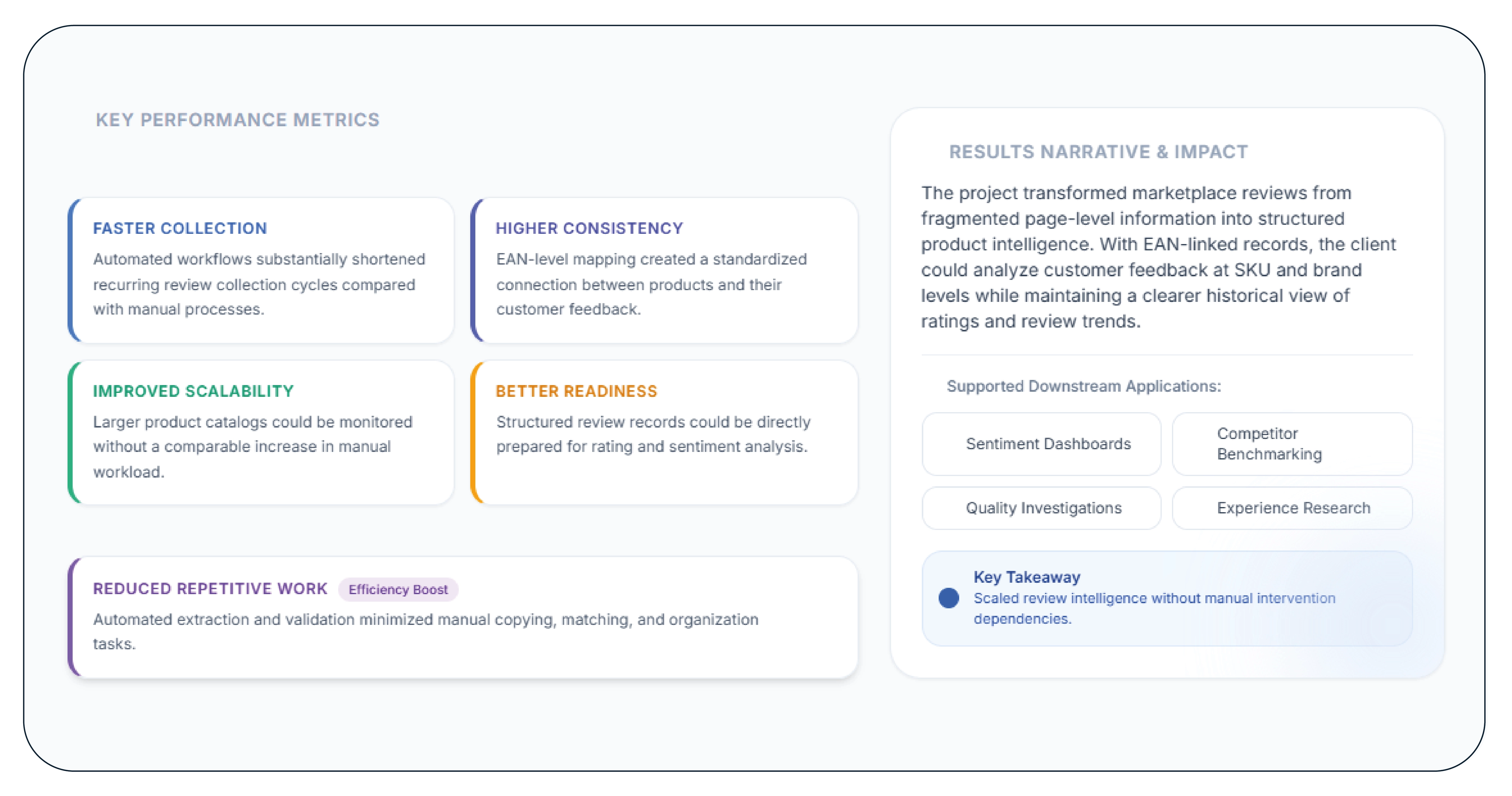
Faster data collection: Automated workflows substantially shortened recurring review collection cycles compared with manual processes.
Higher data consistency: EAN-level mapping created a standardized connection between products and their customer feedback.
Improved scalability: Larger product catalogs could be monitored without a comparable increase in manual workload.
Better analytical readiness: Structured review records could be directly prepared for rating and sentiment analysis.
Reduced repetitive work: Automated extraction and validation minimized manual copying, matching, and organization tasks.
Results Narrative
The project transformed marketplace reviews from fragmented page-level information into structured product intelligence. With EAN-linked records, the client could analyze customer feedback at SKU and brand levels while maintaining a clearer historical view of ratings and review trends. Bol.com Product Data Extraction, Scrape Bol.com EAN-based Reviews Data workflows also created a repeatable foundation for monitoring products across multiple categories. The resulting dataset could support sentiment dashboards, competitor benchmarking, product-quality investigations, and customer experience research. Most importantly, the approach allowed the client to scale review intelligence without relying on the same level of manual intervention required by the previous workflow.
What Made Product Data Scrape Different
Product Data Scrape differentiated the project through a combination of structured extraction, identifier-based mapping, automated validation, and scalable processing. Instead of treating marketplace reviews as standalone text, the framework connected each feedback record to a defined product identity. This made Ratings, reviews and sentiment analysis more reliable because ratings and customer comments could be evaluated against the correct product, brand, and category. Smart automation also supported recurring data collection and quality checks, helping the client maintain consistent datasets as marketplace content changed. The framework could accommodate products ranging from Samsung electronics and Philips appliances to LEGO toys and Sony accessories, creating a flexible foundation for broader e-commerce intelligence applications.
Client's Testimonial
"The project gave our team a much more structured way to understand marketplace customer feedback. Previously, review information required considerable effort to collect, organize, and connect with individual products. The EAN-based approach improved consistency and made the information much more useful for ongoing analysis. We can now work with product-level review data in a more scalable way and use it alongside our wider e-commerce intelligence datasets. The automation has also reduced repetitive operational work, allowing our analysts to focus more on interpreting customer sentiment and identifying meaningful product trends."
— Head of E-commerce Intelligence, Client Organization
The workflow also created opportunities to combine customer sentiment with Price Elasticity Analysis, helping teams investigate whether rating trends, customer complaints, pricing changes, and product positioning were influencing marketplace performance.
Conclusion
Customer reviews have become a critical intelligence source for e-commerce brands, retailers, and marketplace analysts. However, their value depends on accurate collection, product identification, historical consistency, and scalable processing. This project demonstrated how EAN-level extraction can transform fragmented marketplace feedback into structured customer intelligence. Through automated collection, validation, product mapping, and analytics preparation, the client gained a stronger foundation for understanding ratings and customer sentiment across its monitored catalog. The approach can also support Competitor Review Monitoring, Scrape Bol.com EAN-based Reviews Data initiatives, enabling businesses to track changing customer perceptions, identify recurring product issues, benchmark competitors, and build more informed product and marketplace strategies.
FAQs
1. Why are EANs important for Bol.com review analysis?
EANs provide a consistent product identifier that can help connect customer reviews with the correct product. This reduces confusion caused by similar product names, variants, models, and seller listings.
2. What information can be collected from product reviews?
Depending on availability, review datasets can include product identifiers, ratings, review titles, review text, publication dates, product URLs, and related product information. These fields can support structured customer sentiment analysis.
3. How can review data help e-commerce brands?
Review data can reveal customer satisfaction levels, recurring complaints, product strengths, quality concerns, and changing customer expectations. Brands can use these insights for product development, customer experience, and competitive benchmarking.
4. Can the workflow monitor different product categories?
Yes. A structured extraction framework can be adapted for electronics, appliances, toys, beauty products, sports equipment, and other marketplace categories. Products such as Philips appliances, Samsung TVs, LEGO sets, Bosch products, and Sony headphones can be incorporated into category-level analysis.
5. Can review extraction be integrated with analytics systems?
Yes. Structured datasets can be prepared for databases, dashboards, business intelligence platforms, and sentiment-analysis pipelines. Recurring extraction can also help maintain continuously updated review intelligence for ongoing monitoring.


 Singapore
 EMAIL
 PHONE











.webp)