Quick Overview
A leading FMCG retail brand partnered with Product Data Scrape to improve
market intelligence, pricing visibility, and inventory forecasting in the highly competitive
grocery sector. Using Woolworths Grocery data Scraping, the client gained access to real-time
product insights, pricing updates, and promotional intelligence across multiple grocery
categories.
The project focused on helping the client Extract Woolworths Grocery
& Gourmet
Food Data for competitor analysis and demand forecasting. Within six months, the brand
achieved
a 42% improvement in pricing response time, a 37% increase in inventory forecasting accuracy,
and a 29% improvement in promotional campaign planning efficiency.
The Client
The client was a fast-growing FMCG brand operating across packaged foods,
beverages, and household essentials. The grocery retail industry was becoming increasingly
competitive due to rising customer demand for online shopping, fast delivery, and aggressive
pricing campaigns.
The client faced growing pressure to monitor competitor pricing, track product
availability, and respond faster to changing market trends. Manual tracking methods were no
longer effective because grocery pricing and inventory levels changed several times daily.
Before partnering with us, the client relied on spreadsheets and manual
analysis to collect market intelligence. This process caused delays, data inaccuracies, and poor
visibility into competitor strategies. They also struggled to maintain consistent monitoring
across thousands of SKUs and multiple grocery categories.
Using Woolworths supermarket data scraping, the client aimed to automate data
collection and improve operational efficiency. Access to a structured Grocery store dataset
became essential for forecasting customer demand, tracking promotions, and optimizing inventory
planning in real time.
Goals & Objectives
The client wanted to improve pricing intelligence, inventory forecasting, and
competitive analysis across grocery categories. They also needed a scalable system capable of
handling large product datasets with minimal manual intervention.
By implementing Woolworths grocery Competitor price monitoring, the brand aimed
to respond faster to pricing changes and promotional campaigns introduced by competitors.
The technical objective was to build an automated data extraction
infrastructure powered by the Woolworths
Grocery Data Scraping API. The system needed to deliver
real-time product updates, pricing alerts, inventory insights, and structured analytics
dashboards.
The solution also required seamless integration with the client’s internal BI
tools and reporting systems for continuous decision-making support.
The project focused on measurable performance outcomes, including:
Reduce manual data collection time by 70%
Improve pricing update speed by 40%
Increase forecasting accuracy by 35%
Monitor over 100,000 grocery SKUs daily
Improve promotional analysis efficiency by 30%
Enhance competitor tracking coverage across categories
The Core Challenge
The client faced major operational bottlenecks in monitoring grocery pricing,
stock availability, and promotional trends across multiple categories. Their manual workflows
were slow, inconsistent, and unable to scale with rapidly changing market conditions.
One major issue involved Woolworths stock availability tracking. Products
frequently went out of stock without timely alerts, affecting demand forecasting and
replenishment planning. The client also struggled to identify pricing fluctuations and
promotional changes across competitors quickly enough to respond effectively.
Limited visibility into digital shelf performance created additional
challenges. Without structured Digital Shelf
Analytics, the client could not accurately monitor
product rankings, visibility, or assortment positioning across online grocery listings.
Data inconsistencies also reduced confidence in business reporting. Duplicate
entries, missing product information, and delayed updatedigital-shelf-analytics.phps created
forecasting errors that
affected inventory planning and promotional decisions.
The lack of automation prevented the client from scaling their competitive
intelligence strategy efficiently in the growing grocery eCommerce market.
Our Solution
.webp)
We implemented a fully automated grocery intelligence ecosystem designed to
improve pricing visibility, inventory tracking, and competitor analysis.
The first phase focused on building scalable extraction pipelines to Scrape
Woolworths Grocery Product Data across grocery, beverages, packaged foods, gourmet products, and
household categories. Our team deployed automated crawlers capable of collecting real-time
pricing, inventory, and promotional information multiple times daily.
The second phase involved advanced normalization and data structuring
processes. Product attributes such as SKU details, category mapping, pricing variations, stock
status, and discount information were standardized for accurate reporting.
The third phase focused on implementing real-time dashboards and analytics
systems. These dashboards enabled the client to monitor inventory movement, pricing changes, and
promotional trends using interactive visual reports.
To strengthen Competitor Price
Monitoring, we developed automated alert systems
that notified the client whenever competitors changed pricing, launched discounts, or introduced
promotional campaigns. This allowed the brand to respond faster to market shifts and optimize
pricing strategies.
Key Technologies & Frameworks Used
Automated web crawlers
API-based data pipelines
Cloud data processing infrastructure
Real-time monitoring dashboards
Data normalization engines
AI-driven anomaly detection systems
How Each Phase Solved Challenges
Automated extraction reduced manual workload
Structured datasets improved reporting accuracy
Real-time alerts enhanced pricing responsiveness
Dashboard analytics improved forecasting visibility
Continuous monitoring strengthened competitive intelligence
The final implementation delivered scalable grocery analytics that supported
faster decision-making and improved operational efficiency across the client’s retail ecosystem.
Results & Key Metrics
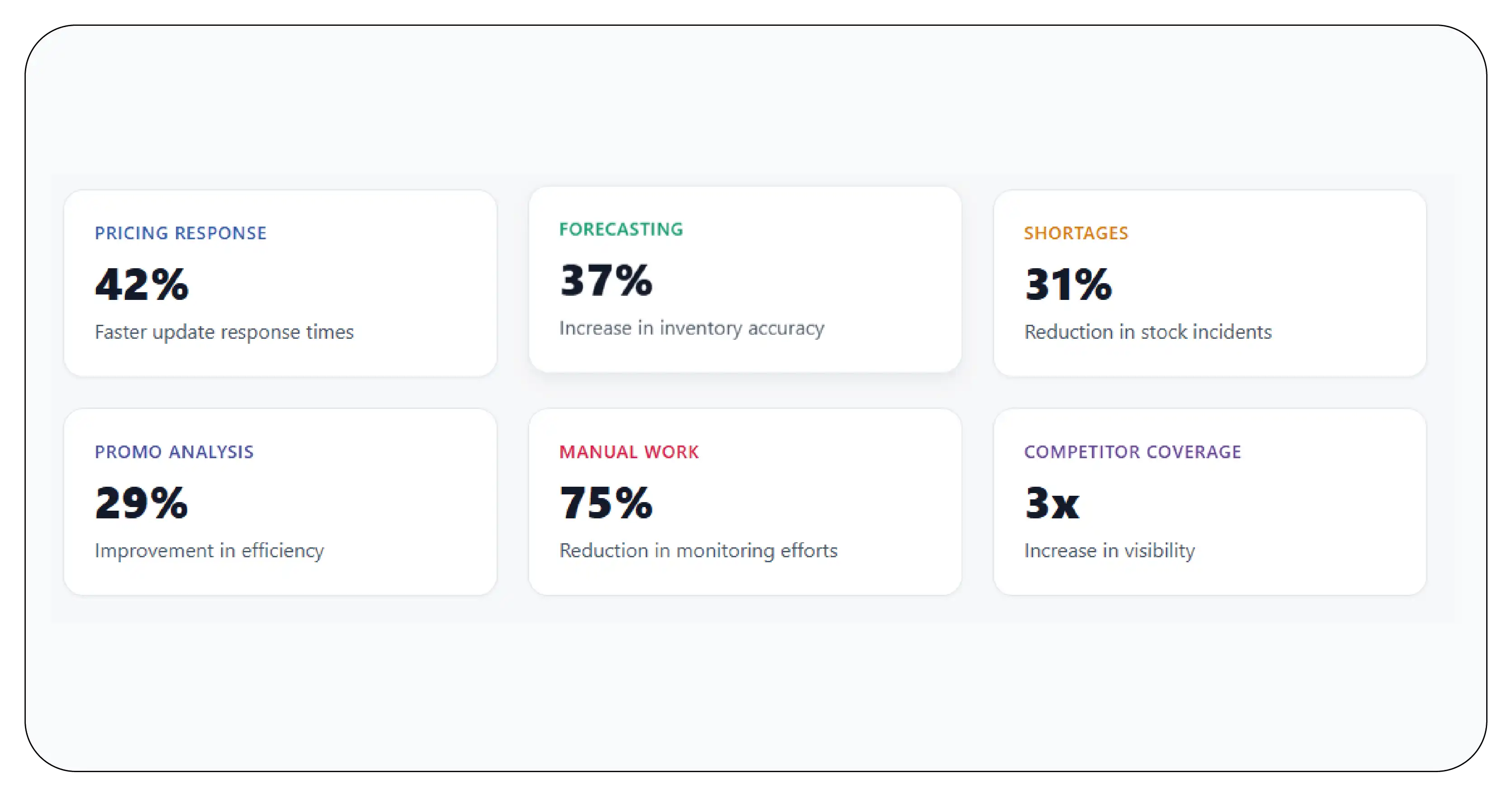
Using Woolworths Supermarket Data Intelligence, the client achieved measurable
improvements across pricing, inventory planning, and market monitoring operations.
Performance Improvements
42% faster pricing update response
37% increase in inventory forecasting accuracy
31% reduction in stock shortage incidents
29% improvement in promotional analysis efficiency
75% reduction in manual monitoring efforts
3x increase in competitor coverage visibility
The implementation also improved reporting accuracy and helped the client
monitor thousands of grocery SKUs in real time.
Results Narrative
The client successfully transformed its grocery analytics operations using our
automated retail intelligence solution.
By implementing Product Pricing
Strategies Service, the brand gained faster
access to competitor insights, promotional trends, and inventory movement analytics. This
enabled better pricing decisions and stronger category planning.
Real-time monitoring improved collaboration between pricing, inventory, and
marketing teams. The client also achieved greater visibility into customer demand patterns and
product performance across grocery categories.
The project significantly strengthened the brand’s ability to compete in the
fast-changing grocery retail market.
What Made Product Data Scrape Different
We delivered a customized retail intelligence framework designed specifically
for high-frequency grocery data monitoring.
Our advanced automation systems improved Woolworths Grocery Pricing
Intelligence by enabling real-time pricing alerts, inventory visibility, and category-level
analytics. Unlike traditional manual tracking methods, our scalable infrastructure supported
continuous monitoring across thousands of SKUs with high accuracy.
We also integrated AI-driven anomaly detection systems that identified sudden
price fluctuations, stock inconsistencies, and unusual promotional patterns automatically. This
innovation helped the client respond faster to market changes and improve strategic planning.
Client’s Testimonial
“Product Data Scrape
transformed how we monitor grocery pricing and
competitor activity. Their automated retail intelligence solution gave us real-time
visibility into pricing, stock availability, and promotional campaigns.
The implementation of Woolworths Grocery data Scraping significantly
improved our forecasting accuracy and helped our teams respond faster to market changes. We
now make pricing and inventory decisions with greater confidence and efficiency.”
—Head of Retail Analytics
Conclusion
The grocery retail industry requires fast, accurate, and scalable market
intelligence solutions to stay competitive. Using Woolworths
Grocery Store Dataset solutions,
businesses can improve pricing visibility, inventory forecasting, and promotional monitoring
across grocery categories.
This case study demonstrates how Woolworths Grocery data Scraping helped a
leading FMCG brand strengthen competitive intelligence, improve operational efficiency, and
optimize retail decision-making using automated analytics.
Businesses investing in structured grocery datasets and real-time monitoring
systems gain a significant advantage in rapidly evolving digital retail markets.
FAQs
1. What is Woolworths grocery data scraping?
Woolworths grocery data scraping extracts pricing, inventory, promotions, and product
information from Woolworths grocery listings to support competitor analysis, forecasting, and
retail intelligence strategies.
2. How does grocery data scraping improve demand forecasting?
Grocery data scraping provides real-time inventory, pricing, and demand insights that help
businesses predict buying patterns and improve replenishment planning across product categories.
3. Why is competitor price monitoring important in grocery retail?
Competitor price monitoring helps retailers compare pricing strategies, identify promotional
trends, optimize discounts, and maintain competitiveness in rapidly changing grocery markets.
4. What industries benefit from grocery retail intelligence?
FMCG brands, grocery retailers, market research firms, pricing analysts, and supply chain
companies benefit from structured grocery intelligence and automated market monitoring
solutions.
5. Why choose Product Data Scrape for grocery analytics?
Product Data Scrape provides scalable grocery intelligence solutions, automated competitor
tracking, inventory analytics, and real-time retail datasets tailored for modern FMCG and
grocery businesses.



 USA
USA
 EMAIL
EMAIL
 PHONE
PHONE


.webp)








.webp)