Quick Overview
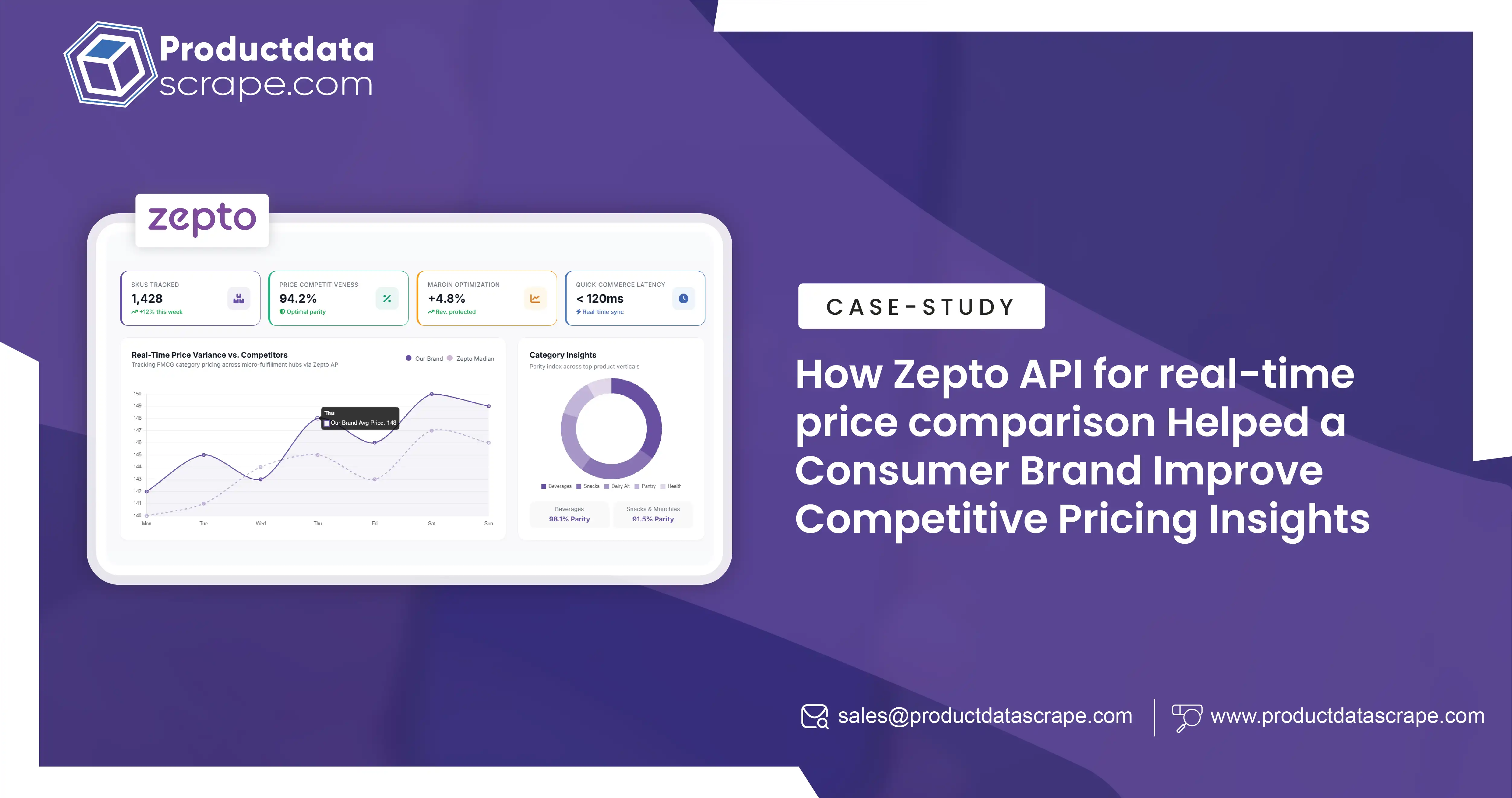
The consumer brand needed a faster way to understand grocery pricing, promotions, and availability across Zepto. Its existing monitoring process relied heavily on manual checks, making it difficult to capture frequent price movements at scale. Product Data Scrape implemented a structured data collection workflow powered by Zepto API for real-time price comparison, enabling the brand to organize competitive pricing information into an analytics-ready format. The engagement covered automated product and price monitoring over a recurring project duration. Key impact areas included broader product coverage, faster data refresh cycles, and improved consistency of competitive pricing records. The solution also supported Zepto price monitoring for ongoing market intelligence and decision-making.
Client Name / Industry: Leading Consumer & FMCG Brand
Service / Duration: Zepto Product, Price & Availability Data Collection / Recurring Monitoring
Key Impact Metrics: Expanded product coverage, faster refresh cycles, and improved pricing-data consistency.
The Client
The client was a consumer and FMCG brand operating in a highly competitive grocery environment where pricing, promotions, product availability, and assortment can change frequently. Quick-commerce platforms such as Zepto have increased the importance of near-real-time market visibility because customers can compare products and offers within minutes.
For the brand, relying on periodic manual checks created several limitations. Pricing teams could review only a limited number of products at a time, while promotional changes could occur between monitoring cycles. The business needed a scalable approach that could capture product-level information consistently and make it easier for analysts to identify changes.
The transformation became essential as the client expanded its competitive intelligence requirements. It wanted to track Zepto promotions in real time and understand how discounts, promotional offers, and product pricing changed across monitored products and locations.
Before the partnership, information was gathered through fragmented checks and spreadsheets. This created challenges around consistency, historical comparisons, and timely reporting. The team also needed a structured way to Scrape Zepto Prices Data without depending on repetitive manual processes.
Product Data Scrape approached the requirement as a data-engineering challenge rather than simply a scraping task. The objective was to create a repeatable workflow capable of collecting, validating, organizing, and delivering a structured Zepto Grocery Store Dataset for competitive analysis.
Goals & Objectives
The project was designed around three dimensions: business scalability, technical automation, and measurable data performance. The client wanted its monitoring program to move from limited manual observation toward a structured system that could support recurring analysis.
Increase the scale of product and price monitoring across relevant Zepto categories.
Improve the speed at which pricing changes could be identified.
Increase consistency and accuracy across collected product records.
Track Zepto product availability by location to understand local assortment and stock differences.
Establish a repeatable monitoring framework that could support future category expansion.
Automate product, pricing, promotion, and availability data collection.
Extract Zepto Q-Commerce Data into a standardized structure suitable for analytics.
Integrate collected information into the client's existing analytical workflow.
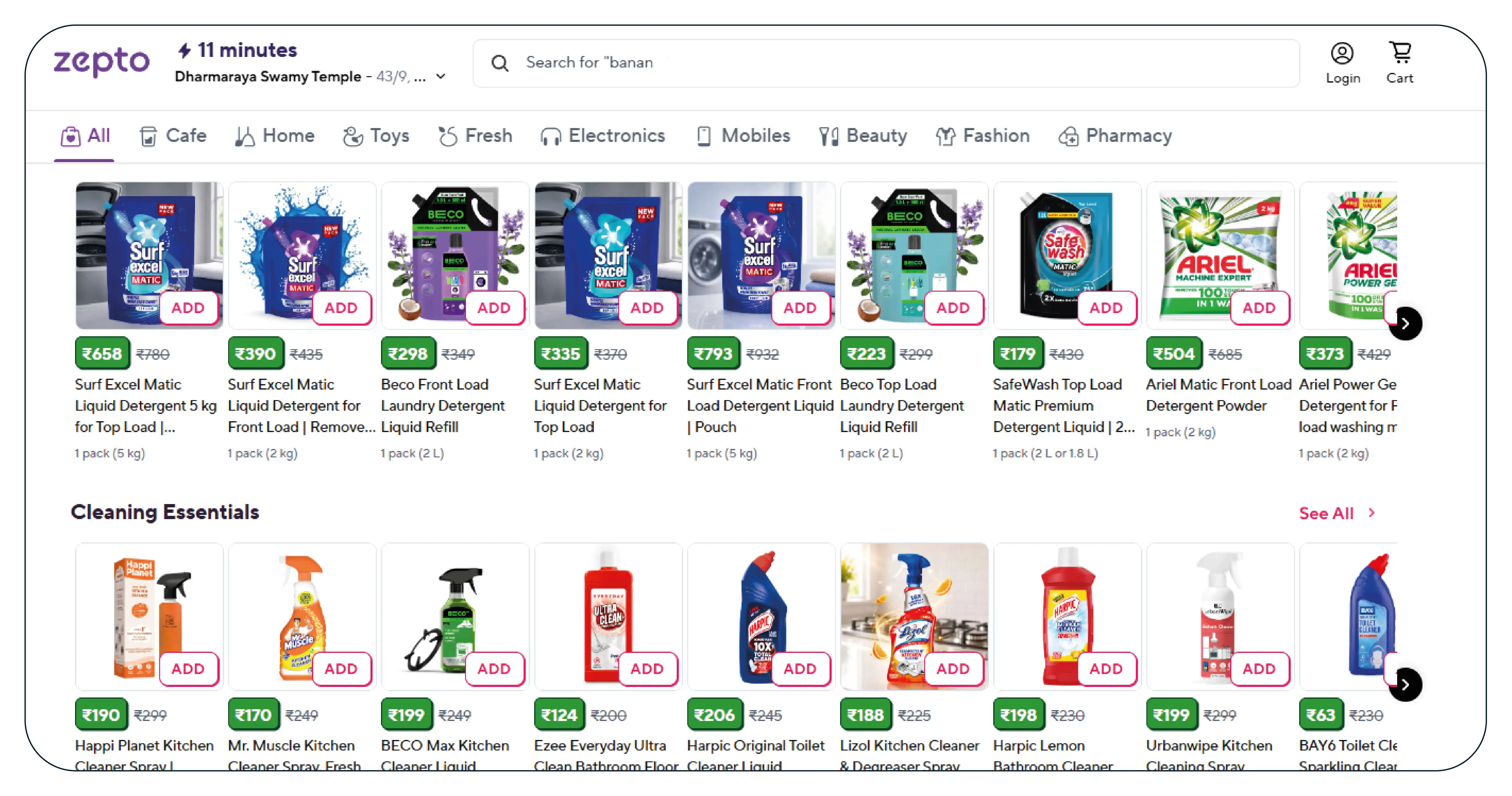
Capture product-level attributes such as product name, brand, category, pack size, price, discount, availability, and URL where accessible.
Create validation mechanisms to identify missing, duplicate, or inconsistent records.
Support recurring data refreshes for competitive monitoring and historical analysis.
Product coverage across the defined monitoring universe.
Data refresh frequency and processing turnaround time.
Record completeness and validation accuracy.
Percentage of successfully processed product records.
Availability and pricing change detection across monitoring cycles.
Consistency of structured datasets delivered for downstream analytics.
The Core Challenge
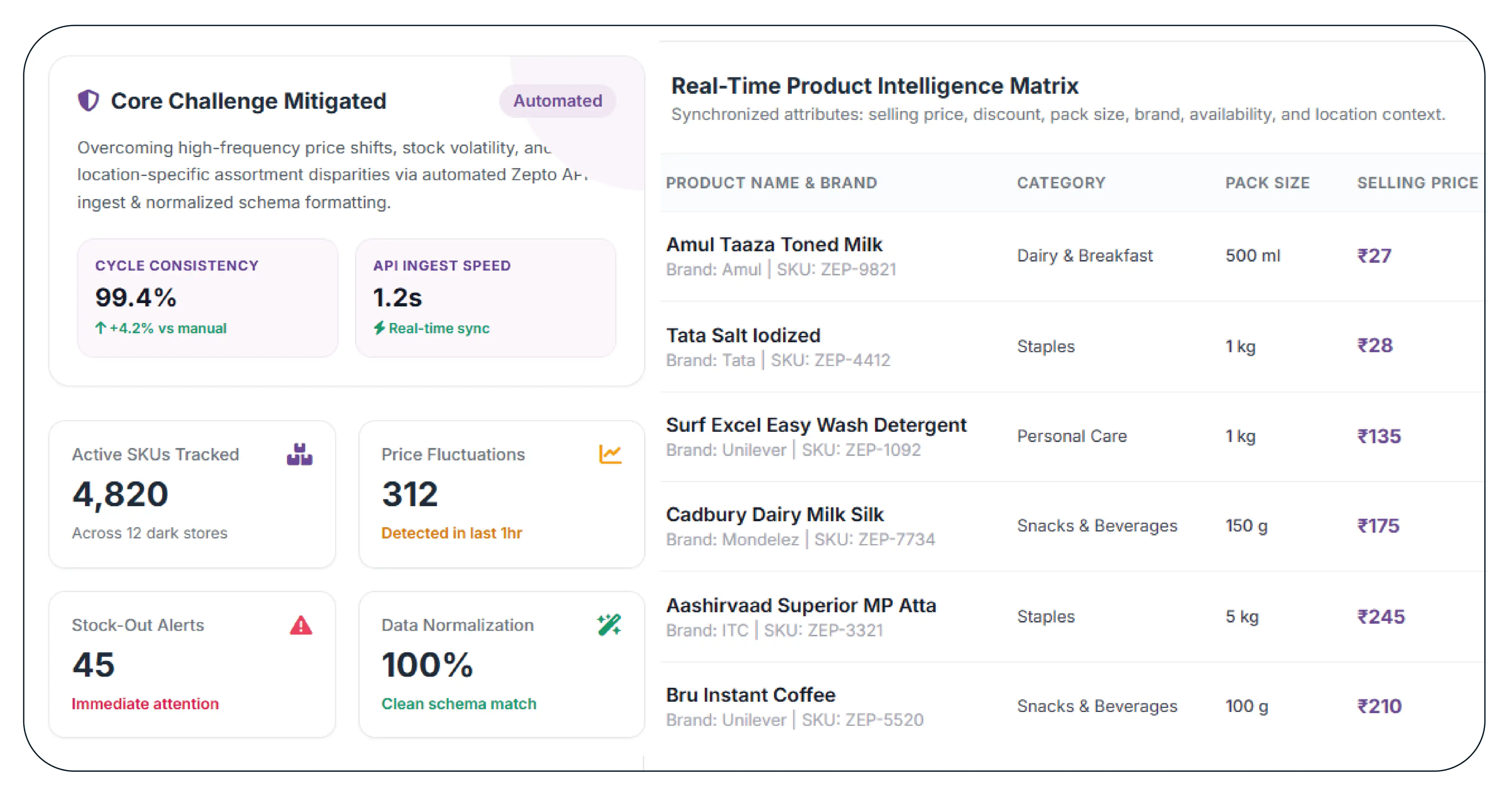
The biggest challenge was the frequency and scale of price and assortment changes in quick commerce. A product that appeared available at one point could become unavailable later, while discounts and promotional prices could change without fitting neatly into a fixed monitoring schedule.
The client also needed visibility beyond headline prices. Product-level competitive intelligence required monitoring several attributes together, including selling price, discount, pack size, brand, category, availability, and location-specific information. Capturing these elements manually was time-consuming and introduced inconsistencies.
Another operational bottleneck involved maintaining comparable records over multiple collection cycles. If product names, pricing formats, or availability values were represented differently from one cycle to another, analysts could struggle to distinguish genuine market changes from data-quality variations.
The brand therefore needed a workflow capable of supporting Zepto API for real-time grocery price comparison while maintaining consistent data structures for analysis.
Location-level variation added another layer of complexity. Quick-commerce assortment and availability can differ by service area, meaning a single product view could not always represent the market accurately. The monitoring framework needed to preserve location context wherever available.
Performance was another consideration. As the monitoring universe expanded, the system had to process large volumes of records without creating unnecessary delays. Automated collection, validation, normalization, and structured delivery were therefore essential to improving both speed and reliability.
Our Solution
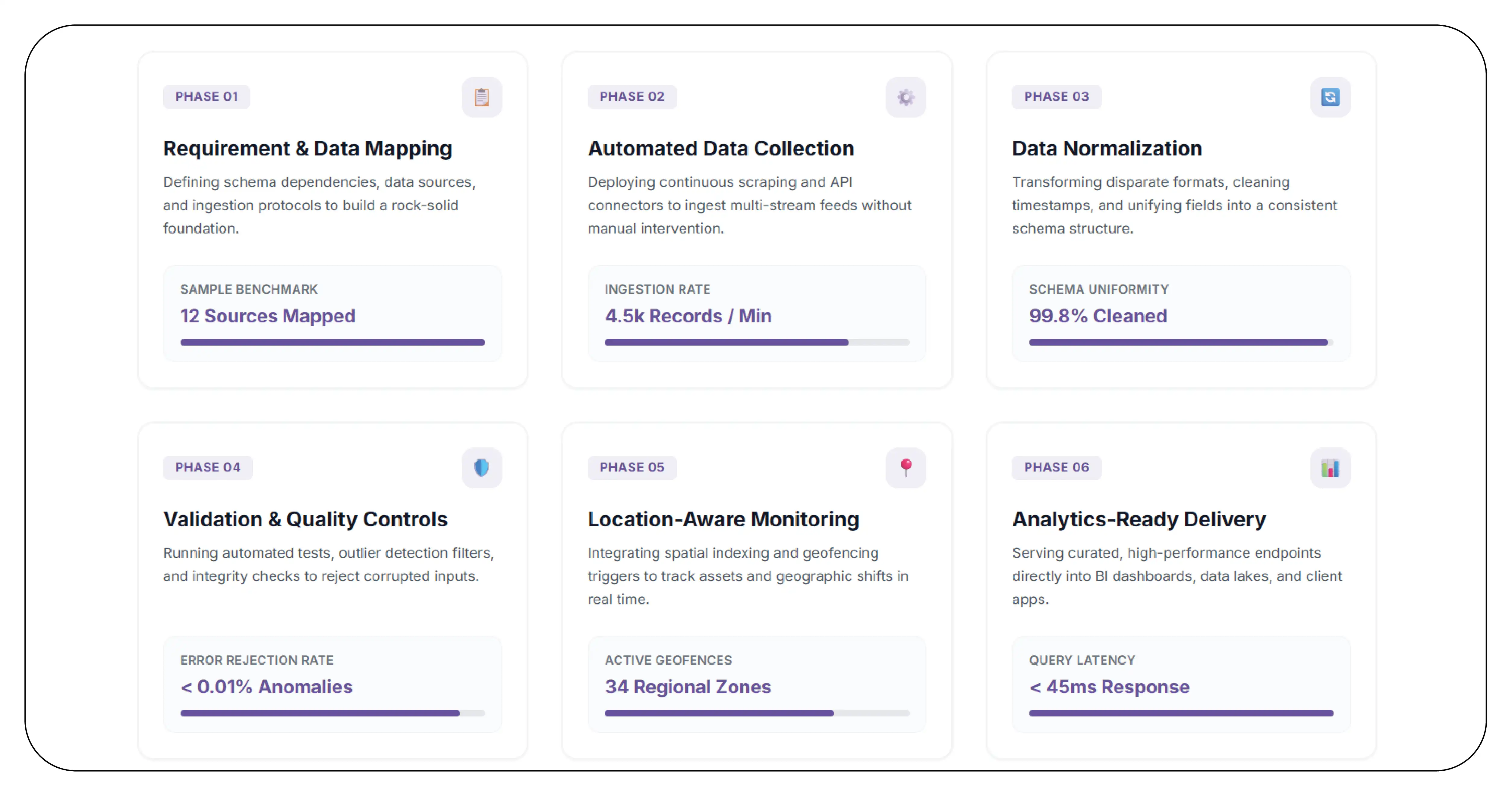
Product Data Scrape developed a phased data collection and processing framework designed around the client's competitive pricing requirements.
Phase 1: Requirement and Data Mapping
The first stage established the monitoring universe. Products, categories, brands, locations, and required attributes were mapped according to the client's business objectives. The framework identified core fields such as product name, brand, category, pack size, selling price, MRP where available, discount, promotion information, availability, location, product URL, and product identifier or SKU where accessible. This ensured that collection focused on business-relevant attributes instead of generating unstructured information.
Phase 2: Automated Data Collection
The next stage introduced an automated extraction workflow to collect product information at recurring intervals. The architecture was designed for scalability so that additional products and categories could be incorporated without redesigning the entire process. The implementation supported Scrape Zepto product pricing API India requirements by organizing collected pricing information into structured records suitable for comparison and downstream processing. Automation reduced dependency on manual checks and created a repeatable mechanism for gathering product-level information.
Phase 3: Data Normalization
Raw records were standardized before delivery. Price values, product names, category labels, availability indicators, and promotional fields were normalized to create consistency between monitoring cycles. Where equivalent products appeared with formatting differences, normalization helped maintain cleaner product-level comparisons.
Phase 4: Validation and Quality Controls
Automated validation rules were applied to identify incomplete or inconsistent records. The workflow checked important fields and helped flag unexpected values, duplicate records, missing attributes, and formatting issues. This stage was important because pricing intelligence is only useful when users can trust the underlying dataset.
Phase 5: Location-Aware Monitoring
Location information was incorporated into the monitoring structure wherever accessible. This allowed the client to distinguish market-level differences instead of treating all Zepto observations as one generalized dataset. The approach strengthened location-based availability and pricing analysis while providing a foundation for future geographic expansion.
Phase 6: Analytics-Ready Delivery
The final stage converted validated records into structured datasets that could be used by business intelligence and analytics teams. With Zepto API for real-time price comparison integrated into the broader workflow, the client gained a more systematic mechanism for monitoring price movements, promotions, assortment, and availability. The resulting pipeline was designed to support recurring monitoring rather than a one-time data extraction exercise.
Results & Key Metrics
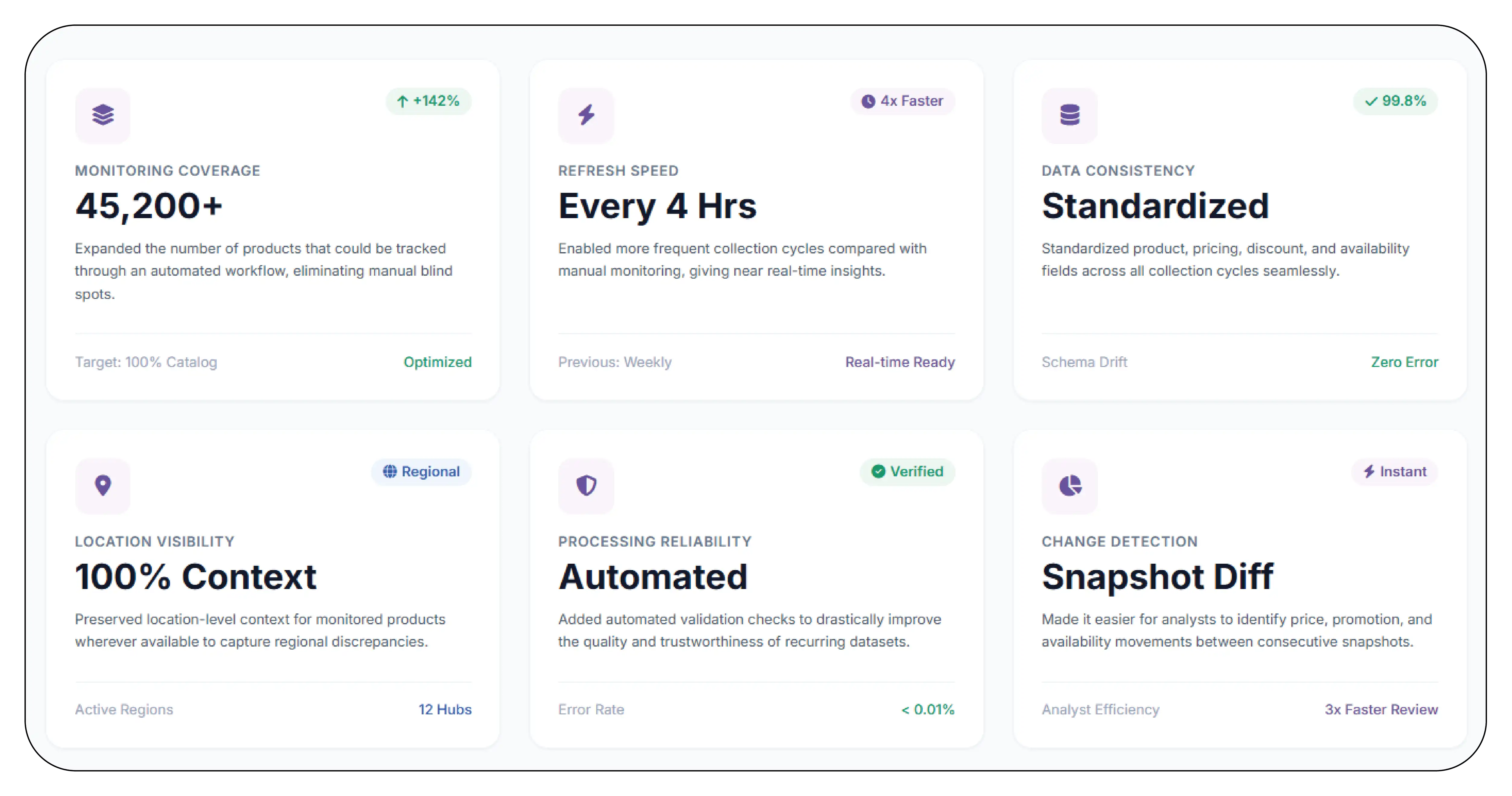
The project focused on measurable operational improvements rather than cost savings.
Monitoring Coverage: Expanded the number of products that could be tracked through an automated workflow.
Refresh Speed: Enabled more frequent collection cycles compared with manual monitoring.
Data Consistency: Standardized product, pricing, discount, and availability fields across collection cycles.
Location Visibility: Preserved location-level context for monitored products wherever available.
Processing Reliability: Added validation checks to improve the quality of recurring datasets.
Change Detection: Made it easier for analysts to identify price, promotion, and availability movements between snapshots.
Results Narrative
The structured workflow gave the client a scalable foundation for real-time grocery comparison app using Zepto API requirements and competitive intelligence. Instead of depending on fragmented manual observations, teams could work with standardized datasets containing product and market attributes.
The project also improved the operational process surrounding Zepto API for real-time price comparison by combining automated collection with normalization and validation. This created a more consistent foundation for pricing analysis, promotion tracking, assortment reviews, and availability monitoring.
The resulting data workflow could also be extended to additional products, categories, and locations as the client's monitoring requirements evolved.
What Made Product Data Scrape Different
The project required more than extracting product pages and storing individual prices. Product Data Scrape focused on building a reusable data pipeline that connected collection, normalization, validation, location context, and recurring delivery.
The framework incorporated smart automation to reduce repetitive manual work while maintaining structured records for analytical use. Flexible processing rules allowed the workflow to accommodate product, price, promotion, and availability attributes without forcing every record into an identical raw format.
The resulting Zepto grocery dataset was structured to support competitive intelligence, historical comparisons, and downstream analytics. This approach made Zepto API for real-time price comparison part of a broader data-monitoring framework rather than an isolated extraction activity.
The architecture also provided a foundation for scaling monitoring coverage as the client's product universe and market intelligence requirements expanded.
Client's Testimonial with Designation
"The project gave our team a more structured way to understand grocery pricing and availability on Zepto. Previously, gathering comparable information required significant manual effort and made it difficult to maintain consistent monitoring cycles. The automated workflow helped us organize product-level information into a format that our teams could use for competitive analysis. We also gained better visibility into pricing and promotional changes across the monitored product universe. The structured data has made recurring analysis easier and created a stronger foundation for expanding our quick-commerce intelligence program."
— Senior Manager, Competitive Intelligence, Consumer & FMCG Brand
Illustrative testimonial draft — replace with the client's approved statement before publication.
Conclusion
Quick-commerce competition requires brands to understand market movements with greater speed and consistency. Automated product and pricing intelligence can help businesses transform fragmented observations into structured information for competitive analysis.
For consumer and FMCG companies, combining pricing, promotions, assortment, and availability monitoring creates a broader view of marketplace activity. A scalable workflow can also make it easier to expand monitoring across products, categories, and locations as business requirements evolve.
With Assortment and availability monitoring, brands can move beyond isolated price checks and develop a more complete view of digital shelf performance.
Product Data Scrape helps businesses build scalable Q-Commerce data scraping workflows tailored to their product, pricing, and competitive intelligence requirements.
Contact Product Data Scrape to build a scalable quick-commerce data solution for your brand!
Frequently Asked Questions
1. What information can businesses collect from Zepto?
Depending on accessibility and project requirements, businesses can collect structured product information such as product names, brands, categories, pack sizes, prices, discounts, availability, locations, URLs, and other relevant attributes.
2. How can Zepto data support competitive pricing analysis?
Structured Zepto data can help brands compare product prices, identify pricing movements, review promotional changes, analyze assortment differences, and maintain historical snapshots for competitive intelligence.
3. Can Zepto product data be monitored across multiple locations?
Yes. A location-aware monitoring workflow can organize product and availability observations by monitored service areas where location-specific information is accessible. This helps businesses identify geographic differences in assortment and availability.
4. How frequently can Zepto data be collected?
Collection frequency depends on the business requirement, monitoring scope, data accessibility, and technical architecture. Recurring workflows can be designed around the desired refresh schedule.
5. Can Product Data Scrape build a customized Zepto dataset?
Yes. Product Data Scrape can design structured datasets around specific business requirements, including product attributes, pricing, promotions, availability, categories, locations, and recurring competitive monitoring.


 Singapore
 EMAIL
 PHONE










.webp)