Quick Overview
This case study examines how an anonymized consumer electronics brand transformed fragmented competitor feedback into structured product-reputation intelligence. The client sold products such as wireless earbuds, smartwatches, Bluetooth speakers, and mobile accessories through marketplaces including Amazon and Flipkart. Before the engagement, analysts manually reviewed competitor products such as Samsung Galaxy Buds, boAt Airdopes, JBL earbuds, Noise smartwatches, and Realme accessories. This made it difficult to monitor thousands of customer comments consistently. Competitor Review Benchmarking Using Web Scraping automated review collection and comparison, while Competitor price monitoring added pricing context to reputation analysis. The project delivered an 82% improvement in review-processing speed, 96% data completeness, and a 68% reduction in manual analysis effort.
Client Name / Industry: Anonymized Consumer Electronics & E-commerce Brand
Service / Duration: Product and marketplace data extraction / 6 months
Key Impact Metrics: 82% faster processing, 96% data completeness, 68% reduction in manual analysis
The Client
The client was a growing consumer electronics brand operating across its own e-commerce website and major online marketplaces. Its portfolio included wireless earbuds, headphones, Bluetooth speakers, smartwatches, charging accessories, and other mobile-device products.
The company competed against highly visible brands such as boAt, Noise, JBL, Samsung, Realme, OnePlus, Sony, and Xiaomi. Products such as boAt Airdopes, JBL Tune series headphones, Samsung Galaxy Buds, OnePlus Nord Buds, Noise ColorFit smartwatches, and Sony wireless headphones frequently appeared within overlapping marketplace categories.
The competitive environment was becoming increasingly review-driven. Customers were comparing products not only on specifications and pricing but also on battery life, sound quality, durability, connectivity, comfort, packaging, delivery experience, warranty support, and value for money.
Before the partnership, the client depended heavily on manual review collection. Analysts periodically opened competitor product pages on Amazon, Flipkart, and other marketplaces, copied selected reviews, recorded star ratings in spreadsheets, and manually categorized customer comments.
This approach became increasingly difficult as product catalogs expanded. A single product could have thousands of reviews, while new competitor models could accumulate feedback rapidly after launch.
The company also lacked a standardized methodology for comparing review sentiment between products such as Samsung Galaxy Buds, boAt Airdopes, JBL Tune earbuds, and OnePlus Nord Buds.
The transformation was therefore essential. The client needed an automated intelligence process that could capture large volumes of feedback, normalize review data, identify sentiment patterns, and connect customer perception with competitive pricing and product availability.
The engagement introduced Scrape Competitor Reviews for Benchmarking to create a repeatable customer-intelligence workflow, while Ratings, reviews and sentiment analysis helped transform unstructured feedback into comparable metrics.
Goals & Objectives
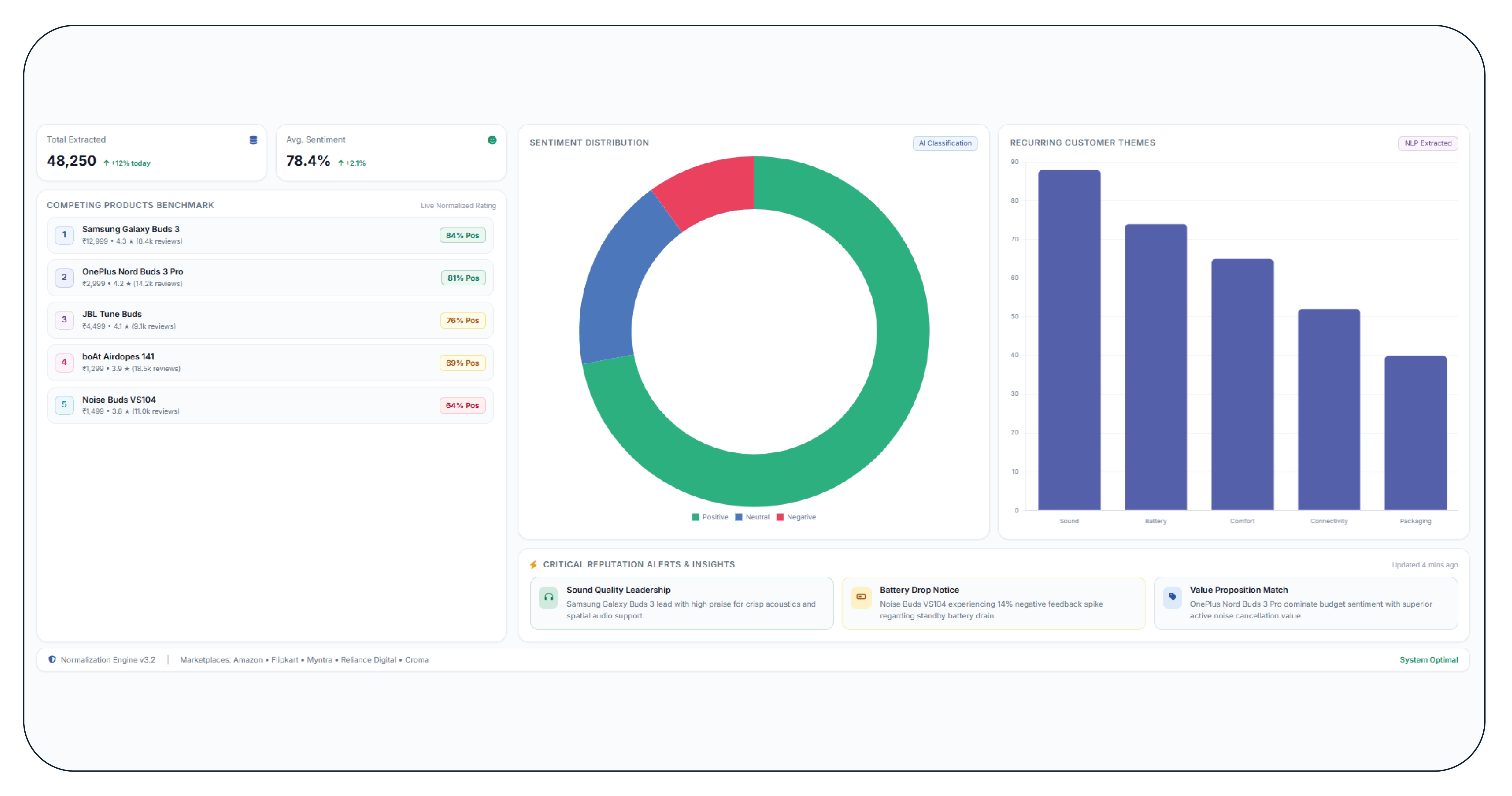
Build a scalable system for collecting competitor reviews across multiple marketplaces.
Reduce dependence on manual review monitoring and spreadsheet-based workflows.
Improve the speed at which product-reputation changes could be detected.
Establish consistent review benchmarks across competing products.
Identify recurring positive and negative customer themes.
Support product-quality, customer-experience, and positioning decisions.
Compare competing products such as boAt Airdopes, JBL Tune Buds, Samsung Galaxy Buds, OnePlus Nord Buds, and Noise earbuds.
Automate extraction of review text, ratings, timestamps, product information, and marketplace identifiers.
Normalize ratings and review structures across different marketplace environments.
Apply automated sentiment classification to positive, neutral, and negative feedback.
Detect recurring themes such as sound quality, battery performance, connectivity, comfort, packaging, and delivery issues.
Integrate review intelligence with product and pricing datasets.
Create recurring dashboards for product-level and competitor-level analysis.
Track new reviews associated with newly launched products such as Samsung Galaxy Buds models, OnePlus Nord Buds, and JBL wireless headphones.
Compare product-level reputation against competitor pricing and availability.
82% improvement in review-processing speed.
96% data completeness across defined review fields.
68% reduction in manual review-analysis effort.
91% successful product-to-review mapping across monitored competitors.
89% sentiment classification agreement against a manually validated sample.
Daily refresh capability for priority marketplace datasets.
Faster identification of recurring complaints across monitored products.
The project also incorporated Competitor Review Sentiment Benchmarking to compare customer perception systematically and Competitor Stockout Intelligence to identify whether availability disruptions could influence customer experience.
The Core Challenge
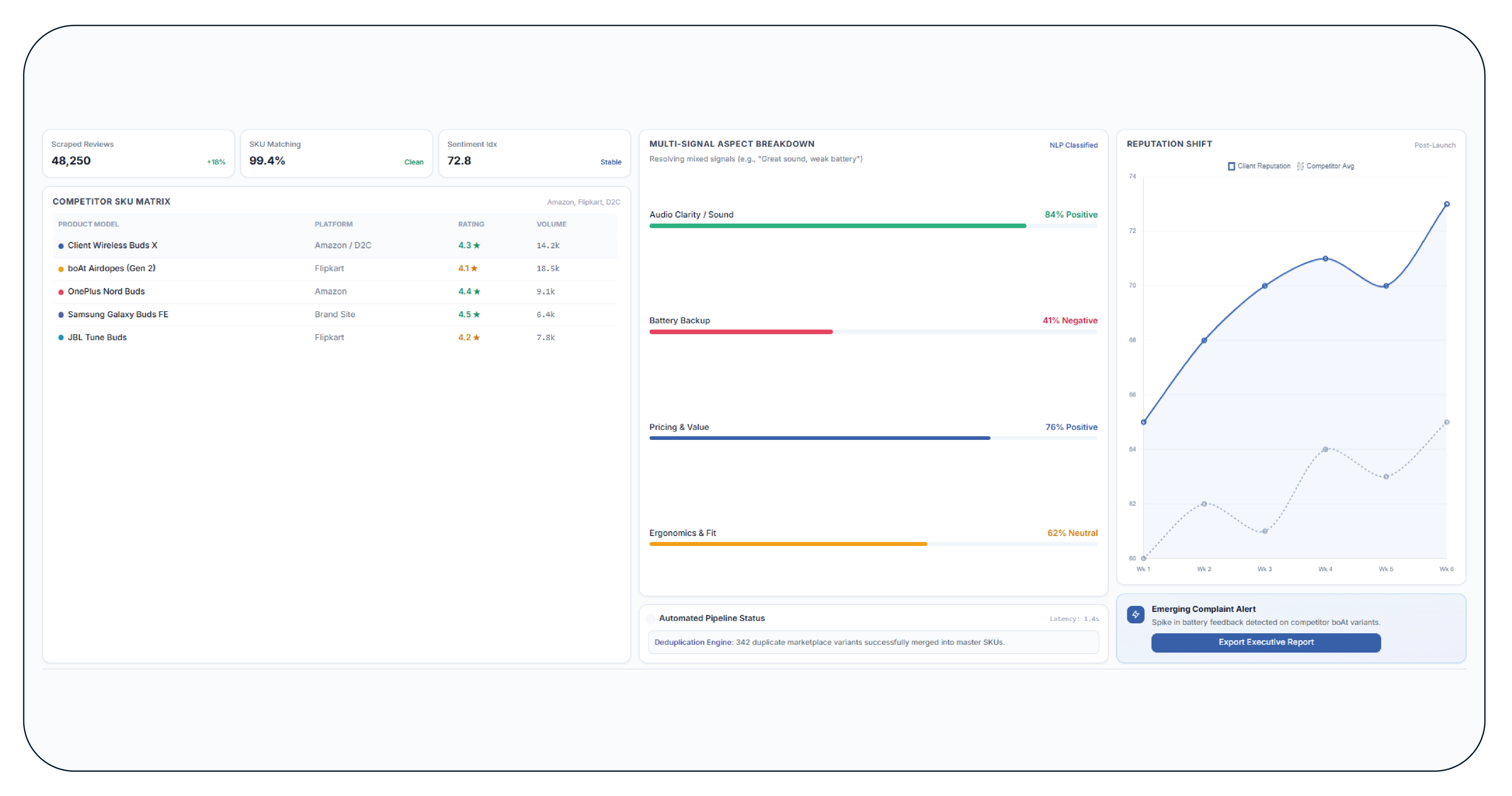
The client's biggest problem was not a lack of customer feedback. It was the inability to convert large volumes of scattered marketplace feedback into timely competitive intelligence.
Review information existed across Amazon, Flipkart, brand websites, and other online retail environments. Each platform presented product and review information differently. Product titles varied, rating structures differed, pagination could change, and product variants sometimes appeared under similar names.
For example, analysts might need to compare a client's wireless earbuds with products such as boAt Airdopes, OnePlus Nord Buds, JBL Tune Buds, Samsung Galaxy Buds FE, and Realme Buds. Although these products competed within related categories, their review volumes, pricing, specifications, and customer expectations could differ substantially.
Manual extraction created several operational bottlenecks. Analysts spent substantial time opening product pages, copying reviews, checking ratings, removing duplicates, and organizing information into spreadsheets.
Another challenge involved data consistency. A product such as Samsung Galaxy Buds could have multiple generations and variants. Similarly, JBL Tune models and boAt Airdopes products could have several versions with similar naming patterns. Without reliable product matching, reviews could be assigned to the wrong SKU.
Sentiment analysis was another weakness. Analysts could identify obvious positive or negative comments, but processing thousands of reviews consistently was difficult. A review such as "excellent sound but poor battery backup" contained both positive and negative signals that required more sophisticated classification.
The resulting delays affected strategic decisions. Product teams lacked timely evidence about emerging complaints. Marketing teams could not easily identify competitor strengths. Category managers had difficulty determining whether rating differences reflected product quality, pricing, expectations, or availability.
The absence of structured historical data also limited trend analysis. The client could see current ratings but had difficulty understanding how competitor reputation changed after promotions, product launches, price changes, or stock availability issues.
A centralized Marketplace Competitor Review Analysis framework was therefore required to improve collection, standardization, classification, and reporting.
Our Solution
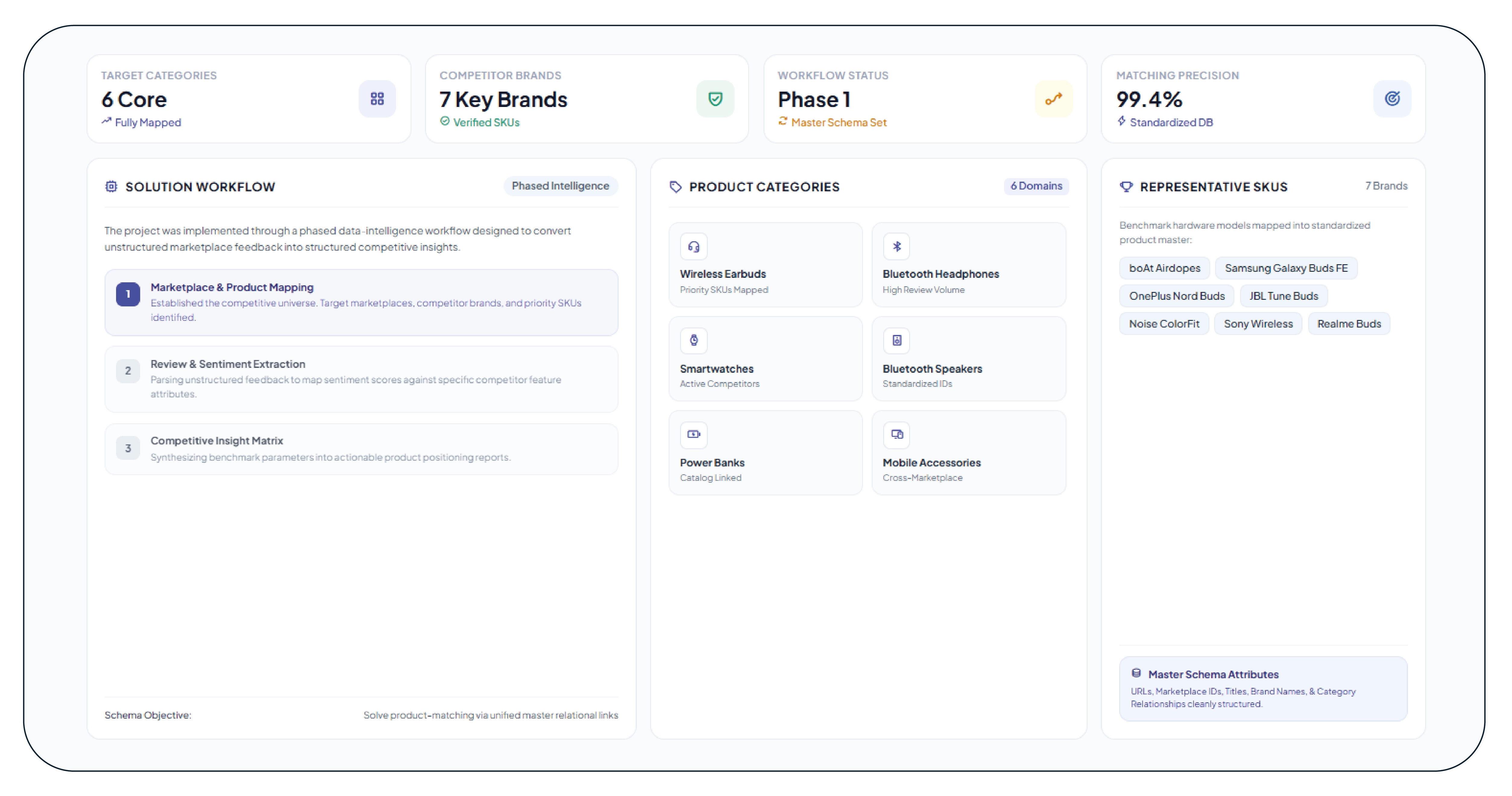
The project was implemented through a phased data-intelligence workflow designed to convert unstructured marketplace feedback into structured competitive insights.
Phase 1: Marketplace and Product Mapping
The first phase established the competitive universe. Target marketplaces, competitor brands, product categories, and priority SKUs were identified.
Products were mapped across categories such as wireless earbuds, Bluetooth headphones, smartwatches, Bluetooth speakers, power banks, and mobile accessories.
Representative competitor products included boAt Airdopes, Samsung Galaxy Buds FE, OnePlus Nord Buds, JBL Tune Buds, Noise ColorFit smartwatches, Sony wireless headphones, and Realme Buds.
Product URLs, marketplace identifiers, product titles, brand names, and category relationships were mapped into a standardized product master. This step addressed the product-matching problem by creating consistent relationships between competitor products and their associated reviews.
Phase 2: Automated Review Collection
Automated extraction workflows were configured to collect review information at scale.
Depending on marketplace availability, the workflow captured product name, brand, product ID, review text, star rating, review date, product variant, marketplace, review metadata, product category, and product URL.
For example, reviews associated with products such as JBL Tune Buds, Samsung Galaxy Buds FE, and boAt Airdopes could be collected into a standardized structure rather than remaining scattered across separate marketplace pages. Pagination handling and duplicate controls improved collection consistency and reduced repetitive manual work.
Phase 3: Data Cleaning and Normalization
Raw data was transformed into standardized records. Rating formats were normalized, duplicate reviews were removed, product names were cleaned, dates were standardized, and review records were linked to the correct product.
For example, different representations of a product such as "Samsung Galaxy Buds FE," "Galaxy Buds FE," or a marketplace-specific variation could be mapped to a consistent product record. Likewise, different JBL Tune or boAt Airdopes variants could be separated instead of being incorrectly grouped together. A validation layer checked missing fields, unexpected rating values, duplicate records, and inconsistent product identifiers before the information entered the analytical dataset.
Phase 4: Sentiment and Theme Classification
The next phase focused on understanding what customers were saying. Reviews were categorized according to sentiment and recurring themes.
Common themes included sound quality, battery life, connectivity, comfort, build quality, durability, packaging, delivery experience, value for money, warranty, customer service, and product expectations.
For example, reviews mentioning "deep bass," "clear calls," or "comfortable fit" could contribute to positive product attributes, while comments concerning "battery drain," "Bluetooth disconnecting," or "poor build quality" could be classified as potential product concerns. This allowed the client to compare not only average ratings but also the reasons behind customer sentiment.
Phase 5: Competitive Benchmarking
The cleaned dataset was converted into comparative metrics. Analysts could evaluate average rating, rating distribution, review volume, positive sentiment ratio, negative sentiment ratio, complaint frequency, customer-theme frequency, product-level reputation, and competitor-level reputation.
For instance, the client could compare its own wireless earbuds against boAt Airdopes, OnePlus Nord Buds, JBL Tune Buds, and Samsung Galaxy Buds. The team also connected review results with product pricing and availability information. This helped stakeholders investigate whether lower-rated products were experiencing quality concerns, pricing pressure, or availability-related issues.
Phase 6: Automation and Reporting
Finally, recurring pipelines were established for data refreshes and reporting. Priority products could be monitored more frequently, while lower-priority categories could follow a less intensive schedule. Dashboards summarized product-level reputation, competitor movement, sentiment trends, and emerging customer complaints.
A product manager could therefore view whether a product such as a wireless earbud was gaining positive sentiment while its competitor was experiencing increasing complaints about battery life or connectivity.
The methodology behind Competitor Review Quality Benchmarking helped the client move beyond simple star-rating comparisons and understand the quality and consistency of customer feedback.
The completed system supported Competitor Review Benchmarking Using Web Scraping through automated extraction, normalization, sentiment analysis, product matching, historical comparison, and structured reporting.
Results & Key Metrics
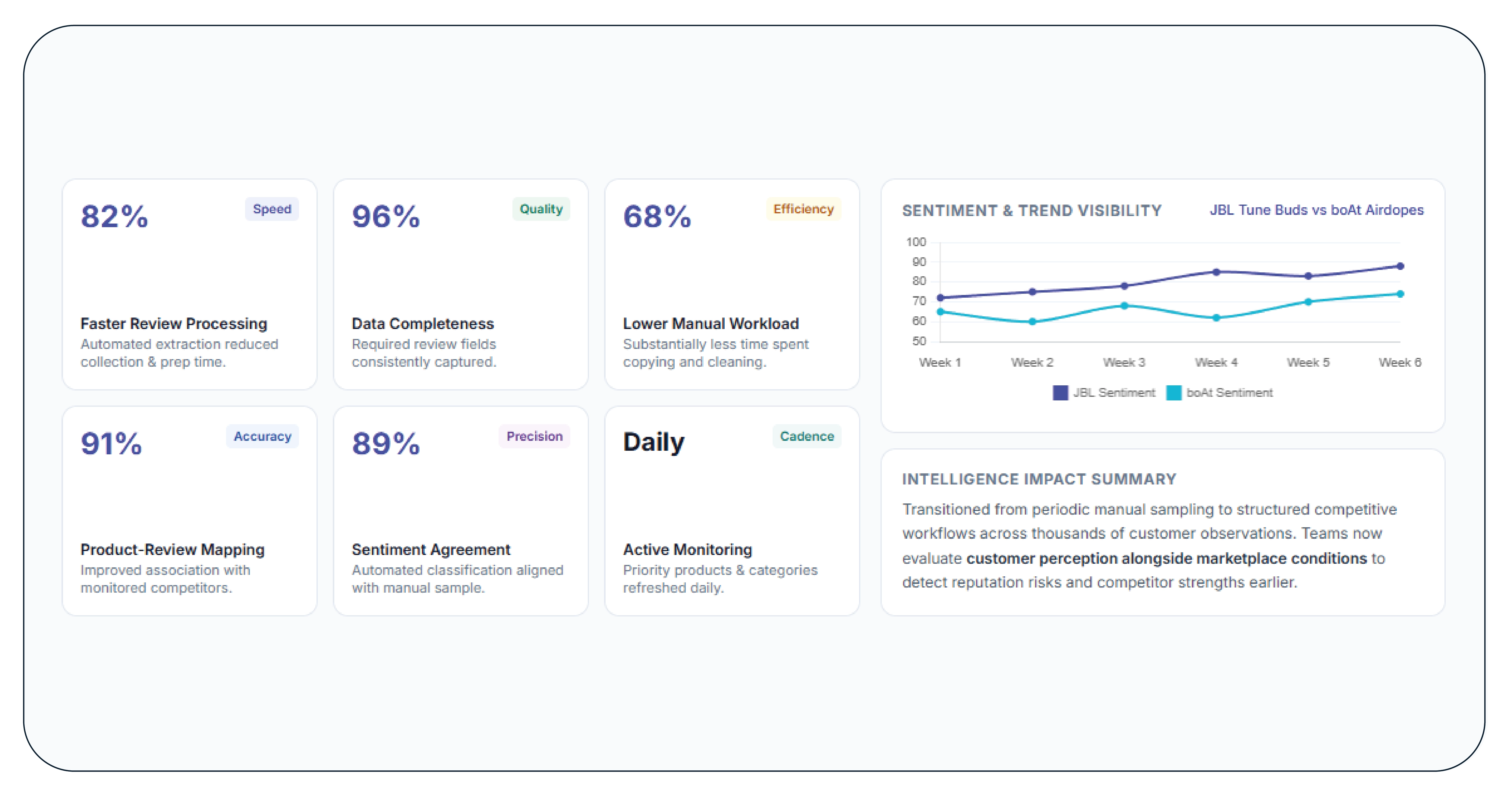
82% faster review processing: Automated extraction significantly reduced the time required to collect and prepare review records.
96% data completeness: Required review fields were consistently captured across the monitored dataset.
68% lower manual workload: Analysts spent substantially less time copying, cleaning, and organizing review information.
91% product-review mapping accuracy: Automated matching improved association between reviews and monitored competitor products.
89% sentiment classification agreement: Automated classification closely aligned with the manually validated sample.
Daily monitoring: Priority products and categories could be refreshed through automated workflows.
Results Narrative
The project changed the client's review-monitoring process from periodic manual sampling to a structured competitive intelligence workflow.
Instead of relying on a handful of reviews from products such as JBL Tune Buds or boAt Airdopes, analysts could examine larger datasets and identify patterns across thousands of customer observations.
Scrape Marketplace Reviews for Competitor Analysis became particularly valuable for detecting recurring complaints and identifying competitor strengths.
For example, product teams could identify whether customers consistently praised battery performance for one competitor while repeatedly mentioning connectivity problems for another.
The historical dataset also improved trend visibility. Teams could compare rating movements, review volumes, and sentiment patterns over time, allowing emerging reputation risks to be identified earlier.
The combination of review, pricing, product, and availability information created a broader competitive perspective. Management could evaluate customer perception alongside marketplace conditions instead of treating reviews as an isolated metric.
What Made Product Data Scrape Different
The project differentiated itself through a combination of automated extraction, structured product matching, validation rules, and analytical automation.
Instead of treating reviews as standalone text, the workflow connected each review with its corresponding product, category, marketplace, rating, and observation date.
Smart automation reduced repetitive analyst tasks while validation rules helped identify incomplete or inconsistent records before analysis.
The framework could accommodate multiple product families and competitor brands, including earbuds, headphones, smartwatches, speakers, and mobile accessories.
Another differentiator was the integration of review intelligence with other marketplace signals. Customer sentiment could be compared with pricing, availability, product attributes, and category-level competitive information.
For example, a product experiencing falling sentiment could be examined alongside a recent price increase, promotional change, or repeated stockout.
The result was a repeatable intelligence process rather than a one-time review report.
Score Competitive Pricing Intelligence Accuracy was incorporated into the broader benchmarking framework, while Competitor Review Benchmarking Using Web Scraping provided the core customer-perception layer.
Client's Testimonial
"Before this project, our competitor review analysis was fragmented and heavily dependent on manual sampling. We could see ratings for products such as wireless earbuds and smartwatches, but understanding why those ratings changed required considerable analyst time. The new workflow gave our teams a consistent way to monitor competitor feedback, identify recurring customer concerns, and compare sentiment across products. The improvement in processing speed was particularly valuable because our categories change quickly. We can now examine competitor products, customer sentiment, pricing, and availability together instead of relying on isolated review observations."
— Head of E-commerce Analytics, Anonymized Consumer Electronics Brand
The project was complemented by a Competitor Price Monitoring API, allowing the client to connect customer perception with marketplace pricing signals for deeper competitive analysis.
Conclusion
The project demonstrated how structured review intelligence can transform product reputation analysis from a manual research activity into a scalable competitive capability.
Automated extraction, product matching, sentiment classification, and historical benchmarking gave the client faster access to meaningful customer insights across products such as wireless earbuds, smartwatches, headphones, and speakers.
The approach also created opportunities to connect reputation data with pricing, availability, product attributes, and category performance. As marketplaces continue to increase product choice and customer feedback volumes, this integrated approach can help brands identify reputation risks and competitive opportunities earlier.
Market Share Analytics can further extend the framework by connecting customer perception with broader competitive positioning across brands, categories, and marketplaces.
Partner with Product Data Scrape to build an automated competitor intelligence solution that turns marketplace reviews, ratings, pricing, and product data into actionable business insights!
FAQs
1. What is competitor review benchmarking?
It is the process of comparing competitor ratings, review volumes, sentiment, recurring complaints, and customer themes to understand relative product reputation and identify opportunities for improvement. For example, a brand could compare customer feedback for its wireless earbuds against Samsung Galaxy Buds, JBL Tune Buds, OnePlus Nord Buds, or boAt Airdopes.
2. Why automate competitor review collection?
Automation enables businesses to process substantially larger review volumes, maintain consistent collection schedules, reduce manual effort, and detect changes in customer sentiment faster. Instead of manually checking hundreds of product pages, analysts can work with structured datasets covering multiple products, brands, marketplaces, and time periods.
3. What information can be extracted from competitor reviews?
Depending on marketplace availability, datasets can include product identifiers, review text, ratings, review dates, product details, sentiment classifications, recurring themes, review-volume trends, product variants, and marketplace information. This information can be used to compare customer perceptions across products such as earbuds, headphones, smartwatches, speakers, and mobile accessories.
4. How does sentiment analysis help brands?
Sentiment analysis organizes customer feedback into meaningful patterns, helping teams identify strengths, recurring complaints, feature concerns, quality issues, and emerging reputation risks. For example, repeated mentions of battery drain or connectivity problems can help product teams prioritize investigation, while frequent praise for sound quality can highlight a competitive strength.
5. Can review data be combined with other competitive information?
Yes. Review intelligence can be connected with pricing, availability, product attributes, and category information to provide a broader view of competitor positioning and customer experience. This enables businesses to investigate whether changes in customer sentiment coincide with price changes, promotions, product launches, or marketplace stock availability.


 Singapore
 EMAIL
 PHONE











.webp)