Introduction
The rapid growth of quick commerce platforms has transformed how consumers
purchase groceries and FMCG products online. Businesses now rely heavily on data-driven insights
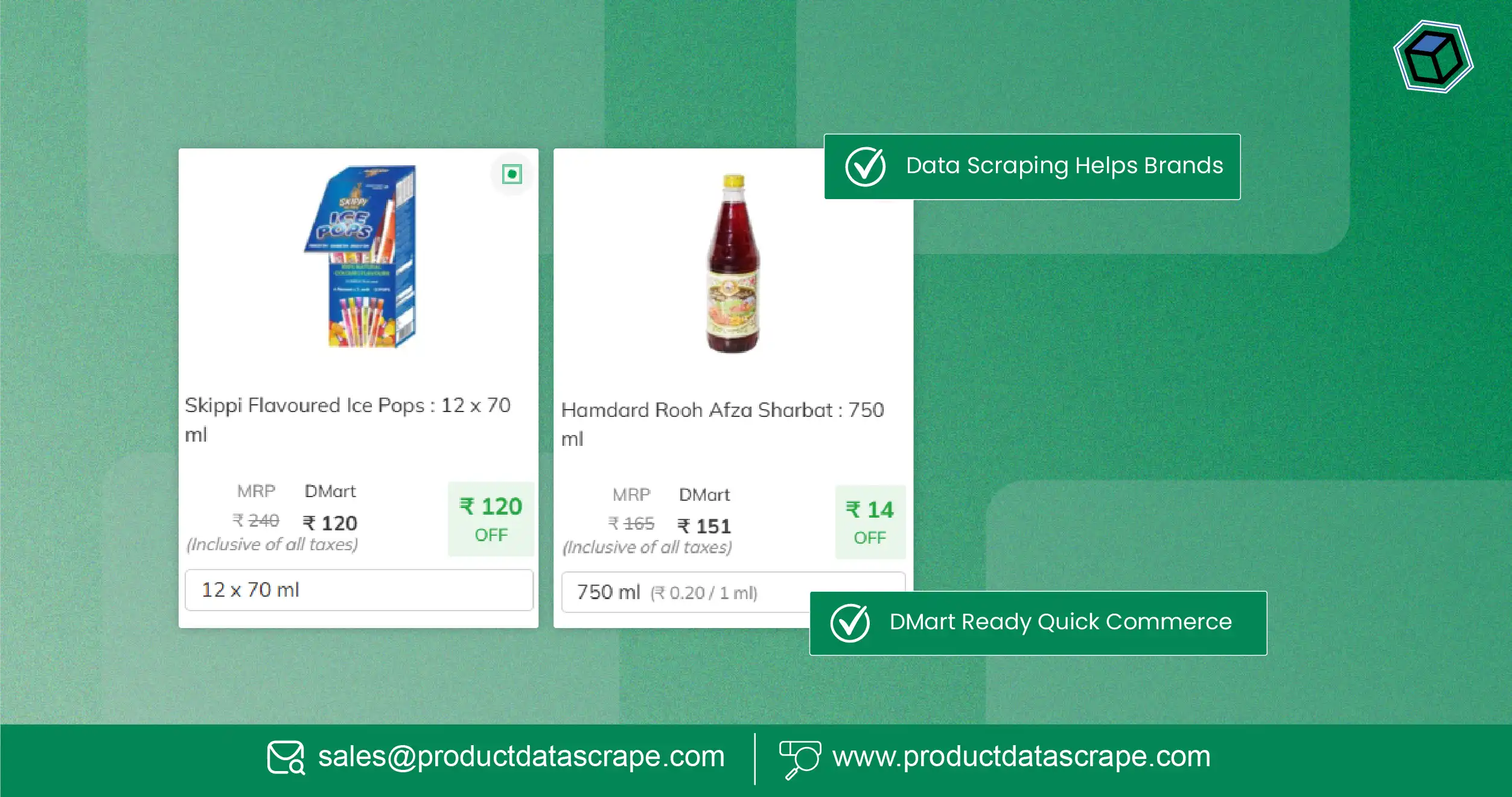
to optimize pricing, inventory management, and delivery performance. DMart Ready Quick Commerce
Data Scraping enables brands, retailers, and market researchers to gather valuable real-time
information from product listings, stock updates, and promotional campaigns.
Using Web Scraping
DMart Ready Quick Commerce Data, companies
can monitor
consumer demand patterns, evaluate competitor pricing strategies, and improve operational
efficiency. With the quick commerce sector projected to grow significantly between 2020 and
2026, accurate datasets have become essential for making informed business decisions. Businesses
can identify trending categories, monitor delivery availability, and analyze regional pricing
fluctuations to stay competitive in the evolving digital retail ecosystem.
Understanding Consumer Buying Patterns Through Real-Time Retail Data
The grocery and FMCG sector has experienced a massive shift toward quick
commerce platforms due to convenience, faster deliveries, and increasing smartphone penetration.
Brands now use Scrape DMart Ready Q Commerce Grocery & FMCG Data to understand purchasing
behavior, monitor product visibility, and evaluate customer demand patterns across different
locations.
Retailers can also analyze Pricing Strategies by comparing product costs across
categories and identifying pricing fluctuations during seasonal campaigns or festive sales. This
helps businesses optimize profit margins while maintaining competitive pricing structures.
Grocery & FMCG Quick Commerce Growth (2020–2026)
| Year |
Market Growth (%) |
Average Online Grocery Orders |
| 2020 |
18% |
1.2 Million |
| 2021 |
26% |
2.1 Million |
| 2022 |
33% |
3.4 Million |
| 2023 |
41% |
4.8 Million |
| 2024 |
49% |
6.2 Million |
| 2025 |
58% |
7.5 Million |
| 2026 |
65% |
9.1 Million |
By leveraging retail data extraction, companies gain insights into fast-moving
categories such as dairy, packaged foods, beverages, and household essentials. Data scraping
also helps identify inventory gaps and out-of-stock products that may affect customer
satisfaction.
Businesses using structured grocery datasets can improve category planning,
optimize product assortment, and align supply chain operations with market demand trends.
Tracking Competitor Performance Across Urban Markets
Quick commerce competition is intensifying as platforms continuously adjust
prices and delivery models. Businesses use DMart Ready Quick Commerce Market Intelligence to
evaluate competitor activities, monitor new product launches, and identify pricing changes in
real time.
With advanced Price Monitoring, brands can compare pricing across multiple
product categories and detect sudden discounts or promotional campaigns. This helps retailers
respond quickly to market fluctuations and improve their pricing strategies.
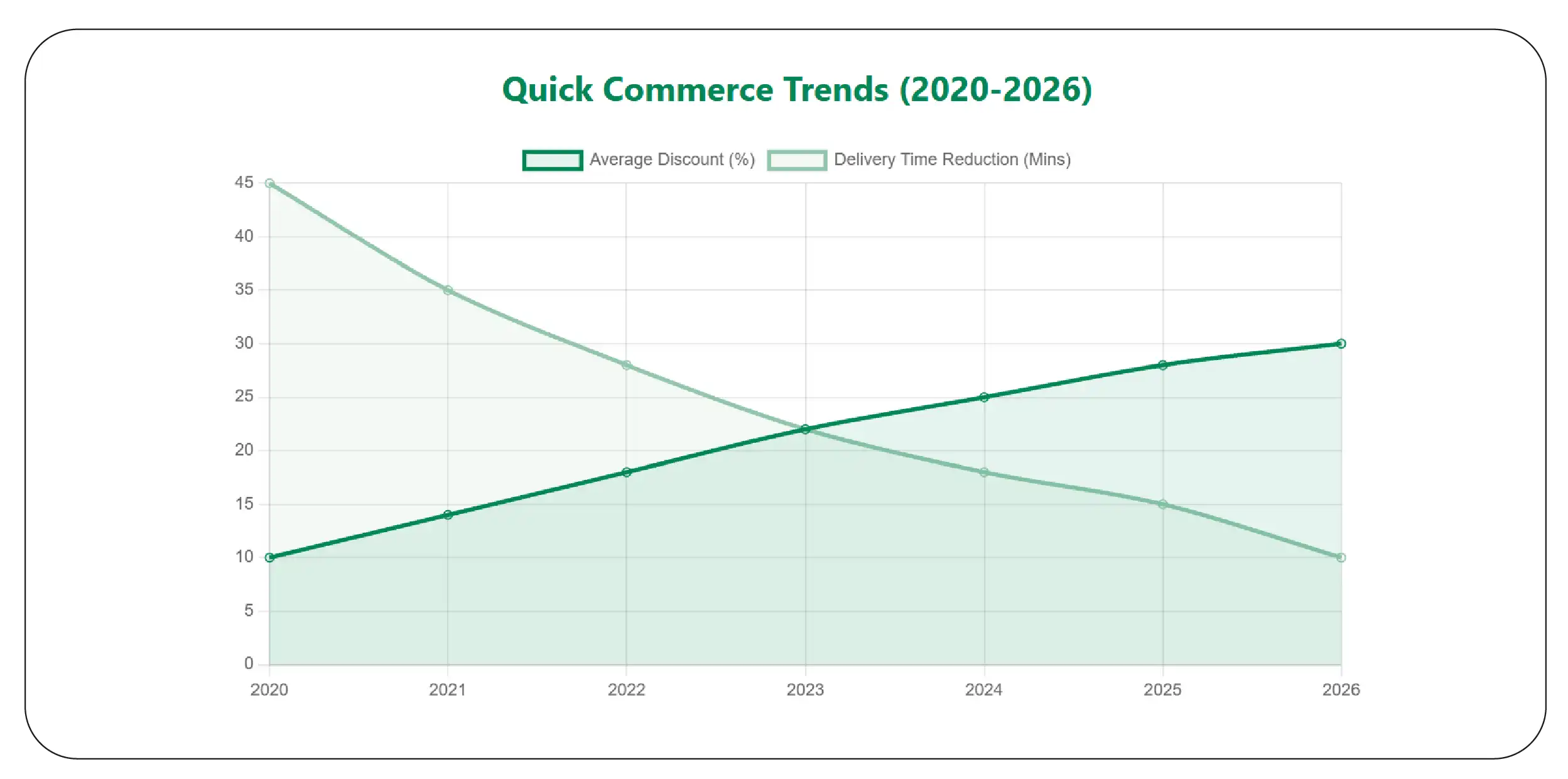
Price Monitoring Trends in Quick Commerce
| Year |
Average Discount (%) |
Delivery Time Reduction |
| 2020 |
10% |
45 Minutes |
| 2021 |
14% |
35 Minutes |
| 2022 |
18% |
28 Minutes |
| 2023 |
22% |
22 Minutes |
| 2024 |
25% |
18 Minutes |
| 2025 |
28% |
15 Minutes |
| 2026 |
30% |
10 Minutes |
Market intelligence data enables businesses to identify premium-selling
products, region-specific demand trends, and pricing inconsistencies. Retailers can optimize
dynamic pricing strategies and improve promotional
planning based on competitor
analysis.
Moreover, companies can track delivery availability across cities and assess
how quick commerce platforms are improving operational efficiency to meet growing customer
expectations.
Enhancing Business Decisions with Automated Data Collection
Modern businesses require automated solutions to collect structured data from
large-scale eCommerce platforms. Using DMart Ready Quick Commerce Insights, organizations can
analyze category performance, inventory trends, and customer demand patterns efficiently.
Advanced Web Scraping API Services
allow businesses to automate
product data
extraction processes and integrate datasets directly into analytics dashboards or enterprise
systems. This reduces manual effort while ensuring accurate and scalable data collection.
Automated Data Collection Adoption (2020–2026)
| Year |
Businesses Using Automation |
Data Accuracy Rate |
| 2020 |
24% |
82% |
| 2021 |
32% |
86% |
| 2022 |
41% |
89% |
| 2023 |
53% |
92% |
| 2024 |
66% |
94% |
| 2025 |
74% |
96% |
| 2026 |
81% |
98% |
Automation helps businesses monitor thousands of SKUs across categories such as
snacks, beverages, frozen foods, and personal care products. Retailers can quickly identify
price fluctuations, unavailable products, and newly added inventory items.
Data-driven insights also support demand forecasting, helping brands improve
procurement planning and minimize stock shortages during peak sales periods.
Improving Inventory Visibility Across Product Categories
.webp)
Inventory management remains one of the most critical aspects of quick commerce
operations. Businesses using DMart Ready FMCG Data Scraping can track stock availability,
identify inventory shortages, and monitor product replenishment frequency across locations.
Real-time inventory insights help brands avoid overstocking or understocking
situations while ensuring efficient warehouse operations. Retailers can analyze which products
experience high demand and allocate inventory accordingly.
Inventory Availability Trends (2020–2026)
| Year |
Out-of-Stock Reduction |
Inventory Accuracy |
| 2020 |
8% |
76% |
| 2021 |
13% |
81% |
| 2022 |
19% |
85% |
| 2023 |
27% |
89% |
| 2024 |
35% |
92% |
| 2025 |
41% |
95% |
| 2026 |
48% |
97% |
Businesses can also evaluate inventory turnover rates across grocery categories
and identify slow-moving products. This enables retailers to improve procurement efficiency and
optimize supply chain performance.
Accurate inventory monitoring helps companies deliver a seamless customer
experience while reducing operational losses associated with unavailable products or delayed
deliveries.
Identifying High-Demand Categories for Better Sales Planning
Quick commerce platforms offer thousands of products across multiple
categories, making category-level analysis essential for retailers. Through DMart Ready
Category-wise Product Scraping, businesses can track category performance and identify products
experiencing increasing demand.
Category-based insights help brands understand customer preferences and
optimize product placements for improved sales performance. Retailers can analyze seasonal
demand fluctuations and plan promotional campaigns more effectively.
Category-Wise Sales Growth (2020–2026)
| Year |
Grocery |
Beverages |
Personal Care |
Household Essentials |
| 2020 |
12% |
9% |
7% |
11% |
| 2021 |
18% |
14% |
10% |
16% |
| 2022 |
24% |
19% |
15% |
21% |
| 2023 |
31% |
25% |
20% |
27% |
| 2024 |
39% |
33% |
28% |
34% |
| 2025 |
46% |
41% |
35% |
42% |
| 2026 |
54% |
48% |
43% |
50% |
Category-wise product analysis enables businesses to optimize assortment
planning and identify emerging consumer trends. Retailers can also evaluate pricing variations
within categories and improve margin management strategies.
Such insights are particularly useful for FMCG brands aiming to strengthen
market positioning in the highly competitive quick commerce industry.
Monitoring Promotional Campaigns and Discount Trends
.webp)
Discount campaigns play a major role in attracting customers to quick commerce
platforms. Businesses use data analytics tools to Monitor Daily Offers and Discounts on DMart
Ready and evaluate the effectiveness of promotional strategies.
Tracking discounts helps retailers understand how pricing campaigns influence
customer purchasing behavior and product demand. Businesses can identify frequently discounted
categories and analyze competitor marketing strategies.
Promotional Campaign Performance (2020–2026)
| Year |
Average Discount Campaigns |
Conversion Growth |
| 2020 |
15 |
9% |
| 2021 |
22 |
14% |
| 2022 |
31 |
19% |
| 2023 |
40 |
25% |
| 2024 |
52 |
32% |
| 2025 |
65 |
39% |
| 2026 |
78 |
47% |
Retailers can optimize marketing budgets and promotional schedules by
understanding discount performance across categories. Insights into offer frequency, bundle
pricing, and seasonal promotions help businesses maximize customer engagement and improve sales
conversions.
Monitoring promotional campaigns also allows brands to detect pricing anomalies
and maintain competitive positioning in rapidly evolving digital marketplaces.
Why Choose Product Data Scrape?
Businesses seeking reliable retail intelligence solutions need scalable and
accurate data extraction services. Dmart Ready
Grocery Store Dataset solutions
help brands
access structured datasets for pricing analysis, inventory tracking, and category performance
evaluation.
With expertise in DMart Ready Quick Commerce Data Scraping, we deliver
automated, accurate, and real-time datasets tailored to business requirements. The company
supports grocery retailers, FMCG brands, market researchers, and analytics firms with customized
scraping solutions that improve decision-making and operational efficiency.
Using advanced automation technologies, we ensure high-quality data delivery,
scalable extraction processes, and actionable insights that help businesses stay ahead in the
competitive quick commerce industry.
Conclusion
The quick commerce industry continues to evolve rapidly, creating new
opportunities for brands and retailers to leverage data-driven strategies. Quick
Commerce
Grocery & FMCG Data Scraping
enables businesses to track pricing trends, inventory availability,
category performance, and promotional campaigns effectively.
By utilizing DMart Ready Quick Commerce Data Scraping, companies can gain
valuable market intelligence and improve operational efficiency through accurate, real-time
datasets. Businesses that invest in structured retail analytics can make informed pricing
decisions, optimize inventory planning, and enhance customer experiences.
Partner with Product Data
Scrape today to unlock scalable quick
commerce
insights and transform your retail strategy with accurate data solutions tailored for evolving
market demands!
FAQs
1. What is DMart Ready data scraping?
DMart Ready data scraping refers to extracting product, pricing, inventory, and delivery
information from the platform to help businesses analyze market trends and optimize operational
strategies.
2. How does quick commerce data help FMCG brands?
Quick commerce data helps FMCG brands monitor competitor pricing, analyze customer demand, track
inventory availability, and improve category planning for better market performance.
3. Why is price monitoring important in quick commerce?
Price monitoring allows businesses to compare competitor pricing, detect discount campaigns, and
adjust Pricing Strategies to remain competitive in
rapidly changing digital
retail markets.
4. How often should businesses collect retail datasets?
Businesses should collect retail datasets daily or weekly to monitor pricing fluctuations, stock
availability, and promotional trends effectively across multiple product categories.
5. Why choose Product Data Scrape for retail intelligence?
Product Data Scrape provides scalable data extraction solutions, automated analytics support,
and accurate quick commerce datasets that help businesses improve decision-making and market
competitiveness.



 Singapore
 EMAIL
EMAIL
 PHONE
PHONE



.webp "thumb")
.webp "thumb")









.webp)