Introduction
The US and global handmade marketplace continues to offer opportunities for retailers, product researchers, manufacturers, and e-commerce businesses seeking insights into consumer preferences, product pricing, and category performance. Etsy Handmade Marketplace Product Scraping helps businesses organize publicly available marketplace information through permitted data-access methods, while Etsy Product Data Scraping supports structured analysis of product listings, seller information, pricing, categories, and availability. These insights can help businesses identify changing product preferences, evaluate competing offers, and understand demand across handmade clothing, jewelry, personalized gifts, home décor, and craft products.
Etsy is a global marketplace connecting independent sellers with buyers looking for creative, personalized, and distinctive merchandise. Its 2025 annual report recorded 86.5 million active buyers and 5.6 million active sellers on the Etsy marketplace. In the third quarter of 2026, active buyers returned to year-over-year growth, reaching approximately 87.5 million. These figures demonstrate why marketplace intelligence is relevant to businesses evaluating handmade product opportunities.
For retailers and market research teams, the objective is not simply to collect product listings. It is to understand how prices vary across countries, which categories attract buyer attention, how sellers position their merchandise, and how product availability changes over time. A structured dataset can turn these observations into practical decisions about assortment planning, competitive positioning, and category expansion.
How Can US Marketplace Monitoring Improve Product Intelligence?
Etsy US Handmade Product Data Monitoring gives retailers and research teams a structured way to evaluate product listings, pricing patterns, seller activity, and category-level competition in the United States. Businesses can examine product titles, listing descriptions, available variants, displayed prices, shipping information, and listing status where access is authorized. These attributes help identify differences between competing products and reveal how sellers position similar handmade merchandise.
The US market deserves particular attention because Etsy reported that US buyers contributed 74% of its marketplace gross merchandise sales in 2025. This makes American buyer preferences and product assortment important considerations for businesses targeting the platform's largest buyer market.
Retailers can also use Catalog Enrichment Services to standardize product names, categorize merchandise, normalize attributes, and improve the consistency of collected records. For example, handmade jewelry listings may contain different descriptions for similar materials, sizes, finishes, and customization options. Standardization makes these listings easier to compare.
Important monitoring fields include:
- Product name, category, and listing identifier.
- Displayed price and currency.
- Product materials, dimensions, and available variations.
- Seller location and shop information, where available.
- Shipping charges, delivery estimates, and listing availability.
- Product photographs and descriptive attributes, subject to usage permissions.
The following table provides verified US retail e-commerce context. These figures describe the wider retail market, not Etsy-specific sales.
| Year |
US retail e-commerce sales (approx.) |
| 2020 |
$784.6 billion |
| 2021 |
$916.4 billion |
| 2022 |
$972.3 billion |
| 2023 |
$1.083 trillion |
| 2024 |
$1.183 trillion |
| 2025 |
Full-year comparable Census annual series not yet available |
| 2026 |
Full-year data not yet available |
US Census Bureau data published through the Federal Reserve Bank of St. Louis.
For US retailers, combining standardized product records with category and price comparisons can improve assortment decisions and help identify gaps in the handmade merchandise market.
What Can International Pricing Analysis Reveal About Handmade Product Demand?
Global Etsy Category Price Data Extraction helps businesses understand how handmade merchandise is positioned across international markets. A product listed by a US-based seller may have a different displayed price, shipping charge, currency, or delivery estimate from a comparable product offered by a seller in the United Kingdom, Canada, or another country. Comparing these attributes helps retailers evaluate international competition and identify potential market opportunities.
A useful international dataset should capture product category, listing currency, displayed price, seller location, shipping destination, product attributes, and listing status. Businesses should preserve original currencies and record the date of collection rather than combining prices without accounting for exchange-rate differences.
The importance of international analysis is supported by Etsy's 2025 marketplace disclosures: buyers outside the United States accounted for 26% of marketplace GMS, while US buyers accounted for 74%. This establishes a substantial international component in the platform's business.
For companies conducting Etsy Handmade Marketplace Product Scraping, the practical priority should be comparing equivalent products rather than simply ranking the cheapest listings. Handmade products often differ in materials, dimensions, customization, production methods, and craftsmanship. These differences can significantly affect their prices.
| Year |
International marketplace research consideration |
| 2020 |
Establish historical category and price baselines |
| 2021 |
Compare changing online shopping preferences |
| 2022 |
Examine pricing differences and currency movements |
| 2023 |
Evaluate category competition and seller positioning |
| 2024 |
Compare international assortment and shipping information |
| 2025 |
Use Etsy's reported 26% non-US GMS contribution as market context |
| 2026 |
Use Q3 marketplace performance and current permitted listing information |
The historical research considerations above are analytical priorities, not published Etsy category-price measurements. Etsy's Q3 2026 shareholder report provides current marketplace performance context, but does not publish a complete country-by-country handmade product price index.
Retailers can use these comparisons to identify product categories that deserve deeper research, evaluate cross-border pricing strategies, and prioritize markets where their merchandise may have a competitive advantage.
How Can Seller-Level Price Tracking Improve Competitive Research?
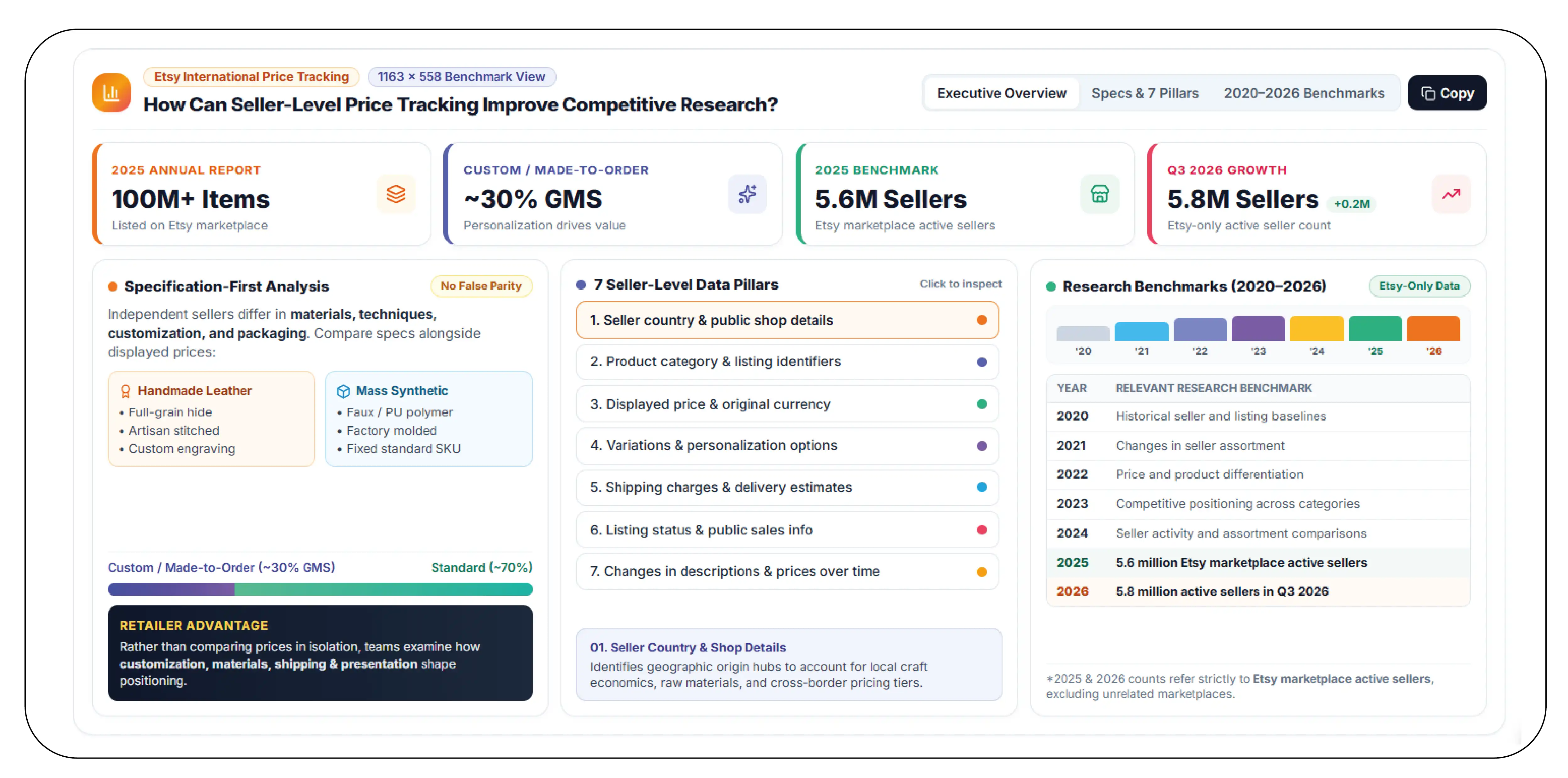
Etsy International Seller Price Tracking helps businesses understand how independent sellers position similar merchandise across different locations. Handmade products are not always directly comparable because sellers may use different materials, manufacturing techniques, customization options, and packaging. Seller-level analysis therefore needs to consider product specifications alongside displayed prices.
For example, a handmade leather accessory and a mass-produced synthetic accessory should not automatically be treated as equivalent products. A reliable research process should compare products with similar materials, dimensions, construction, and customization features.
Seller-level research can include the following information:
- Seller country and publicly available shop details.
- Product category and listing identifiers.
- Displayed price and original currency.
- Product variations and personalization options.
- Shipping charges and estimated delivery information.
- Listing status and publicly displayed sales information, where permitted.
- Changes in product descriptions and listed prices over time.
Etsy's 2025 annual report identified more than 100 million items for sale on its marketplace. It also reported that approximately 30% of Etsy marketplace GMS came from custom or made-to-order merchandise. These disclosures highlight why personalization and product differentiation should be considered when comparing sellers.
| Year |
Relevant research benchmark |
| 2020 |
Historical seller and listing baselines |
| 2021 |
Changes in seller assortment |
| 2022 |
Price and product differentiation |
| 2023 |
Competitive positioning across categories |
| 2024 |
Seller activity and assortment comparisons |
| 2025 |
5.6 million Etsy marketplace active sellers |
| 2026 |
5.8 million active sellers in Q3 2026 |
The 2025 and 2026 figures refer to Etsy marketplace active sellers, not the combined seller count across unrelated marketplaces.
For retailers, the main benefit is a more complete understanding of competition. Instead of comparing prices in isolation, research teams can examine how customization, materials, shipping, and product presentation influence the positioning of handmade merchandise.
Which Clothing Attributes Should Retailers Examine?
Extract Etsy Handmade Clothing Category research can help fashion retailers understand how independent sellers present apparel, accessories, and customized clothing products. Handmade clothing has several product attributes that influence its positioning, including fabric composition, garment construction, size availability, design, personalization, and production method.
Etsy identifies apparel among its leading gross-merchandise-sales-generating categories. Its 2025 annual report also identifies home and living, jewelry and personal accessories, craft supplies, paper and party supplies, and toys and games among its other major categories. Together, the six categories represented approximately $8.9 billion, or 85% of Etsy marketplace GMS.
For fashion retailers, Etsy Handmade Marketplace Product Scraping research should focus on comparable clothing attributes rather than product titles alone. For example, two handmade dresses may have different prices because of fabric quality, embroidery, sizing, production complexity, or customization.
Useful fields include:
- Product attributes: Garment type, material, color, pattern, size, and design.
- Price information: Displayed price, currency, discounts, and available variants.
- Seller information: Shop location and publicly available seller details.
- Availability: Listing status and available product variations.
- Customization: Made-to-order options, personalized measurements, and design choices.
| Year |
Verified market context |
| 2020 |
Historical baseline for US online retail |
| 2021 |
Continued expansion of online retail sales |
| 2022 |
US retail e-commerce sales: $972.3 billion |
| 2023 |
US retail e-commerce sales: $1.083 trillion |
| 2024 |
US retail e-commerce sales: $1.183 trillion |
| 2025 |
Full-year comparable annual Census figure not yet available in the cited series |
| 2026 |
Q3 Etsy marketplace performance available; full-year data pending |
US Census Bureau annual retail e-commerce series and Etsy's Q3 2026 shareholder report.
Fashion businesses can use these structured attributes to identify assortment gaps, compare similar clothing designs, and evaluate how product differentiation affects competitive positioning. This also supports better decisions about which handmade apparel segments deserve further market research.
How Can Gift Category Pricing Help Businesses Identify Seasonal Opportunities?
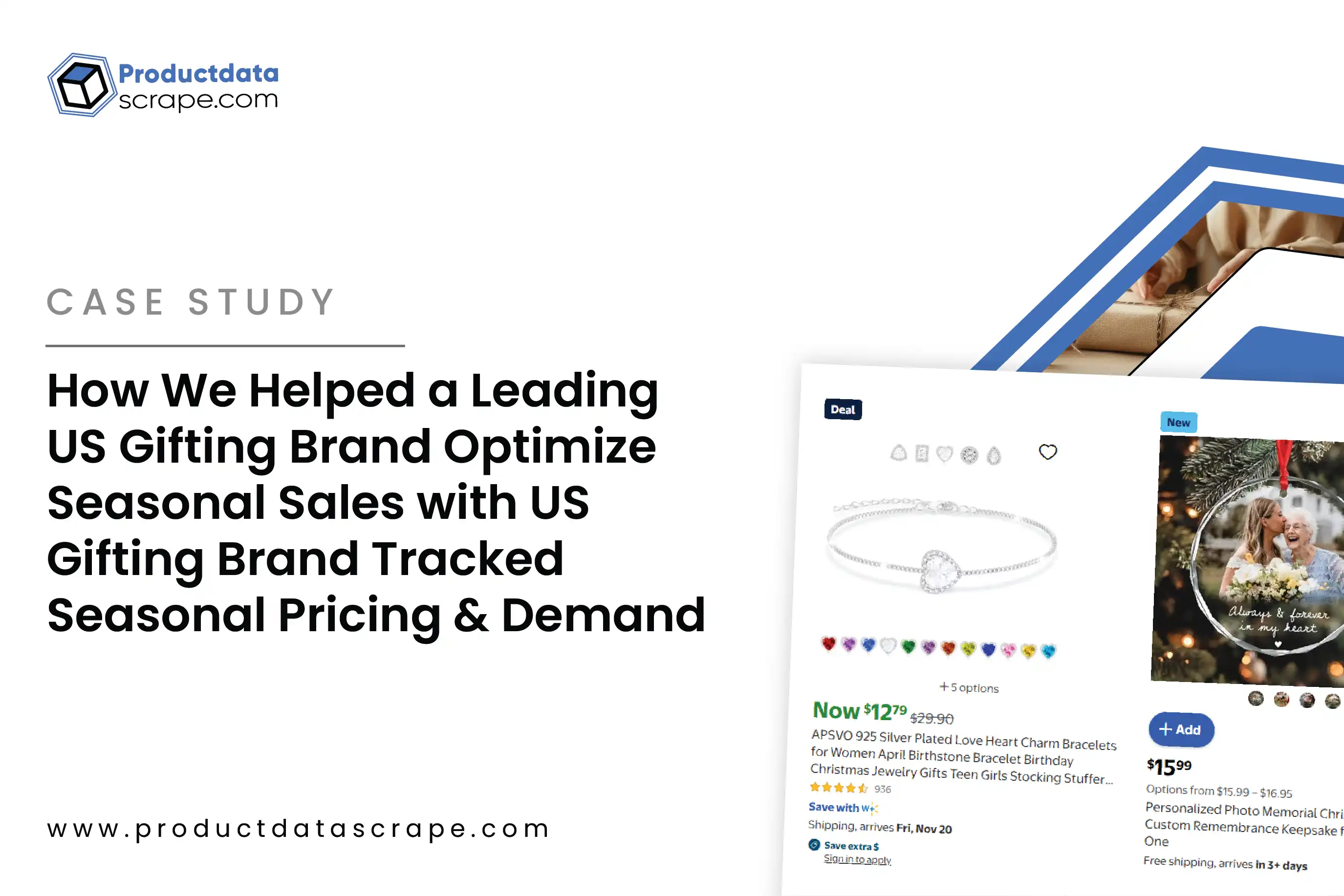
US Etsy Handmade Gift Category Price Scraping can help retailers evaluate how handmade and personalized gifts are positioned across different product segments. Gift merchandise includes personalized accessories, wedding presents, birthday gifts, customized home décor, handcrafted keepsakes, and holiday-related products.
Gift categories are particularly relevant because Etsy identifies gifting, holidays, and personal milestones, including weddings, as important cross-category purchase occasions. Its 2025 annual report highlights these occasions as opportunities to connect buyers with unique and personalized merchandise.
Retailers can use structured gift product information to compare displayed prices, personalization options, materials, product dimensions, shipping costs, and listing availability. This information is useful for understanding whether higher-priced products offer additional customization or different materials.
Important research areas include:
- Personalized gifts: Names, initials, customized messages, and engraving options.
- Wedding merchandise: Handmade decorations, personalized accessories, and keepsakes.
- Holiday products: Seasonal ornaments, handmade decorations, and festive gifts.
- Birthday gifts: Customized jewelry, artwork, and handmade accessories.
- Home gifts: Decorative items, handcrafted storage products, and personalized furnishings.
| Year |
US retail e-commerce sales |
Research application |
| 2020 |
$784.6 billion |
Historical online shopping baseline |
| 2021 |
$916.4 billion |
Compare changing product preferences |
| 2022 |
$972.3 billion |
Examine category competition |
| 2023 |
$1.083 trillion |
Evaluate product assortment |
| 2024 |
$1.183 trillion |
Assess the expanding online retail market |
| 2025 |
Not available in the cited annual series |
Analyze seasonal product positioning |
| 2026 |
Not available as a full-year figure |
Monitor current marketplace activity |
US Census Bureau data, available through FRED. Figures are total US retail e-commerce sales, not handmade gift sales or Etsy-specific revenue.
A practical strategy is to compare equivalent products across seasonal periods while recording the collection date. Retailers can then identify changing price positions, product variations, and assortment opportunities without confusing seasonal listing changes with long-term consumer demand.
For businesses selling handmade gifts, these insights can support more informed promotional planning, product selection, and competitive research.
What Can Handmade Crochet Baby Clothing Reveal About Niche Product Demand?
Scraping Handmade Crochet Baby Dresses can support detailed research into a specialized handmade clothing category. Crochet baby dresses are often differentiated through yarn composition, stitching patterns, color combinations, decorative elements, sizing, and customization. These attributes make product-level comparisons more useful than relying exclusively on displayed prices.
For example, a retailer researching crochet baby dresses may need to distinguish cotton yarn products from acrylic yarn products. Similarly, differences in sleeve designs, decorative flowers, lining, sizing, and handmade construction can affect product positioning.
Etsy Handmade Marketplace Product Scraping research can organize relevant product information into comparable records, subject to Etsy's authorized data-access requirements. Important attributes include:
- Product title and listing identifier.
- Crochet pattern and garment design.
- Yarn material and available colors.
- Size and age-range information.
- Displayed price and currency.
- Personalization and made-to-order options.
- Seller location and shipping details, where available.
- Listing status and product variations.
Etsy's 2025 annual report states that approximately 30% of Etsy marketplace GMS came from custom or made-to-order merchandise. This is an important marketplace-level indicator of the relevance of personalized products, although it should not be interpreted as the share of crochet clothing sales.
| Year |
Marketplace research focus |
| 2020 |
Establish historical niche-product baselines |
| 2021 |
Compare product assortment changes |
| 2022 |
Evaluate material and design differentiation |
| 2023 |
Examine pricing and customization |
| 2024 |
Compare product availability and seller positioning |
| 2025 |
Consider the reported 30% custom and made-to-order GMS share |
| 2026 |
Monitor current product listings and marketplace performance |
Businesses can use this information to identify underserved product variations, compare similar handmade designs, and understand how customization affects product positioning.
For baby clothing retailers, product research should also account for material descriptions, sizing clarity, and accurate product information. These details help create more meaningful comparisons and support better-informed assortment decisions.
Why Should Businesses Choose Product Data Scrape?
Product Data Scrape helps businesses turn product information into structured datasets that support e-commerce research, competitor analysis, and marketplace intelligence.
An Etsy Product Data Scraper solution can help organize authorized product information into consistent records for analysis. Businesses can use structured datasets to understand category performance, compare similar merchandise, evaluate seller positioning, and monitor permitted listing information.
Key advantages include:
- Structured product information: Organize product titles, descriptions, categories, prices, and available attributes.
- Competitive pricing analysis: Compare equivalent products across selected sellers and categories.
- Category intelligence: Understand product assortment across clothing, jewelry, gifts, crafts, and home décor.
- Seller research: Analyze publicly available seller and shop information where permitted.
- Product catalog enrichment: Standardize product attributes and improve dataset consistency.
- Historical comparisons: Maintain dated snapshots of authorized data to identify changes over time.
- Market research support: Prepare datasets for business intelligence, reporting, and strategic planning.
Businesses conducting Etsy Handmade Marketplace Product Scraping research should also prioritize data quality, permission management, and compliance with platform requirements.
Etsy's current Terms of Use explicitly restrict automated bots from accessing, scanning, crawling, or scraping its pages without express permission. Etsy's developer documentation also states that screen scraping is not allowed and directs developers to its API requirements. Therefore, Product Data Scrape projects must use authorized API access, expressly permitted data sources, or other approved arrangements rather than unauthorized automated collection.
This compliance-first approach helps businesses build more reliable research processes while respecting marketplace policies and seller content rights.
Conclusion
The handmade marketplace provides valuable opportunities for businesses researching product trends, pricing strategies, seller competition, and consumer preferences across US and international markets. From personalized gifts and handmade clothing to crochet baby dresses, structured marketplace intelligence can help retailers understand product differentiation and identify opportunities for better assortment planning.
Combining Fashion data scraping research with standardized product attributes, historical comparisons, and category-level analysis can support more informed business decisions. However, accurate market intelligence depends on reliable sources, comparable product records, and authorized data access.
Etsy's 2026 marketplace performance, including its Q3 growth in gross merchandise sales and active buyers, reinforces the importance of monitoring changing marketplace conditions.
Ready to turn handmade marketplace information into actionable business intelligence? Partner with Product Data Scrape to explore compliant data collection, structured product datasets, competitive pricing analysis, and customized e-commerce research solutions!



 Singapore
 EMAIL
 PHONE











.webp)