Introduction
Latin America's e-commerce market is creating significant opportunities for retailers, brands, distributors, and marketplace sellers, but understanding category demand, seller competition, and product pricing remains a major challenge. The LATAM E-Commerce market report Track helps businesses evaluate regional marketplace developments, while the Mercado Libre Product Data Scraping API enables structured collection of product listings, prices, availability, seller information, and category-level intelligence. By examining the Mercado Libre Category & Seller Landscape, businesses can identify high-demand product segments, monitor competing merchants, evaluate pricing strategies, and uncover opportunities across major Latin American markets. This research report explores marketplace developments from 2020 to 2026, focusing on product-level visibility, seller performance, competitive positioning, and regional expansion. It also explains how structured marketplace data can help businesses make informed decisions, improve product assortment planning, and build stronger e-commerce strategies across Mexico, Brazil, Argentina, Colombia, and other LATAM markets.
How Has Marketplace Competition Changed Across Latin America?
Marketplace competition has evolved considerably since 2020 as more consumers adopted online shopping and businesses expanded their digital sales channels. Mercado Libre Data Scraping helps retailers understand these changes by collecting product information, listing prices, seller details, availability, ratings, and category-level activity. This information supports Commerce Intelligence by transforming marketplace listings into structured business insights.
For brands and marketplace operators, understanding historical performance is important. The pandemic accelerated digital adoption in 2020 and 2021, while subsequent years brought stronger competition, improved logistics, and increased investment in digital payments. Mercado Libre's gross merchandise volume (GMV) increased from approximately $21 billion in 2020 to $65 billion in 2025. Its annual unique active buyers also reached 121 million in 2025.
The following figures illustrate the platform's growth trajectory.
| Year | Mercado Libre GMV (US$ billion) |
|---|
| 2020 | 21 |
| 2021 | 28 |
| 2022 | 34 |
| 2023 | 45 |
| 2024 | 51.5 |
| 2025 | 65.0 |
| 2026 | 40.9 (H1 only) |
Mercado Libre investor presentation and financial disclosures. 2026 represents the first half, not a full-year result. Figures are rounded.
For businesses, these developments highlight the importance of tracking more than overall sales growth. Companies should evaluate product assortment, competitive pricing, seller concentration, and stock availability. For example, a retailer monitoring electronics listings can identify frequently discounted products, compare competing offers, and detect changes in assortment before adjusting its own pricing strategy.
A structured collection process also helps businesses compare marketplace activity across Brazil, Mexico, Argentina, and Colombia. By reviewing the same product attributes across different markets, decision-makers can identify regional differences in customer demand and competitive intensity. Historical data provides a baseline for understanding whether a category is experiencing sustainable growth or temporary promotional activity.
Why Should Businesses Examine Merchant Competition and Brand Positioning?
Seller competition directly influences product visibility, pricing, customer trust, and purchasing decisions. Mercado Libre Seller Landscape Analysis helps brands understand which merchants dominate particular categories, how competing sellers position their products, and where new market opportunities exist. This information is especially valuable for manufacturers, authorized distributors, and retailers managing brand consistency across multiple marketplace accounts.
Another important consideration is Brand Protection. Unauthorized product listings, inconsistent descriptions, misleading product claims, and potentially counterfeit merchandise can affect customer confidence. Businesses need reliable listing intelligence to identify suspicious seller activity and investigate products that may violate brand guidelines.
A useful monitoring framework should capture seller names, storefront identifiers, product URLs, listed prices, shipping information, seller ratings, review counts, and listing status. Comparing these attributes over time can reveal whether a seller has introduced new products, changed pricing, or expanded into additional categories.
| Year | Market development | Seller intelligence priority |
|---|
| 2020 | Rapid online shopping adoption | Identify newly active sellers |
| 2021 | Expansion of digital storefronts | Track assortment growth |
| 2022 | Increasing marketplace competition | Compare seller pricing |
| 2023 | Greater focus on customer experience | Monitor ratings and reviews |
| 2024 | Broader fulfillment capabilities | Evaluate delivery propositions |
| 2025 | Continued marketplace expansion | Identify competitive positioning |
| 2026 | Ongoing platform growth | Track seller changes and category shifts |
The market developments are qualitative research observations, not independently measured annual seller-count statistics. Mercado Libre reported 100 million annual unique buyers in 2024 and 121 million in 2025.
For example, a consumer electronics manufacturer may discover that several merchants are selling the same product at significantly different prices. Reviewing seller history, product descriptions, and listing changes helps the manufacturer investigate potential unauthorized distribution and identify pricing inconsistencies.
Businesses should also distinguish between legitimate competitive activity and genuine brand violations. Automated data collection can flag unusual changes, but human verification and authorized enforcement processes remain important. This combination helps brands protect their reputation while maintaining a clearer understanding of marketplace competition.
How Can Product-Level Tracking Improve Competitive Decisions?
Product-level marketplace monitoring provides a more detailed understanding of competition than category-level research alone. Mercado Libre SKU-Level Seller Monitoring enables businesses to follow individual products across multiple sellers, compare offers, and identify changes in availability and pricing.
A SKU-level dataset should include product identifiers, listing titles, brand names, model numbers, seller IDs, prices, discounts, shipping charges, stock status, and listing URLs. These attributes help businesses match identical products across different merchant accounts and distinguish genuine price differences from variations in product specifications.
For example, two sellers may advertise the same smartphone model at different prices. However, one listing may include additional storage, a different warranty, or bundled accessories. Without accurate product matching, retailers could make incorrect pricing decisions. Structured extraction and product normalization help reduce these inconsistencies.
| Year | SKU-level monitoring focus | Business application |
|---|
| 2020 | Product and seller identification | Establish product baselines |
| 2021 | Listing and price changes | Compare merchant offers |
| 2022 | Discount and promotion tracking | Evaluate promotional activity |
| 2023 | Availability monitoring | Identify stockout risks |
| 2024 | Product matching improvements | Reduce duplicate records |
| 2025 | Large-scale seller comparisons | Improve competitive analysis |
| 2026 | More frequent monitoring | Support responsive decisions |
These are recommended monitoring priorities rather than historical platform-wide SKU measurements.
Businesses can use the collected information to develop several actionable insights. First, recurring price differences can help retailers identify competitive pricing gaps. Second, stock availability changes can reveal potential supply shortages. Third, seller-level comparisons can identify merchants gaining visibility in particular product segments.
Monitoring frequency should depend on product volatility. High-demand electronics, seasonal products, and frequently discounted consumer goods may require more frequent checks than stable household products. Daily or intraday monitoring can be useful where permitted by applicable platform terms and technical access arrangements.
Another important practice is maintaining historical snapshots. Instead of overwriting existing product records, businesses should preserve timestamps and previous values. This creates a reliable record of price movements, listing changes, and seller activity, supporting better forecasting and more informed commercial decisions.
What Do Product Prices and Category Trends Reveal About Market Opportunities?
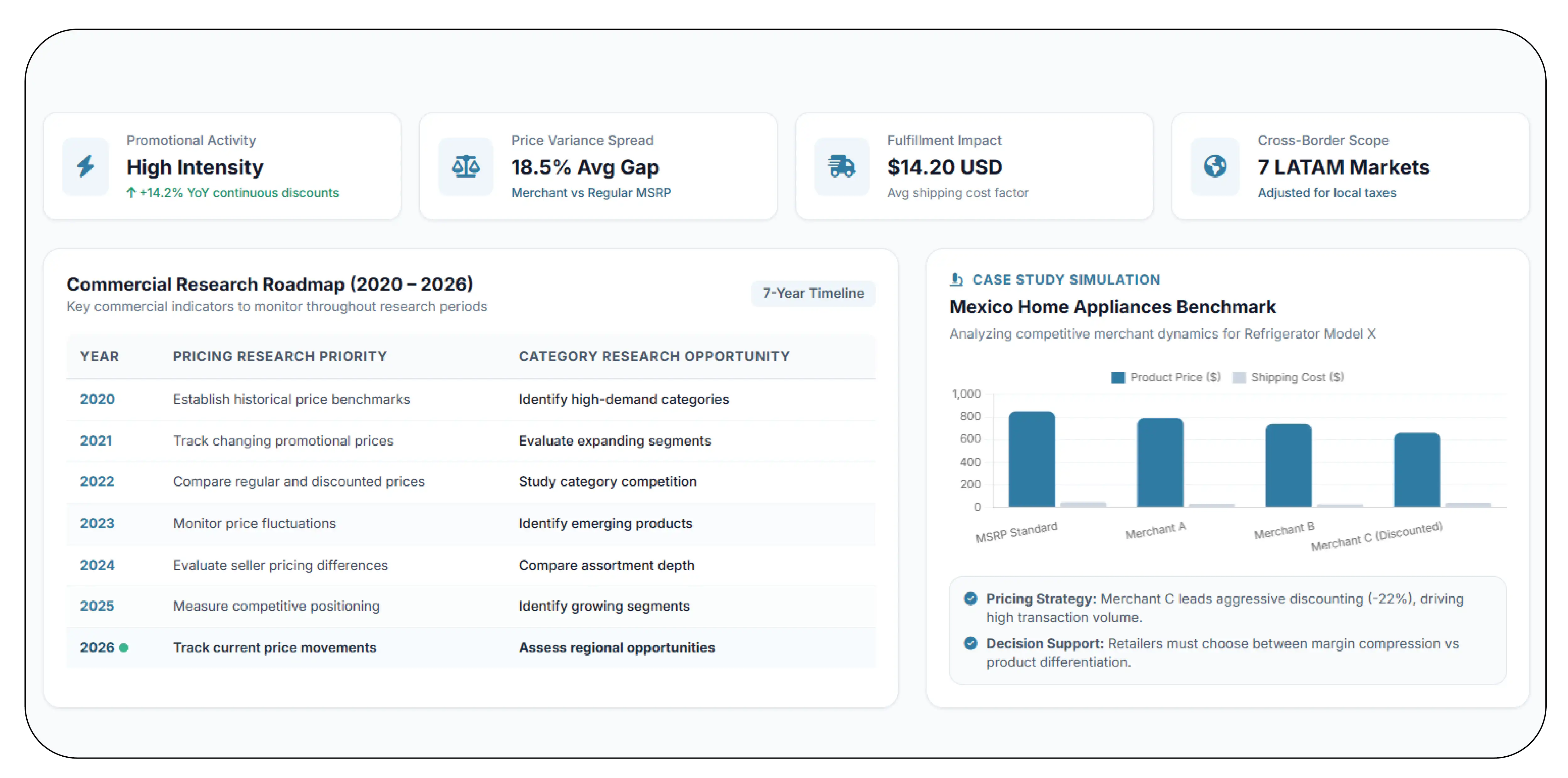
Understanding product demand and pricing differences is essential for businesses competing across multiple Latin American countries. Mercado Libre Product and Pricing Intelligence helps retailers evaluate product prices, promotional activity, discounts, availability, and competing offers across marketplace categories. These insights also contribute to the LATAM E-Commerce market report Track by revealing how category-level competition changes over time.
For example, a retailer selling home appliances in Mexico may find that a particular refrigerator model is consistently discounted by several competing merchants. Comparing its regular price, promotional price, shipping cost, and seller positioning can help the retailer determine whether to adjust its pricing or focus on product differentiation.
The following table outlines important commercial indicators to monitor throughout the research period.
| Year | Pricing research priority | Category research opportunity |
|---|
| 2020 | Establish historical price benchmarks | Identify high-demand categories |
| 2021 | Track changing promotional prices | Evaluate expanding segments |
| 2022 | Compare regular and discounted prices | Study category competition |
| 2023 | Monitor price fluctuations | Identify emerging products |
| 2024 | Evaluate seller pricing differences | Compare assortment depth |
| 2025 | Measure competitive positioning | Identify growing segments |
| 2026 | Track current price movements | Assess regional opportunities |
These indicators can be used to develop country-specific pricing strategies. Businesses should compare products using consistent attributes, including brand, model, size, specifications, currency, and shipping costs. Currency conversion and local taxes should also be considered when comparing offers across borders.
Combining price history with seller information and product availability provides a more complete picture of marketplace performance. This allows brands to identify pricing gaps, prioritize competitive products, and make informed decisions about regional assortment expansion.
How Can Category-Level Research Identify Emerging Retail Opportunities?
Category-level research helps retailers understand where competition is concentrated and which product segments offer opportunities for expansion. LATAM Category-Level Data Scraping supports this process by collecting structured information across departments such as electronics, fashion, beauty, home appliances, automotive accessories, groceries, and consumer goods.
Instead of reviewing individual listings manually, businesses can organize product information into comparable category datasets. These datasets may include listing counts, product brands, seller participation, average listed prices, discount percentages, ratings, and availability indicators. This creates a practical foundation for identifying category leaders and underserved product segments.
For example, a beauty brand planning to enter Brazil and Mexico can compare skincare assortment, competing brands, product pricing, and merchant participation in both markets. If one market has fewer competing listings for a particular product segment, the business can investigate whether this represents a potential market opportunity.
Important research indicators include:
- Category depth: Number of products and variations available within each category.
- Brand distribution: Representation of local and international brands.
- Seller concentration: Number of merchants competing within individual product segments.
- Pricing distribution: Differences between entry-level, mid-range, and premium products.
- Availability trends: Changes in product availability and listing activity.
- Promotional intensity: Frequency and scale of discounts across competing products.
| Year | Category intelligence priority | Recommended analysis |
|---|
| 2020 | Digital category adoption | Baseline category mapping |
| 2021 | Assortment expansion | Product range comparisons |
| 2022 | Increasing competition | Brand and seller distribution |
| 2023 | Pricing differentiation | Category price segmentation |
| 2024 | Improved product discovery | Listing and assortment analysis |
| 2025 | Marketplace expansion | Cross-category comparisons |
| 2026 | Current competitive shifts | Emerging category opportunities |
These are suggested research milestones, not measured annual category growth rates.
For decision-makers, category research should connect marketplace observations with commercial objectives. Product manufacturers can identify potential distribution gaps, retailers can improve product assortment, and market researchers can evaluate competitive intensity. Combining category data with country-level information also helps businesses avoid treating Latin America as a single uniform consumer market.
Which Merchant-Level Insights Matter When Expanding Across LATAM?
Merchant-level intelligence helps businesses understand how marketplace competition differs between countries, categories, and individual product segments. A LATAM Mercado Libre Merchant Dataset can consolidate information about seller identities, storefronts, product listings, pricing, ratings, shipping propositions, and category participation.
This information is particularly valuable for international brands, distributors, and retailers planning regional expansion. A merchant performing strongly in Argentina may have a different assortment and pricing strategy in Mexico or Brazil. Comparing these differences helps businesses understand local competition rather than relying on assumptions based on another country's marketplace activity.
The LATAM E-Commerce market report Track should therefore incorporate country-specific merchant information alongside product and category observations.
A practical merchant dataset can include:
| Data field | Business purpose |
|---|
| Seller name and ID | Identify marketplace merchants |
| Country and marketplace | Compare regional activity |
| Product listing URL | Verify individual offers |
| Brand and product model | Match competing products |
| Listed price and discount | Evaluate pricing strategies |
| Seller rating | Understand marketplace reputation |
| Review count | Assess available customer feedback |
| Shipping information | Compare delivery propositions |
| Stock status | Identify availability changes |
| First-seen and last-seen dates | Monitor listing history |
Merchant analysis can help manufacturers identify active distributors, retailers discover competing storefronts, and marketplace operators evaluate seller participation. It can also highlight merchants expanding their product ranges or entering new categories.
For example, a consumer goods company planning to distribute products across Mexico, Argentina, and Colombia can compare merchant participation, product coverage, and pricing differences before selecting potential distribution partners. Seller information should be treated as a research input rather than automatic proof of authorization or business legitimacy.
Historical snapshots are equally important. Preserving seller and listing information enables businesses to identify changes in assortment, pricing, and marketplace participation. Combining this information with category-level and product-level datasets creates a stronger foundation for regional planning, competitive benchmarking, and market-entry decisions.
Product Data Scrape helps businesses transform marketplace information into structured datasets that support product research, competitive benchmarking, and regional market intelligence. Its data collection approach can help retailers, manufacturers, distributors, and market research teams understand marketplace developments without relying entirely on manual listing reviews.
Through Scrape Mercado Libre Mexico Products, businesses can collect relevant product information, including listing titles, brand names, model details, prices, discounts, seller information, and availability indicators, subject to applicable platform access and usage requirements.
For companies evaluating regional expansion, the LATAM E-Commerce market report Track can provide a research framework for comparing marketplace conditions across multiple countries.
Key advantages include:
- Structured product datasets: Organize product listings into consistent, analysis-ready formats.
- Competitive price monitoring: Compare product prices, discounts, and merchant offers.
- Seller intelligence: Examine merchant participation and competing storefronts.
- Category research: Identify assortment gaps and competitive product segments.
- Historical tracking: Maintain snapshots to understand listing and pricing changes.
- Regional comparisons: Evaluate marketplace differences across selected LATAM countries.
- Custom data delivery: Structure information according to business requirements and reporting workflows.
The collected datasets can support business intelligence dashboards, pricing analysis, assortment planning, competitor research, and strategic decision-making. Product Data Scrape can help organizations build a more consistent view of marketplace activity and convert fragmented listing information into practical commercial insights.
Conclusion
Latin America's e-commerce ecosystem continues to create opportunities for brands, retailers, distributors, and marketplace operators. However, capturing these opportunities requires accurate information about product availability, merchant participation, category competition, and pricing movements. Businesses that rely only on occasional marketplace research may miss important changes in seller activity and competitive positioning.
Mercado Libre Argentina Seller Intelligence can help businesses evaluate merchant participation, product assortment, pricing differences, and seller activity within Argentina's marketplace. When combined with insights from Mexico, Brazil, and Colombia, this information supports more informed regional comparisons and market-entry planning.
The LATAM E-Commerce market report Track provides a structured approach to understanding marketplace developments between 2020 and 2026. By combining product-level monitoring, seller research, pricing intelligence, and category analysis, businesses can identify competitive gaps and develop stronger commercial strategies.
Ready to turn marketplace data into actionable business intelligence?
Partner with Product Data Scrape to collect structured Mercado Libre product, pricing, category, and seller datasets. Explore customized data extraction solutions that help your business monitor competitors, discover market opportunities, and make smarter decisions across Latin America.
Research and data interpretation note: Historical figures in this report are sourced from Mercado Libre disclosures. The 2026 GMV figure represents first-half performance, not a full-year forecast. The qualitative tables describe recommended research priorities rather than independently verified historical market measurements.


 Singapore
 EMAIL
 PHONE











.webp)