Introduction
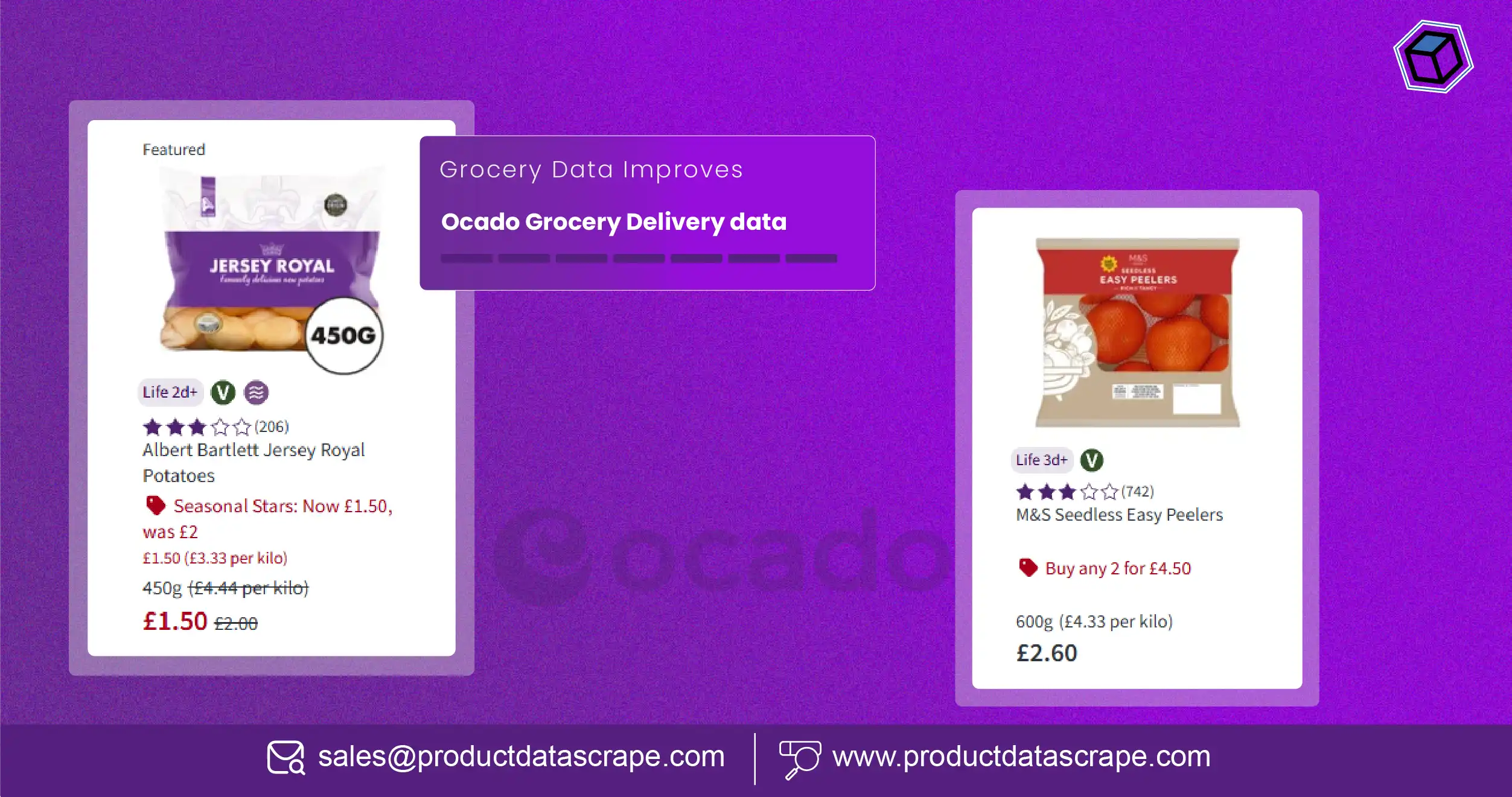
Ocado Grocery Delivery data scraping helps retailers, grocery brands, market analysts, and eCommerce businesses monitor pricing, delivery efficiency, inventory trends, and consumer shopping behavior in real time. Businesses use this data to improve competitive pricing, optimize logistics, and strengthen digital grocery strategies.
According to industry estimates, online grocery sales in the UK are expected to exceed £28 billion by 2026, with delivery-based shopping contributing over 35% of digital grocery transactions. Retailers increasingly rely on automated grocery intelligence solutions to monitor market dynamics and customer demand patterns.
The growing demand for structured grocery datasets has made the Ocado Grocery Data Scraping API essential for businesses seeking accurate and scalable retail intelligence. Modern grocery analytics platforms provide access to product pricing, stock availability, category trends, promotional insights, and customer engagement metrics across thousands of grocery SKUs.
For grocery retailers, FMCG brands, logistics providers, and retail analysts, real-time grocery intelligence supports:
- Dynamic pricing optimization
- Delivery performance monitoring
- Competitor benchmarking
- Inventory forecasting
- Consumer behavior analysis
- Digital shelf visibility tracking
As online grocery competition intensifies, data-driven decision-making is becoming critical for operational efficiency and customer retention.
How Does Online Grocery Extraction Improve Market Visibility?
.webp)
Online grocery platforms generate enormous volumes of retail intelligence daily. Businesses need structured datasets to analyze delivery trends, pricing changes, and customer purchasing patterns across grocery categories.
Companies increasingly use Extract Online Ocado Grocery Delivery App Data to monitor product listings, promotional campaigns, and delivery slot availability across different regions. Retail intelligence providers also use Extract Grocery & Gourmet Food Data to evaluate premium grocery demand, organic food trends, and category-level performance within digital grocery ecosystems.
Ocado Grocery Delivery Platform Growth (2020–2026)
| Year |
Active Online Products |
Delivery Orders (Millions) |
Gourmet Food Demand Growth (%) |
Mobile Grocery Orders (%) |
| 2020 | 42,000 | 78 | 14 | 36 |
| 2021 | 48,000 | 91 | 17 | 42 |
| 2022 | 54,000 | 108 | 21 | 47 |
| 2023 | 61,000 | 126 | 24 | 53 |
| 2024 | 68,000 | 144 | 28 | 58 |
| 2025 | 75,000 | 161 | 31 | 63 |
| 2026 | 83,000 | 179 | 35 | 68 |
Real-time grocery extraction helps businesses monitor assortment expansion, identify high-demand categories, and improve market forecasting accuracy. Grocery brands also use these insights to optimize promotional timing and strengthen product visibility across digital retail platforms.
The increasing shift toward app-based grocery shopping has made structured grocery intelligence critical for improving customer experiences and maintaining competitive advantage in online retail.
Why Is Real-Time Pricing Intelligence Important for Grocery Delivery?
Pricing volatility in the grocery industry has increased significantly due to inflation, supply chain disruptions, and changing consumer demand. Retailers must monitor price fluctuations continuously to maintain profitability and customer loyalty.
Businesses rely on Real-Time Ocado Delivery Pricing Data Scraping to track grocery pricing changes, delivery fee adjustments, and promotional offers in real time. Retail analytics platforms also support Product Competitive Pricing Services that benchmark competitor pricing across grocery categories.
Grocery Pricing Intelligence Trends (2020–2026)
| Year |
Avg Grocery Basket Price (£) |
Delivery Fee Growth (%) |
Promotional Pricing Activity (%) |
Real-Time Price Updates Daily |
| 2020 | 71 | 4 | 21 | 8,000 |
| 2021 | 76 | 5 | 24 | 11,000 |
| 2022 | 84 | 8 | 29 | 15,000 |
| 2023 | 92 | 10 | 33 | 19,000 |
| 2024 | 97 | 7 | 36 | 24,000 |
| 2025 | 103 | 5 | 39 | 29,000 |
| 2026 | 108 | 4 | 42 | 35,000 |
Real-time pricing intelligence allows grocery retailers to:
- Monitor competitor discounts
- Optimize dynamic pricing models
- Improve promotional efficiency
- Analyze regional pricing variations
- Increase customer retention
How Does Competitor Monitoring Strengthen Grocery Pricing Strategies?
.webp)
Competitive pricing analysis has become essential for online grocery retailers seeking to maintain market share and improve customer loyalty. Real-time competitor intelligence helps businesses respond quickly to changing market conditions.
Organizations use Scrape competitor grocery pricing from Ocado to benchmark prices across categories such as dairy, beverages, frozen foods, and household essentials. Retail analytics providers also offer Product Pricing Strategies Service solutions that help businesses identify pricing gaps and optimize promotional planning.
Competitor Pricing Intelligence Metrics (2020–2026)
| Year |
Competitor Products Tracked |
Avg Daily Price Changes |
Consumer Price Sensitivity (%) |
Discount Campaign Growth (%) |
| 2020 | 120,000 | 6,500 | 48 | 14 |
| 2021 | 145,000 | 8,100 | 53 | 17 |
| 2022 | 172,000 | 10,500 | 59 | 21 |
| 2023 | 201,000 | 13,800 | 64 | 25 |
| 2024 | 235,000 | 16,900 | 68 | 28 |
| 2025 | 268,000 | 20,500 | 71 | 31 |
| 2026 | 304,000 | 24,000 | 74 | 35 |
Retailers use competitor intelligence to refine pricing strategies, optimize category performance, and improve customer acquisition campaigns. Real-time pricing comparison also helps businesses maintain transparency and strengthen value-driven marketing strategies.
Digital grocery competition continues intensifying as retailers invest in automated pricing systems and AI-driven retail analytics to improve market responsiveness.
How Does Digital Shelf Visibility Improve Grocery Analytics?
Digital shelf visibility is becoming increasingly important as online grocery shoppers rely heavily on search rankings, product availability, and promotional visibility during purchase decisions.
Businesses leverage Ocado Supermarket Pricing Intelligence to monitor category-level pricing behavior, track digital shelf positioning, and evaluate promotional performance. Retail analytics solutions also provide Digital Shelf Analytics capabilities that measure product discoverability and online merchandising effectiveness.
Digital Shelf Performance Trends (2020–2026)
| Year |
Digital Product Listings |
Sponsored Product Growth (%) |
Avg Search Ranking Accuracy (%) |
Conversion Rate (%) |
| 2020 | 58,000 | 12 | 71 | 3.8 |
| 2021 | 66,000 | 16 | 74 | 4.1 |
| 2022 | 75,000 | 21 | 77 | 4.5 |
| 2023 | 84,000 | 25 | 81 | 4.9 |
| 2024 | 94,000 | 29 | 84 | 5.3 |
| 2025 | 105,000 | 33 | 87 | 5.7 |
| 2026 | 117,000 | 37 | 90 | 6.1 |
Digital shelf analytics help businesses:
- Improve product discoverability
- Optimize category placement
- Monitor competitor visibility
- Enhance promotional effectiveness
- Strengthen customer engagement
Why Does Real-Time Stock Monitoring Matter?
.webp)
Inventory availability significantly impacts customer satisfaction and order completion rates in online grocery retail. Consumers expect accurate stock visibility and fast delivery fulfillment.
Businesses increasingly use solutions to Monitor real-time Ocado stock availability to track inventory fluctuations, identify stock-out risks, and improve replenishment planning.
Grocery Inventory Intelligence Metrics (2020–2026)
| Year |
Inventory Updates Daily |
Avg Stock-Out Rate (%) |
Same-Day Delivery Availability (%) |
Fulfillment Accuracy (%) |
| 2020 | 18,000 | 11 | 19 | 87 |
| 2021 | 24,000 | 10 | 23 | 89 |
| 2022 | 31,000 | 9 | 28 | 91 |
| 2023 | 39,000 | 8 | 34 | 93 |
| 2024 | 48,000 | 7 | 39 | 94 |
| 2025 | 57,000 | 6 | 44 | 96 |
| 2026 | 67,000 | 5 | 49 | 97 |
Real-time inventory analytics helps grocery businesses:
- Improve fulfillment accuracy
- Reduce stock shortages
- Optimize replenishment cycles
- Increase delivery efficiency
- Strengthen customer satisfaction
How Does Product Catalog Intelligence Support Grocery Growth?
.webp)
Structured product catalog datasets provide deep visibility into grocery assortment trends, pricing structures, and consumer demand patterns.
Businesses use Extract Ocado Grocery & Gourmet Food Data to monitor SKU performance, category growth, nutritional trends, and product assortment changes across grocery categories.
Product Catalog Intelligence Growth (2020–2026)
| Year |
Total SKUs Tracked |
Organic Product Growth (%) |
New Product Listings |
Category Expansion (%) |
| 2020 | 88,000 | 14 | 7,200 | 10 |
| 2021 | 99,000 | 17 | 8,600 | 12 |
| 2022 | 112,000 | 21 | 10,400 | 15 |
| 2023 | 126,000 | 24 | 12,300 | 18 |
| 2024 | 141,000 | 27 | 14,100 | 21 |
| 2025 | 157,000 | 30 | 16,000 | 24 |
| 2026 | 174,000 | 34 | 18,200 | 27 |
Catalog intelligence supports:
- Product assortment optimization
- Consumer trend forecasting
- Category expansion planning
- Competitive benchmarking
- Personalized marketing campaigns
Why Choose Product Data Scrape?
Modern grocery intelligence requires scalable data infrastructure capable of handling large volumes of real-time retail information. Businesses seeking actionable grocery analytics increasingly rely on automated data extraction platforms to improve operational efficiency and competitive visibility.
Organizations use Real Time Ocado Grocery Dataset solutions to monitor pricing, delivery performance, stock availability, and product assortment changes across online grocery platforms. Businesses leveraging Ocado Grocery Delivery data scraping gain access to structured datasets that support pricing optimization, inventory forecasting, digital shelf analytics, and competitor benchmarking.
Product Data Scrape provides scalable grocery intelligence solutions designed for retailers, FMCG brands, analytics firms, and eCommerce businesses seeking accurate and reliable grocery market insights.
Conclusion
Online grocery delivery continues reshaping the retail industry as consumers increasingly prefer convenience-driven shopping experiences and real-time delivery services. Data-driven grocery intelligence is becoming essential for retailers seeking to improve pricing strategies, optimize inventory, and strengthen digital customer engagement.
The growing importance of Extract Ocado Grocery & Gourmet Food Data highlights the need for structured grocery datasets and advanced analytics solutions capable of delivering actionable retail intelligence. Businesses leveraging Ocado Grocery Delivery data scraping gain significant advantages through real-time pricing visibility, inventory monitoring, delivery analytics, and competitor benchmarking.
As online grocery commerce continues expanding through 2026, retailers that invest in scalable retail intelligence solutions will improve operational efficiency, strengthen market positioning, and enhance customer retention across digital grocery ecosystems.
Partner with Product Data Scrape to unlock scalable grocery intelligence solutions powered by real-time Ocado retail analytics, automated delivery monitoring, and advanced grocery data extraction capabilities!
FAQs
1. What is Ocado grocery delivery data scraping?
Ocado grocery delivery data scraping collects real-time grocery information such as prices, stock availability, product listings, delivery slots, and promotional insights from Ocado’s online grocery platform.
2. How does real-time grocery data help retailers?
Real-time grocery data helps retailers optimize pricing, monitor competitors, improve inventory planning, enhance delivery performance, and respond quickly to changing consumer demand patterns.
3. What industries benefit from grocery data analytics?
Retailers, FMCG brands, market research firms, logistics providers, eCommerce businesses, and pricing intelligence companies benefit from grocery delivery data analytics and structured retail datasets.
4. Why is digital shelf analytics important in online grocery?
Digital shelf analytics improves product visibility, search rankings, promotional performance, and customer engagement while helping retailers strengthen online conversion rates and merchandising strategies.
5. How does Product Data Scrape support grocery intelligence solutions?
Product Data Scrape provides scalable grocery data extraction services, real-time retail analytics, competitor monitoring, inventory tracking, and structured grocery datasets for advanced business intelligence.



 Singapore
 EMAIL
EMAIL
 PHONE
PHONE


.webp "thumb")
.webp "thumb")








.webp)