Introduction
Retailers can recover missing product visuals, improve catalog completeness, and strengthen product listings by systematically collecting images, videos, thumbnails, and other publicly available media from ecommerce sources. Image and Media Asset Extraction converts scattered visual content into structured assets that can be mapped to SKUs, products, variants, and categories.
For ecommerce managers, marketplace teams, catalog owners, and digital merchandising leaders, missing or inconsistent visual assets create practical problems. Products may have incomplete galleries, outdated images, incorrect media associations, or different visual coverage across sales channels. These gaps can make catalog migration, marketplace onboarding, and product-content management unnecessarily difficult.
A Rich Product Catalog with Images gives retailers a more complete content foundation. Instead of maintaining product titles and descriptions separately from visual assets, teams can connect images and videos to product identifiers and metadata.
The process is particularly useful during store migration, marketplace expansion, catalog enrichment, supplier onboarding, and competitive catalog research. A structured media dataset can also preserve source URLs, image order, media type, dimensions, and timestamps where available.
The core objective is simple: identify the visual assets associated with products, extract them consistently, map them accurately, and make them available for downstream catalog and merchandising workflows.
How Can Retailers Recover Product Images During Store Migration?
Scrape Product Images for Store Migration to collect product photography and related media before moving catalogs between ecommerce platforms. Store migration projects frequently involve thousands of products, and visual assets can become disconnected from product records when URLs, folder structures, or platform-specific media references change.
A structured extraction workflow can capture product URLs, image URLs, image sequence, product identifiers, SKU references, image types, and available metadata. Retailers can then associate each asset with the correct product before importing it into the new platform.
E-commerce data scraping can also support broader migration projects by collecting product titles, descriptions, categories, specifications, prices, and other available catalog fields alongside visual assets. This creates a more complete migration dataset rather than treating images as a separate manual task.
Retailers should validate image-to-product relationships before migration. Duplicate images, broken URLs, missing variants, and incorrectly associated media can create catalog quality problems after launch. Maintaining source references and extraction timestamps can make troubleshooting easier.
Media Migration Monitoring
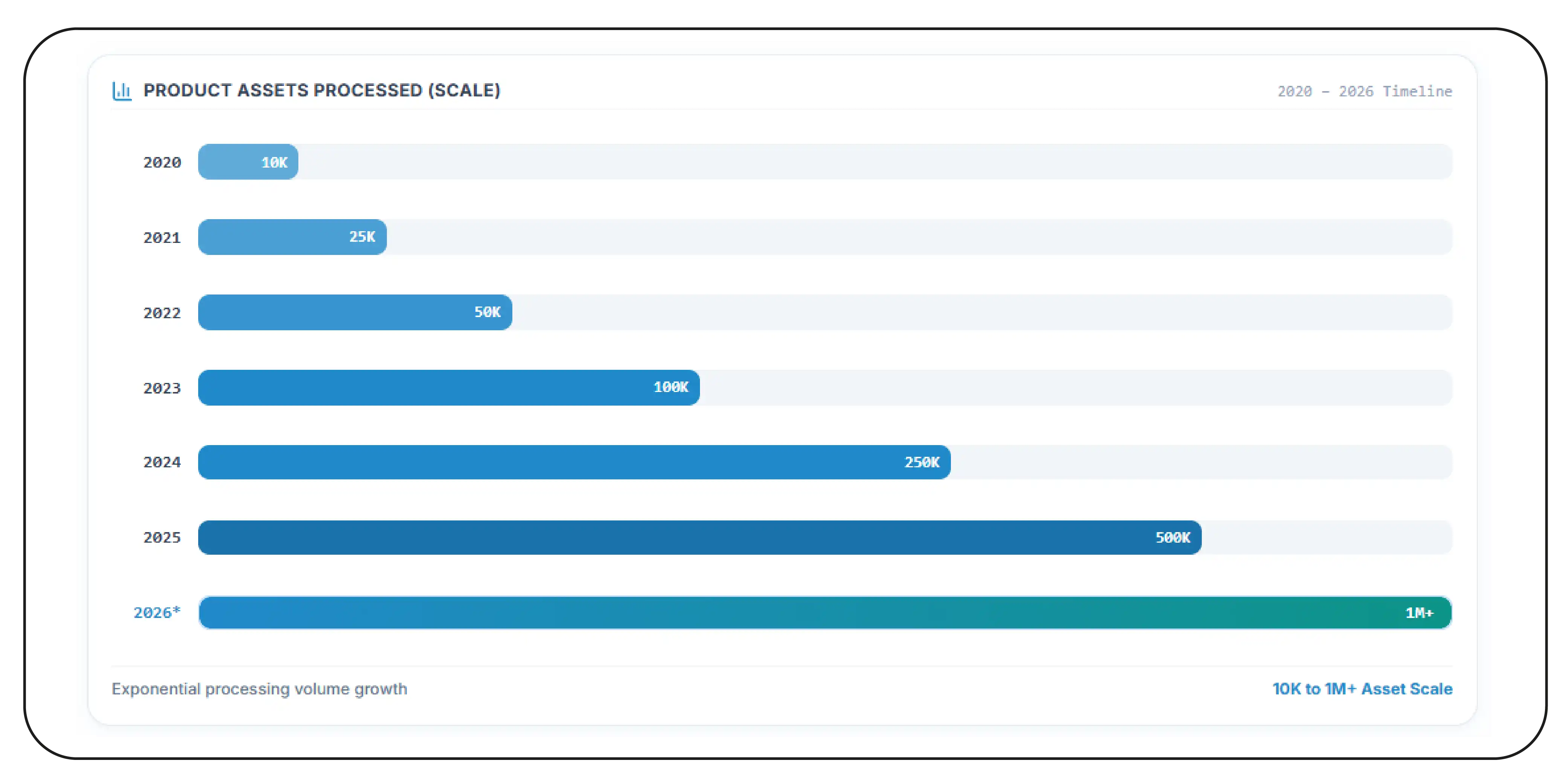
| Year |
Product Assets Processed |
Validation Focus |
Workflow |
| 2020 |
10K |
URL validation |
Manual |
| 2021 |
25K |
Duplicate detection |
Semi-automated |
| 2022 |
50K |
SKU association |
Automated |
| 2023 |
100K |
Variant validation |
Automated |
| 2024 |
250K |
Image completeness |
Rule-based |
| 2025 |
500K |
Multi-channel validation |
Automated |
| 2026 |
1M+ |
Continuous asset validation |
Scalable pipeline |
These figures are operational planning benchmarks, not industry statistics.
A migration-focused asset dataset can reduce manual downloading and make it easier to identify products with incomplete galleries. Retailers can also establish rules such as minimum image counts, required primary images, acceptable formats, and variant-specific media.
This approach is particularly valuable when migrating large catalogs where manually checking every product page is impractical.
What Does a Complete Product Asset Dataset Include?
Product Catalog Asset Extraction creates a structured inventory of visual content associated with individual products. The objective is not simply to collect image files. It is to preserve the relationships between assets and the products they represent.
A useful asset record can include product ID, SKU, product title, brand, category, source URL, image URL, image type, image position, video URL, thumbnail URL, extraction timestamp, and other publicly available metadata.
Image type classification can distinguish primary product images, secondary views, lifestyle images, packaging images, technical diagrams, thumbnails, and promotional media. This makes downstream catalog management easier because teams can determine whether a product has the expected visual coverage.
Duplicate detection is another important component. The same image may appear under multiple URLs, particularly when websites use different image sizes or content-delivery paths. Hashing or similarity methods can help identify duplicates and reduce unnecessary storage.
Asset Dataset Development
| Year |
Asset Attributes |
Media Classification |
Quality Checks |
| 2020 |
6 |
Basic image type |
URL check |
| 2021 |
9 |
Primary/secondary |
Duplicate check |
| 2022 |
12 |
Product/lifestyle |
SKU validation |
| 2023 |
16 |
Image/video |
Variant validation |
| 2024 |
20 |
Detailed classification |
Completeness |
| 2025 |
25 |
Automated classification |
Similarity checks |
| 2026 |
30+ |
Advanced media mapping |
Continuous validation |
These are process-development benchmarks.
For catalog teams, the advantage is centralization. Instead of searching individual product pages whenever an image is missing, teams can work from a structured asset repository.
The dataset can also support marketplace syndication, content refreshes, supplier audits, store migrations, product page enrichment, and internal catalog governance.
How Can Visual Data Improve Ecommerce Content Decisions?
eCommerce Visual Asset Intelligence helps retailers understand the quality, completeness, and distribution of visual content across products and channels. Visual intelligence is broader than image collection because it evaluates how assets are being used and where content gaps exist.
Retailers can compare the number of images per SKU, the presence of videos, image types, resolution where available, variant coverage, and differences between ecommerce channels. These comparisons can identify products with incomplete galleries or inconsistent visual presentation.
For example, a retailer may discover that premium products have extensive image coverage while lower-volume products have only one image. Another analysis may show that competitor listings commonly provide lifestyle images and videos while the retailer relies primarily on basic product photography.
These findings can inform content-production priorities. Rather than updating every product simultaneously, teams can prioritize high-value SKUs with incomplete or outdated media.
Visual Intelligence Maturity
| Year |
Products Reviewed |
Visual Signals |
Decision Capability |
| 2020 |
10K |
3 |
Basic audit |
| 2021 |
25K |
5 |
Coverage comparison |
| 2022 |
50K |
7 |
Gap identification |
| 2023 |
100K |
10 |
Category benchmarking |
| 2024 |
250K |
14 |
Priority scoring |
| 2025 |
500K |
18 |
Automated insights |
| 2026 |
1M+ |
20+ |
Continuous intelligence |
These figures represent operational scale targets.
Visual intelligence can also support brand governance. Teams can identify products where imagery differs substantially across channels, potentially creating inconsistent customer experiences.
For ecommerce leaders, this means media extraction becomes part of a broader product-content strategy. The goal is not to accumulate images but to determine which visual assets are available, where they are used, which products lack them, and what should be improved first.
When Should Retailers Use an Image and Media API?
A Product Image & Media Scraping API can support recurring asset collection when retailers need to monitor large product catalogs across multiple ecommerce sources. An API-based workflow can provide a consistent interface for submitting product URLs or catalog sources and receiving structured media information.
This approach is useful when asset collection is not a one-time migration project. Retailers may need ongoing monitoring because products change, images are replaced, new variants are introduced, videos are added, or media URLs are updated.
An API workflow can capture source URLs and associate extracted assets with product identifiers. Depending on the source, it may also collect image dimensions, media type, position, and other available attributes.
Automation is especially valuable for retailers managing large catalogs. Manual collection can become difficult when thousands of products require repeated checks.
API-Based Media Monitoring
| Year |
Asset Requests |
Monitoring Frequency |
Primary Use |
| 2020 |
10K |
Monthly |
Catalog migration |
| 2021 |
25K |
Monthly |
Asset recovery |
| 2022 |
50K |
Biweekly |
Catalog updates |
| 2023 |
100K |
Weekly |
Content monitoring |
| 2024 |
250K |
Weekly |
Multi-channel coverage |
| 2025 |
500K |
Daily |
Automated validation |
| 2026 |
1M+ |
Near real time |
Continuous monitoring |
These figures are operational planning benchmarks.
An API-driven model also makes integration easier with existing catalog systems. Extracted assets can feed product information management platforms, ecommerce databases, digital asset management systems, or internal analytics pipelines.
Retailers should still apply validation rules to prevent broken URLs, unsupported formats, duplicates, and incorrect product associations from entering production systems.
The strongest implementation combines extraction with quality checks, product mapping, and exception handling.
How Can Retailers Capture Both Product Images and Videos?
Product Image & Video Data Extraction enables retailers to build richer media datasets instead of focusing exclusively on static product photography. Videos can include demonstrations, product walkthroughs, promotional clips, instructional content, and other publicly available media depending on the source.
Image and video extraction should preserve the connection between media and the associated product. A video without a reliable SKU or product relationship can be difficult to use in downstream catalog workflows.
Retailers can also classify media by purpose. Product images may show front, side, back, packaging, or detail views. Videos may demonstrate functionality or provide additional product information. This classification helps teams identify content gaps.
Media freshness is another important consideration. A product may retain old photography after packaging or design changes. Historical extraction records can help identify when an asset changed and whether product content needs review.
Image and Video Coverage
| Year |
Media Records |
Media Types |
Validation |
| 2020 |
15K |
Images |
URL validation |
| 2021 |
30K |
Images + thumbnails |
Duplicate checks |
| 2022 |
60K |
Images + video |
Product matching |
| 2023 |
125K |
Multiple image types |
Variant mapping |
| 2024 |
300K |
Images + video + rich media |
Completeness |
| 2025 |
650K |
Multi-format |
Automated checks |
| 2026 |
1.2M+ |
Expanded media types |
Continuous validation |
These figures represent planning targets.
For marketplaces and omnichannel retailers, broader media coverage can support richer product experiences. It can also make catalog audits more systematic by showing exactly which products lack videos, alternate images, or required visual formats.
The resulting dataset becomes a reusable asset layer for merchandising, catalog operations, migration, and content governance.
How Can Retailers Connect the Same Product Across Ecommerce Websites?
Product-Data Mapping Across Ecommerce Sites connects product information and media assets from different online sources to a consistent internal product structure. This is critical because the same product can appear with different titles, SKUs, URLs, image sequences, or category assignments.
Mapping can use product identifiers where available, while additional attributes can strengthen matching. Brand, model number, product name, pack size, specifications, dimensions, variant attributes, and other available fields can help establish product relationships.
Media mapping should preserve the distinction between a parent product and its variants. A retailer may have one parent product with several colors or sizes, each requiring different images. Treating all media as interchangeable can lead to incorrect catalog associations.
Confidence scores can be assigned to matches. High-confidence relationships can move directly into production workflows, while uncertain relationships can be reviewed manually.
Cross-Site Mapping Development
| Year |
Matching Attributes |
Mapping Scope |
Validation |
| 2020 |
3 |
Product level |
Manual |
| 2021 |
5 |
Product + SKU |
Manual sampling |
| 2022 |
7 |
Product + variants |
Rule-based |
| 2023 |
10 |
Multi-site |
Confidence scoring |
| 2024 |
13 |
Cross-channel |
Automated validation |
| 2025 |
16 |
Historical mapping |
Exception review |
| 2026 |
20+ |
Continuous mapping |
Automated + human |
These figures are operational maturity targets.
Accurate mapping prevents several common catalog problems. The same product should not be duplicated simply because its name differs across websites. Similarly, unrelated products should not be merged because their titles are similar.
When product and media relationships are correctly mapped, retailers can compare visual coverage, recover missing assets, enrich internal catalogs, and maintain consistent product information across multiple ecommerce channels.
Why Choose Product Data Scrape?
Retailers need reliable visual data to maintain complete and consistent product catalogs. Web Scraping Images can help collect publicly available product media at scale while preserving important product relationships. Image and Media Asset Extraction supports catalog migration, marketplace onboarding, asset recovery, content audits, and recurring visual monitoring. Structured datasets can connect images and videos with SKUs, product titles, categories, variants, and source URLs. This reduces manual asset collection and makes missing-content identification easier. The approach is useful for ecommerce brands, marketplaces, retailers, distributors, and catalog teams managing large assortments where manual image retrieval and validation are difficult to scale.
Conclusion
Retailers can strengthen product listings by systematically collecting, validating, and mapping images and media to their underlying products. A well-designed catalog structure makes visual assets easier to organize across SKUs, variants, categories, and ecommerce channels. Image and Media Asset Extraction can support store migration, catalog enrichment, marketplace onboarding, visual audits, and ongoing content management. With Product Data Scrape, retailers can transform scattered online media into structured assets that are easier to manage and reuse.
Contact Product Data Scrape today to recover missing product visuals, improve catalog completeness, and build a scalable media extraction workflow for your ecommerce business!
FAQs
1. What is image and media asset extraction?
It is the process of collecting publicly available product images, videos, thumbnails, and related media from online sources and associating them with relevant product records.
2. Why do retailers need product media extraction?
It helps retailers recover missing visuals, support migrations, enrich listings, improve catalog completeness, and maintain consistent product media across ecommerce channels and marketplaces.
3. What media can be extracted?
Depending on the source, businesses can collect product images, thumbnails, videos, alternate views, packaging visuals, lifestyle images, technical graphics, and available media URLs or metadata.
4. How does Product Data Scrape support media extraction?
Product Data Scrape can help structure product media with identifiers, URLs, categories, SKUs, and other available catalog attributes for scalable asset management and enrichment workflows.
5. Can extracted media be mapped to products?
Yes. Media can be associated with products using identifiers and supporting attributes such as SKU, model number, brand, title, specifications, variants, and product relationships.


 Singapore
 EMAIL
 PHONE











.webp)